What is the boundary of collaboration between FAW Toyota and GAC Toyota behind FAW Toyota's 'independent survival'?
 10/09 2026
 345
345
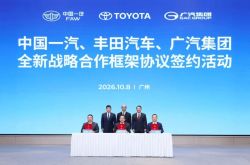
At 4:30 PM on October 8, China FAW Group, Toyota Motor Corporation, and GAC Group simultaneously issued an official statement with identical wording—GAC Group plans to purchase a 50% stake in FAW Toyota held by China FAW Group through the issuance of shares. After the transaction, FAW Toyota will continue to operate as an independent entity, and China FAW Group will become a significant strategic shareholder of GAC Group. In the next phase, FAW Toyota and GAC Toyota will jointly undertake functions such as R&D, procurement, production, and sales for the joint venture.
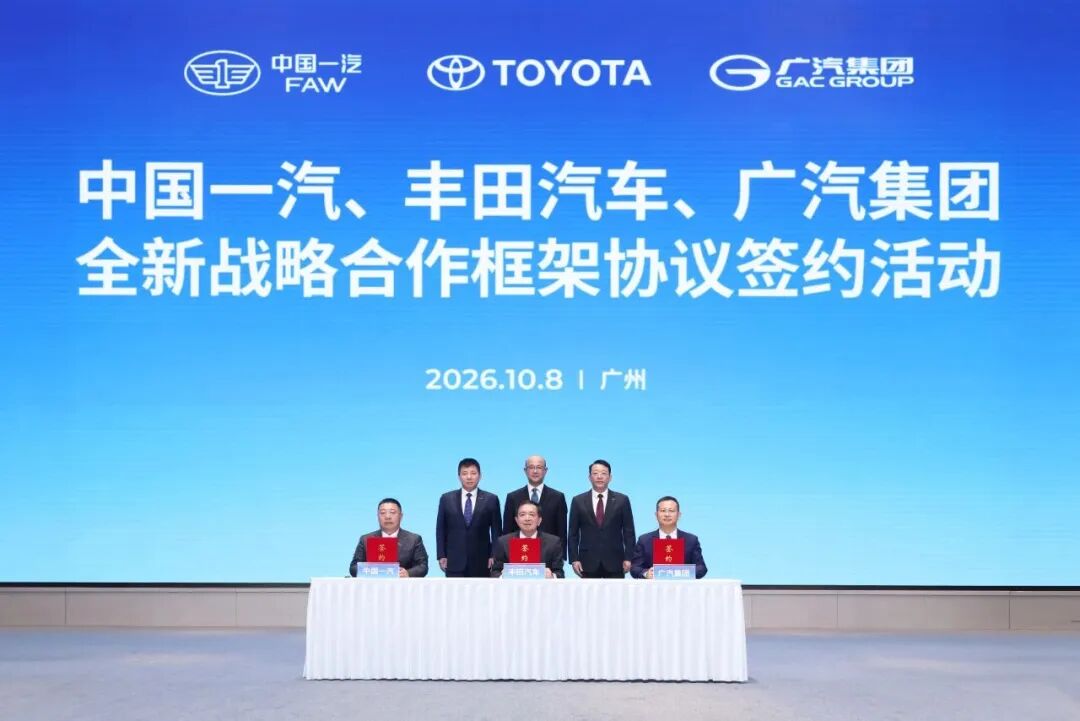
The simultaneous release of identical content by three parties at the same moment sends a clear signal: after nearly ten days of public speculation, the three parties need a unified official statement to end the guesses.

"Independent Survival" Provides Reassurance for FAW Toyota
The core messages of this statement are actually two-fold: first, FAW Toyota will not disappear; second, FAW Toyota and GAC Toyota will 'jointly undertake' multiple functions. The first point directly responds to recent rumors that 'FAW Toyota will exit the historical stage,' while the second point officially confirms, for the first time, the direction of collaborative operations between FAW Toyota and GAC Toyota.
After GAC Group disclosed the restructuring plan on September 28, numerous online accounts interpreted the 'equity change' as a 'brand exit,' leading to claims such as 'FAW Toyota is about to exit the market' and 'store clearance sales with significant price reductions.' Some consumers planning to purchase vehicles specifically visited dealerships to inquire about discounts, while potential car owners delayed their orders in anticipation of greater discounts.
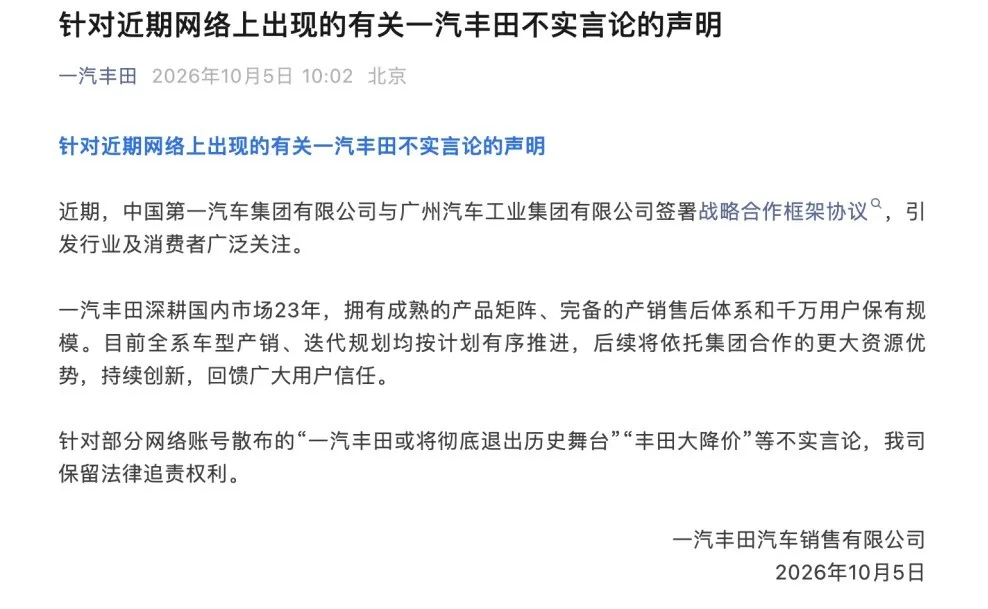
Before the joint statement by the three parties, FAW Toyota had already fought a 'preliminary battle' on October 5. On that day, FAW Toyota Motor Sales Co., Ltd. issued a statement addressing false claims such as 'FAW Toyota may completely exit the historical stage' and 'significant price reductions by Toyota,' stating that the company reserves the right to pursue legal action.
The statement emphasized that 'FAW Toyota has been deeply rooted in the domestic market for 23 years, possessing a mature product matrix, a complete production, sales, and after-sales system, and a user base of tens of millions.' It also specifically mentioned that 'it will continue to innovate by leveraging greater resource advantages from group cooperation,' implying that FAW Toyota will not only not exit but will also receive new resource support from this cooperation.
After the public outcry triggered by GAC's announcement on September 28, FAW Toyota faced the greatest public pressure and needed to take the lead in 'extinguishing the fire.' The release of the joint statement by the three parties provided the final tone at a higher level.
It is noteworthy that the equity structure of FAW Toyota Motor Sales Co., Ltd. (FTMS) remains unchanged in this transaction. FTMS is 38% owned by FAW Group, 32% by Toyota Motor, and 30% by FAW Toyota. This means that although FAW Group no longer directly holds equity in FAW Toyota, it has not completely exited the FAW Toyota system—it still maintains a direct equity connection with the sales side through FTMS. This is likely an important 'reservation clause' secured by FAW during the negotiations.
What is the Boundary of Collaboration Between FAW Toyota and GAC Toyota?
The most substantive sentence in the joint statement is: 'FAW Toyota and GAC Toyota will jointly undertake functions such as R&D, procurement, production, and sales for the joint venture.'
This statement is consistent with the expression in FAW Toyota's October 5 statement about 'leveraging greater resource advantages from group cooperation,' but it is more specific. However, the wording of 'jointly undertake' leaves considerable room for interpretation. It could be a prelude to deep integration or the beginning of limited collaboration.
Based on the disclosed information, the collaboration path between FAW Toyota and GAC Toyota appears closer to the latter. According to sources, a new company will be established, with the original GAC Toyota side primarily responsible for R&D and supply chain, and the original FAW Toyota side primarily responsible for marketing, channels, and customer management. There are also reports that FAW Toyota and GAC Toyota will adopt a 'production-sales separation' approach, with production coordinate (coordinated) by GAC and sales dominated by Toyota with tripartite collaboration. However, these reports have not been officially confirmed, and the integration of the sales side is precisely the core variable determining the depth of collaboration between FAW Toyota and GAC Toyota.
In other words, FAW Toyota's role in vehicle production will gradually weaken, but its accumulations in marketing and channel management will be retained. FAW Toyota has vehicle production bases in Tianjin, Changchun, and Chengdu, as well as supporting engine plants, possessing the capability for independent R&D and manufacturing of vehicles and core components. These production capacities will not disappear but will be incorporated into the unified framework of FAW Toyota and GAC Toyota for future capacity scheduling and product planning.
Conclusion:
From an industry trend perspective, the integration of FAW Toyota and GAC Toyota aligns with the broader direction of China's automotive industry shifting from 'scale expansion' to 'stock integration.' The potential benefits of integration are clear. By 2025, the combined sales of FAW Toyota and GAC Toyota will account for 17.03% of joint venture passenger vehicle sales, making them the largest joint venture brand in the Chinese market by sales volume after collaborative operations.
By coordinating R&D, supply chains, production bases, and channels, duplicate investments within the same brand system can be reduced, and greater bargaining power can be achieved in supply chain negotiations and terminal layout.
The more fundamental question is whether this collaboration can truly enhance Toyota's competitiveness in the Chinese market, rather than just being a financial capital reshuffle. If the integration merely combines two systems onto a single platform without accelerating product iteration and technological upgrades, the synergistic effects will ultimately be limited.
-
![]()
What is the boundary of collaboration between FAW Toyota and GAC Toyota behind FAW Toyota's 'independent survival'?
-
![]()
Optical Waveguide Route Selection and Performance Optimization: Four Questions Integrators Must Answer Correctly
-
![]()
The Collective Surge of Major AI Models Toward Public Listing: The High-Stakes Race Behind the Buzz
-
![]()
A Staggering $50 Billion Valuation! The Resurgence of a Tsinghua-Educated Engineer’s Venture
-
![]()
In His Inaugural Year, Porsche CEO Implements Three Daring Strategies: 9,000 Job Cuts, 20% Price Increase, and Reintroduction of Gasoline Cars
-
![]()
JAC’s Stock Plummets to Limit Down! Dcd Auto Tests Zunjie V800, Three Consecutive Cars Experience Brake Failures: Extreme Testing or Defective Product? | Mingjingpro
-
![]()
【Electric Equipment】Fengcheng Zhuoxin Logistics Signs Contract for 150 SANY Electric Heavy Trucks
-
![]()
[Intelligentization] Huawei and Seres Sign New Five-Year Cooperation