Why Aren't More People in the Industry Talking About 360 After Its All in AI Strategy?
 10/12 2026
 461
461


360's AI Narrative
Image source | Internet (Please contact us for removal if infringement occurs) Partially AI-generated
In early 2025, Zhou Hongyi announced 360's 'All in Agent' strategy, betting all of the company's resources on the agent track (agent sector).
More than a year later, the 2025 annual report showed revenue of RMB 8.693 billion, up 9.37% year-on-year, with net profit attributable to the parent company at RMB 263 million, marking the first return to profitability in three years.
From a financial perspective, this is undoubtedly a 'turnaround' report card.
But if you shift your gaze from the financial statements to the industry context, a strange phenomenon emerges: 360 is barely visible in everyday AI industry discussions.
When discussing large models, people talk about DeepSeek, Tongyi Qianwen, and Doubao; for AI search, Perplexity and Kimi are constantly compared; for agents, Manus and Coze dominate the conversation.
What about 360? It has launched products, secured orders, and generated profits, yet it has never become a player 'seriously discussed by the industry.'
What exactly is happening behind the scenes?

A 'Stereotyped' C-Side Company
To understand 360's current AI dilemma, one must first grasp what kind of company it was before the AI wave arrived.
360's foundation lies in C-side internet services. During the PC era, it built its traffic base with free antivirus software, with 360 Security Guard, 360 Browser, and 360 Search forming its core trio.
Even today, 360 Security Guard boasts over 400 million monthly active users, with the browser nearing 400 million.
This represents a vast user pool, but the problem is that the pool itself is shrinking.
After entering the mobile internet era, users and advertisers accelerated their migration to mobile, continuously eroding the traditional PC advertising market.
From 2022 to 2024, 360 incurred three consecutive years of losses, totaling over RMB 4 billion.
These three years coincided with the critical window from the brewing to the explosion of the AI wave. While Baidu released Wenxin Yiyan, Alibaba launched Tongyi Qianwen, and ByteDance fully invested in Doubao, 360 was still digesting the overdrawn dividends from the PC internet era.
Even more challenging is 360's historical legacy in the B-side market.
In 2019, 360 and Qi'anxin completed their separation, with clear business divisions: 360 focused on the C-side personal security market, while Qi'anxin specialized in the B-side government and enterprise security market.
At the time, this division seemed like 'each managing their own turf,' but as the government and enterprise security market rapidly expanded, 360 found itself nearly absent from the most growth-potential sector.
Although it later announced a 'return to the government and enterprise security market,' it was already far behind.
Thus, before the AI wave arrived, 360 faced a 'triple squeeze': stagnant C-side traffic, a weak B-side foundation, and near-total strategic lag in the mobile internet era.
This explains why 360 is consistently overlooked in AI discussions—it had already faded from the industry's central stage before AI even arrived.


Products Are Advancing, But 'Buzz' Is Lacking
In 2023, 360 established a dual-mainline strategy of 'AI+Security.' By 2025, this evolved into 'All in Agent,' concentrating all resources on agent R&D. The moves were significant.
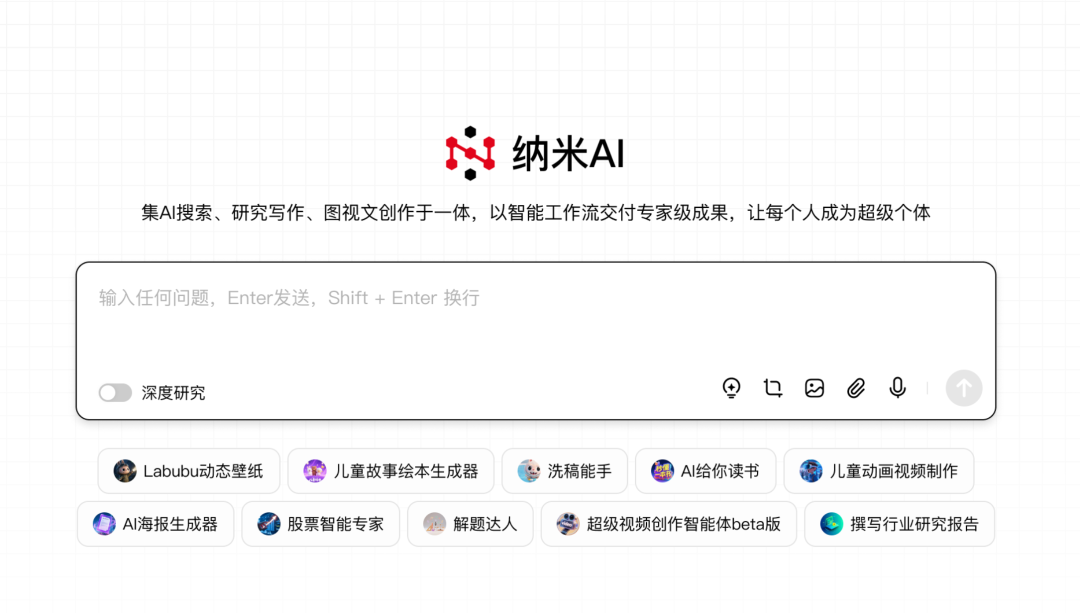
At the product level, 360 has indeed delivered. Nano AI Search upgraded to a 'multi-agent swarm' system, with December 2025 data showing Nano AI Search and Nano AI ranking second and third, respectively, on China's AI product website rankings, with a combined monthly visit volume exceeding 450 million.
In security, 360's Security Grand Model covers 18 industries, with its security agent matrix deployed in scenarios like security operations, endpoint security, and traffic detection.
B-side orders continue to land, with 360 securing over RMB 300 million in AI-related project bids in October 2025 alone.
Financially, these efforts have paid off. Internet value-added services revenue reached RMB 1.95 billion, up 41.38% year-on-year, with a gross margin of 94.18%.
Security and other businesses generated RMB 1.446 billion, up 12.33% year-on-year. R&D investment hit RMB 3.225 billion, accounting for 37.11% of revenue, with R&D personnel exceeding 57% of the workforce.
But the problems lie hidden behind these 'impressive numbers.'
Take Nano AI. While 450 million monthly visits sound impressive, a breakdown reveals that in June 2025, Nano AI Search's app monthly active users were in the 1-5 million range, with a compound growth rate of -8.6%. Meanwhile, Kimi's app monthly actives were in the 10-100 million range, nearly ten times higher.
More notably, Nano AI is essentially a 'model aggregator,' primarily integrating mainstream domestic large models, while its own 360 Zhinao basically halted iterations after the 4.0 version. Nano AI's core competitiveness does not stem from 360's own technological breakthroughs.
A long-time Nano AI user to speak bluntly (bluntly stated) in a community forum: 'Apart from its low barrier to entry, it seems to offer no other value.'
He pointed out that the models provided by Nano AI's image and video generation portals are 'a year outdated,' the personal knowledge base feature has 'not been updated for a year,' and the reasoning-type agent has 'limited capabilities, only able to invoke MCP, not skills or other tools.'
Such user feedback speaks far louder than official propaganda in revealing the product's actual competitiveness.
Now, consider the B-side. 360's security business generated RMB 1.446 billion in 2025, while Qi'anxin's revenue for the same period was RMB 4.392 billion.
360's entire security segment revenue is just one-third of Qi'anxin's.
More critically, while Qi'anxin is losing money, its revenue scale demonstrates its far superior client coverage and delivery capabilities in the government and enterprise market compared to 360.
In the upstream cloud security market, Alibaba Cloud, Tencent Cloud, and Huawei Cloud collectively hold over 70% market share, making their influence in security hard for 360 to challenge.
360's situation can be summed up as follows: It has traffic on the C-side but lacks growth, and technology on the B-side but lacks scale. It's advancing on both fronts but remains weak on both.
Reviewing 2025, what was 360's most viral event in the AI space? It was Zhou Hongyi announcing 'to eliminate the marketing department' and using AI to complete independently (independently complete) product launches; it was the 'car giveaway livestream' to promote Nano AI Search.
These marketing stunts did generate short-term buzz, but the focus remained on Zhou Hongyi personally, not 360's technology or products.
When the industry discusses DeepSeek's open-source strategy, Alibaba's enterprise-level deployment of Tongyi Qianwen, or ByteDance's user growth flywheel for Doubao, 360 contributes more 'events' than 'topics.'

Genes Determine Path, Path Determines Ceiling
Throughout its development, 360's DNA has determined its niche in the AI race: It is neither an infrastructure player (unlike Alibaba and Huawei in computing power and cloud) nor a first-tier model provider (unlike DeepSeek and Tongyi Qianwen in continuous model breakthroughs). It operates in the application layer, which happens to be the most crowded and hardest to differentiate.
Zhou Hongyi himself sees this clearly. In a conversation with Luo Yonghao, he admitted 360's role as an 'industry supporting actor' in the AI era, announcing that it would not build general-purpose large models but instead establish a cooperative ecosystem with 16 large model companies, even actively purchasing computing power services from Alibaba Cloud and Tencent Cloud.
This positioning is pragmatic but also means 360 has voluntarily relinquished the possibility of becoming a 'definer.'
In an industry where winners take all, supporting actors naturally generate less discussion.
A deeper contradiction lies in 360's 'transformation paradox.' Zhou Hongyi has repeatedly emphasized 360's 'return to the government and enterprise security market,' and the financial reports also position 'AI+Security' as the core narrative.
However, 360's revenue structure makes it clear: Internet advertising remains the largest revenue source, accounting for nearly 50%; internet value-added services (membership subscriptions, AI tool payments, etc.) are the fastest-growing segment, still fundamentally rooted in C-side logic.
360's DNA is that of a C-side internet company. Its product thinking, organizational structure, and commercialization paths are all designed around C-side users.
Transitioning to B-side services requires more than just changing the client base—it demands a bottom-up reconstruction of the sales system, delivery capabilities, and service models.
The external environment is not friendly to 360's B-side transformation.
The government and enterprise security market is already a highly competitive battleground. Qi'anxin has a nationwide sales and delivery network and advantages in government private cloud contracting. Sangfor is more mature in product standardization and channel coverage, while Alibaba Cloud and Huawei Cloud extend their influence into security through their cloud infrastructure advantages.
In 360's 2025 bid wins, a significant portion were 'consortium bids,' relying on partners for delivery, indicating that its B-side capabilities are not yet independent.
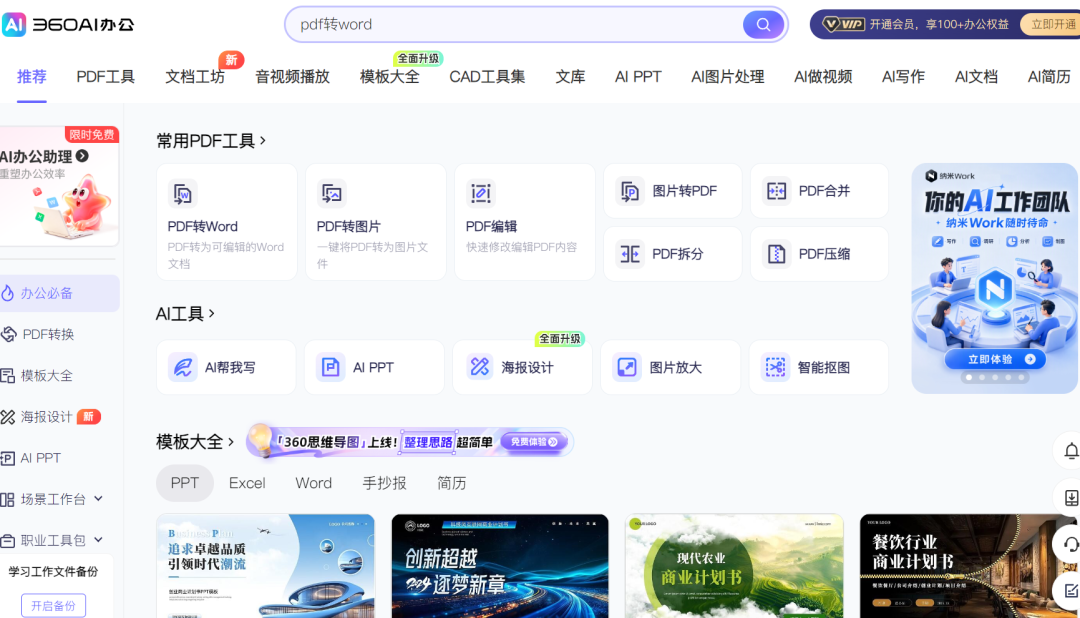

On the positive side, 360 still has cards to play. Nearly 400 million monthly active users on PC represent a scarce traffic entry point. Two decades of security attack and defense (offensive and defensive) experience form a technological moat. RMB 3.2 billion in annual R&D investment shows it is still seriously committed. Returning to profitability also proves that AI-empowered C-side product commercialization is viable.
But from a competitive standpoint, 360's situation is not optimistic.
On the C-side, Nano AI faces overwhelming superiority from Kimi, Doubao, DeepSeek, and others in user experience and model capabilities. On the B-side, Qi'anxin, Sangfor, Alibaba Cloud, and Huawei Cloud have first-mover advantages and scale effects in the government and enterprise market that cannot be bridged shortly.
360's best bet is to find its niche in the 'AI+Security' crossover space—not the biggest player, nor the brightest star, but able to defend its own turf through differentiated security capabilities and C-side traffic foundations.
As for industry discussion, perhaps 360 needs to accept a reality: In the AI super-competition, not all participants can be at the center of the conversation.
Some companies are destined to be 'silent players,' not standing in the spotlight but also not easily eliminated.
360 is likely one such company. Its AI story is not about disruption but about survival.
-
Kimi Valued at $50 Billion, Yang Zhilin's Past Disputes Reach IPO Threshold
-
Founder from Generation Z Leads 14-Member Team to Challenge Meta
-
![]()
Over 1 Billion Yuan in Series C+ Funding Secured! Kunyu Optoelectronics’ 12-Inch Optical Production Line Slated for Operation by 2027
-
![]()
Can AI Be Integrated into Smartphones, or Will It Completely Transform Them?
-
FDE Suddenly Becomes a Topic ‘No One Wants to Discuss’
-
![]()
Android Takes the Lead, Honor Makes a Comeback
-
![]()
Android Takes the Lead, Honor Makes a Comeback
-
![]()
Virtual Humans Now Have Official Identification! AI Idols with Certificates Can Participate in Commercial Performances, But Who is Liable if Issues Arise?