Tech Titans' Strategy Divergence, AI Budget Shifts, and Globalization Hurdles for Chinese Open-Source AI Models | AI Weekly Review
 10/12 2026
 360
360
In the mere three working days following the holiday, the AI sector has witnessed a flurry of new developments. We've handpicked the three most significant and pertinent ones to offer our insights.
Major corporations are forging new paths, AI budgets for the coming year are charting the course, and Chinese open-source AI models are encountering fresh obstacles in their global expansion. Let's begin with the divergent strategies adopted by Google and OpenAI.
01 Tech Giants Pursue Divergent Strategies, Persistent Challenge of Insufficient AI Demand
On October 7th, OpenAI incorporated charts, calculators, and forms into ChatGPT through the use of Intelligent UI. A day later, Google integrated the Gemini agent into Gmail, Docs, Sheets, and Calendar. OpenAI continues to bolster ChatGPT as a gateway, while Google integrates intelligent agents into its pre-existing product ecosystem.
These strategies reflect their respective strengths. Google boasts Workspace, cloud services, and enterprise data; OpenAI, on the other hand, has amassed over 1.2 billion weekly active users. A similar dichotomy exists in China: Alibaba leverages Alibaba Cloud, DingTalk, and enterprise clients, while ByteDance bets on Doubao as a personal gateway.
We hold a more optimistic view of the paths chosen by OpenAI and ByteDance. The primary hurdle for AI implementation remains insufficient demand. Companies are willing to invest in labor-saving and process-shortening solutions, and coding can also yield revenue. However, the long-term value of mere efficiency enhancements is limited. Compared to the transformative apps like e-commerce and short videos during the mobile internet era, the real game-changing opportunities for AI await the emergence of new consumer products.
Google and Alibaba are pursuing enterprise efficiency improvement routes, while OpenAI and ByteDance are focusing on personal gateways. The former can more readily generate revenue by tapping into existing enterprise user demands, but this route has a clear ceiling. The latter, by relying on high-frequency usage by a vast number of personal users, has a greater chance of discovering new consumption scenarios.
02 AI Budgets for Next Year Are Taking Shape, AI Vendors Should Gear Up
For 2027, the AI budgets of government and central state-owned enterprises will prioritize pilot-scale production bases. In October, central documents identified pilot-scale production bases and high-value application scenarios as key focus areas. At this juncture, government and central state-owned enterprises are formulating their plans and budgets for the coming year, with policies providing clear direction before budgets are finalized, making pilot-scale production bases a top priority for project reserves and funding allocations.
The policy focus has shifted from promoting AI adoption to driving its industrial integration and large-scale deployment. In 2024, the concept of 'AI+' was introduced; in 2025, targets for the penetration rate (adoption rate) of intelligent terminals and agents were set; in March 2026, requirements for commercial and large-scale applications were introduced; and by October, pilot-scale production bases and high-value scenarios were further clarified. Policy directions are increasingly centered on specific business outcomes.
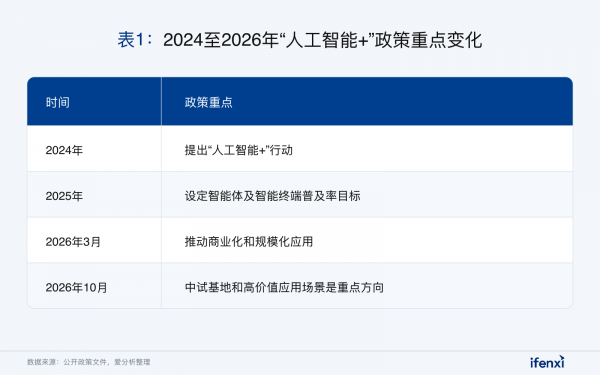
Table 1: Key Shifts in 'AI+' Policy Priorities from 2024 to 2026
Pilot-scale production bases address the precise pain points in government and enterprise AI implementation. Over the past two years, numerous projects have been undertaken, but most have remained confined to easily demonstrable peripheral scenarios. Core businesses are often avoided due to fears of uncontrollable risks. By establishing pilot-scale production bases in collaboration with local governments, leading enterprises, and research institutions, business processes can be tested with real data and validated for stability before being integrated into production systems. Sharing a platform among multiple enterprises can also reduce redundant investments.
For AI vendors, the construction, operation, and core business validation of pilot-scale platforms represent golden opportunities to secure government and enterprise budgets for 2027. The Ministry of Finance has already commenced budget preparation for central departments, while local governments and large enterprises are also finalizing their investment plans for the coming year in the fourth quarter. With central documents providing clear direction before budgets are finalized, local project reserves will prioritize follow-up, and vendors should plan their business priorities for next year accordingly.
03 Chinese Open-Source AI Models Going Global Must Factor in Additional Security Considerations
The AI attack in South Korea will lead to more stringent procurement reviews of Chinese open-source AI models by overseas clients. On October 7th, attack records released by CrowdStrike revealed the involvement of DeepSeek and Zhipu's GLM. Attackers exploited these models through the open-source penetration testing agent ARTEX. South Korean media reported that at least seven financial institutions experienced data breaches, affecting approximately 68,000 customers.
Open-source models are at a disadvantage in such incidents. Closed-source services can log usage, ban accounts, and sever interfaces upon detecting abnormalities. However, once an open-source model is downloaded, the original developer finds it challenging to track its deployment or control its modified usage. While models can be open, the risks of abuse do not vanish.
The European Union will commence regulatory enforcement on general-purpose AI models in August 2026, and open-source models are not exempt from all compliance obligations. The South Korean incident provides overseas financial and government clients with even stricter review justifications. Vendors must furnish additional security evaluation and abuse monitoring materials, explaining how incidents will be managed. Each additional review step and slower integration process incur additional costs.
Chinese models have relied on open-source approaches to penetrate overseas developer markets, primarily competing on performance and price in the past. Going forward, they will also need to compete on how they manage security risks. Superior performance and low prices remain advantages, but if security reviews are not passed, clients will be hesitant to make purchases. While open-source remains a vital means of global expansion, vendors cannot solely calculate costs based on model usage.
-
Kimi Valued at $50 Billion, Yang Zhilin's Past Disputes Reach IPO Threshold
-
Founder from Generation Z Leads 14-Member Team to Challenge Meta
-
![]()
Over 1 Billion Yuan in Series C+ Funding Secured! Kunyu Optoelectronics’ 12-Inch Optical Production Line Slated for Operation by 2027
-
![]()
Can AI Be Integrated into Smartphones, or Will It Completely Transform Them?
-
FDE Suddenly Becomes a Topic ‘No One Wants to Discuss’
-
![]()
Android Takes the Lead, Honor Makes a Comeback
-
![]()
Android Takes the Lead, Honor Makes a Comeback
-
![]()
Virtual Humans Now Have Official Identification! AI Idols with Certificates Can Participate in Commercial Performances, But Who is Liable if Issues Arise?