Musk’s Computing Power Venture Recoups Investment Within a Year, Meta’s Muse Faces Uncertain Rollout Timeline
 10/23 2026
 365
Long-Term AI Narratives Matter, but Short-Term Financial Metrics Hold More Weight
Author | Huawen
Editor | Xiaobai
Illustrations | AI-Generated
Produced by | Qiangdiao Next
This week, SpaceX, Tesla, and Meta sequentially unveiled their third-quarter financial results. On October 20, SpaceX revealed during its earnings call that, at prevailing rates, newly deployed computing resources could recoup investment costs in under 12 months.
A day later, Zuckerberg informed investors that Meta’s personal AI assistant, Muse, could not yet be rolled out globally, partly due to the immense computational demands required for its operation.
For these two companies, the same computing resources carry different financial implications. SpaceX can monetize them by selling to external clients, whereas Meta must initially absorb the costs and await revenue generation from free users.
Tesla’s financial report presents a third growth paradigm: despite a year-over-year decline in vehicle deliveries, the number of paying FSD (Full Self-Driving) subscribers increased.
The success of AI monetization hinges on understanding why customers are willing to pay—this dictates the business’s scalability. Musk’s SpaceX provides major corporations and investors with a tangible pricing benchmark for computing power.
As long as computing resources remain in short supply and can be allocated across diverse business units, revenue from external leasing will serve as a benchmark for internal projects. Free offerings necessitate budget allocations, and proving user acquisition is insufficient—they must also demonstrate that these users justify the company forgoing immediate leasing revenue.
The more straightforward Musk’s computing power business becomes, the higher the bar for launching complimentary AI initiatives.
Once Computing Power Has a Price, Model Success Isn’t the Sole Profitability Driver
SpaceX’s supercomputing division, SI, generated $7.56 billion in revenue in the third quarter, accounting for roughly 52% of total revenue. The company did not attribute all growth to Grok but explicitly cited the execution of new cloud service agreements as a primary driver. 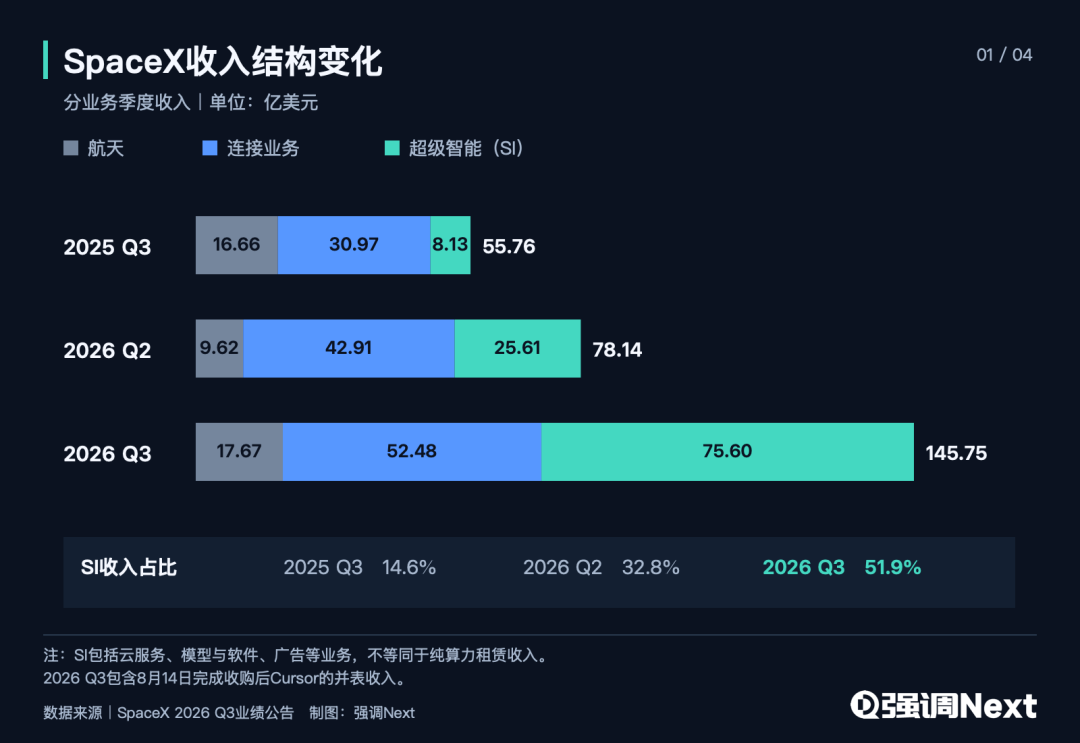
In May, Anthropic announced it would lease all computing power from SpaceX’s Colossus 1 data center, adding over 300 megawatts of capacity to enhance usage quotas for Claude’s paying subscribers.
Another agreement disclosed in June stated that Google would pay $920 million monthly starting in October to purchase computing power.
Thus, Musk’s model investments have a clear path to returns without relying solely on Grok’s success. The stronger the demand for Claude, the more likely SpaceX is to generate computing power revenue.
Model competition no longer directly determines which company profits or incurs losses. This also exerts new pressure on cloud providers. Despite having its own cloud business, Google still procures computing resources from SpaceX.
At least during periods of tight supply, whoever can deliver usable computing power on time stands a chance to secure revenue. Long-term customer relationships and software service advantages cannot bridge immediate capacity gaps.
SpaceX’s management has also clarified that they will evaluate the returns from training their own models, inferencing their own products, and providing external cloud services before deciding how to allocate computing power.
This decision is pivotal. SpaceX can continue betting on its own models while earning returns from the growth of other models. 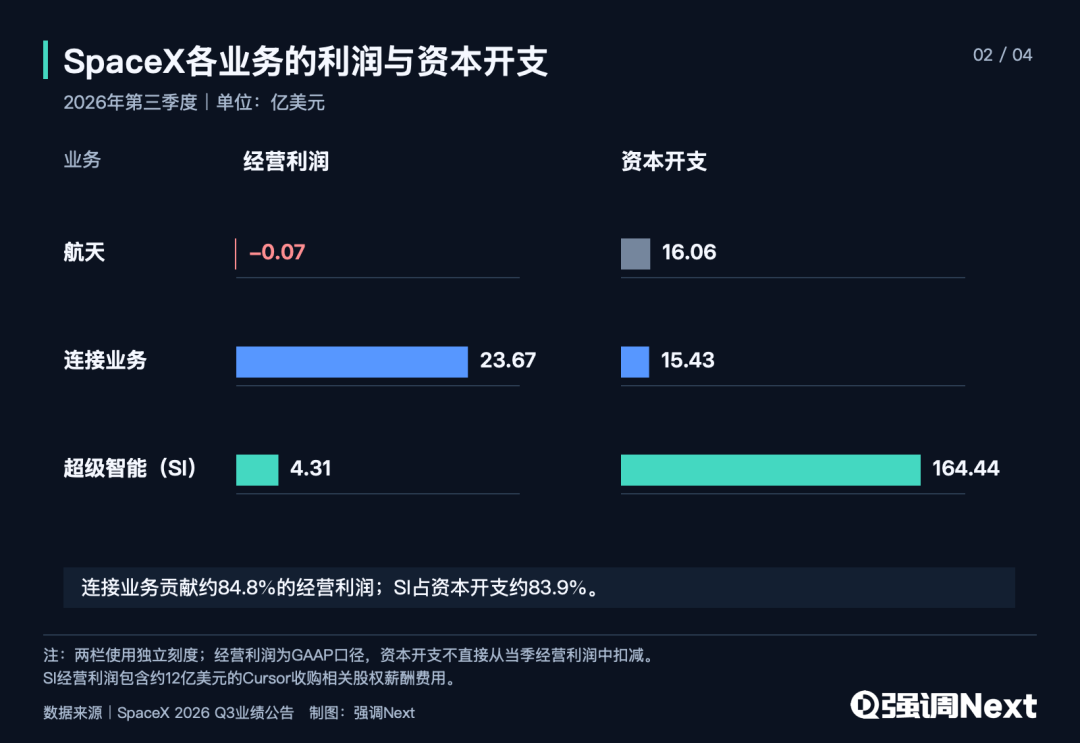
However, this pricing is time-sensitive. Google’s agreement with SpaceX allows either party to terminate it with 90 days’ notice after December 31 this year, and the “less than a year to recoup investment” claim is explicitly based on current prices. But as long as computing power remains scarce, this pricing will remain a topic of discussion in every major company’s internal meetings.
Freemium Models Must Find Revenue Streams Beyond Advertising
Roughly translating SpaceX’s payback period, it equates to recovering more than double the investment annually. This is the benchmark set by external clients, and free products like Muse must measure up.
Meta’s position is thus somewhat precarious.
Muse was initially launched in the U.S. and Canada, and management acknowledged that computing power constraints limited its expansion pace. The company hopes to improve computing cost efficiency by more than tenfold in the coming year, but financial executives simultaneously anticipate total service costs to rise as user numbers increase. While unit costs decline, total spending rises, as cheaper inferencing leads to more complex tasks, reabsorbing the savings.
Meta’s revenue structure is also under pressure. In the third quarter, Meta reported $64.6 billion in revenue, up 26% year-over-year, with ad impressions growing about 10% and average prices rising about 14%—a combined effect largely matching revenue growth. Growth still stems from advertising, with AI not yet significantly contributing to revenue lines. Meanwhile, the company raised its full-year capital expenditure forecast to $135–145 billion.
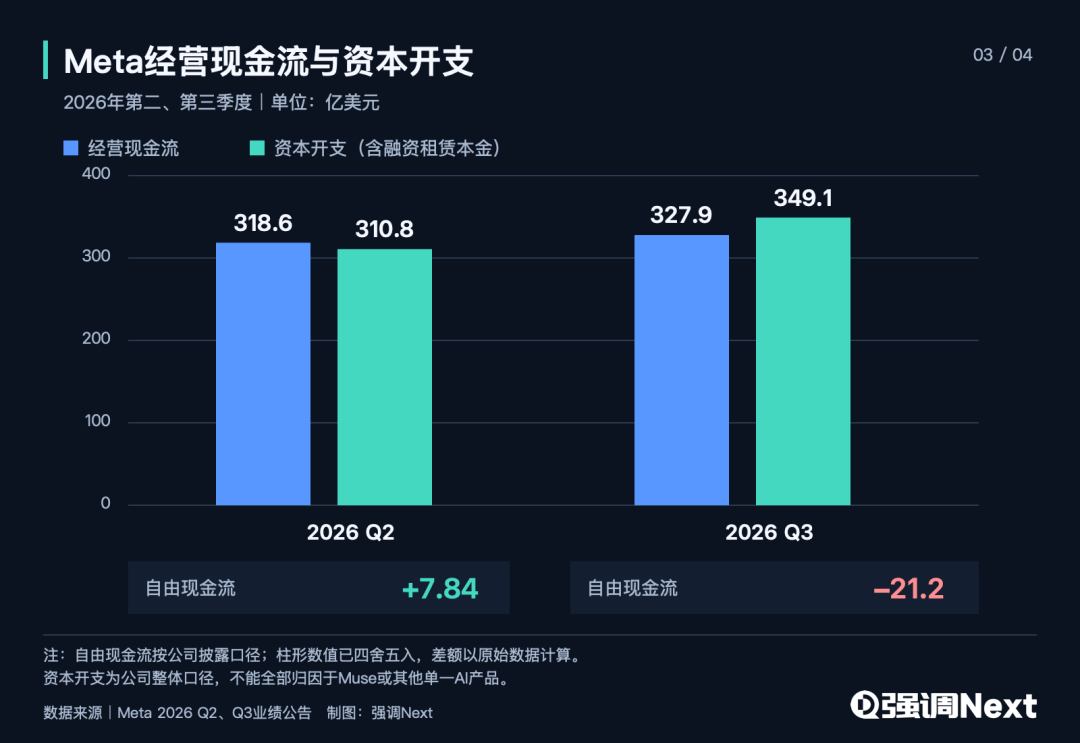
Zuckerberg’s proposed solution is to charge for transactions. Muse is free for most users, with merchants paying for transactions facilitated by Muse, while advanced models, extra usage, and enterprise features require separate subscriptions. He revealed that shopping is Muse’s most common use case, with over a quarter of users participating and average purchase amounts exceeding $200.
Whether merchants are willing to pay is the biggest variable in this model. Recommendation ads help merchants gain visibility, but agents promise to compare prices and streamline purchasing for consumers. The more effective Muse is, the harder it becomes to charge merchants an additional fee simply for “bringing users.”
If an order would have closed via Meta ads anyway, and Muse completes it while adding a service fee, merchants will likely deduct it from their ad budgets. Meta must prove that Muse creates incremental transactions, not just relabels ad revenue.
Agents lacking payment and fulfillment data cannot stand alone in this regard.
Thus, major companies with massive user bases cannot simply migrate users from existing products into high-cost agents unchanged. Decisions on which regions to cover first, which tasks to assign stronger models to, and how much usage to reserve for paying clients directly affect expansion speed. Traffic advantages still matter but must be re-evaluated based on the returns from serving that traffic. The same logic applies to agent products like Qianwen GO and Doubao Shopping.
Revenue-Generating AI Is Tied to Specific Tasks
Tesla’s case is more straightforward. In the third quarter, vehicle deliveries reached 486,500 units, down 2% year-over-year, while active FSD subscriptions hit 1.74 million, up 67% year-over-year. This metric includes one-time purchases and monthly subscriptions, excluding free trials, and FSD still requires active driver supervision. 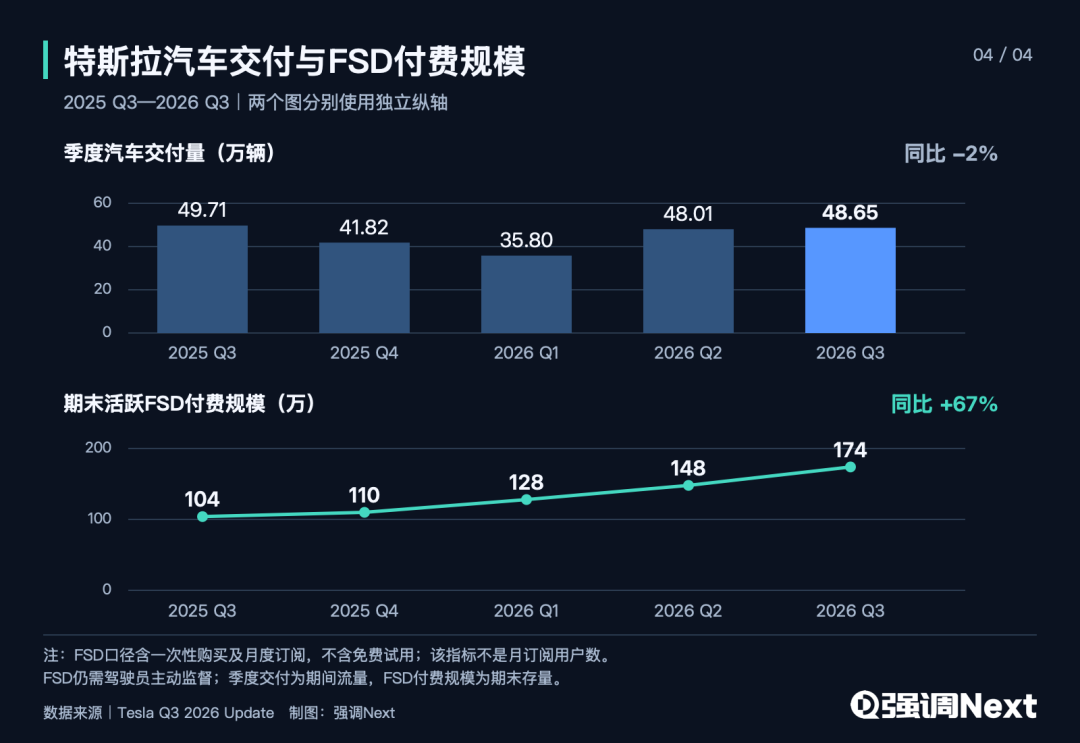
Fewer cars sold but more software sold—the two growth curves have diverged. The reason lies not in grand narratives like “cars as AI gateways” but in FSD addressing the specific task of driving, with users able to feel its effects after a few drives and deciding whether to pay themselves.
This also sheds light on Muse’s true situation. Its most frequent use case is shopping, which happens to be a specific task with monetary outcomes, closer to a chargeable form than general chat. But FSD users’ willingness to pay for assisted driving does not mean they will pay for a general-purpose in-car assistant, let alone guarantee Robotaxi profits. In the third quarter, Tesla’s Robotaxi accumulated nearly 2 million unsupervised miles, about eight times the figure at the end of the second quarter. While mileage growth indicates service expansion, fleet profitability depends on factors like operational efficiency, vehicle utilization, and cost per mile.
Another key move by Tesla this quarter is equally critical. It lowered its full-year capital expenditure forecast from over $25 billion to about $20 billion, with quarterly free cash flow turning positive at $1.531 billion. Part of the cash improvement comes from new businesses, and part from adjusted spending rhythms. Thus, the maturity of the software business should not be overestimated.
Only features that can generate revenue qualify for long-term budgets. Projects farther from monetization must rely on the company’s willingness to wait longer. While announcing its financial results, Meta also introduced non-voting Class C shares, adding tools for future financing, employee compensation, and potential acquisitions. This allocation does not bring new cash but gives Muse a longer waiting period.
Financial Reports Demand a Closer Look at AI Revenue for Major Companies
Every chunk of AI revenue for major companies could be an expense for someone else.
Cloud providers’ computing power sold to model companies becomes a cost for those model firms. Agents’ commissions charged to merchants may come from displaced ad budgets. When multiple companies report growth simultaneously, it does not mean end customers are spending proportionately more.
Major companies’ own accounting methods also influence readings.
Microsoft announced in July’s earnings call that starting in fiscal 2027, it would extend the depreciation period for data centers and office buildings from 15 to 25 years while shifting more data center leases from finance leases to operating leases. Finance leases count as capital expenditures; operating leases do not. This change reduced Microsoft’s projected capital expenditures for calendar year 2026 from about $190 billion to about $175 billion. Management emphasized that investment plans remained unchanged. Based on disclosed building costs, this depreciation adjustment alone could reduce annual depreciation expenses recorded in the income statement by billions of dollars.
The money is still being spent—it just hurts less on paper.
Cash flow tells another story. According to Google’s second-quarter financial report, its operating cash flow minus capital expenditures turned negative for the first time since going public. Meta faced a similar situation in the third quarter, with rising capital expenditures and cash pressure. While increasing computing power investments and seeking returns for free products, major companies’ cash flows are under pressure from both ends.
Meta is expanding its choices. On September 28, it announced the launch of Meta Enterprise Platform, bringing Muse, enterprise agents, model APIs, and programming tools to businesses, with CJ Desai reporting directly to Zuckerberg. This introduces consumer-side paid demands into Meta’s resource allocation. It also reflects a consensus among major companies: reducing reliance on the success of individual proprietary apps and shifting resources toward B-side monetization closer to reality, such as the intensified AI office competition in China this quarter.
Thus, upcoming financial reports from other major tech companies can be similarly scrutinized using these questions: How much of the AI revenue comes from external clients versus internal transfers? Has new AI revenue displaced existing business revenue? After adjusting capital expenditure accounting, how much has true computing power investment grown?
SpaceX has demonstrated the returns from selling computing power to external clients, Tesla has shown paid demand for specific tasks, and Meta is attempting to turn shopping into a third revenue stream. AI products still acquiring free users owe their financial reports a critical number: how much new profit these users leave the company after using the product.
Note: Data in this article comes from public sources and does not constitute investment advice.
- END -
-
![]()
Will Doubao Mobile Trigger a New Round of 'Soul Theory' Debate?
-
![]()
Doubao Phone: Will It Spark a Fresh Wave of 'Soul Theory' Controversy?
-
![]()
When AI Creates Problems but No One Is Held Accountable: It Gave the Police a False Tip
-
![]()
From Doubao Mobile Phone to OPPO’s Partnership with Manus, and the Gradual Rise of Startups like Jieyue Xingchen: Who’s Riding the Wave of Opportunity?
-
![]()
Audi in Negotiations with Huawei: Developing Next-Gen A8 for China Using Huawei’s Platform, with Plans for Multiple New Models | Mirror Pro
-
![]()
People Trapped in Algorithms
-
![]()
Musk’s Computing Power Venture Recoups Investment Within a Year, Meta’s Muse Faces Uncertain Rollout Timeline
-
![]()
AI: From ‘Accelerator’ to ‘Paradigm Reconstructor’ in Metaphotonics