ByteDance's Automotive Ambitions Come to the Fore
 10/26 2026
 360


For ByteDance, the industrial layout and strategic depth gained by shaping the automotive soul are undoubtedly more critical than building cars itself.

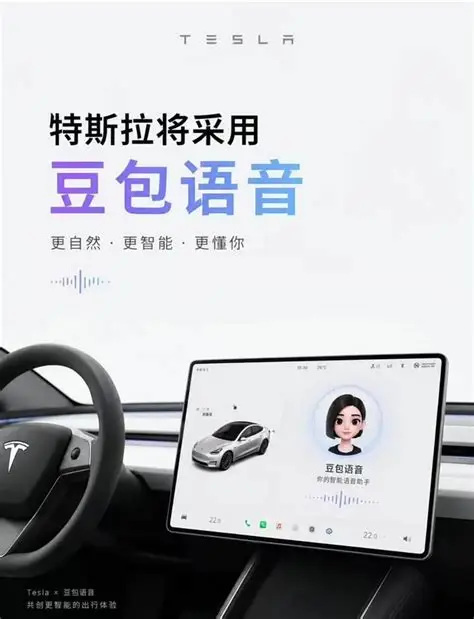
On August 19, Volcano Engine, a subsidiary of ByteDance, announced that Tesla China's in-car system had officially integrated the Doubao large model, with related features being rolled out in batches. This marks the first time Tesla has integrated a third-party large model into its in-car system since entering the Chinese market. Prior to this, over 7 million smart cars equipped with the Doubao large model had already been deployed, covering more than 50 brands and 145 models. Tesla's integration has brought ByteDance's automotive AI strategy into the spotlight.
Previously, ByteDance's automotive business had limited presence in the industry. However, after the launch of the Doubao large model in May 2024, the situation began to change: ByteDance re-entered the automotive cockpit market as a "large model supplier," partnering with automakers ranging from Mercedes-Benz and Roewe to Seres and Tesla. Its installed base grew from zero to 7 million vehicles, and its business model evolved from functional integration to deep collaboration. Over six years, this business line has shifted three times: from "selling cloud services" to "selling AI" and then to "deep customization."
01 Musk Chooses Doubao
According to Tesla China's official website terms for its in-car voice assistant, the system simultaneously integrates Doubao and DeepSeek Chat, both provided by Volcano Engine: Doubao handles vehicle control commands such as navigation, air conditioning, and media playback, while DeepSeek manages casual chat and information queries. Public reports indicate that Tesla and Volcano Engine reached a technical cooperation agreement in August 2025, completed voice service filing in Shanghai in April 2026, and began rolling out OTA updates with the 2026.14.13 version on July 31, covering all Model 3, Model Y, Model S, and Model X variants.
It is worth noting that Tesla's overseas in-car systems use its proprietary Grok model, but for the Chinese market, it opted for a third-party large model. The reasons lie in regulatory and linguistic factors: China's regulations on generative AI require filing, domestic data storage, and traceable content, while Grok's servers are located in the U.S., with its corpus primarily in English and limited support for Chinese spoken language and dialects. Even with localization efforts, verification and filing would take years.
Thus, Tesla's candidates for its in-car large model fell on domestic options. In addition to the "Doubao + DeepSeek dual-model" selection, Sina Finance reported that Elon Musk personally participated in evaluating potential partners for this collaboration.
However, Tesla did not entrust all scenarios to Doubao. Public information indicates that Doubao handles vehicle control, while DeepSeek manages casual chat. Additionally, Jiemian News reported on July 31 that multiple sources revealed Qianwen had entered advanced testing stages for Tesla China's in-car system, with plans for "listening, answering, vehicle control, navigation, and task execution." Considering various reports, Tesla does not intend to deeply bind itself to a single large model but instead designed an architecture capable of continuously integrating new models.
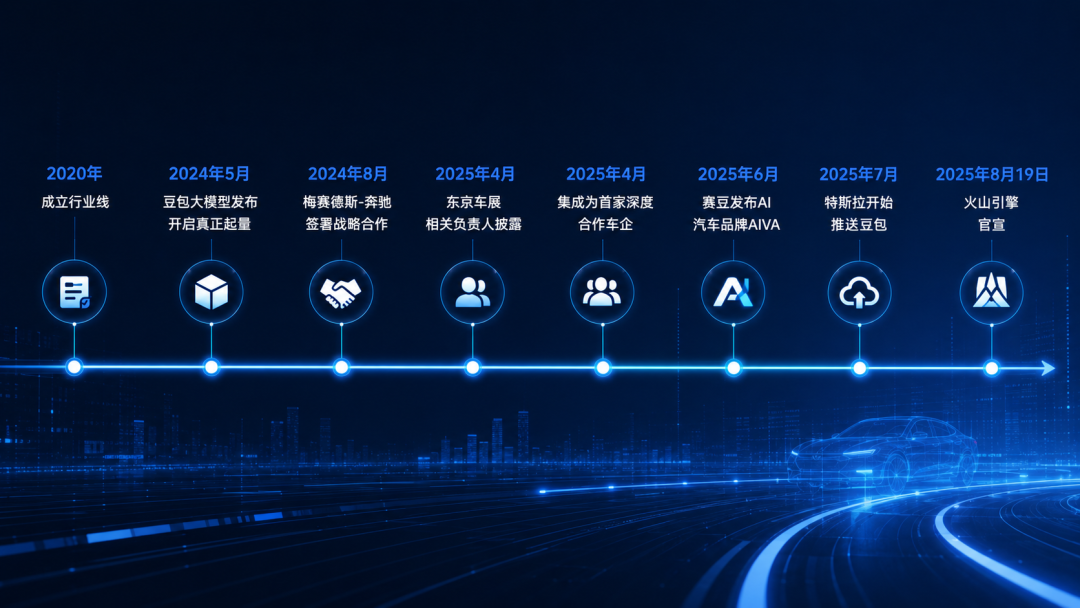
ByteDance's strategy has also evolved over time. Established as an industry line in 2020, ByteDance's automotive business only gained momentum after the Doubao large model's launch in May 2024. Subsequently, its partners grew increasingly prominent: Mercedes-Benz signed a strategic cooperation agreement in August 2024, Roewe became the first deep collaboration partner in April 2025, Tesla joined in August 2025, and Seres followed in October 2025. By April 2026 at the Beijing Auto Show, relevant executives disclosed that over 7 million smart cars were equipped with the Doubao large model, covering more than 50 brands and 145 models, with over 30 million daily cockpit interactions. Two solutions were also unveiled: an AI cockpit suite and the Doubao Cockpit Assistant. In June, Saido launched the AI automotive brand AIVA. In July, Tesla began rolling out Doubao. On August 19, Volcano Engine made an official announcement.
Volcano Engine's speed and determination in entering the automotive market are evident. According to an IDC report released in May this year, China's public cloud large model call volume reached 1,944 trillion Tokens in 2025, a 16-fold year-over-year increase, with Volcano Engine leading at 49.5% market share. Its revenue comes from two areas: intelligent cockpit and AI large model services (software licensing, API calls, solution suites) and automotive digital marketing services. Regarding entry point value, ByteDance executives believe automakers are not just manufacturing cars but also generating Tokens, with user entry points determining long-term growth potential. Smartphones represented ByteDance's most successful entry point battle, and automobiles are the next critical frontier. From a product matrix perspective, if Douyin content, Toutiao news, Dongchedi services, and local life capabilities were integrated into vehicles via Doubao accounts, cars would become an extension of ByteDance's ecosystem.
However, ByteDance's automotive Layout (layout) is missing one piece: autonomous driving. On July 13, 36Kr reported that ByteDance is exploring entry into the autonomous driving sector, with the project led by its core AI research team, Seed's World Model team. The preferred application scenario is unmanned logistics, and the business falls under Volcano Engine's automotive industry line. Currently in early preparation stages, it has extended offers to leading autonomous driving talent. In response, ByteDance stated it has no plans for intelligent driving business.
Seed, established as a first-tier strategic large model research department by ByteDance in 2023, expanded its management scope year by year (year by year) after its 2024 leader took charge of multimodal large model R&D. Multimodal, visual generation, world models, and robotics gradually fell under one leader, with the autonomous driving project spearheaded by this World Model team—ByteDance's organizational Layout (layout) along the line of "understanding the physical world" aligns with the technical pathways of autonomous driving and embodied AI. Based on 36Kr's reporting, autonomous driving is seen as the first physical AI application scenario, and ByteDance's foray into this field represents a step toward embodied intelligence.
02 Whose Market Share Is ByteDance Taking?
Many believe ByteDance will directly compete with Huawei. However, Huawei has already expanded a vast business footprint in automotive intelligence, covering LiDAR, three-electric systems, intelligent driving, cockpits, intelligent control, intelligent power, in-vehicle optics, and vehicle-cloud services. By 2026, Huawei's Qiankun intelligent driving solutions will be deployed in over 1.9 million vehicles, with special project (special) investments exceeding 18 billion yuan that year and plans for an additional 70-80 billion yuan over the next five years. In contrast, Volcano Engine does not manufacture hardware but only outputs the Doubao large model, cockpit solutions, and content ecosystems. Analysts summarize the difference as follows: Huawei charges per vehicle, with deeper integration yielding higher per-unit revenue; Volcano Engine charges per service cycle, generating continuous revenue after vehicle sales.
Indeed, the two companies currently occupy different positions. Huawei's Qiankun system covers intelligent driving and cockpits, with its Harmony Cockpit integrating the Pangu large model; Volcano Engine focuses on cockpit interactions, providing only cloud services and infrastructure for intelligent driving. Their direct overlap lies in cockpit AI, a market that is expanding: according to Zuo Si Auto Research, as of June 2025, over 50 brands and 130-plus models in China came standard with AI large models, nearing a 16% adoption rate. Gaishi Automotive Research Institute data shows that in Q1 2026, 83.0% of domestic passenger vehicles featured smart cockpits, rising to 94.5% for new energy vehicles.
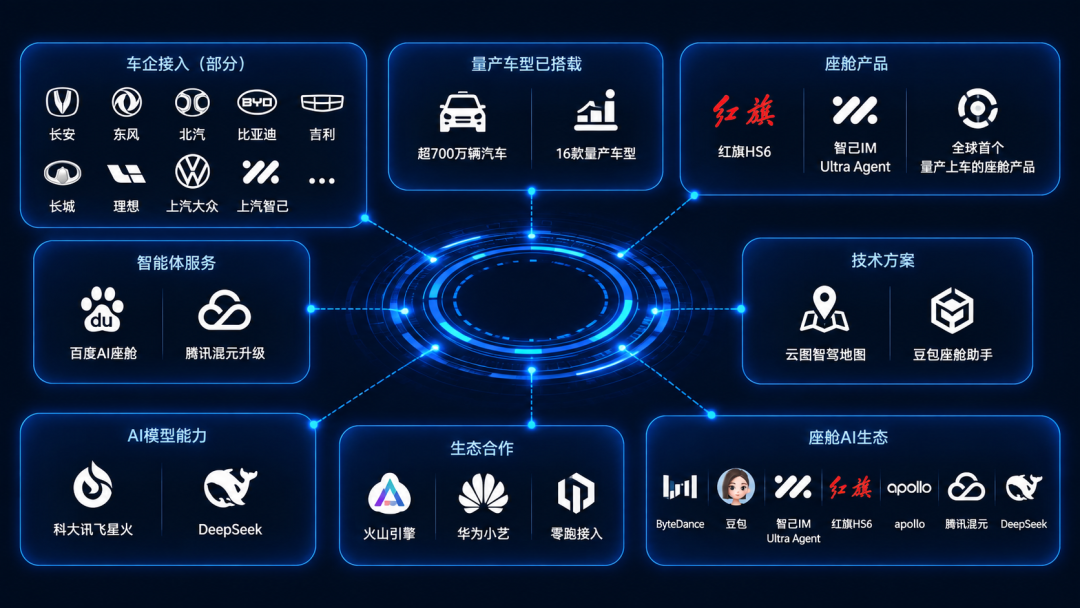
The cockpit AI market has multiple competitors, with a multi-line parallel pattern (landscape). ByteDance's Doubao is deployed in over 7 million vehicles; Alibaba's Qianwen, announced at the 2026 Beijing Auto Show, is integrated by over 10 automakers, including Changan, Dongfeng, BAIC, BYD, Geely, Great Wall, Li Auto, SAIC Volkswagen, and SAIC IM. IM Ultra Agent represents the world's first Qianwen-powered mass-produced cockpit product, while the Hongqi HS6 also uses Qianwen for cockpit AI. iFlytek's Spark large model covers Chery, GAC, Great Wall, Changan, Volkswagen, JAC, FAW, and Nissan, with 16 mass-produced models already deployed. Baidu's AI cockpit agent services over 16 million mass-produced vehicles. Tencent's Hunyuan upgrades cockpit large models, while its Yuntu intelligent driving maps account for 49% of new energy passenger vehicles standard configuration (standard equipment) with urban NOA intelligent driving maps. Step.ai and Geely jointly developed Super Eva, deployed in the Zeekr 8X. DeepSeek's lightweight model is integrated by BYD, Geely, Dongfeng, IM, Changan, and Leapmotor, while Huawei's Xiaoyi also incorporates DeepSeek in its model base.
Under intense competition, two routes have emerged. The in-house development camp, led by new forces: Li Auto developed Mind GPT and MindVLA-o1; XPeng mass-produced its second-generation VLA, with assisted driving mileage exceeding 50% in the first month of rollout; NIO upgraded NOMI into a vehicle-wide intelligent agent; Xiaomi released the XLA cognitive large model; Leapmotor brought end-to-end intelligent driving to models priced around 100,000 yuan; Huawei conducted full-stack in-house development based on Pangu. The hybrid camp, dominated by traditional and foreign automakers: Chery developed its LION base while integrating iFlytek's Spark and DeepSeek; SAIC Group uses three technologies—Doubao, Qianwen, and Momenta; BAIC named its approach "Bai Mo Hui Chuang" (Hundred Models Collaborative Innovation); FAW's Hongqi HS6 uses Qianwen, while the Hongqi HS6 PHEV uses Doubao. The logic behind these choices is clear: for new forces, AI is central to their valuation narrative, with data loops and model capabilities serving as moats; traditional automakers adopt multi-model approaches for rapid deployment and to avoid vendor lock-in. Multi-model routing has thus become the default for automakers, presenting both opportunities and pressures for ByteDance: opportunities lie in entering more automakers through neutrality, while pressures stem from no automaker exclusively reserving entry points for ByteDance.
Meanwhile, the industry is converging on technical routes—this year, companies like Geely, Momenta, Xiaomi, and QCraft have aligned under world models. XPeng released VLA 2.0, approaching world model architecture, while Li Auto unveiled MindVLA-o1 with built-in 3D spatial encoders and predictive latent world models. As world models become a technical consensus, competition shifts from engineering rules to AI paradigms, giving ByteDance an entry point into intelligent driving through its accumulations in computing power, talent, and models.
03 Schrödinger's Car Manufacturing
On June 9, Saido Technology, a subsidiary of Seres, launched the AI automotive brand AIVA, unveiling the concept car AIVA Origin Concept simultaneously. Saido Technology, formerly Seres' Blue Electric Technology, rebranded after completing industrial and commercial changes in late May 2026. Due to the name's association with Doubao, market speculation arose that ByteDance was entering car manufacturing. However, ByteDance officially stated, "ByteDance has no plans to manufacture cars or launch automotive brands" and "has no equity cooperation with Saido."
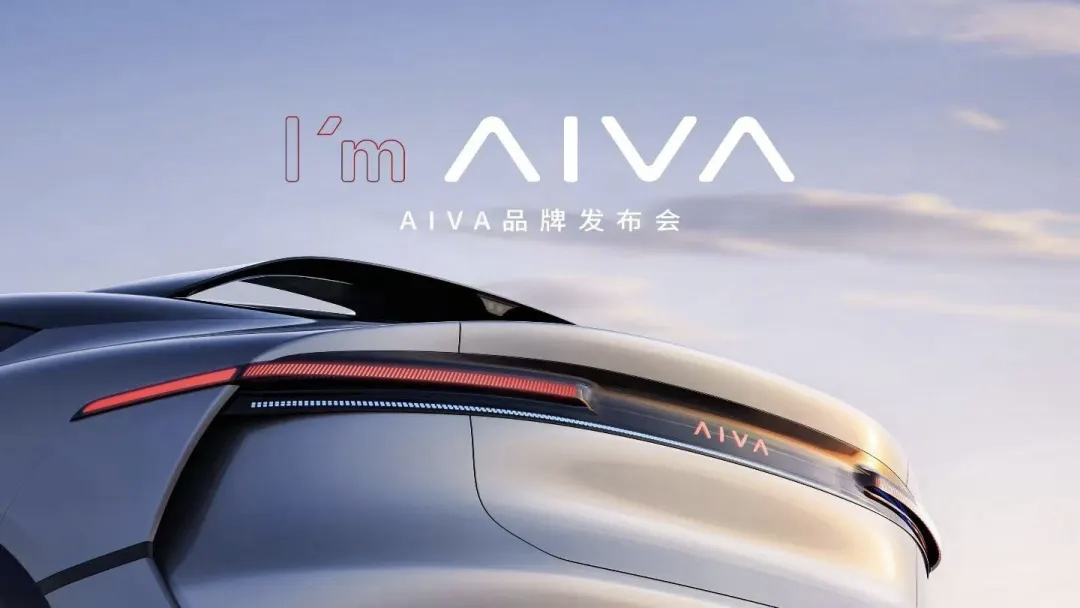
The name Saido itself completed marketing for ByteDance. "Sai" refers to Seres, and "Dou" refers to ByteDance's Doubao—the external interpretation of these two characters is nearly unanimous, with their combination writing both manufacturing and AI lineage into the brand name. This is rare in the automotive industry; by comparison, Huawei's Harmony Intelligent Mobility Alliance brands like Aito and Luxeed avoid explicitly including "Huawei" in their names. Saido Technology is a Seres subsidiary, yet its name blends Seres and ByteDance's AI. While ByteDance officially denies equity cooperation with Saido, it has not objected to the naming, and external discussions about Saido default to viewing it as "ByteDance's AI in a Seres car."
Indeed, Saido collaborates with Volcano Engine, described officially as "joint definition, joint design, and co-creation": Volcano Engine provides the Doubao large model, intelligent cockpit technology, cloud-native computing power, and content ecosystem, while Saido handles branding, product definition, and vehicle manufacturing. Cockpit engineering is undertaken by Yitu Technology, also invested in by Volcano Engine—this represents ByteDance's capital involvement, targeting engineering service providers rather than Saido itself. Saido's intelligent driving solution comes from Yuanrong Qixing. According to reports, this project, internally codenamed "Project A" at ByteDance, is directly overseen by Volcano Engine's vice president.
Saido also reveals Volcano Engine's boundaries. 36Kr previously reported that Volcano Engine customized Thor z chips from NVIDIA, deploying cockpit models as Al Box "external attachments" in vehicles. Seres ceded development leadership for new cockpit interactions to Volcano Engine, providing vehicle platforms, implementation capabilities, and over 100 million yuan in funding. However, Saido's assisted driving partner is Yuanrong Qixing, not Volcano Engine. Some autonomous driving industry insiders argue that without integrating intelligent cockpits and assisted driving, achieving a closed-loop intelligent experience for the entire vehicle is difficult—this is the backdrop for ByteDance's exploration of autonomous driving.
FAW Group represents another automaker partnering with Volcano Engine. During the 2026 Beijing Auto Show, the FAW Hongqi HS6 PHEV debuted as a new vehicle equipped with the Doubao large model. FAW also integrates other models: the Hongqi HS6 previously used Alibaba Cloud's Qianwen for cockpit AI, and FAW is on iFlytek's partner list while advancing its self-developed Lingxi cockpit with AI scenario services. Having one group use multiple models is common as multi-model routing becomes an industry trend.
Roewe Jia Yue represents the deepest and most closely tied level of cooperation with ByteDance. In April 2025, Roewe became the first automotive company to establish in-depth cooperation with Volcano Engine in the automotive sector, with joint development beginning at the product definition stage. The Jia Yue series adopts the CPP AI-native technology architecture, comprising three layers: full-dimensional contextual awareness, AI planning, and atomic invocation. It breaks down over 2,000 in-car functions into independent modules that can be scheduled by AI, enabling granular control over the air conditioning, seats, doors and windows, and driving modes. The Jia Yue 07 is positioned for the family market, with a price range of RMB 150,000 to 200,000.
From system-level binding with Jia Yue to brand-level marketing with Sai Dou, and then to function-level integration with Tesla, Volcano Engine's collaboration spectrum ranges from deep to shallow. In contrast to Huawei's model, the key difference lies in the depth of intervention. Huawei's cooperation with automakers includes three modes: component supply, solution provision, and "Smart Selection" vehicles. The Smart Selection model involves branding, channel management, and product definition, with the Aito series being a product of this approach, participating at a level close to joint vehicle manufacturing. Volcano Engine's collaboration remains at the technical level, without involvement in channels or branding.
However, in the current era of AI's significant foray into the automotive industry, large models and the intelligent functions they enable have long been considered the soul of automobiles. From this perspective, whether ByteDance admits to building cars is no longer crucial. As investments grow and interventions deepen, for ByteDance, shaping the soul of automobiles through industrial Layout (industrial layout) and strategic depth is bound to be more important than building cars itself.
(The accompanying images and public data materials in this article are sourced from the internet and public industry platforms. If there is any infringement, please contact us promptly for corrections.)
-
![]()
Annual Production Capacity in Phase I to Hit 50,000 Units! Weijing Optics Unveils Mudanjiang Production Base
-
![]()
Net Profit Loss Shrinks by 35.52% in First Three Quarters of 2026, Yet Costar’s Stability Remains Elusive
-
![]()
Massive Exchange Losses! Lens Technology’s Profits Plummet in First Three Quarters—Will the iPhone Duo Mark a New Turning Point?
-
![]()
2026 World Intelligent Connected Vehicles Conference: Transitioning from Spec Benchmarking to Safety Benchmarking, the Industry Steps into a New Era of Regulatory Oversight
-
![]()
Hundreds of Billions Fully Invested in AI, Yet No Returns in Sight
-
![]()
ByteDance's Automotive Ambitions Come to the Fore
-
![]()
$12.9 Billion: Nvidia Buys an 'Insurance Policy'
-
![]()
iPhone Duo: Is It a Thorn in Ternus's Side?