iPhone Duo: Is It a Thorn in Ternus's Side?
 10/26 2026
 559
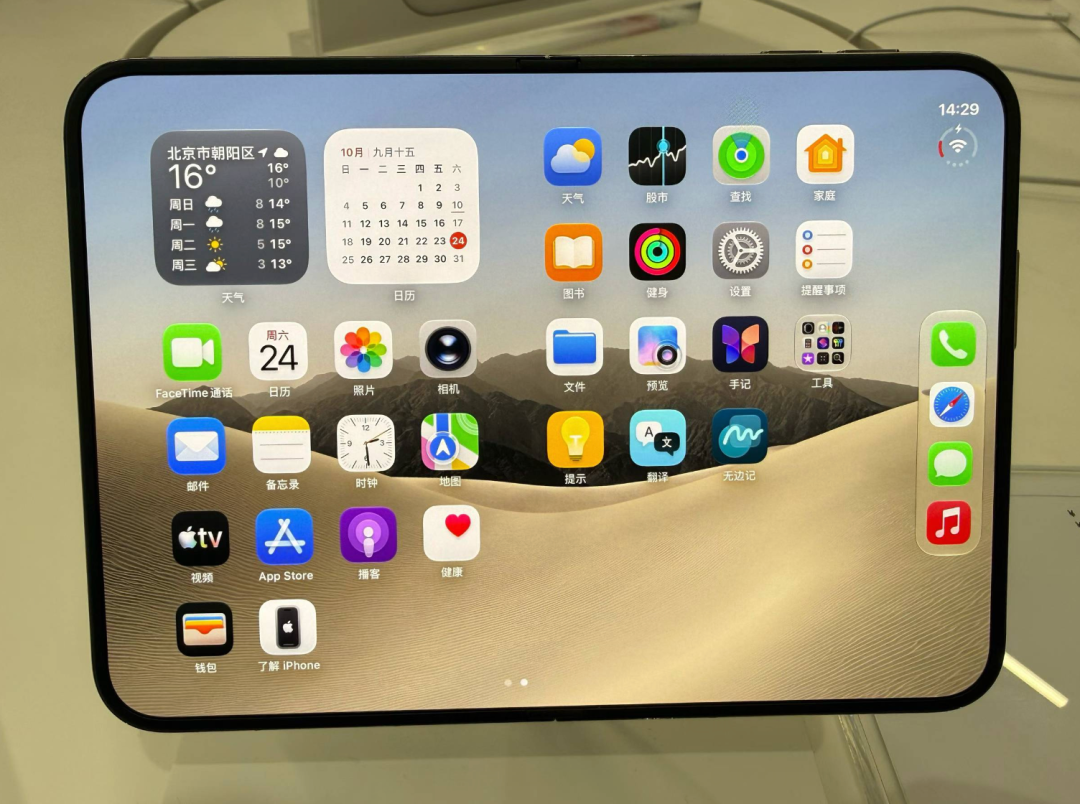
The iPhone Duo has landed Ternus in a tough spot.
On October 23rd, the iPhone Duo hit the market, only to be quickly mired in controversy, sparking multiple trending topics. Software compatibility emerged as the foremost concern. For instance, before its launch, a test conducted by He Tongxue on 25 popular apps revealed that approximately 80% had yet to be optimized for foldable screens, with some apps displaying large black borders upon opening.
Numerous users also reported issues such as screen zooming, lack of split-screen functionality, and app crashes when switching between the inner and outer screens.
Quality control issues also surfaced. Both domestic and international users took to social media to report that their iPhone Duo devices came out of the box with screen bright lines or cracks, with most defects concentrated directly above the hinge. Tim from Media Storm conducted folding tests—10,000 folds at room temperature and 1,000 folds at -20°C—and discovered that while the hinge remained smooth, the screen creases deepened over time.
Apple also took shortcuts on hardware specifications: the absence of a telephoto lens, no Face ID, eSIM-only support, and a hefty weight of 254 grams. Teardown expert Yang Changshun revealed that Apple's much-touted "revolutionary" matte screen "black technology," developed over several years, might simply be a matte screen protector costing between $40 and $50.
Moreover, the price of the iPhone Duo plummeted within days, catching scalpers off guard.
As Apple's inaugural foldable phone and its flagship hardware with the longest delivery time in history—I noted that over the past five years, its fall flagships took an average of 3 days from announcement to pre-sale and about 10 days to market launch, whereas the iPhone Duo extended these intervals to 36 and 43 days, respectively—the iPhone Duo appears to be a half-baked product rushed to market.
While Apple has had its share of "mishaps" in the past, these have mostly been product-level issues such as connectivity, craftsmanship, or keyboard problems. This time, the issue lies in Apple's once-esteemed app ecosystem. The "Duo" debacle is somewhat farcical and has dealt a significant blow to Ternus, who has just assumed the role of Apple's CEO.
Why is Apple pushing this device amid the leadership transition between Cook and Ternus?
On one hand, Apple is racing to capitalize on the foldable screen market window. Competition in AI-powered phones continues to dampen growth expectations, and foldable large screens represent one of the few hardware categories still capable of driving new growth.
Furthermore, the viability of the form factor no longer needs to be proven. Previously, Huawei and Samsung iterated for years in the horizontal fold segment, refining hinge designs, large-screen optimizations, and split-screen interactions multiple times, with cumulative foldable phone sales exceeding 100 million units.
Meanwhile, IDC projects global foldable shipments to reach 22.9 million units in 2026, up 12.6% year-on-year, while overall global phone shipments are expected to decline by 16.7% in the same year. This represents one of the few growing market segments.
As a latecomer, Apple has less room than ever to refine its product and ecosystem, as the market and competitors offer narrower margins for error.
On the other hand, Apple faces growth pressures. The iPhone accounts for nearly half of Apple's revenue. For example, in Q3 2026, Apple's total revenue was $109.4 billion, with iPhone revenue contributing $54.25 billion (49.6%).
However, iPhone replacement cycles are lengthening, and rising storage costs continue to drive up production expenses. Apple's response has been to raise prices, as evidenced by the iPhone Duo's starting price of $1,999.
With Apple Intelligence (AI) for China still pending and AI-driven upgrade incentives yet to materialize, Apple needs a significant new hardware form factor to sustain its next growth curve.
Currently, Apple is prioritizing two key initiatives: expanding the availability of Apple AI and ramping up iPhone Duo production.
The rollout of Apple AI has been fraught with challenges. After more than two years of delays, the China version finally has a launch timeline but remains limited in supply, releasing features and regions in small batches.
This is Apple's classic strategy: create scarcity through limited availability to drive paid adoption, transforming AI into a sellable commodity.
Meanwhile, the iPhone Duo is making progress in small, rapid strides, with new device deliveries now scheduled for January 2027. Apple claims "exceptional" pre-order demand and promises to deliver products to consumers as quickly as possible.
Simultaneously, it has imposed "mandatory" deadlines for third-party app compatibility, set for April 2027. This means Apple prioritized hardware delivery over ecosystem readiness, leaving existing apps with a lengthy adaptation period.
This approach mirrors Apple's strategies with AI and Vision Pro: pitch the vision first, then deliver the product. However, foldable phones are mass-market consumer devices, and product flaws will be immediately apparent, making it harder to hide behind Apple's hype.
Apple's confidence in this delivery timeline stems from the fact that stock buyers and phone purchasers are two distinct groups.
On the iPhone Duo's launch day, Apple's market cap surpassed $5.1 trillion, briefly overtaking Nvidia. Apple relies on the iPhone to sustain its business, and the perceived potential of the foldable form factor is enough to attract investor buy-in.
Of course, Apple's stock rally isn't solely attributable to the new foldable. A larger driver is the shift in capital flows. After two to three years of AI infrastructure hypergrowth, markets and investors worry that some tech firms have overextended themselves on AI-related debt.
Estimates suggest Apple's annual AI-related spending remains between $11 billion and $13 billion, while competitors spend tens of billions annually on capital expenditures.
Many analysts conclude that Apple's relatively low AI spending has made it a safe-haven asset amid tech stock sell-offs, further boosted by strong demand for its first foldable.
However, consumers are concerned with the actual in-hand experience, not speculative hype. No one wants to pay a premium for a defective device. This disconnect between investor and consumer expectations has erupted into a public relations crisis.
In my view, the iPhone Duo's issues stem from Apple's strategic choices and their product ramifications.
Apple claims to have been "coy" about foldables for years, but the market has matured after seven years of cultivation by competitors.
Take the two leading foldable brands: Huawei captured 71.8% of China's foldable market in 2025, with its Pura X Max shipping over 1.2 million units in four months; Samsung maintained its global lead with around 40% share.
Interestingly, the launch of the Duo coincided with a 76% sales surge for Huawei's Pura X Max.
Apple's first foldable inadvertently boosted its rival.
Historically, Apple entered categories like the iPod, iPhone, iPad, Watch, and AirPods to mature or redefine markets. With foldables, Apple watched competitors iterate for seven years before jumping in to reap the rewards.
When Apple stops "redefining" products, its brand premium must be reevaluated. The iPhone Duo's "most expensive ever" pricing raises questions: How much is due to product strength, brand power, or scalper-driven hype? No one knows for sure.
As Angry Miao founder Li Nan suggested, the iPhone Duo's quality issues may reflect Apple's estrangement from China's supply chain. More likely, risks were predicted but ignored by executives.
Ternus and Cook. Image source: Internet
Ternus inherited Cook's stable cash flow and supply chain but has adopted a cautious approach to product decisions. By past logic, Apple would likely wait until software, hardware, and AI synergies were fully aligned before launching the iPhone Duo.
But Ternus lacks time. He needs a guaranteed win to establish his reputation, and the iPhone Duo is his only bet.
As I previously argued, "scalper speculation became Apple's cheapest marketing"—not just a joke, but likely a strategic choice for Ternus's first financial report.
The rush has backfired: the iPhone Duo now faces ecosystem compatibility issues, quality control disputes, collapsed channel premiums, and public relations fallout. All these contradictions ultimately burden Ternus, hence the "eye medicine" metaphor.
In my view, the iPhone Duo's conflicts arise from Apple's divergent delivery strategies for hardware and AI under Ternus, creating market abnormalities.
To be fair, Ternus's choice of the foldable market isn't misguided. Early entry isn't without rewards: engineering data on hinge and large-screen compatibility, developer collaboration experience, and first-mover positioning will benefit future iterations.
Moreover, Apple's stock hit an all-time high. But once the iPhone Duo's premium fades, Ternus will confront the awkwardness of capital narratives outpacing product reality.
Is this opening move a hidden trap left by Cook for Ternus?
References:
Tang Chen, "'Lagging' Apple Begins Limited AI Supply," "Apple Needs Scalpers More Than Ever"
Huxiu, "Apple's First Foldable Fails to Enrich Scalpers"
-
![]()
Annual Production Capacity in Phase I to Hit 50,000 Units! Weijing Optics Unveils Mudanjiang Production Base
-
![]()
Net Profit Loss Shrinks by 35.52% in First Three Quarters of 2026, Yet Costar’s Stability Remains Elusive
-
![]()
Massive Exchange Losses! Lens Technology’s Profits Plummet in First Three Quarters—Will the iPhone Duo Mark a New Turning Point?
-
![]()
2026 World Intelligent Connected Vehicles Conference: Transitioning from Spec Benchmarking to Safety Benchmarking, the Industry Steps into a New Era of Regulatory Oversight
-
![]()
Hundreds of Billions Fully Invested in AI, Yet No Returns in Sight
-
![]()
ByteDance's Automotive Ambitions Come to the Fore
-
![]()
$12.9 Billion: Nvidia Buys an 'Insurance Policy'
-
![]()
iPhone Duo: Is It a Thorn in Ternus's Side?