Net Profit Loss Shrinks by 35.52% in First Three Quarters of 2026, Yet Costar’s Stability Remains Elusive
 10/26 2026
 382
On October 26, Costar released its third-quarter financial report for 2026. During this period, the company reported an operating revenue of RMB 329 million, marking a 6.43% decrease year-on-year. The net profit attributable to the parent company stood at a loss of RMB 51.1964 million.
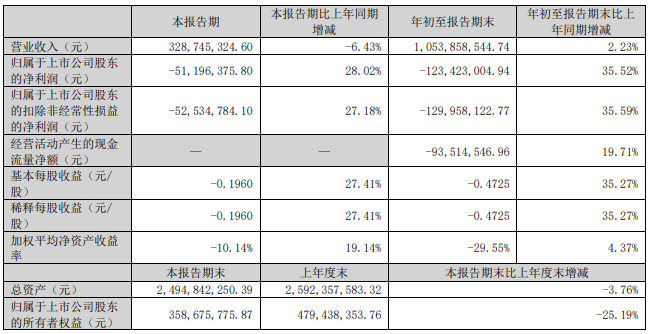
Over the first three quarters, the net profit attributable to the parent company amounted to a loss of RMB 123 million, a significant 35.52% reduction compared to the RMB 191 million loss recorded in the same period the previous year. The net profit after non-recurring gains and losses was also a loss of RMB 130 million, down by 35.59%. Meanwhile, operating profit witnessed a 35.90% year-on-year improvement.
Against a backdrop of relatively stagnant revenue, the fact that losses have contracted by over 30% suggests that Costar’s profitability recovery is not driven by scale expansion but rather by structural enhancements.
The primary factor behind the improvement in operating profit is the notable increase in gross margin. In the first three quarters, operating profit surged by approximately RMB 72.61 million year-on-year, which the company, in its announcement, attributed to shifts in the product sales mix and a rise in gross margin. This trend was clearly hinted at in the semi-annual report: the gross margin for the optoelectronic defense and strategic surveillance businesses soared from 0.69% in the same period last year to 21.52%, while the gross margin for optical components increased by 1.19 percentage points year-on-year to 4.27%.
The proportion of high-margin defense products and automotive and consumer optoelectronic products in the revenue mix has risen. Although the low-margin projector business continues to exert a drag, its dilutive effect on the overall structure is diminishing. In essence, Costar is forsaking low-quality revenue to enhance the quality of its profitability.
Cost reductions on the expense side have concurrently provided flexibility to profits. Total operating costs decreased by RMB 32.9189 million year-on-year in the first three quarters, with management expenses dropping by 14.85% and selling expenses also narrowing slightly. The intensity of inventory reduction is particularly striking: inventory decreased by RMB 113 million from the beginning of the year, a 31.76% reduction, corresponding to a 39.34% year-on-year decrease in asset impairment losses. The simultaneous alleviation of the inventory burden and impairment pressure accumulated in the early stages has provided tangible support for the narrowing of losses on the “cost-cutting” front.
However, it is crucial to note that operating cash flow remained negative at RMB -93.5145 million, despite a 19.71% year-on-year improvement, and has yet to turn positive. The issue of accounts receivable did not abate in the third quarter but instead intensified, with accounts receivable at the end of the period rising to RMB 902 million, an increase of approximately RMB 173 million from RMB 729 million at the beginning of the year, or about 23.7%. In the semi-annual report, accounts receivable already accounted for more than 30% of total assets. The quality of revenue and the timing of payment collection remain constraints on the sustainability of profitability recovery.
What truly determines Costar’s medium-term trajectory is whether the time lag for new businesses to transition from “design wins” to “volume production” can be offset by the speed of loss reduction in traditional businesses. The company’s布局 (layout) in the automotive optoelectronics sector is timely: HUD systems and PGU modules have achieved small-batch shipments, with early design wins for certain models from automakers such as Changan Automobile and subsequent shipments. AR-HUD and lidar-related products continue to undergo customer validation and progress in design wins.
The challenge lies in timing. From design wins to SOP (Start of Production), the industry typically anticipates a period of 12 to 24 months under optimistic estimates, with some projects taking even longer. From SOP to large-scale delivery, an additional 6 to 12 months of capacity ramp-up is required. The company itself acknowledged in research that automotive HUD products have “generally small order volumes in hand and limited performance contributions,” with “overall limited contributions to current operations.” New domains and equipment directions, such as smart helmets and unmanned counter-UAV optoelectronic pods, are also in their incubation period and have not yet generated a revenue scale sufficient to offset the decline of the projector business.
The automotive HUD and lidar component directions that Costar has ventured into do not lack demand-side potential. The real test is whether a company that has incurred non-recurring losses for consecutive years and still operates with negative gross margins in the projector business can convert new business design win reserves into meaningful revenue increments before completing the “clearance” of traditional businesses.
The answer provided by the third-quarter report is that the direction of loss reduction is on the right track, and the quality of structural improvements is initially discernible. However, the path to the breakeven line still needs to be traversed inch by inch through enhanced order delivery and payment collection efficiency.
-
![]()
Annual Production Capacity in Phase I to Hit 50,000 Units! Weijing Optics Unveils Mudanjiang Production Base
-
![]()
Net Profit Loss Shrinks by 35.52% in First Three Quarters of 2026, Yet Costar’s Stability Remains Elusive
-
![]()
Massive Exchange Losses! Lens Technology’s Profits Plummet in First Three Quarters—Will the iPhone Duo Mark a New Turning Point?
-
![]()
2026 World Intelligent Connected Vehicles Conference: Transitioning from Spec Benchmarking to Safety Benchmarking, the Industry Steps into a New Era of Regulatory Oversight
-
![]()
Hundreds of Billions Fully Invested in AI, Yet No Returns in Sight
-
![]()
ByteDance's Automotive Ambitions Come to the Fore
-
![]()
$12.9 Billion: Nvidia Buys an 'Insurance Policy'
-
![]()
iPhone Duo: Is It a Thorn in Ternus's Side?