One Person, 11 Labs: The "Pick-and-Shovel" Gold Rush of AI-Driven Science
 11/06 2026
 419
"I struck a road to riches"
Author|Zuri Layout|Ray
In October of this year, OpenAI announced its acquisition of Orchestra Bio, a company that helps biopharma teams coordinate R&D tasks and manage project progress. That same month, Anthropic disclosed that it had acquired Mithril Medicine back in July. In a striking coincidence, the two leading model companies went on acquisition sprees at virtually the same time.
The Mithril story has a whiff of legend about it. Before the acquisition, the company had just one full-time employee. The founder used Claude to coordinate 11 external laboratories—handling contracts, arranging experiments, analyzing data, and advancing drug research for two types of rare muscular dystrophies.
One scientist, one AI assistant, and a network of external labs—together they are exploring R&D work that previously demanded a much larger team. This also sharpens a question: as AI enables small teams to push more research projects forward, who will absorb the resulting surge in experimental, operational, and data demands?
Put another way, in AI for Science, where exactly are the opportunities for "selling shovels"?
In 2026, Google DeepMind and MIT FutureTech released "AI in Science: Early Insights," painting an early picture of how AI is entering the scientific research process.
Among the 637 UK and US researchers surveyed, nearly 50% use AI daily; about 41% are troubled by having accumulated a backlog of unverified hypotheses.
Literature search, code writing, computational prediction, and candidate design have all accelerated—generating more tasks that await validation. Yet the constraints of reality remain unchanged: samples must be prepared, cells cultured, equipment scheduled, and results reviewed.
AI has boosted the output efficiency of upstream hypotheses, and downstream validation capacity is becoming scarcer. At the same time, the emergence of well-funded leading companies has given providers of downstream validation services a pool of potential paying customers.
In the life sciences, companies such as Isomorphic Labs, Earendil, Xaira, and Chai Discovery have emerged with hefty funding or valuations; in new materials, there is Periodic Labs. Market rumors even peg Discovery Loop's valuation at around $50 billion.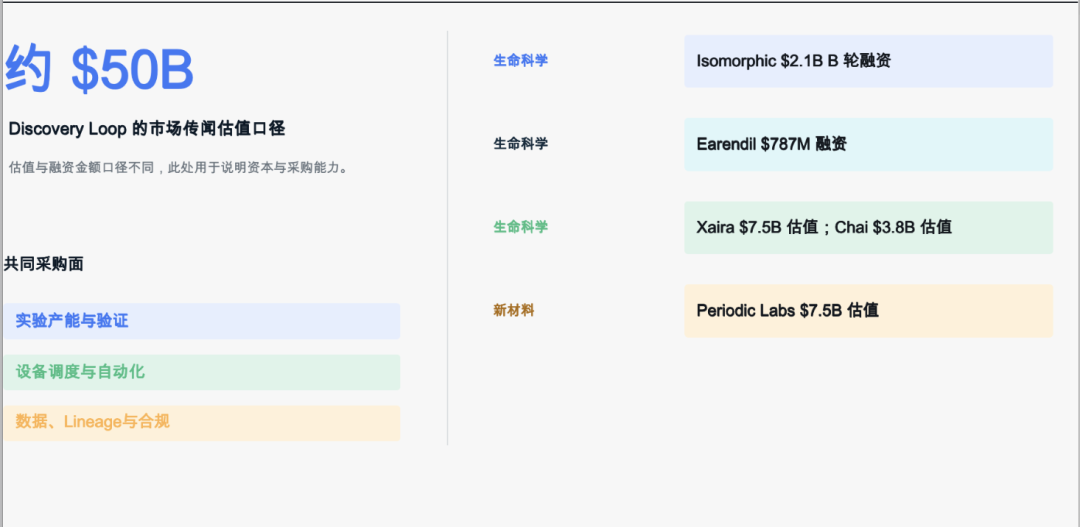
Produced by Silicon Bunny. Information from public sources; data as of September 2026.
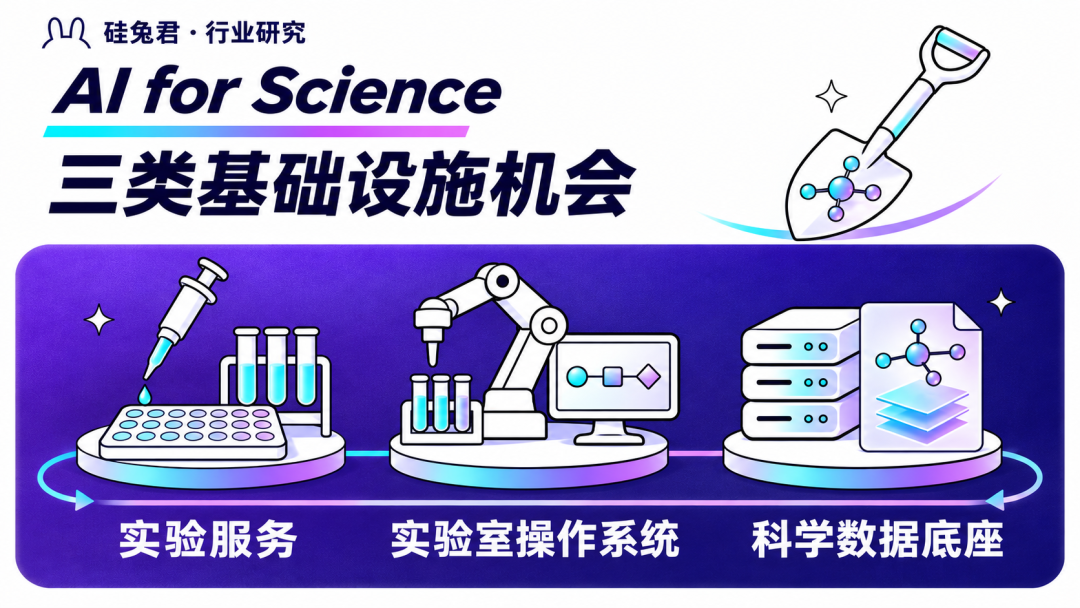
We believe that as leading AI for Science companies emerge, some demand may flow from inside model companies to specialized suppliers. From this, we see three types of opportunities.

AI CRO — Experimental Validation Services
A CRO, or contract research organization, undertakes R&D work outsourced by clients. In the experimental validation business, what clients are buying is an experimental result delivered within an agreed timeframe and meeting agreed quality standards.
Traditional CROs have served the industry for many years, with varying levels of automation. The opportunity for a new generation of companies lies in re-engineering experimental delivery: standardizing high-frequency assay methods, making quotation, ordering, scheduling, status inquiry, and result delivery a seamless process, and then connecting to model teams through software interfaces.
When clients need to submit large batches of candidates every round, the cost of email communication and manual handoffs is amplified. Only by reliably taking on the next round of tasks can a company earn a place in the client's scientific research process.
Adaptyv is a case in point. In August of this year, it closed a $40 million Series A led by Highland Europe, with participation from ACE Ventures.
AI model developers design proteins; Adaptyv handles DNA synthesis, protein expression, and then tests whether the proteins bind to targets, whether they are stable, and whether they can be produced normally.
In the past, this step typically required clients to have their own labs or to find traditional CROs to outsource to—a process involving repeated price inquiries, discussion of experimental plans, queuing, running experiments, and receiving Excel/PDF reports.
Adaptyv built a standardized product. Clients can now submit protein sequences through the website or call its API via an agent; the company handles the subsequent synthesis, expression, purification, and testing, and returns structured experimental data directly—seamlessly feeding into model training.
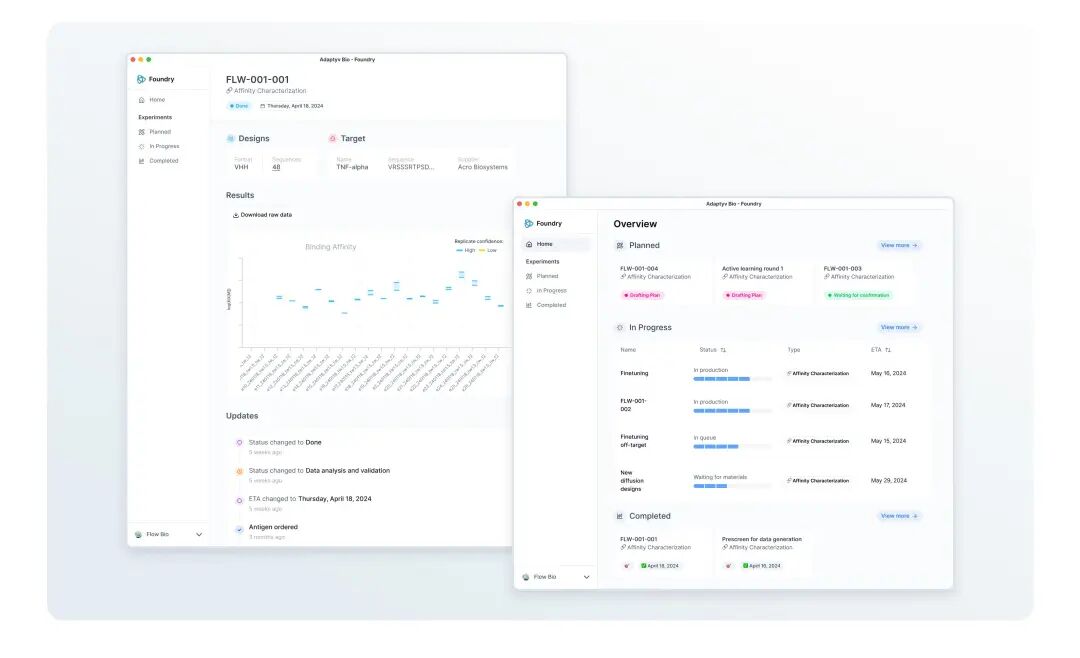
Adaptyv's Foundry experimental management platform, allowing users to view experiment progress, manage tasks, and access experimental results online. Image source: Adaptyv Bio official website.
A protein design study disclosed by Anthropic illustrates this demand: Adaptyv tested 1,320 proteins designed by Claude, of which 354 actually bound to targets—an overall hit rate of about 26.8%.
For infrastructure entrepreneurs, the key takeaway is that model capabilities need real experimental results to back them up. As design tasks multiply, experimental validation may become a recurring procurement need.
Adaptyv also demonstrates the data monetization value embedded in its business model. It launched the Proteinbase database, which combines computational predictions, design methods, and real experimental results—including relatively rarely publicized failure data—which can become a data resource for model evaluation and iteration.
Dash Bio demonstrates an opportunity at another point in the R&D chain.
If Adaptyv sits closer to the upstream of the drug R&D validation chain, Dash Bio sits closer to the downstream. After candidate drugs enter animal testing or clinical stages, the company validates efficacy changes and immune responses through bioanalysis, providing evidence on whether a drug should continue development.
For example, by analyzing samples such as blood, plasma, and tissue, it determines how much of the drug enters the body, how long it takes to be metabolized, and whether it triggers immune reactions and other manifestations. At this stage, the speed of sample processing, testing, and data delivery directly affects subsequent R&D arrangements.
Dash Bio organizes its business around automated experimental platforms, transparent fixed pricing, and self-service quotations. In its 2025 summary, the company stated that results for multiple types of assays can be returned within a few days—about 10 times the industry's conventional delivery speed.
Also in August of this year, Dash Bio announced a $30 million Series A led by Oak HC/FT. The company says it has signed more than 30 customers, including 4 of the global Top 15 pharmaceutical companies.
Among the early-stage projects we follow, Templar Nova, backed by UpHonest Capital, enters from the oncology field. Through its self-developed platform, it integrates medical reports, data management, biostatistics, and experimental operations into a unified process, delivering through a combination of AI agent execution and expert review. The founder previously served as head of pharmacokinetics review at the US FDA Office of Clinical Pharmacology and is a leader in the FDA's application of AI/ML to drug review.
For AI CROs, the entrepreneurial entry point can be very narrow: one high-frequency assay, one type of slow-turnaround sample, or one repeatedly occurring delivery process. First make customers willing to repurchase, then expand capabilities.
Investors, however, need to ask: does delivery acceleration come from reusable systems or from more personnel input? After equipment utilization improves, can gross margins improve? Will customers keep increasing purchases because of reliable delivery?
These questions determine whether a company can build economies of scale.

Lab OS — Laboratory Automation
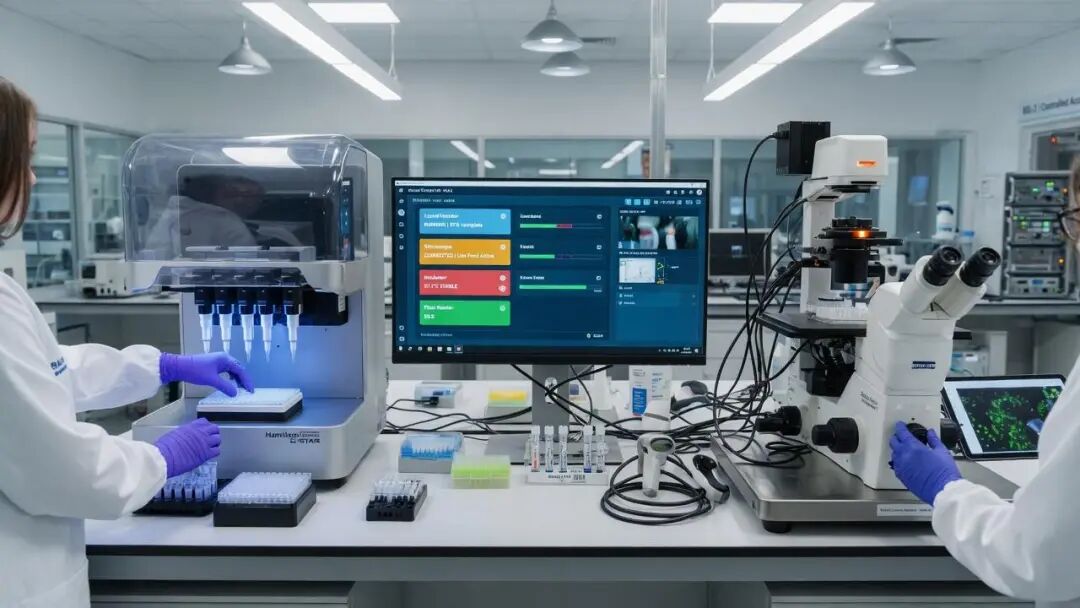
This opportunity focuses on how to improve the efficiency of existing laboratories. Although some experimental equipment can complete tasks automatically, equipment still relies on manual sample transfer, file conversion, and sequencing.
When a model proposes thousands of candidates at once, these handoffs can become bottlenecks.
Laboratory AI operating systems, or Lab OS, attempt to fill this layer. After a scientist or AI agent submits an experimental plan, the system translates the plan into equipment actions and records the execution process.
Automata demonstrates this path.
It connects different experimental equipment, robots, software systems, and data flows. Scientists describe "what experiment I want to complete," and the system translates that into equipment actions and scheduling plans—arranging "who goes first, who goes later, when to do it, and what to do if it fails" according to workflows—and records the data of the entire experimental process.
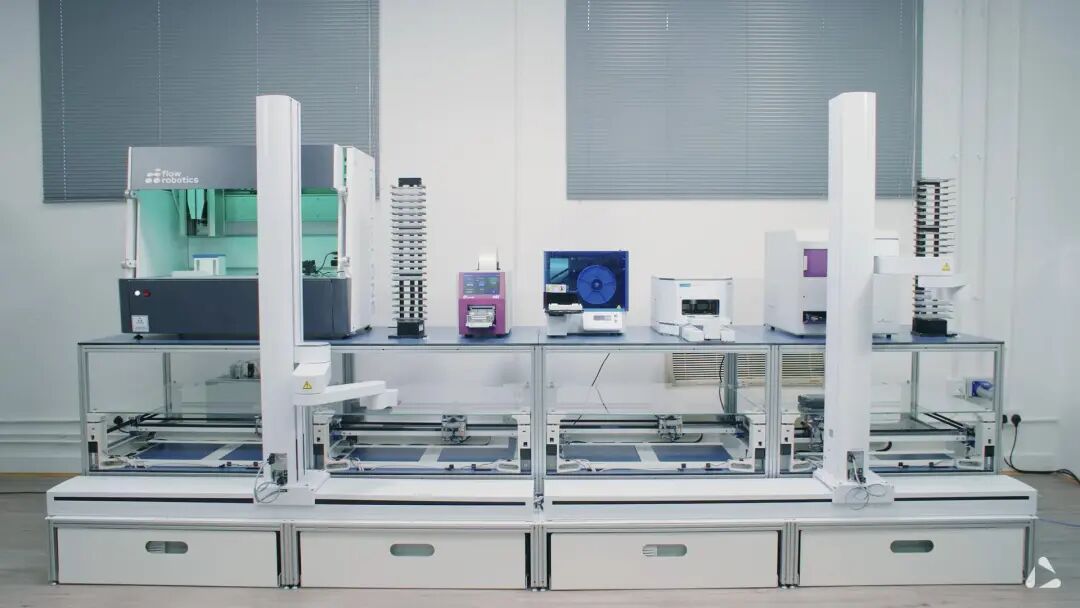
Automata LINQ automated experimental system. Image source: IoT World Today
What is delivered to customers is a software and hardware system. The software handles workflow design, equipment scheduling, operation monitoring, data flow, and API/MCP/AI interfaces; the physical automated hardware platform includes workbenches, robots, rail/transport systems, control electronics, and integration with third-party laboratory instruments.
Medra explores another path: enabling robots to adapt to existing instruments and experimental environments, and connecting scientific reasoning with physical execution.
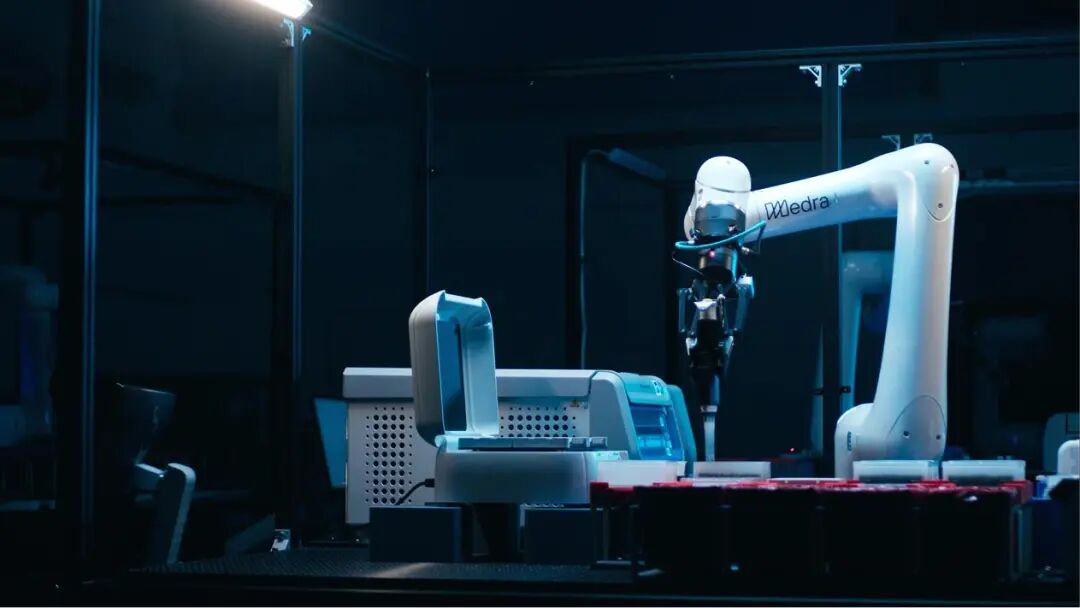
Medra's Physical AI laboratory robot, performing experimental operations via a robotic arm. Image source: Medra official website
In its product design, Scientific AI is responsible for understanding experimental goals, processing information, and adjusting plans; Physical AI uses robotic arms + machine vision + instrument control agents to open doors, take samples, press buttons, and move things like a human. Medra is training an embodied AI in the laboratory that can understand the experimental environment, operate different experimental equipment, and translate Scientific AI's decisions into real-world actions.
Of the two companies, Automata completed a $45 million Series C in January of this year led by Dimension, with participation from Danaher Ventures and others. Medra announced a $52 million Series A last December led by Human Capital, with continued participation from Lux Capital and others.
Behind the two paths, the common business question is: can laboratory experience be precipitated into reusable products?
How much adaptation work is needed to add a new instrument? How many engineers need to be on-site to add a new experimental workflow? After a system error occurs, in how many cases can it recover automatically? When the same set of capabilities enters a second customer, is deployment noticeably faster?
For entrepreneurs, early integration work is often unavoidable. The key is whether each delivery leaves behind reusable device connections, scheduling capabilities, and process templates.
For investors, what is worth observing is the change in deployment costs. As customers increase, can the delivery cycle and manpower input for new projects decline, and can recurring software revenue grow?
If entering every laboratory requires redevelopment, it will be difficult for the company to deliver on the scale advantages of a platform business.

Scientific Data Foundation — Enabling AI to Understand Experiments
The problem with scientific research data today is fragmentation, lack of context, and difficulty of reuse.
Fragmentation is reflected in the fact that storage containers each serve their own purposes: experimenters record in one, analysts analyze in another, and management retrieves from process management systems in yet another.
For a long time, experimental data has emphasized results while downplaying operational process records and failure data, resulting in a lack of contextual data for experimental results. For human scientists, this information can be partially supplemented by experience, but for AI agents, what they see is often just a pile of isolated files rather than a continuous scientific research process.
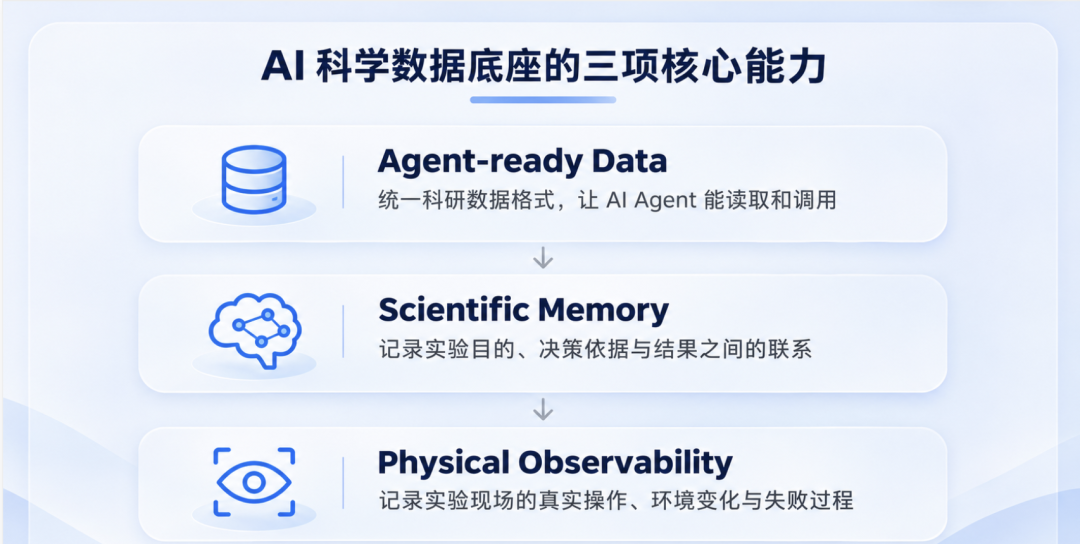
A scientific data foundation oriented toward agents needs core capabilities including: ① unified data formats so agents can directly understand and call them; ② recording why an experiment was done, what model was used, and how results affected the next decision; ③ recording how real experiments were actually executed and how they failed.
Produced by Silicon Bunny
Transfyr enters from the experimental site. In August of this year, it raised a $25 million seed round led by General Catalyst, with participation from Lux Capital and others.
Many details that affect results occur before the instrument output file: pipetting technique, actual reaction time, reagent replacement, and the operational process between people and equipment. Transfyr uses video, sensors, and multimodal AI to capture this information, attempting to turn tacit experience into analyzable records for troubleshooting experiments, process optimization, technology transfer, and training.
Transfyr uses multi-view video, sensors, and AI to record experimental processes, helping identify key operational details that affect experimental results. Image source: Transfyr official website
Its potential value lies in helping teams answer a frequently overlooked question: how exactly was this experiment carried out, and how does it differ from the last run?
Currently, the company generates revenue by deploying experimental observability systems for pharmaceutical companies, research institutions, and AI/robotics customers.
Entrepreneurial opportunities for this type of company often arise from a specific contextual gap: experimental failures are difficult to troubleshoot, analytical processes are difficult to reproduce, or existing data cannot be reliably invoked by intelligent agents.

Who can become the "shovel seller" in the era of AI-driven scientific research?
For those who want to start businesses and invest in AI for Science, this shift is worth continuously tracking.
For every additional batch of candidates worth validating that a model proposes, someone needs to complete the experiments, organize execution, and preserve trustworthy records. Whether these needs can be turned into a business with stable delivery, sustained repeat purchases, and ever-increasing efficiency will determine who can become the infrastructure supplier in this round of scientific research upgrading.
-
Agents Are "Redoing" Databases
-
![]()
SAIC and Audi: Building the Purest-Blooded AUDI Electric Cars
-
![]()
Yiwu Is on a Tear Again! GDP Grew 7.9% in the First Three Quarters, and Foreign Trade Is Still Surging
-
![]()
Driving Momentum in Atomic-Level Ultra-Precision Optical Manufacturing: Lingding Optics Secures New Round of Financing
-
![]()
Q3 Non-Recurring Net Profit Surges 686%, Yet Aopu Optoelectronics Burns Through 240 Million Yuan in First Three Quarters
-
![]()
One Person, 11 Labs: The "Pick-and-Shovel" Gold Rush of AI-Driven Science
-
Volkswagen Recalls 610,000 Vehicles as Profits Plunge 98.7%—Is There Still Hope?
-
![]()
Li Jiaqi Moves 2 Trillion Tokens: AI Starts Landing in Shopping Carts