Q3 Non-Recurring Net Profit Surges 686%, Yet Aopu Optoelectronics Burns Through 240 Million Yuan in First Three Quarters
 11/06 2026
 486
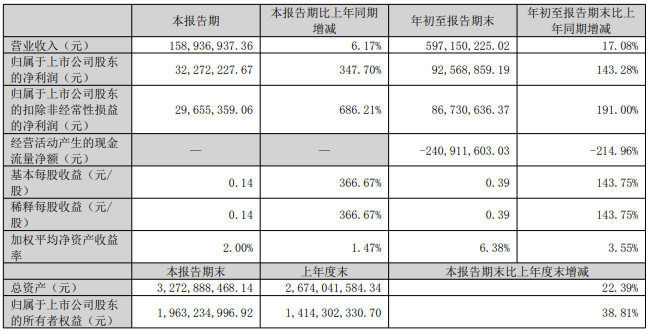
Recently, Aopu Optoelectronics released its Q3 2026 report. Revenue for the first three quarters reached 597 million yuan, up 17.08% year on year; net profit attributable to shareholders came in at 92.5689 million yuan, surging 143.28% year on year; and non-recurring net profit jumped 191.00% year on year.
Breaking it down, Q3 net profit attributable to shareholders was 32.2722 million yuan, up 347.70% year on year; non-recurring net profit reached 29.6554 million yuan, up 686.21% year on year.
According to the company, the revenue growth in the first three quarters was mainly driven by higher year-on-year sales of the parent company's independently developed products and its subsidiaries' grating sensor products.
A closer look at the core businesses: composite materials, optoelectronic measurement and control instruments, and grating sensors accounted for 34.98%, 32.38%, and 28.71% of revenue, respectively—together forming the current backbone of Aopu Optoelectronics.
Looking at gross margins in the first half of 2026, the divergence across the three major segments is more telling than the claim that "grating sensors are the only segment with rising gross margin": composite materials posted a gross margin of 41.54%, down 5.65 percentage points year on year; optoelectronic measurement and control instruments came in at 20.56%, down 5.52 percentage points; grating sensors reached 38.71%, up 1.84 percentage points—the only major segment to record a gross margin increase during the reporting period.
Optoelectronic measurement and control instruments are a traditional strength of Aopu Optoelectronics. Building on the technological heritage of the Changchun Institute of Optics, Fine Mechanics and Physics system, the company continues to secure orders in scenarios such as spaceborne remote sensing and scientific research instruments. It recently won bids for projects including the integrated assembly, adjustment, and testing equipment for optical remote sensing cameras at Hefei University of Technology and the laser-induced desorption mass spectrometry system at the Hefei Institutes of Physical Science, Chinese Academy of Sciences. While the individual amounts are modest, they serve as circumstantial evidence that the company has sustained order-winning capability in high-end optical system integration.
Notably, there is a gap between order visibility and cash flow that must be confronted head-on. Net cash flow from operating activities in the first three quarters was -241 million yuan, down 214.96% year on year.
The company cited two reasons: first, major contracts were signed and some payments received in advance during the same period last year, leading to a year-on-year decline in sales collections this period—and the base effect amplified the scale of the outflow; second, revenue growth drove year-on-year increases in cash paid for goods and services, employee compensation, and taxes.
For a precision manufacturing enterprise primarily serving the military and aerospace sectors, the seasonality of collection cycles and mismatched contract milestones can explain part of the fluctuation. But relative to revenue of 597 million yuan, a net outflow of nearly 240 million yuan clearly signals growing working capital occupation.
The certainty of converting orders in hand into revenue does not automatically translate into synchronized cash inflow. The new businesses of grating sensors and semiconductor optics remain in the "capacity building" and "small-batch validation" stages, and upfront investment will continue to consume cash for some time. The coexistence of a bright income statement and pressure on the cash flow statement is an essential footnote for understanding Aopu Optoelectronics at its current stage.
Aopu Optoelectronics' Q3 report essentially captures an optical precision manufacturing enterprise rebalancing its weight across multiple business lines: composite materials provide the base of current revenue, optoelectronic measurement and control holds its position within the system, and grating sensors and semiconductor optics carry the promise of long-term structural upgrading.
The variables that truly warrant tracking going forward are whether the validation pace of high-end grating rulers in industrial machine tools and semiconductor equipment can translate into orders with sustained volume growth, and when operating cash flow will return to a trajectory matching the revenue scale. OFweek Optics will continue to follow.
-
Agents Are "Redoing" Databases
-
![]()
SAIC and Audi: Building the Purest-Blooded AUDI Electric Cars
-
![]()
Yiwu Is on a Tear Again! GDP Grew 7.9% in the First Three Quarters, and Foreign Trade Is Still Surging
-
![]()
Driving Momentum in Atomic-Level Ultra-Precision Optical Manufacturing: Lingding Optics Secures New Round of Financing
-
![]()
Q3 Non-Recurring Net Profit Surges 686%, Yet Aopu Optoelectronics Burns Through 240 Million Yuan in First Three Quarters
-
![]()
One Person, 11 Labs: The "Pick-and-Shovel" Gold Rush of AI-Driven Science
-
Volkswagen Recalls 610,000 Vehicles as Profits Plunge 98.7%—Is There Still Hope?
-
![]()
Li Jiaqi Moves 2 Trillion Tokens: AI Starts Landing in Shopping Carts