Yiwu Is on a Tear Again! GDP Grew 7.9% in the First Three Quarters, and Foreign Trade Is Still Surging
 11/06 2026
 531
Source: Shenlan Finance
Can you imagine it? A county-level city racked up 615.37 billion yuan in exports in the first nine months—shattering the 500 billion yuan mark a full month ahead of schedule and setting a historic high.
That city is Yiwu.
At a time when the global trade environment is complex and ever-shifting, Yiwu's foreign trade remains brisk. In the first nine months of 2026, Yiwu's total imports and exports reached 714.5 billion yuan, up 13.2% year on year, of which exports accounted for 615.37 billion yuan, up 11.1%. Among China's county-level economies, Yiwu's export scale continues to rank firmly in the top tier.
Behind that trade growth lies the continuous evolution of a city's business ecosystem. Yiwu is home to more than 20 night markets of various sizes—some with stalls of only two or three square meters—all venues that merchants compete to move into. Traditional foreign trade merchants here have begun shifting from crystal lamps to drones, energy storage and smart hardware. And at the Global Digital Trade Center, new products such as robots, smart wearables and AI toys keep multiplying.
But Yiwu's growth has long since outgrown foreign trade alone. In the first three quarters of 2026, Yiwu's gross regional product reached 208.88 billion yuan, up 7.9% year on year—the fastest growth among Zhejiang Province's top 17 counties (cities and districts). Over the same period, the added value of high-tech manufacturing jumped 57.4%, manufacturing investment rose 30.2%, and investment in high-tech industries grew 59.4%.
On one side, the scale of foreign trade keeps climbing; on the other, the industrial structure is accelerating its upgrade. Yiwu—a county-level city known for small commodities—is now doing business in a much broader world.
1
In the Sixth-Generation Market, Small Commodities Are Undergoing a "Major Transformation"
Yiwu's changes begin in the market.
Conventionally, Yiwu is seen as the "capital of global small commodities." With its strong commercial DNA, vast market network and trade tentacles reaching across the globe, Yiwu—alongside places such as Kunshan and Jiangyin—forms one of China's strongest groups of county-level cities and stands as a highly representative sample of China's county-level economic development. In the past, merchants guarded their counters, buyers carried samples, and once the price was agreed and the order placed and shipped, a deal was done. Today, however, the way business is done in Yiwu's market has reached a new level.
The Global Digital Trade Center, now under construction and partially in operation, is the core project of Yiwu's sixth-generation market. It integrates five major sections—market, shopping mall, apartments, office buildings and the World Trade Port—and houses more than 5,200 booths, with product categories extending from traditional fashion jewelry and travel goods to emerging consumer and tech products such as trendy toys, drones, robots and smart wearables.
Here, about 80% of office building owners have their own shops upstairs. For merchants, office work, display, trading and supply chain collaboration are compressed into the same building—business connections can be completed upstairs and downstairs.
Behind this spatial layout is the industrial collaboration capacity that Yiwu's market has built over the long term. An accessories merchant may need designers, raw material suppliers, processing plants, packaging companies and logistics providers all at once. In the past, these links might have been scattered across different places; now the market strives to gather them together so merchants can complete the entire process—from product design to delivery—more quickly.
The way business is done in the market is changing, too. AI tools have begun to assist accessories design; merchants can use technology to rapidly generate design plans, adjust styles, and then iterate based on market feedback. Data shows that in the Global Digital Trade Center, merchants with their own brands and IP account for 68%—meaning more and more merchants are building their own designs, brands and product features.
Wholesale remains the foundation of Yiwu's market, but retail, e-commerce, livestreaming and offline experiences are integrating with traditional wholesale. Consumers can browse products online and then visit the offline market to experience and buy them; overseas buyers can select products on site while continuously following up on orders through digital channels.
Zhu Xingping, deputy general manager of the branch company of the Global Digital Trade Center, noted in an exchange with Shenlan Finance that in recent years consumers' demands have gradually shifted from simply pursuing cost-effectiveness to valuing bang for the buck and emotional value. A 598-yuan AI smart plush toy is a microcosm of this shift—it sells not only the plush toy itself, but also the experience of intelligent interaction and emotional companionship.
From accessories costing a few yuan to AI toys costing hundreds, Yiwu's market is still in the small commodities business—but added value, design capability and technological content have become new dimensions of competition.
2
Traditional Business Is Getting Harder, and Yiwu Bosses Are Turning to Technology
While visiting the Global Digital Trade Center, Shenlan Finance ran into Zhang Jun, boss of Sai'er Technology. His experience showed us another side of Yiwu merchants.
Zhang Jun told us he had done business in Russia for more than 20 years, mainly in crystal lamps in the early years, and when business was good, the enterprise scaled to more than 100 million yuan. But over the past five or six years, as growth in the traditional lighting business came under pressure, he gradually turned his attention to new fields such as drones, smart hardware and energy storage.
For someone long in foreign trade, the transformation is supported both by technological advantages and by overseas customer resources accumulated over many years. Zhang Jun's phone stores the contact details of more than 4,000 foreign customers. These customers come from the business network he built over more than 20 years in the crystal lamp business, and they have now become important resources for expanding new businesses into overseas markets.
At the same time, he has laid out a 50,000-square-meter energy storage base in Pujiang and expanded smart hardware products such as translators supporting more than 100 languages.

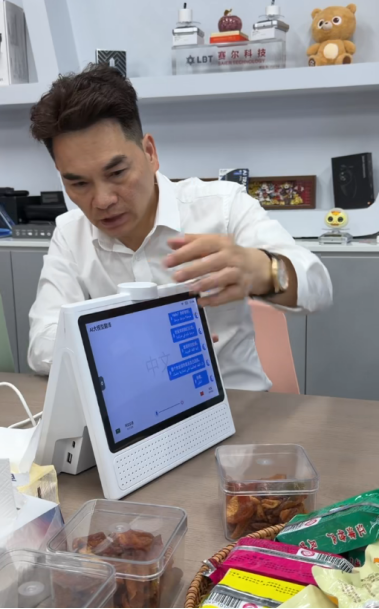
Zhang Jun showing us his company's translation software
Zhang Jun's story shows at least that the commercial tentacles of Yiwu merchants have extended beyond traditional small commodities. Zhang Jun also said that one core reason he is willing to develop in Yiwu is that first-hand information is available here—Yiwu merchants are often highly sensitive to market changes. They may not have a complete technology R&D team, nor necessarily mature manufacturing capabilities, but they know overseas markets, know what customers need, and can quickly find suppliers, organize production, and then ship products out through sales channels built over many years.
When profit margins on traditional goods come under pressure, finding new products and new tracks becomes an active choice for some merchants. For these foreign trade merchants, the customer resources, market experience and channel networks accumulated in the past may well become the starting point for entering new industries.
This also offers an angle for understanding the rapid growth of the added value of Yiwu's high-tech manufacturing. The local industrial structure is extending toward fields with higher technological content, and traditional foreign trade merchants have begun to become participants in emerging industries.
3
A Global Business Is Backed by What Kind of System?
Of course, finding new products and expanding new markets is only the first step in global business. For goods to move from the production end to overseas consumers, coordination is also needed in cross-border e-commerce, logistics, warehousing and compliance.
In Yiwu, behind goods moving from factories to overseas consumers, cross-border e-commerce platforms, logistics companies, supply chain service providers, payment institutions and government departments jointly form an increasingly complex foreign trade service system.
Data provided by the Yiwu Cross-border E-commerce Association shows that Yiwu currently has nearly 1.3 million e-commerce business entities and nearly 4,000 cross-border logistics companies. The association has about 370 member units and 13 professional committees covering platforms, supply chains, logistics, compliance and other fields, and conducts training for about 400,000 person-times each year.
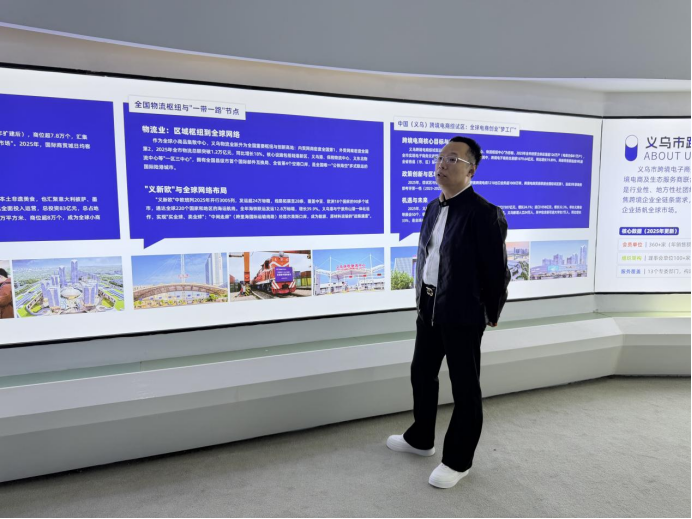
Huang Liang, executive secretary-general of the Yiwu Cross-border E-commerce Association
The association's role has gone beyond that of a traditional industry organization. It needs to connect enterprises scattered across different links, help merchants understand platform rules, expand overseas markets, solve logistics and compliance problems, and at the same time promote the integration of supply chain resources.
According to the association, its supply chain resources cover six provinces and can reach more than 90% of products. For Yiwu merchants, this means the scope for product selection and organizing supply is further expanded. Merchants do not have to place all production links locally in Yiwu; they can also rely on the association and its service network to find suitable suppliers over a wider area.
And once goods truly enter the cross-border logistics stage, efficiency and compliance become another battleground.
At the smart warehousing center of Tengxin Logistics, goods can already be managed through intelligent systems from warehousing and storage to sorting and outbound delivery. The warehouse covers about 12,000 square meters and has 41,200 container slots, 18 aisles and 6 loading docks. Through intelligent vertical warehouses and single-box-level management, the company can track the location and circulation status of each box of goods with greater precision.
The direct effect of this change is improved labor costs and operational efficiency. Tengxin Logistics said that after the intelligent upgrade, labor costs fell by about 60%, container-loading efficiency rose by 35%, and accuracy reached 100%. Work that originally required 60 people can now be completed by about 24, and some outbound links require only about 2 people.
Even though cross-border logistics is no longer just about moving goods from one place to another—because commodity exports involve multiple links such as destination country policies, product certification, customs supervision and transport safety, and a problem in any link may affect delivery—Tengxin Logistics has moved security inspection forward and uses systems for cargo management and compliance control, reducing uncertainty in the transport process as much as possible.
From the association integrating supply chains to logistics companies improving warehousing and transport efficiency, Yiwu has formed a foreign trade service network covering product selection, production, trading, warehousing, transport and compliance.
Against the backdrop of a complex international trade environment and constantly changing overseas market rules, the role of this service network is even more prominent. After all, for local small and medium-sized merchants, building a complete cross-border operating system on their own is very costly, while Yiwu's industrial agglomeration and specialized services can give them access to the global trade network at relatively low cost.
4
What Is Truly Valuable About Yiwu Is a Set of Organizational Capabilities for Global Business
The commercial vitality of a county-level city must ultimately be measured on the scorecard of global trade.
In the first nine months of 2026, Yiwu's total imports and exports reached 714.5 billion yuan, up 13.2% year on year, of which exports were 615.37 billion yuan, up 11.1%.
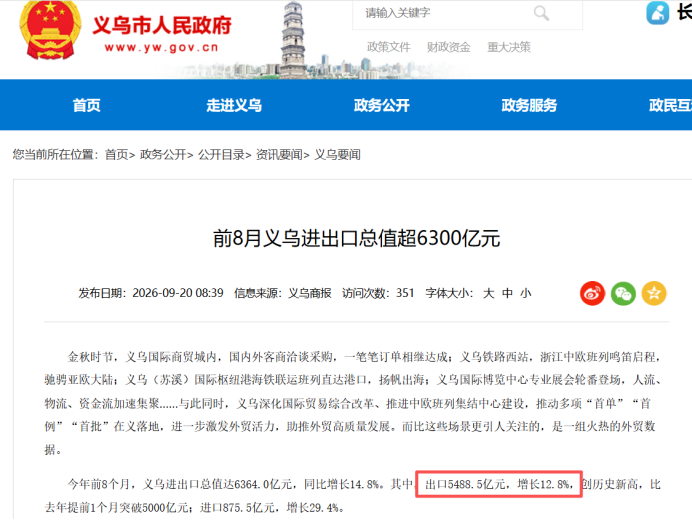
The export scale of Yiwu, a county-level city, can already be compared on the same scorecard with many major foreign trade cities in China.
More noteworthy is that Yiwu's foreign trade growth still maintains strong resilience. In the first nine months, Yiwu traded with 231 countries and regions around the world, 4 more than in the same period last year. Among them, imports and exports with Africa were 149.68 billion yuan, up 34.7% year on year; imports and exports with ASEAN were 106.02 billion yuan, up 46.8% year on year. The further expansion and rapid growth of market coverage show that Yiwu's global business continues to expand.
"With righteousness and affection, world Yiwu." This city slogan, seen everywhere, precisely captures the city's unique character. Here there is Chinese merchants' keen capture of global demand, and also a city's openness and vitality toward the world. From a small commodity to a global order, from a specialized market to a cross-border trade system, Yiwu has gradually done business in a broader world.
Such a Yiwu is worth more people approaching—and more people rediscovering.
*Disclaimer: The content of this article represents only the author's views. Markets carry risks, and investment requires caution. Under no circumstances does the information or any opinions expressed in this article constitute investment advice to anyone.
The Shenlan Finance new media cluster, originating from the Shenlan Finance reporter community, boasts a 16-year history and stands as a renowned domestic financial new media outlet. Its platforms concentrate on China's most valuable companies, frontier industry developments, and emerging regional economies, delivering valuable content to investors, listed company executives, and the middle class. We welcome you to follow us.
-
Agents Are "Redoing" Databases
-
![]()
SAIC and Audi: Building the Purest-Blooded AUDI Electric Cars
-
![]()
Yiwu Is on a Tear Again! GDP Grew 7.9% in the First Three Quarters, and Foreign Trade Is Still Surging
-
![]()
Driving Momentum in Atomic-Level Ultra-Precision Optical Manufacturing: Lingding Optics Secures New Round of Financing
-
![]()
Q3 Non-Recurring Net Profit Surges 686%, Yet Aopu Optoelectronics Burns Through 240 Million Yuan in First Three Quarters
-
![]()
One Person, 11 Labs: The "Pick-and-Shovel" Gold Rush of AI-Driven Science
-
Volkswagen Recalls 610,000 Vehicles as Profits Plunge 98.7%—Is There Still Hope?
-
![]()
Li Jiaqi Moves 2 Trillion Tokens: AI Starts Landing in Shopping Carts