AI Capital Investment Nears $300 Billion as Internet Giants Rush to Buy "Tickets to Cyber Immortality"
 11/08 2026
 554
Source | Source Media Hub
In early October this year, Li Lu — whom Charlie Munger called "China's Buffett" — delivered a speech at Columbia University that is still being discussed even now.
His view is that AI is no longer merely a productivity tool but is evolving along the "tool-to-creation" spectrum, possessing reasoning, programming, and collaboration capabilities — even touching on "recursive self-improvement" and "artificial gods" — and beginning to cross the threshold of the Turing test. Precisely because it may become powerful enough to reach the level of an "artificial god," human society will not let it go all the way: either the technology will not reach that point, or it will be jointly stopped.
This attitude — first affirming AI's revolutionary nature, then remaining cautious about its boundaries — is not an isolated case. Buffett and Duan Yongping have expressed similar views.
But in contrast to this caution, capital's pursuit of AI is almost frenzied.
On the same day, November 3, AI businesses under internet giants collectively brought new news. Kuaishou Technology's Kling AI had just completed the delivery of its latest round of financing, Tencent Hunyuan released Hyra 2.0, and due to reaching a cooperation with Apple, Alibaba's Hong Kong stock price surged.
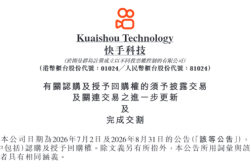
Among them, Kling AI had just completed its latest financing round, with a valuation of about 18 billion USD — even exceeding that of its parent company Kuaishou Technology.
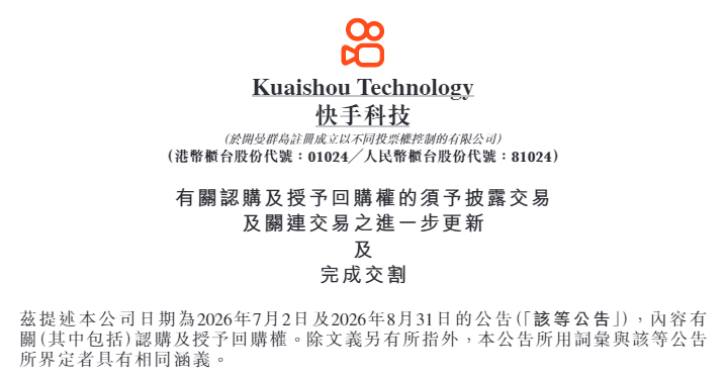
Image source: Kuaishou Hong Kong stock announcement
According to 21 Venture Capital data, from July 2025 to June 2026, a total of 3,297 financing deals occurred in the domestic AI and application field; among them, 1,595 occurred in the first half of this year alone, with disclosed total financing estimated at about 227 billion yuan.
Among them, internet companies are the most willing to invest heavily, even regarding AI as a second growth curve. Take Kling AI for example: three years ago, no one would have dared to price it this way. But in the current era where everything can be AI, it is clearly already commonplace.
What is truly worth pondering is not the contrast of Kling's valuation surpassing its parent company. It is only a microcosm of the internet AI narrative — when capital expenditure changes from expected investment to rigid expenditure, and from expense to survival tax, what exactly is the turning point measured by?
01.
Commercialization Fulfillment Is Accelerating
From the data perspective, Kling AI is rapidly becoming Kuaishou's second-curve business.
Financial reports show that in the first and second quarters of 2026, Kling AI achieved revenue exceeding 650 million yuan and exceeding 850 million yuan respectively, with year-on-year growth of over 300% and over 200% respectively; ARR rose from 100 million USD in the first quarter of 2025 to nearly 500 million USD in the first quarter of 2026, quadrupling in one year.

Image source: Kuaishou Technology 2026 interim report
The user and product sides are also expanding simultaneously. As of June, Kling AI's global users exceeded 100 million, enterprise customers approached 50,000, and in January this year its monthly active users reached 12 million; native 4K direct output, Kling 4.0's 30-second generation, and director-thinking prompts are rapidly advancing toward production tools.
Of course, looking only at revenue growth makes it difficult to fully understand Kuaishou's layout logic.
Kling AI's positioning is not to recreate another "Kuaishou" or "Douyin," but to embed itself into Kuaishou's most profitable commercial pipeline.
For Magnetic Engine advertising materials, Xingmang short drama storyboard previews, and e-commerce merchant product short videos, Kling AI's approach to entering these scenarios is very pragmatic: no forced promotion, no assigned tasks, but letting merchants calculate for themselves — using AI to generate materials in batches, comparing how much cost can be saved versus building an in-house shooting team, and comparing how much time can be shortened versus outsourcing shooting.
Kuaishou's investment layout logic is simple: it does not purely chase AI concept hype, but serves the content production needs of the ecosystem.
In its interim report, Kuaishou mentioned that with the launch of MCP and CLI interfaces, AI Agents can be supported in calling Kling AI, enabling batch video generation and automated creation links, and raising the production efficiency of professional content teams.
Its most essential difference from most AI startup projects: it does not rely on press conferences to tell stories, but takes root in the rigid demand for material production that millions of merchants in the Kuaishou ecosystem must bear day after day.
This may also be the reason Kuaishou is willing to continue betting heavily. In 2026, Kuaishou Group's overall capital expenditure is expected to reach 26 billion yuan, an increase of about 11 billion yuan over the previous year, with almost all of the increment invested in AI computing power.
Market institutions have also given long-term optimistic expectations.
Some research reports estimate that Kling's revenue is expected to grow from 1.1 billion yuan in 2025 to 39.6 billion yuan in 2030; during the same period, global monthly active users are expected to exceed 60 million, and the paid rate is expected to steadily rise to 20%.
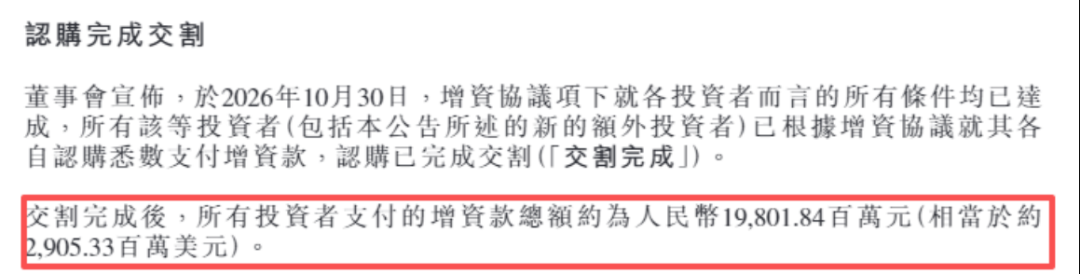
Image source: Kuaishou Technology Hong Kong stock announcement
Returning to this round of financing delivery, Kling AI completed a total capital increase of about 19.802 billion yuan (about 2.905 billion USD), setting the highest single-round financing record in the global video generation large model track. The capital market is using real money to cast a vote of confidence in this commercialization path.
02.
Path Divergence Under Giants' Heavy Bets
The story of heavy betting on AI is not unique to Kuaishou in the internet world.
Domestic internet AI capital expenditure is showing turning-point acceleration. Wind data shows that in the first half of 2026, the total AI capital investment of domestic internet giants is expected to be 270–300 billion yuan, with a year-on-year growth rate exceeding 90%. Among them, the AI capital expenditure of Alibaba, Tencent, and Baidu totaled about 196.6 billion yuan, nearly doubling year-on-year.
Internet giants are all making massive bets on AI, but each company has its own choices regarding where funds go and commercialization paths.
In Q2 this year, Tencent's capital expenditure increased 176% year-on-year to 52.78 billion yuan. The funds were not bet on a single C-end hit: Hunyuan maintained an iteration rhythm of once every two months; WorkBuddy accumulated 85.34 million monthly visits, and after merging with CodeBuddy exceeded 110 million; Yuanbao Search, relying on Tencent Cloud, is open to enterprises as an information foundation. Meanwhile, enterprise-end willingness to pay is significantly higher than on the C-end.
Tencent's approach is to first integrate AI into existing scenarios such as WeChat and enterprise services, and then gradually monetize.
On Alibaba's side, capital expenditure in the first quarter of fiscal year 2027 rose 75% year-on-year to 67.678 billion yuan. Alibaba had previously made clear that investment in cloud and AI infrastructure over the next three years will exceed the total of the past decade, with capital expenditure planned at over 380 billion yuan.
At the commercialization level, Alibaba Cloud's external revenue increased 45% year-on-year this quarter, hitting a new high in 22 quarters. AI cloud and computing power service revenue reached 48.437 billion yuan, adjusted EBITA was 5.628 billion yuan, up 133% year-on-year, and the profit margin rose to 12%. AI-related product revenue reached 12.376 billion yuan, achieving triple-digit growth for 12 consecutive quarters.
At that time, on Alibaba's earnings call, Alibaba CEO Wu Yongming said that Alibaba Cloud's return on investment in AI computing power is highly certain. Based on the average gross margin level of Alibaba Cloud's existing AI products, computing power investment is expected to pay back in three years, and after gross margin improves, it is expected to shorten to 2.5 years.
Previously, the industry consensus was that before 2030, there would be no very big change in the situation of AI computing power shortage.
ByteDance's AI layout relies on its own strong content distribution foundation. In September this year, Doubao had 419 million monthly active users and Jimeng 12.14 million; Seedance 2.5 achieved 30-second native video generation and supports up to 50 multimodal references.
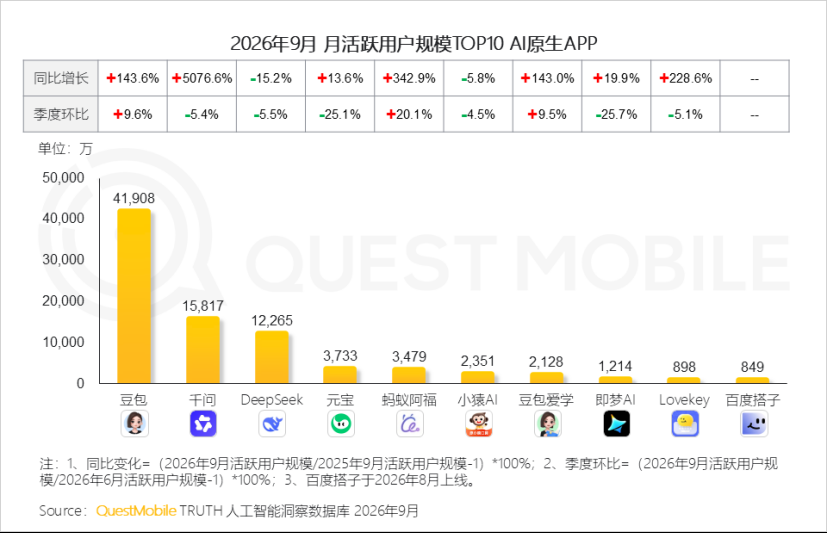
Image source: QuestMobile
Jianying, CapCut, and TikTok Symphony connect a closed loop from content generation to global distribution. Model capabilities are directly embedded into advertising materials, short dramas, and e-commerce content production, relying on huge distribution scenarios to digest high computing power costs.
On Baidu's side, total revenue in Q2 2026 was 31.3 billion yuan, general business revenue was 25.2 billion yuan, and AI business revenue accounted for 50%, exceeding half for two consecutive quarters. AI cloud infrastructure continued to grow rapidly, with GPU cloud business up 283% year-on-year, maintaining triple-digit growth for four consecutive quarters.
On the product side, ERNIE 5.1 released in May had a pretraining cost only 6% of competitors of the same scale, and its Agent capabilities benchmark the leading level; however, constrained by the growth bottleneck of its main search business, ERNIE still needs to prove a second enterprise payment curve beyond search.
The four giants' money goes in different directions, but the underlying consensus is highly consistent: AI has begun to enter real financial reporting items, being counted as cost and accounted as revenue.
The collective bets of the giants also keep prompting the market to ask: has the turning point for internet AI already arrived?
If profitability is used as the yardstick, the answer is clearly no. Looking overseas, the capital expenditure of the four major U.S. cloud vendors is projected to surge to 725 billion USD in 2026, and negative free cash flow is no longer an isolated phenomenon.
03.
Computing Power Investment Is Still a Long Run
What can be certain is that for some time in the future, global AI capital expenditure will continue to rise.
The latest forecast from Morgan Stanley CEO Ted Pick is that over the next decade, global AI capital expenditure may reach 10 trillion to 15 trillion USD. This is the technological wave with the strongest economic impact since the birth of the internet.
He estimates that over the next 7 to 12 years, leading cloud vendors will need to invest 800 billion to 1 trillion USD each year.
Converted on this basis, the current round of computing power infrastructure tide has not even completed the first half of the long cycle.
But huge investment ultimately needs revenue to support it. Another institution, Gartner, believes that by 2030, global AI data centers will need to cumulatively generate 8.5 trillion USD in revenue to cover all capital expenditure, while expected total revenue during the same period will not exceed 3.6 trillion USD. The gap truly exists.
For Kling, Goldman Sachs previously expected that Kling AI's ARR is expected to exceed 1 billion USD by the end of 2026. However, Goldman Sachs also flagged risks: subsequent growth is highly dependent on Kling model iteration and must continue to face competition directly from rivals such as Seedance and MiniMax.
But one clear change has already occurred: in the past, the market was keen to ask about AI's grand stories; now everyone prioritizes commercialization fulfillment capability.
In early July this year, Kuaishou officially announced the spin-off of Kling and the advancement of independent financing, with Tencent, Alibaba, and Baidu all participating, at a post-investment valuation of about 18 billion USD.
Kling also responded to the capital market's expectations with continuously rising revenue; the Q1 and Q2 results are the best proof.
In other words, the next competition is no longer about whose concept is more moving, but whose computing power costs can be digested faster by real, sustainable commercial scenarios.
The AI arms race is far from over, but the scale of the narrative has slowly shifted from imagination toward account settling.
Note: The article materials come from official reports and public information, and the views are for reference only | Some images come from the internet; if there is infringement, please notify us for deletion.
-
![]()
Hengtong Optic-Electric's Controlling Shareholder Plans ¥600 Million Stake Increase: Are AI Optical Communications and the Marine Economy Both Set to Boom?
-
![]()
AI Capital Investment Nears $300 Billion as Internet Giants Rush to Buy "Tickets to Cyber Immortality"
-
The Range-Extender Race Is Nearing Its End—Will Battery Swapping Be the Next Big Thing?
-
UCloud Expands Again in Ulanqab as AI Revenue Surpasses 40%, Accelerating Computing Power Layout
-
Avatr Spotted at a Battery Swap Station
-
Agents Are "Redoing" Databases
-
![]()
SAIC and Audi: Building the Purest-Blooded AUDI Electric Cars
-
![]()
Yiwu Is on a Tear Again! GDP Grew 7.9% in the First Three Quarters, and Foreign Trade Is Still Surging