The World's No. 1 "Stan" Country: Chinese Entrepreneurs Are Flocking In
 11/17 2026
 489
Author | Li Xiaotian
"It's really hard to rent an apartment near KazNU this year. Prices seem to have gone up in a lot of areas. I want to start looking at listings early, but I'm afraid I can't reserve that far in advance. If I wait until I land to look, I'm afraid I won't find anything suitable. And a lot of my classmates say renting will get even harder starting this semester. It feels like the cost of living in Almaty is getting higher and higher."
In September of this year, Leo, who came to study at Kazakhstan's top university, found that rental costs in Almaty, the country's economic center, had risen sharply.
His perception is not an isolated case. In fact, Kazakhstan, Central Asia's largest economy, is currently going through an economic upswing marked by rapidly soaring housing prices. According to data published by the Bureau of National Statistics (BNS) of the Agency for Strategic Planning and Reforms, in September 2026 compared with September 2025, rents for fully furnished housing in Kazakhstan rose by 16.7%, new home prices rose by 10.9%, and second-hand home prices rose by 7.9%. And throughout 2025, compared with the previous year, the pace of increase was equally striking.
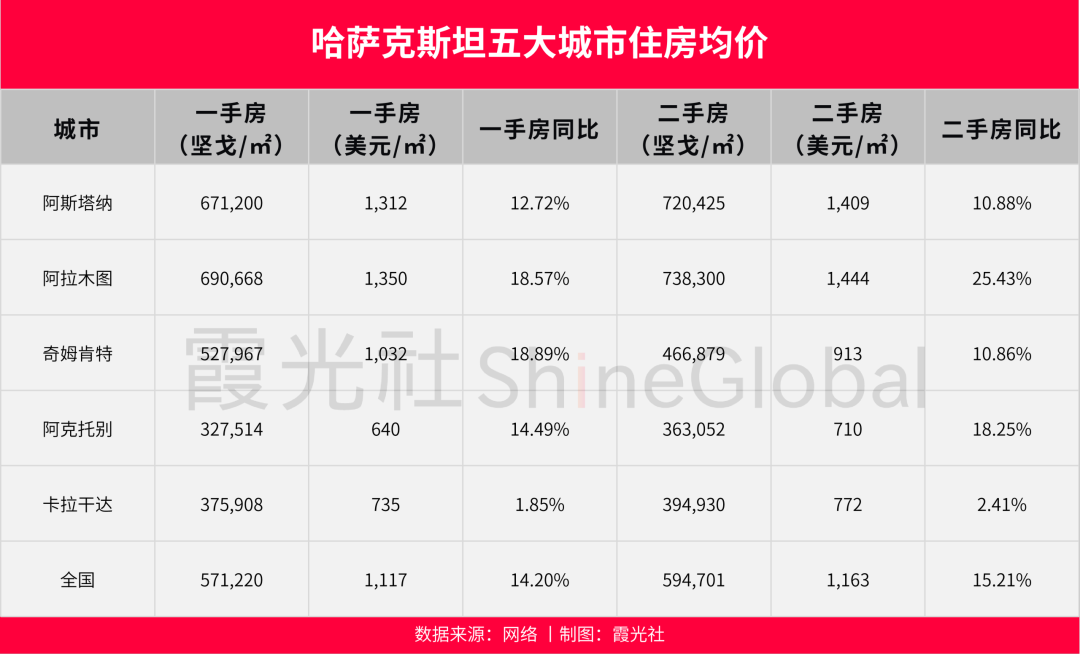
Housing prices are a barometer for observing a city's attractiveness and economic vitality. Just as in the early days of China's reform and opening-up, Beijing, Shanghai, Guangzhou, and Shenzhen witnessed rapid housing price growth due to industrial clustering and population influx; today, Central Asian countries represented by Kazakhstan are replicating such a moment.

Chinese people are pouring into Central Asia in large numbers, and more and more
Since the beginning of this year, Xiaguang Society has noticed that many friends in the going-global circle have gone to Central Asia to survey markets and visit enterprises. This wave is very much like the boom in 2023 when people going global flocked to Middle Eastern markets such as Saudi Arabia.
On the one hand, this is because geopolitical factors such as fluctuations in the Middle East situation at the beginning of this year have forced Chinese companies and brands to bet on the next new blue ocean; but fundamentally, it is the consumer vitality and going-global opportunities unleashed by Central Asia's own reform, opening-up, and economic transformation that have attracted Chinese going-global entrepreneurs in droves.
In Kazakhstan, Central Asia's largest economy, Chinese nationals are pouring in in large numbers. In 2025, the number of Chinese visitors to Kazakhstan increased by 46.8% year on year, surpassing 960,000 person-times.

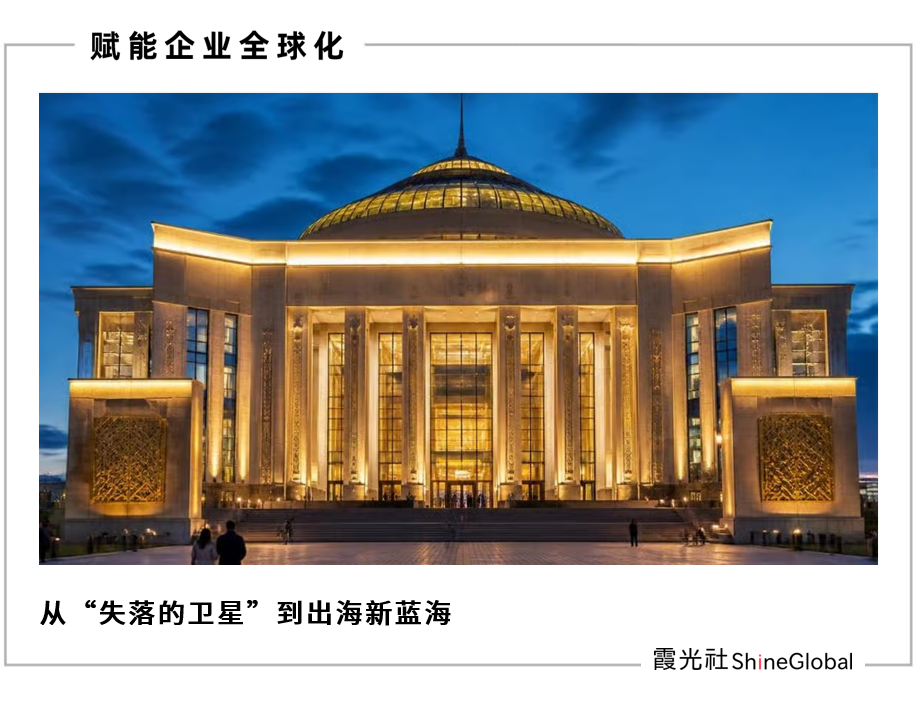
An aerial view of the Nur Alem Museum in Astana, the capital of Kazakhstan
Chinese-funded enterprises are expanding just as rapidly in Kazakhstan. In 2025 alone, 2,800 new ones were added, bringing the total number of Chinese-related legal entities to about 8,000; in terms of exports, Italy (19.8%) and China (19.2%) are almost tied for the top two, with Russia in third place at 10.3%; in terms of imports, Russia (29.7%) and China (29.2%) are evenly matched, while third-place Germany accounts for only 4.8%.
In terms of investment, Kazakhstan attracted a total of US$20.5 billion in foreign direct investment inflows in 2025, with the Netherlands, Russia, and China as the top three source countries. Of this, direct investment from China was US$2.8 billion, up 135% year on year; according to UNCTAD data, from 2021 to 2025, Kazakhstan was the country that absorbed the most greenfield investment in Chinese manufacturing worldwide, surpassing Vietnam, Mexico, Egypt, and the entire European Union.
Betting on multiple sides and actively opening up show that Kazakhstan is striving to transform itself from an oil country into a high-tech middle power that can still prosper in a complex and divided world.
Similar to Middle Eastern countries such as Saudi Arabia and the UAE, as a traditional oil country, Kazakhstan's path of economic diversification and institutional opening-up has always revolved around "escaping resource dependence," and each round of major reform has been related to external shocks: the collapse of the Soviet Union, the 2014 oil price crash, the 2022 "January Events" (in January 2022, the government's cancellation of subsidy policies led to a rise in liquefied gas prices, igniting unrest in the Mangystau Region in western Kazakhstan that eventually swept across most of the country. This unrest, later known as the "January Events," gave rise to large-scale comprehensive reforms called "New Kazakhstan".) and the Russia-Ukraine conflict. The levers of opening-up have also been gradually upgraded: from attracting foreign energy investment in the 1990s, to institutional opening-up such as joining the WTO in 2015 and building an international financial center, and now to the Middle Corridor, data centers, and AI infrastructure.
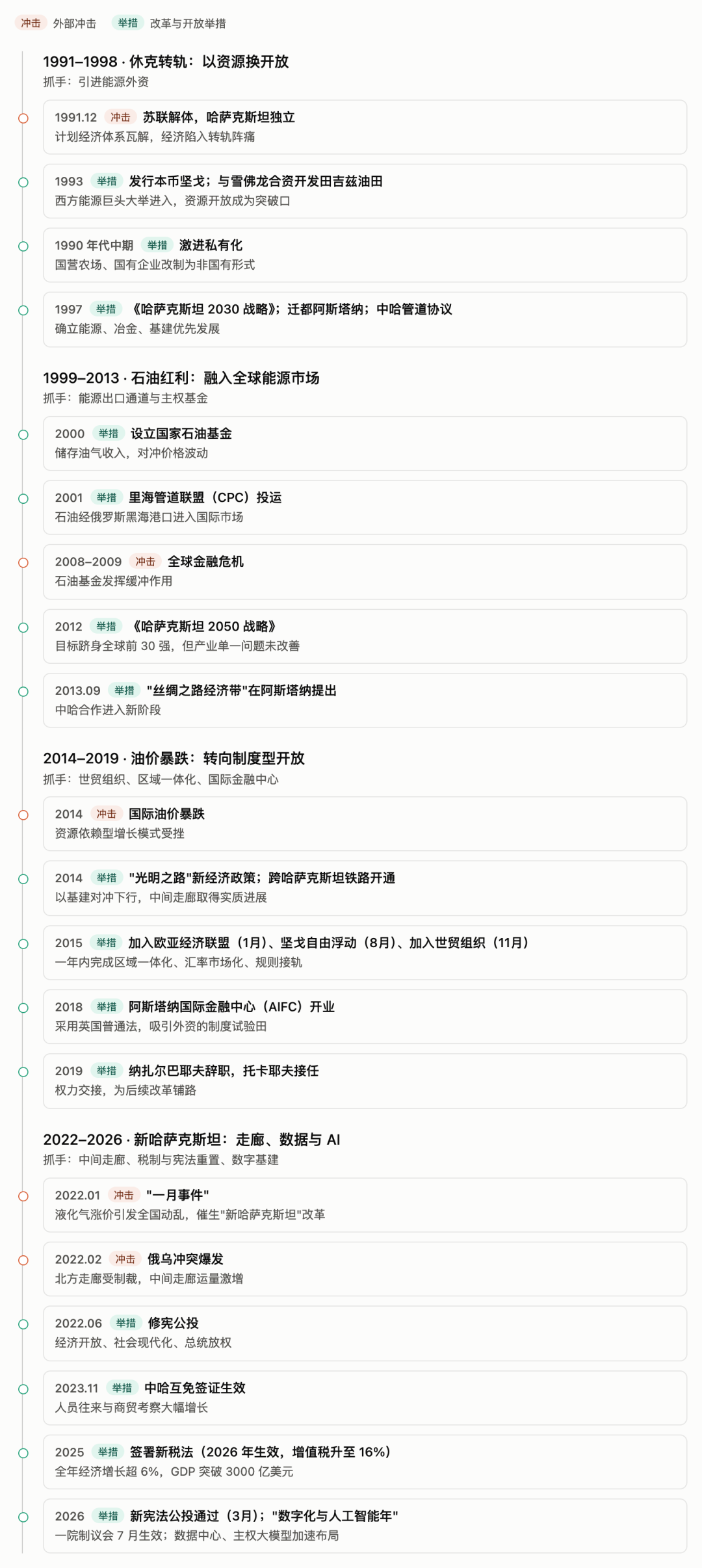
After the collapse of the Soviet Union in 1991 and the achievement of independence, Kazakhstan's path of economic transformation and opening-up
And Uzbekistan, the most populous country in Central Asia, is likewise experiencing a moment of economic transformation and opening-up.
Song Xin, an expert on going-global policy research, returned to Uzbekistan in August last year after 11 years. She felt very intuitively that compared with the isolation 11 years ago, Uzbekistan today is a transformed country, a thoroughly remade market, and from urban management to the business atmosphere, it has completed the historic initial transformation of reform and opening-up.
"The economy here is highly active. At 11 p.m. the roads are still brightly lit, and the city center is completely congested. It has a bit of the flavor of China in the late 1990s; behind the restless bustle is a longing for a better life."
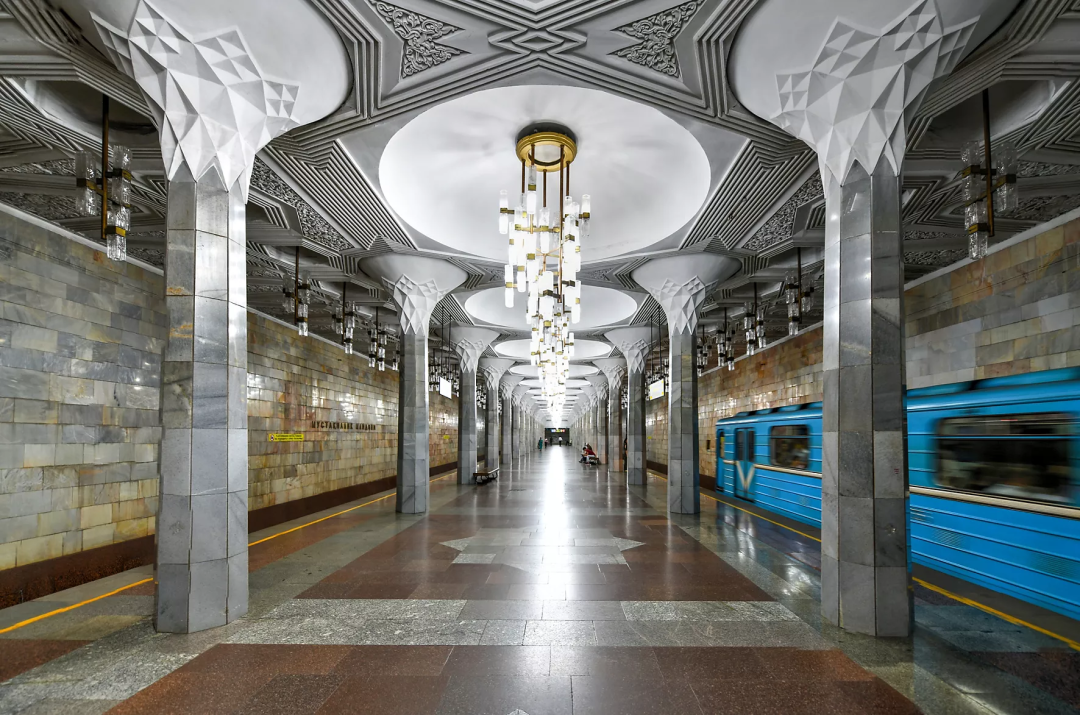
The subway in Tashkent, the capital of Uzbekistan
The driving force behind the transformation of the economic system and social landscape stems from the successive passing of the first-generation leaders of the Central Asian countries after their break from the former Soviet Union, which released room for reform for subsequent reformers.
Uzbekistan's second president, Mirziyoyev, who took office in 2016, is regarded as a bold reformer. By unifying the exchange rate, abolishing currency controls, and modernizing the financial system, he led this country—which had been effectively isolated from the world since 1991—to become one of the most open investment destinations in Central Asia.
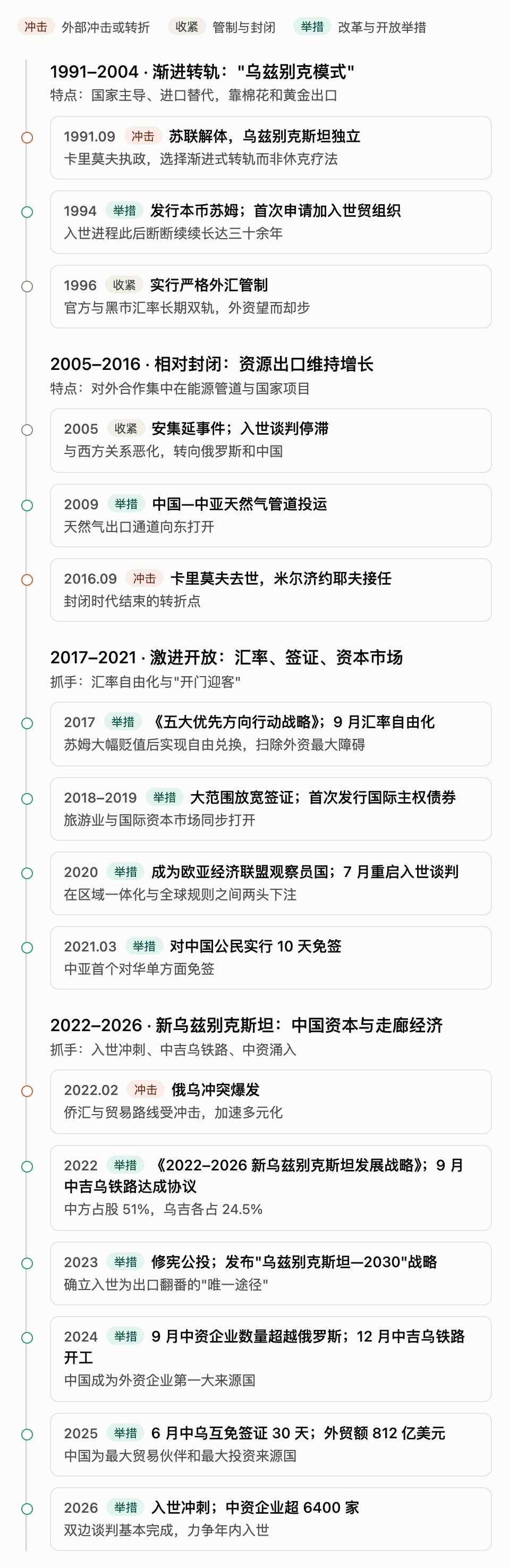
After the collapse of the Soviet Union in 1991 and the achievement of independence, Uzbekistan's path of economic transformation and opening-up
Data best illustrate the changes: from 2017 to 2025, Uzbekistan's population grew from about 32 million to more than 38 million, and the country's GDP grew from US$86.138 billion to more than US$145 billion; in 2025 the economy grew by 7.7%, the highest growth rate on record. According to World Bank and United Nations data, foreign direct investment (FDI) rose from US$2.3 billion in 2021 to US$4.4 billion in 2025; according to the World Bank's assessment system "Business Ready" (B-READY), in 2025 Uzbekistan scored 91 points in "Business Entry" (starting a business), placing it in the top 20% of the economies assessed; while in 2013 its business environment ranking was only 146th.
Chinese-funded enterprises also play a pivotal role in Uzbekistan's transformation. As of September 1, 2026, the number of enterprises with Chinese participation in Uzbekistan had increased to 6,436, about 1.8 times that of second-place Russia (3,589). In 2025, Uzbekistan received a total of US$43.1 billion in overseas investment, up 24% from the previous year; among this, China was the largest investor, contributing US$15.5 billion to Uzbekistan's economy, about 36% of the country's total foreign investment.
And Kyrgyzstan, a small landlocked country sandwiched between China and Kazakhstan, is being called Central Asia's "new tiger economy." This term is borrowed from the "Asian Tiger Cub economies," referring to economies with a low starting point that can nonetheless sustain high-speed growth for many years. According to the National Bank of Kyrgyzstan, the country's economy has maintained a growth rate of more than 9% for three consecutive years; preliminary data from the National Statistical Committee show that GDP grew by 11.1% in 2025, with a total volume close to 2 trillion som (about US$22.6 billion), a growth rate hitting a new high in recent years.

Street art in Bishkek, the capital of Kyrgyzstan
The boom in tourism and construction, rising domestic consumption, and the re-export of Chinese goods to neighboring countries are the main drivers of growth. Among them, the role of entrepôt trade is particularly prominent: after Western sanctions on Russia, Kyrgyzstan, by virtue of its status as a member of the Eurasian Economic Union, transships Chinese goods to Russia and surrounding markets, driving growth in warehousing, logistics, and fiscal revenue.
Even Turkmenistan, long known as the "North Korea of Central Asia," launched an electronic visa system in October this year, and tourist e-visas no longer require an invitation letter, which is seen as a positive signal of opening-up. You should know that in the past, this country, like North Korea, was one of the hardest countries in the world to obtain a visa for: no independent travel, no visa on arrival; one had to book a trip through a local travel agency and submit an invitation letter to the immigration authorities in order to obtain a tourist visa on arrival upon entry.
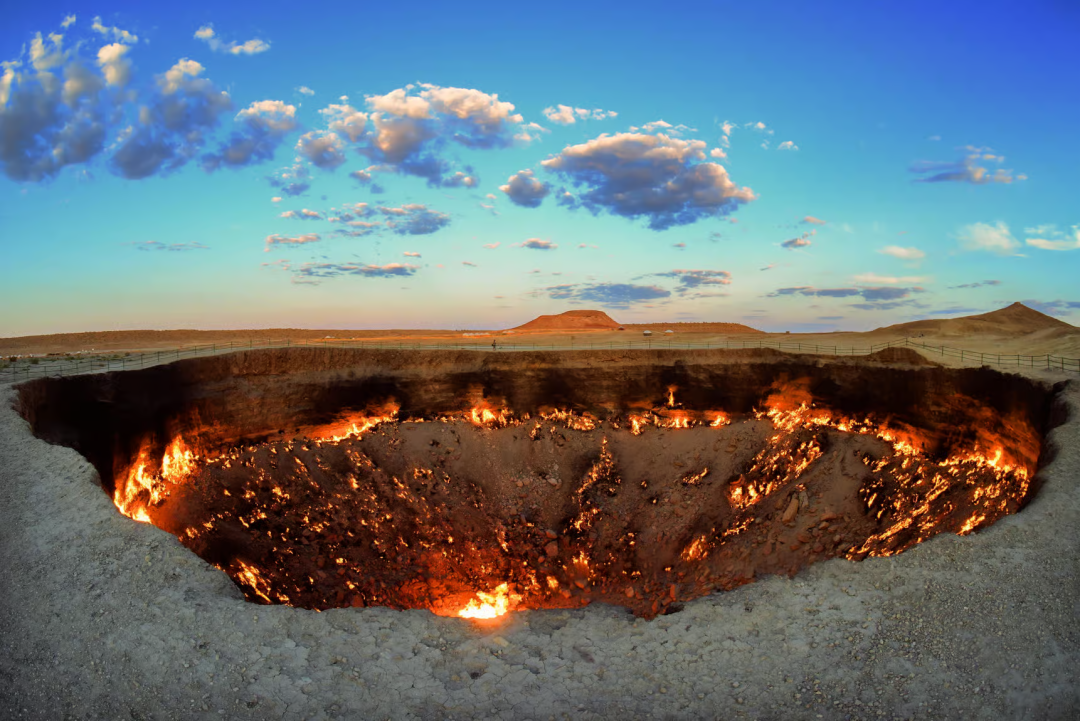
The Darvaza gas crater in Turkmenistan, known as the "Door to Hell"
The Central Asian version of the "Story of Spring," with its unique yet familiar melody, is helping Chinese going-global entrepreneurs find new resonance.

From the "Middle Corridor" to the target market
"Since Zhang Qian opened the way, all subsequent envoys called him the Marquis of Bowang."
The "Records of the Grand Historian: Account of Dayuan" thus records the history of Zhang Qian's mission to the Western Regions and the opening of the strategic Eurasian gateway.
From ancient times to the present, Central Asia has been regarded as the core hub running through both Europe and Asia. In 1997, the American strategist Brzezinski, in "The Grand Chessboard," proposed the concept of the "Eurasian Balkans," viewing Central Asia and the Caucasus as a power vacuum and energy corridor contested by great powers.
Whether this corridor across Eurasia can truly be opened is closely related to Central Asia's geopolitical value as a regional hub. As early as the beginning of this century, the "Middle Corridor," aimed at connecting Central Asia, the Caspian Sea, the Caucasus region with Europe and China, had already begun to be planned, but it was not until the opening of the Trans-Kazakhstan railway in 2014 that substantive progress was made. After the outbreak of the Russia-Ukraine conflict in 2022, the status of this corridor rose rapidly: it starts from western China, passes through Central Asia, crosses the Caspian Sea, then goes through Azerbaijan and Georgia to reach Turkey, and finally connects to Europe, covering more than 4,250 kilometers of railway and about 500 kilometers of sea routes, playing an increasingly important role in China-Europe trade.
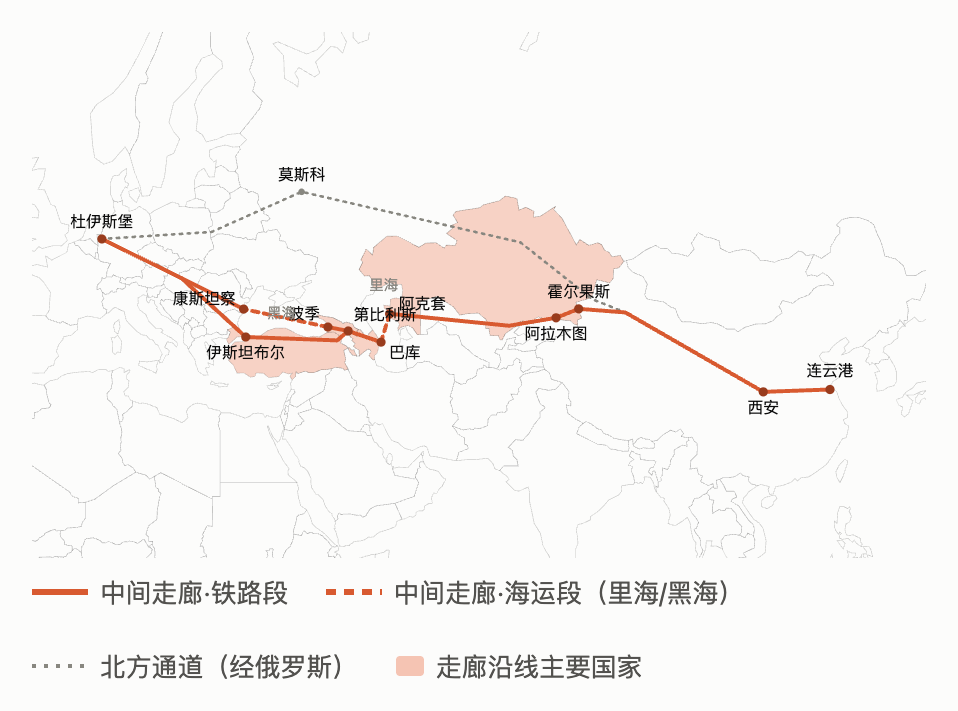
The main routes of the Middle Corridor
Compared with the "Northern Corridor" through Russia, China-Europe freight transport via the Middle Corridor can save an average of about 2,500 kilometers. From 2021 to 2022, the total traffic volume of the Middle Corridor surged from slightly more than 500,000 tons to more than 1.5 million tons; in 2025, this figure reached 4.12 million tons.
But today, the five Central Asian countries are not only a necessary passage for cross-border transport across Eurasia, but also a brand-new blue ocean for Chinese brands going global.
During her market survey in Uzbekistan, Song Xin observed that Central Asia is already full of Chinese brands: Leapmotor, BYD, Hongqi, XPeng, Li Auto, and NIO speeding past on the roads, Midea, Li-Ning, and MINISO stores seen everywhere, as well as subways and major infrastructure in which China participates—all demonstrate the determination of Chinese enterprises to pour in.

This scene of Chinese enterprises swarming in is, to a certain extent, thanks to the rapid growth of Central Asia's middle class and the ensuing wave of consumption upgrading.
According to International Monetary Fund (IMF) data, Kazakhstan's per capita GDP in 2025 was US$14,855, an increase of about 2.7% from US$14,459 in 2024, ranking first among post-Soviet countries and making it an upper-middle-income country.
Lin Xueping, a Chinese industry research expert, visited Kazakhstan in August this year for a market survey. He found that consumers here seem to have a bit of an "old money" attitude toward shopping: they would rather buy something a little more expensive and better, and then use it for many years. This preference for brands actually encourages companies to operate with a longer-term mindset. "For Chinese home appliance companies to achieve a major breakthrough in Central Asia, assembling through imported components is imperative. The traditional FOB model makes it very difficult to truly break the barriers of South Korean home appliances."
Lu Jie, a businessman who has been deeply engaged in foreign trade in Kazakhstan for three years, expressed a similar view to Xiaguang Society: "Kazakhstan is not backward. Neither its level of social civilization nor the way its people think is backward. What is backward is the outside world's stereotype of it."
Lu Jie added that local young people have a strong willingness to consume and are also accustomed to spending ahead of their means. For this reason, mainstream brands generally offer installment payments to drive sales of 3C digital products such as mobile phones and computers.
Song Xin also observed the growing rise of the middle class in Uzbekistan. "During our research in Tashkent, our most intuitive impression was that local middle-class consumption is highly active. Local restaurants costing 100-300 RMB per person are packed every night. BYD, Leapmotor, Zeekr, and Li Auto, with average prices of 350,000-600,000, are standard. High-end residences at 4k USD per square meter are rising in the city center."
Poverty reduction and middle-class expansion driven by economic development have indeed been the main theme since Uzbekistan's reform and opening up. According to a World Bank report, between 2021 and 2025, the country's poverty rate dropped from 17.0% to 5.8%, lifting 3.7 million people out of poverty. Uzbekistan is one of the countries with the largest poverty reduction among middle-income countries globally. At the same time, the country's middle class is growing rapidly, rising from 37% to more than 72% of the total population; however, prosperity growth across regions is uneven, and the expansion of the upper-middle class is mainly concentrated in the capital Tashkent and nearby areas.
On the other hand, the habit of spending ahead of one's means in Central Asia is also related to the persistently high inflation rates in many countries.
In 2025, Kazakhstan's annual inflation rate was 12.3%, the second-highest inflation year in the past decade (20.3% in 2022); public expectations are even more pessimistic: Kazakhstan's inflation expectation for the next year rose to 14.7%; in February 2026, the perceived annual inflation rate among the Uzbek public was 11.6%, while the official inflation rate that month was only 7.3% — when everyone defaults to the belief that money will continue to depreciate, they are more inclined to "buy early for a better deal."
Song Xin told Xiaguang Society that according to her field survey, in Uzbekistan's capital Tashkent, young people generally hold two jobs to cope with high inflation and only then can they earn a monthly salary of 600-700 USD, so seeking excitement and emotional release in life is a very obvious demand. However, the market currently does not yet have an abundant and high-quality supply of emotional consumer goods.
Olivia, the head of a foreign trade enterprise stationed in Uzbekistan, has been based in Central Asia for seven years. Olivia likewise believes that emotional consumer goods such as Pop Mart also have certain room in Uzbekistan. "Local young people's pursuit of beauty is very extreme. For example, getting nail art in Tashkent costs 100 USD, and rhinestone nail art costs more than 150 USD, but business is very good. Local beauty and body care service industries are all very expensive. Therefore, there will be strong demand for products such as press-on nails, home hair removal devices, and trendy beauty brands like Florasis."
Moreover, the growing consumer demand among women is also driving the consumer wave forward.

Women in Uzbekistan
In the World Bank's annual report "Women, Business and the Law" (WBL 2024) released in 2024, it assessed progress in gender equality in major economies around the world based on safety, mobility, workplace, pay, marriage, parenthood, childcare, entrepreneurship, assets, and pensions. Uzbekistan became one of the five countries with the greatest progress.
During her field survey, Song Xin found that consumer demand among women in Central Asia is particularly strong. Although Uzbekistan is an Islamic country, the social atmosphere is highly open and secular, so women have a very high degree of autonomy in choice. "Our local guide in Samarkand calls herself a 'part-time' Muslim and prays only during major festivals throughout the year, and there are quite a few people like this. From the refinement of their clothing, it is not difficult to see that they are full of positive and optimistic attitudes toward future life."
Olivia also added that because offline choices are too limited, women's consumer goods such as fast-moving fashion apparel also have considerable room for development online. "In local shopping malls in Uzbekistan, the women's clothing brands available are basically just four or five labels, among which one is Korean, one is Turkish, and the other three are all made in China, with relatively low-end fabrics and styles. Clothes from domestic wholesale clothing markets such as Shisanhang and Sijichun would be much better than these brands."

The lost satellite does not want to be lost again in the AI era
In August this year, when writer Zhou Kaili was traveling in Central Asia, she found that a local young tour guide who understood Chinese was holding a Chinese book — "The Lost Satellite: A Journey Deep into the Central Asian Continent." "Because the company's largest source of customers is currently Chinese, I want to see how Chinese writers write about Central Asia. It can also be regarded as a kind of market research to better serve the work."
"The lost satellite" seems to be a true metaphor for Central Asia's position in the global political and economic landscape for a long time: this is a land easily forgotten by the world. It has never lacked resources or history, yet on the margins of globalization and in the crevices between major powers, it is struggling to correct its own orbit.
Now, in the surging AI wave, the Central Asian countries do not want to be lost again.
According to the Kazakh government's grand vision for AI industry development, 2026 is the "Year of Digitalization and Artificial Intelligence." In June, Kazakh President Tokayev approved the "Digital Kazakhstan 2029" strategy, proposing to achieve 5 billion USD in AI product and service exports by 2029. Previously, it had passed Central Asia's first artificial intelligence law, established the Ministry of Artificial Intelligence and Digital Development, and built the national supercomputing platform Alem.cloud. At the same time, in order to realize the country's "national large model" strategy, the Institute of Smart Systems and Artificial Intelligence (ISSAI) under Nazarbayev University is developing a Kazakh-language large language model project — KAZ-LLM.
From the perspective of natural endowments, Kazakhstan has a vast territory and sparse population and is rich in energy, making it naturally a promised land for building data centers in the AI era. American AI cloud and infrastructure company Firebird signed an investment agreement with the Kazakh government in late October this year and has obtained US export permission for 45,000 Nvidia Grace Blackwell GPUs. The first phase of its first data center project in Kazakhstan is already under construction, while it is also cooperating with Kazakhtelecom and plans to launch commercially in the third quarter of 2027.
Uzbekistan is equally active. According to its Minister of Digital Technology, the country's data center investment commitments have exceeded 6 billion USD. The government's Nvidia computing cluster reached 90% utilization in its first month online; there are more than 100 AI projects nationwide, with plans to establish more than 20 AI laboratories in universities and build an Uzbek-language corpus to make up for the large models' shortcomings in local languages.
Unlike Kazakhstan's state-led model, Kyrgyzstan's artificial intelligence ecosystem has mainly developed through the efforts of startups, researchers, and the tech community. Although Kyrgyzstan has fewer financial resources and a smaller technology market, one of the most important achievements in AI industry development is the emergence of local-language artificial intelligence models. Startup AkylAI developed the first batch of AI systems designed specifically for the Kyrgyz language, filling the long-standing gap in global AI platforms' support for resource-scarce languages.

AkylAI, a Kyrgyz-language AI smart speaker
Another important initiative is AiRUN, a national-level artificial intelligence ecosystem that includes a large language model, a multilingual voice assistant, and a digital AI avatar capable of generating synchronized Kyrgyz speech and animation. In addition, Kyrgyzstan has launched the AI platform Aitil, which can provide services such as Kyrgyz speech recognition, text-to-speech, translation, document processing, and intelligent chat assistants. These projects show that artificial intelligence is not only being used for economic modernization, but also to expand the influence of the national language.
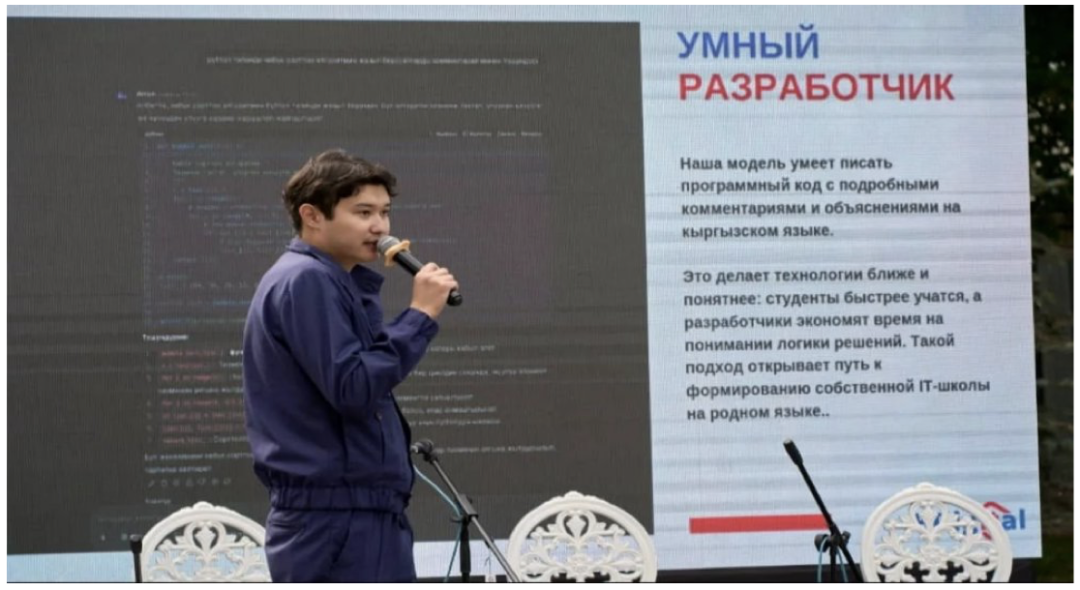
AiRUN, effectively the Kyrgyz-language version of GPT
Behind the AI ambitions of Central Asian countries lie overseas opportunities for Chinese enterprises.
However, when Chinese enterprises enter Central Asia, they do not take the path of "selling a general model," but rather customization and co-construction.
As early as August 2025, 01.AI, with Kai-Fu Lee as CEO, jointly released the Kazakh-language large model AlemLLM for the Central Asian region with the Kazakh government and established a joint venture Q.AI to operate the national AI platform. According to Kai-Fu Lee, 01.AI positions itself as "China's Palantir," no longer building foundation models, but fine-tuning existing Chinese open-source models (DeepSeek, Alibaba Tongyi Qianwen, Zhipu GLM) to provide customized model foundations for enterprises and governments.
In other words, Chinese open-source models are becoming the upstream foundation for Kazakhstan's sovereign models.
In the field of digital and intelligent infrastructure, Huawei participates in cloud infrastructure construction, and China Mobile is building Central Asia's first Tier IV standard data center in Astana; iFlytek launched the Central Asia site of its open platform in July this year, targeting Kazakhstan and Uzbekistan, focusing on knowledge base retrieval and code assistance; in the embodied intelligence track, Unitree's quadruped robots have been used for site inspections by BI Group, Kazakhstan's largest construction company, and Zhiyuan is also providing technical support for local robot platforms.
iFlytek summarizes this approach as "dislocation competition": not confronting American companies head-on, but winning through deep customization and high-quality service. For overseas enterprises, the opportunity also lies here: Central Asia has scarce local language resources, a weak computing foundation, and specific application needs, which are precisely where customization capabilities can be put to use.
As the AI supply chain moves toward bloc formation, Central Asia is also facing the awkward situation of being asked by the United States to "choose sides."
According to a Reuters report on August 14, the US State Department is drafting a letter to 35 countries, asking them to "choose sides" in AI competition. The recipient countries are exactly the 35 countries that signed the "Pax Silica" Declaration on Artificial Intelligence Opportunity in June this year. The draft warns that if these countries also join AI cooperation frameworks that conflict with the US position, they may be excluded from the US-led AI alliance. Although the letter does not name China, a US official said bluntly that the meaning of the letter is "you cannot choose both sides."
According to reports, the trigger for this letter was precisely Kazakhstan's choice to "stand on both sides." In June this year, the United States had just promoted Kazakhstan, which possesses rich reserves of critical minerals, as the first Central Asian country to join "Pax Silica." However, Kazakhstan subsequently joined WAICO (the World Artificial Intelligence Cooperation Organization established in Shanghai in July this year), which clearly touched Washington's red line. This letter is essentially a recruitment document for a "de-Chinaized" supply chain alliance, and the United States is trying to expand "Pax Silica" into an exclusive bloc.
As the digital iron curtain slowly descends, it can be foreseen that the China-US AI rivalry will become a focal issue that continuously rewrites the global geopolitical situation.
In this regard, Wang Yuquan, a global technology industry innovation expert, believes that in the global AI market outside the United States, a pattern of "China seven, America three" may emerge in the future. "The strength of Chinese AI companies is price. Most markets outside the United States are open markets. China has low costs and many industrialization scenarios, so the opportunities are great; but the weakness is standards and credibility. Our level of trust locally is still far from enough. It is not that Chinese people are bad, but that we are not familiar enough with them. But I firmly believe that several Chinese giants will emerge in the AI field, rapidly achieve global expansion, and even rival OpenAI and Anthropic, with core markets in Europe, Asia, Africa, and Latin America. By the application stage, the world will look more like China."
From the Anglo-Russian rivalry of the early 19th century to the "New Great Game" over Caspian oil, gas, and pipelines at the turn of the century, and on to the "Eurasian chessboard" described by Brzezinski in the post-Cold War era, every time Central Asia has captured the world's attention, it has been tied to major powers' strategic calculations regarding the Eurasian heartland. Now the cards have been reshuffled once again: as computing power, data centers, large models, and technical standards emerge as new sources of leverage, this land has once more taken center stage—drawing a growing number of Chinese enterprises with its distinctive appeal.
-
![]()
AR Anti-Reflection Coating: "Reduce Reflection, Increase Transmission" — But the Essence Is Systems Engineering
-
![]()
The Year Computing Power Was Tightest: Baidu's Full-Stack Bet Begins to Pay Off
-
![]()
Metalenz Acquires Israeli Startup PxE Imaging to Advance Optical Metasurface Technology
-
![]()
Business Focus: Optical Giant ams OSRAM Posts €829 Million in Q3 2026 Revenue
-
Jet Fuel Price Surge Inflates Costs, Net Profit Falls Over 20%; Spring Airlines Issues 10 Billion Yuan in Bonds to Fund 27.6 Billion Yuan Aircraft Purchase
-
![]()
A $5 Trillion Foreign Trade Hub Hosts a Landmark Gathering of Chinese and Global Titans
-
Baidu's AI Revenue Tops 50% for the First Time, Yet Shares Hit Record Low—Baidu Is Still Essentially Selling Computing Power
-
![]()
China's 6G Communications Breakthrough: Q/V-Band Experiment Hits 27Gbps, Setting New Domestic Record