Business Focus: Optical Giant ams OSRAM Posts €829 Million in Q3 2026 Revenue
 11/17 2026
 552
Optical giant ams OSRAM recently reported its Q3 2026 results, posting revenue of €829 million—up 3% quarter-on-quarter but down 3% year-on-year. Adjusted EBITDA came in at €135 million, a 19% decline year-on-year.
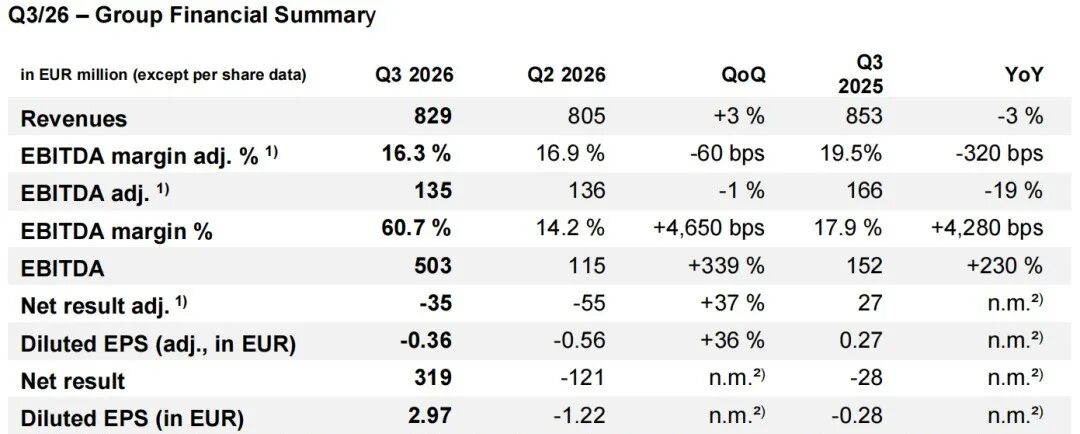
Yet the reported EBITDA margin reached as high as 60.7%, driven entirely by disposal gains from the sale of non-optical sensor businesses. What these figures really reveal is that an irreversible line has now been drawn between what the company chose to sell and what it is determined to keep.
Among the core businesses retained, the optical semiconductors (OS) division offers the clearest evidence of growth. Q3 OS revenue reached €399 million, up 9% year-on-year and 9% quarter-on-quarter, with the adjusted EBITDA margin recovering from 17.7% in Q2 to 19.2%.
The official financial report attributes this improvement to higher shipment volumes and better factory operations. A closer look at the end-market mix, however, shows that industrial and medical application revenue grew 12% year-on-year—or roughly 23% excluding changes in the business portfolio—pointing to a bottoming-out and recovery in industrial demand alongside a synchronized rebound in niche applications such as horticultural lighting and imaging displays. On the automotive side, growth was driven by gains in market share for existing platform products.
Yet the strength in optical semiconductors cannot mask the flat performance across the semiconductor business as a whole. Total semiconductor revenue stood at €625 million, up just 1% quarter-on-quarter and still down 2% year-on-year. The drag clearly comes from the consumer side: consumer application revenue fell 13% year-on-year, which the company directly attributes to weakness in the smartphone market.
Sluggish demand for smartphone optical sensing is nothing new, but it happens to hit the very battlefield where ams OSRAM finds it hardest to offset losses through product upgrades—consumer optical sensors involve large shipment volumes, are price-sensitive, and have short replacement cycles. No matter how strong incremental growth in industrial and automotive may be, it is difficult to fully bridge the gap left by the consumer side within a single quarter.
At CIOE in September, the company launched an imaging-and-display synergy solution for smartphones, integrating under-display spectral sensing, multi-channel ambient light sensing, and dToF sensing, and jointly demonstrated a prototype with vivo. The strategy is to raise per-device value through more highly integrated sensor combinations. However, the time lag between solution launch and mass shipment means the consumer business is likely to remain a headwind through 2026.
The variable truly worth examining over a longer cycle is AI optical interconnect. At ECOC 2026 in September, ams OSRAM showcased an 850nm thin-film microVCSEL platform, achieving error-free transmission at 32Gb/s with energy consumption of approximately 0.25 picojoules per bit and reliability validation exceeding 2,000 hours. The company also participated in the OCP standardization work led by Credo for short-reach micro-emitter optical interconnect, and its micro-emitter has been incorporated into Credo's active optical cable demonstration.
Whether this path can contribute meaningful revenue after 2027 depends on the pace of standardization implementation and the conversion speed of customer design-ins. But in Q3 at least, it moved from the roadmap to a technology milestone verifiable by third parties.
Repair on the balance sheet has already run ahead of the income statement. In March, the sale of the entertainment and industrial lighting business (ENI) to Ushio was completed for consideration of €114 million; in July, the sale of the non-optical analog/mixed-signal sensor business to Infineon was completed for cash consideration of €570 million. The two transactions brought in approximately €670 million in total. Q3 free cash flow thus reached €462 million, compared with only €43 million in the same period last year.
The cost is equally direct: the divested businesses no longer contribute profit, changes in the product portfolio dilute the margin, and the 19% year-on-year decline in adjusted EBITDA reflects this gap. Management maintains its expectation of turning free cash flow positive in 2027, with Q4 guidance of €750 million to €850 million in revenue and an adjusted EBITDA margin of 16.0% ±1.5%.
The current valuation narrative hinges on "how fast the retained parts can run." The sequential margin recovery of optical semiconductors and the depth of design wins provide supporting arguments. The sustainability of the industrial recovery, the pace at which automotive platform projects enter mass production, and the speed at which AI optical interconnect moves from technology validation to order landing together determine the company's true growth trajectory under the banner of "digital photonics."
-
![]()
AR Anti-Reflection Coating: "Reduce Reflection, Increase Transmission" — But the Essence Is Systems Engineering
-
![]()
The Year Computing Power Was Tightest: Baidu's Full-Stack Bet Begins to Pay Off
-
![]()
Metalenz Acquires Israeli Startup PxE Imaging to Advance Optical Metasurface Technology
-
![]()
Business Focus: Optical Giant ams OSRAM Posts €829 Million in Q3 2026 Revenue
-
Jet Fuel Price Surge Inflates Costs, Net Profit Falls Over 20%; Spring Airlines Issues 10 Billion Yuan in Bonds to Fund 27.6 Billion Yuan Aircraft Purchase
-
![]()
A $5 Trillion Foreign Trade Hub Hosts a Landmark Gathering of Chinese and Global Titans
-
Baidu's AI Revenue Tops 50% for the First Time, Yet Shares Hit Record Low—Baidu Is Still Essentially Selling Computing Power
-
![]()
China's 6G Communications Breakthrough: Q/V-Band Experiment Hits 27Gbps, Setting New Domestic Record