AR Anti-Reflection Coating: "Reduce Reflection, Increase Transmission" — But the Essence Is Systems Engineering
 11/17 2026
 357
Abstract: In "AR anti-reflection coating," AR stands for Anti-Reflection — not Augmented Reality. Anti-reflection for optical waveguides is far from simply applying a single layer of film.
Four layers of constraints — coating stack, coating process, reliability testing, and waveguide integration — are coupled with one another. Behind it all lies a complex optical systems engineering challenge.
When many people first encounter "AR anti-reflection coating," they easily confuse the term: here AR means Anti-Reflection — that is, anti-reflection — not Augmented Reality, which is what we commonly call augmented reality.
But on AR optical waveguide lenses, the two ARs happen to converge. With a high-refractive-index glass substrate, if no anti-reflection treatment is applied, single-side reflection alone will consume nearly 10% of the brightness entering the eye;
once the coating is poorly deposited, the image becomes dim and the viewing experience turns blurry, and after high-low temperature cycling, issues such as film peeling and blistering are also likely to occur. Reducing reflection and increasing transmission may look like a minor matter of a thin film, but real mass production presents a whole set of system-level challenges.
First system layer: coating stack design — not "one layer of film," but a set of refractive index steps
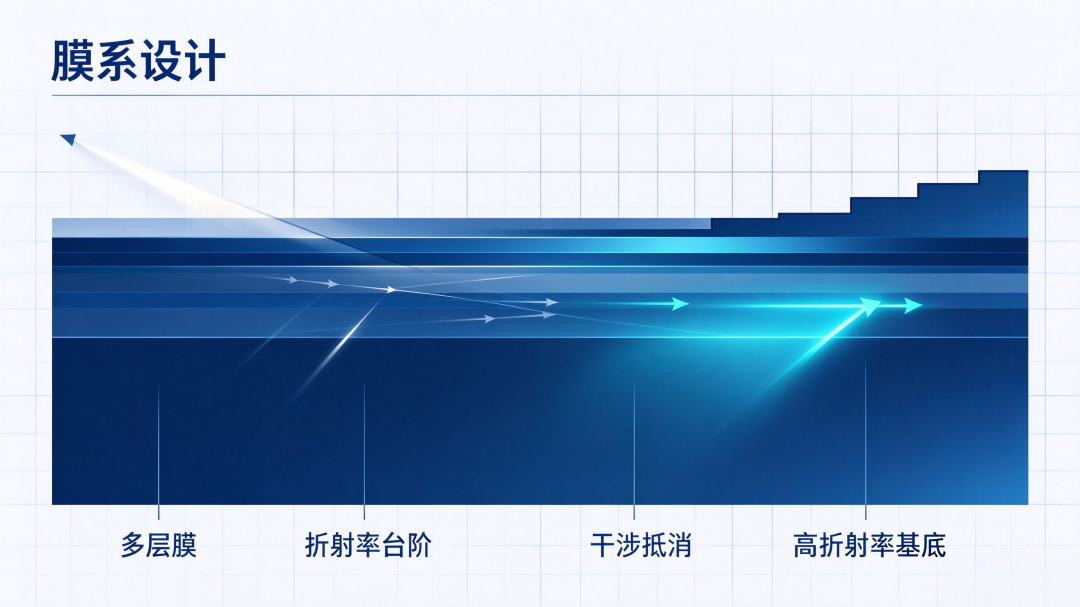
Many people assume anti-reflection coating is a single-layer thin film that cancels reflection through refractive index matching. In the ideal model, the refractive index of the thin film must exactly equal the geometric mean of the refractive indices of air and the substrate, but few materials can meet this value, and using them directly is almost impossible.
The mainstream broadband anti-reflection solution in the industry is a multilayer film formed by alternately stacking high- and low-refractive-index materials, relying on multi-beam interference to equivalently build a gentle refractive index transition.
In AR optical waveguide scenarios, the difficulty escalates immediately. The substrate is often high-refractive-index glass (n≈1.9), with single-side Fresnel reflection approaching 10%;
silicon carbide substrates (n≈2.6) are also used. With a silicon carbide substrate, single-side reflection jumps directly to more than 17%, placing far greater demands on the anti-reflection coating than ordinary glass.
The refractive index gap between air and the substrate is huge, requiring more film layers for compensation; the incident angle range of light received by the optical waveguide is very wide, and the coating stack must maintain low reflection at different angles; at the same time, it must also cover the complete visible light band.
Coating stack design is not simply a matter of selecting materials; it is essentially solving a multivariable constrained equation within a limited material library.
Second system layer: coating process — a thickness difference of a few nanometers makes a noticeable difference in performance
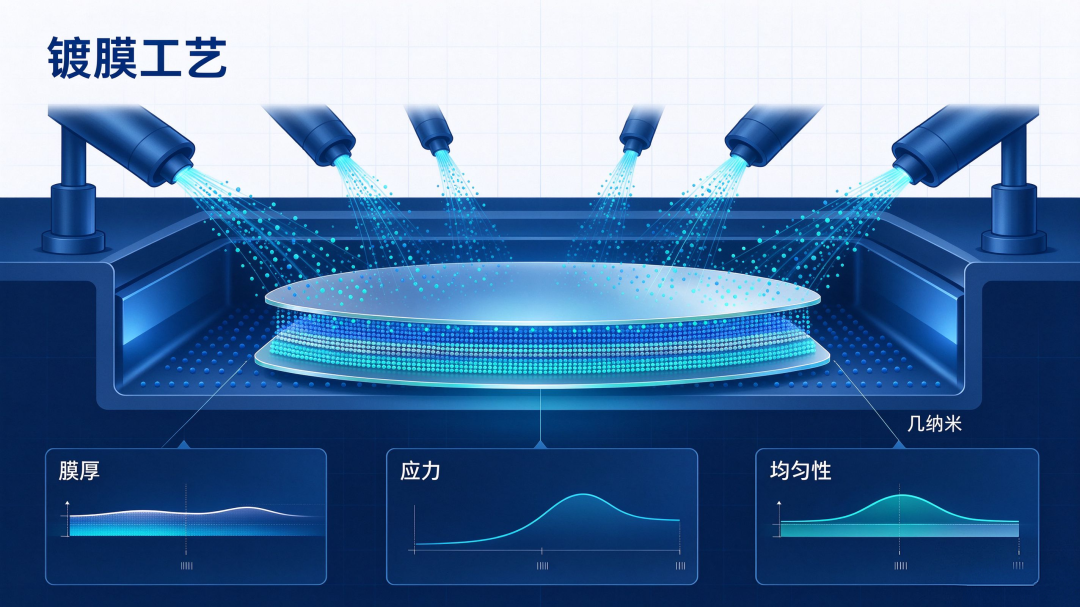
No matter how good the coating stack simulation result is, in the end it is only a design drawing. Whether it can be manufactured and produced stably is determined by the coating process.
Electron beam evaporation, magnetron sputtering, and ion-assisted deposition — films made by different process routes differ greatly in density, adhesion, and internal stress.
If the film thickness deviates by only a few nanometers, the interference cancellation condition shifts, and the anti-reflection effect drops sharply; if the film thickness across a large-size lens surface is uneven, the final image will show bright and dark patches; if film stress control is inadequate, lens warping and film cracking are very common defects.
Whether the anti-reflection coating can achieve "transmission" is not determined by simulation software, but deposited layer by layer by the coating machine.
The process window at this step is very narrow, with extremely high requirements for repeatability, and it is also one of the core links constraining yield in the mass production stage.
Third system layer: testing and reliability — cannot focus only on initial transmittance
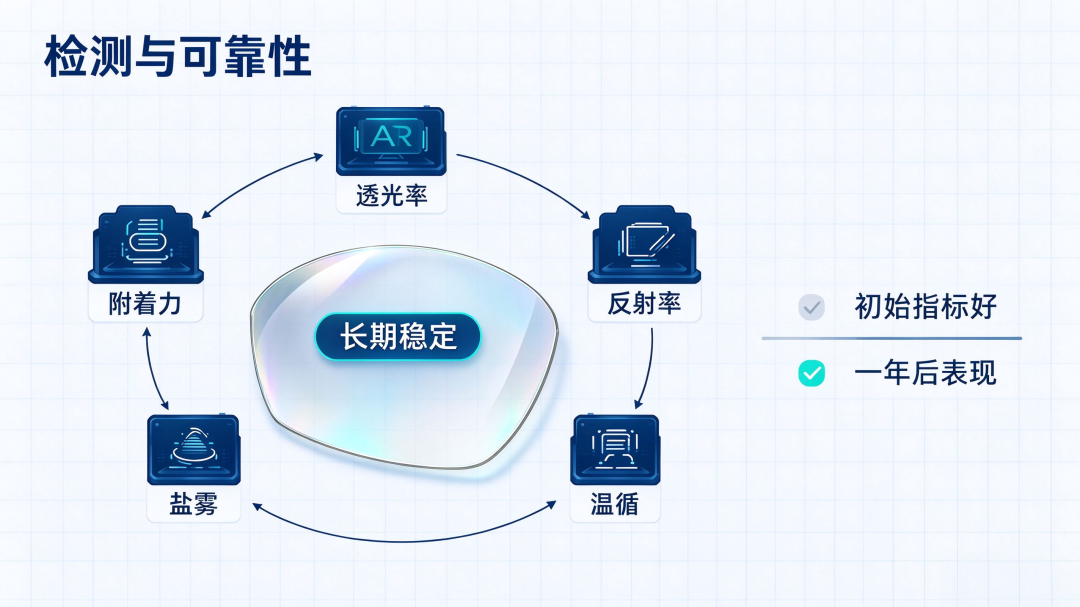
A lens that has just come off the coating machine may measure 99% transmittance, but that does not mean it can be directly delivered for end use.
AR glasses are consumer devices worn outdoors for long periods and must withstand a series of reliability tests such as high temperature and high humidity, thermal cycling, salt spray, abrasion and scratching, and adhesion.
Even if the transmittance looks good at the moment of shipment, after environmental aging the film may crack and adhesion may degrade — and the entire lens is directly scrapped.
Testing cannot be limited to the center point of the lens. Full-aperture transmittance uniformity, reflection spectra at different incidence angles, film stress, and cross-cut adhesion must all be included in closed-loop testing.
The "stability" of anti-reflection coating is not judged by the test data on the day of shipment, but by performance after the user has worn the device for a year.
Fourth system layer: integration with the waveguide — the film cannot concern itself only with transmittance
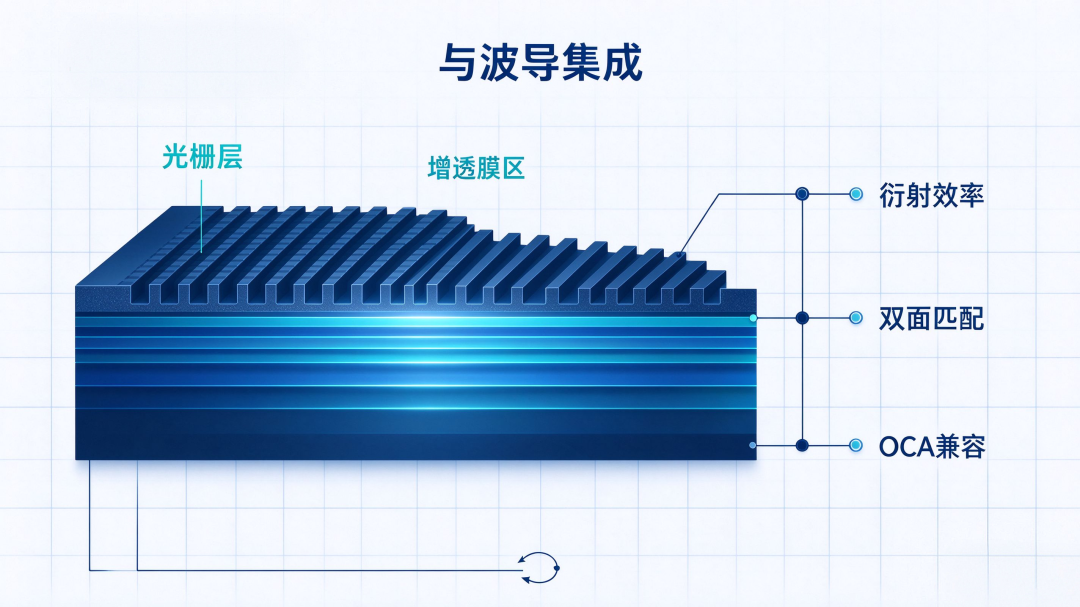
An optical waveguide lens is not the same as ordinary optical glass. The lens has gratings etched on it, dividing input coupling and output coupling regions, and subsequently cover plate bonding and refractive index matching are also required.
The anti-reflection coating can only be applied to non-grating regions and must not alter the optical response of the grating surface, avoiding deviation in diffraction efficiency; when coating both sides, the performance of the coating stacks on the two sides also needs to match each other;
high-temperature-resistant substrates such as silicon carbide offer better tolerance margin, but some waveguide structures cannot withstand high-temperature coating; if OCA optical adhesive is later used to bond the cover plate, the film surface must also be compatible with the adhesive layer to prevent bubbles and delamination.
The film exists because of the waveguide and cannot work independently; it must be compatible with every subsequent manufacturing process.
Why is it said that "the essence is systems engineering"? The four layers of logic stack up one by one: coating stack design sets the theoretical upper limit, coating process delivers the performance on paper, reliability testing safeguards long-term stability, and waveguide integration determines the final image quality.
If any link fails, the lens is a defective product. More critically, the four layers are not isolated from one another.
At the coating stack design stage, it is necessary to consider in advance whether the process can realize the design; process parameters directly affect reliability; and integration constraints such as gratings and bonding in turn limit the selection of the coating stack.
Anti-reflection coating has never been a simple coating step, but a system problem spanning materials, processes, testing, and structural integration.
Before concluding, we previously discussed that a single glass surface has about 8% reflection loss — losing 8% per piece, and ten pieces halve it: the winning factor of AR optics is hidden in nanoscale coating, and after multiple optical elements are stacked, transmittance will continue to be eroded by Fresnel reflection.
The value of anti-reflection coating is to play this game against the laws of physics. But this game cannot be won with only one layer of film.
Coating stack design, coating process, closed-loop testing, and waveguide integration — only through coordinated cooperation of these four layers can a stable and usable anti-reflection effect be achieved. On the surface, its role is only to "reduce reflection and increase transmission," but peeling back the appearance reveals that it is truly systems engineering.
Interactive topic: In your AR waveguide or optical lens project, what is the most difficult aspect of anti-reflection coating to control: coating stack design, coating uniformity, or environmental reliability? You are welcome to leave a message and share your experience.
[Risk note] Numerical values such as refractive index and reflection loss in this article are engineering reference values under typical operating conditions. Indicators vary under different substrates, coating stack solutions, and test conditions, and are not intended as product performance commitments.
—— AR Andy | Focused on optical waveguides and AR microdisplay tracks, deeply analyzing the underlying logic of the optical industry
-
![]()
AR Anti-Reflection Coating: "Reduce Reflection, Increase Transmission" — But the Essence Is Systems Engineering
-
![]()
The Year Computing Power Was Tightest: Baidu's Full-Stack Bet Begins to Pay Off
-
![]()
Metalenz Acquires Israeli Startup PxE Imaging to Advance Optical Metasurface Technology
-
![]()
Business Focus: Optical Giant ams OSRAM Posts €829 Million in Q3 2026 Revenue
-
Jet Fuel Price Surge Inflates Costs, Net Profit Falls Over 20%; Spring Airlines Issues 10 Billion Yuan in Bonds to Fund 27.6 Billion Yuan Aircraft Purchase
-
![]()
A $5 Trillion Foreign Trade Hub Hosts a Landmark Gathering of Chinese and Global Titans
-
Baidu's AI Revenue Tops 50% for the First Time, Yet Shares Hit Record Low—Baidu Is Still Essentially Selling Computing Power
-
![]()
China's 6G Communications Breakthrough: Q/V-Band Experiment Hits 27Gbps, Setting New Domestic Record