China's 6G Communications Breakthrough: Q/V-Band Experiment Hits 27Gbps, Setting New Domestic Record
 11/17 2026
 469
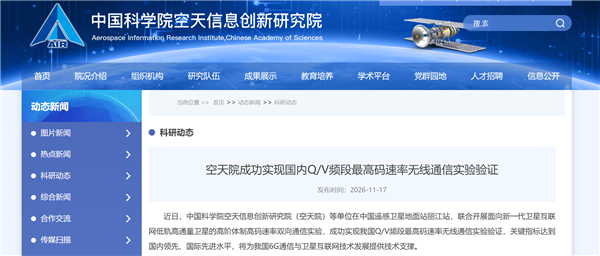
Fast Technology News, November 17 — According to the official website of the Aerospace Information Research Institute under the Chinese Academy of Sciences, the institute, in collaboration with multiple partners, recently completed a Q/V-band high-symbol-rate two-way communication experiment at the Lijiang station of China's Remote Sensing Satellite Ground Station, successfully demonstrating wireless communication at the highest symbol rate ever achieved in this band in China.
The experiment reached a maximum aggregate two-way communication rate of 27Gbps, setting a new domestic record for the Q/V band and placing its key technical indicators at a leading level domestically and an advanced level internationally.
The Q/V band is regarded as a key candidate frequency range for future 6G communications. With roughly 10GHz of available bandwidth and abundant spectrum resources, it represents one of the critical technical directions for enabling ultra-high-speed satellite communications.
However, millimeter-wave signals in this band are highly susceptible to impairments such as RF nonlinearity and phase noise, making high-speed, stable data transmission a significant technical challenge.
In this experiment, the research team overcame multiple key technical hurdles—including lightweight Q/V antennas, intelligent signal compensation, and phase noise compensation—and completed the verification using a full suite of independently developed equipment.
The experiment also marked China's first systematic test of multiple high-order modulation schemes, including 64QAM, 128QAM, 256QAM, and 512QAM, verifying communication transmission performance under each mode.
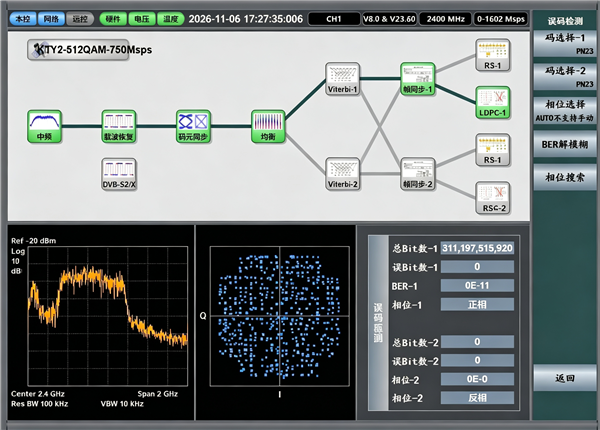
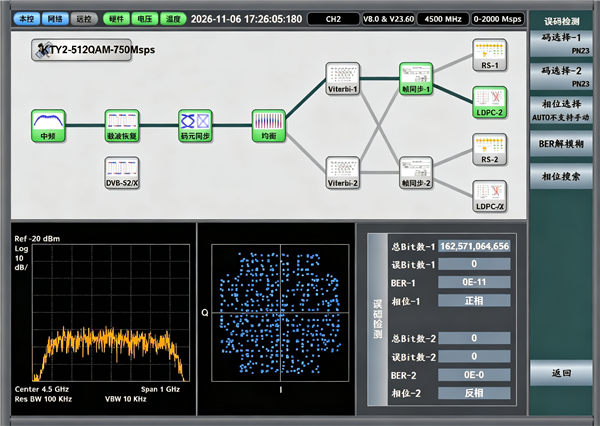
Under 512QAM modulation, the constellation diagram shows no noticeable distortion, and the bit error rate can be reduced to zero. (Top: uplink spectrum; bottom: downlink spectrum)
Test results show that, using 512QAM modulation, a single channel in the Q/V band achieved a maximum two-way transmission rate of 6.75Gbps—2.25 times the existing single-channel rate in the same band in China.
Building on this, the team combined dual-carrier and polarization multiplexing technologies to further raise the aggregate two-way rate to 27Gbps, setting a new domestic record for communication rate in this band.
It is worth noting that the 27Gbps figure represents the aggregate two-way rate achieved under experimental conditions—not the actual download speed that ordinary users would experience on a 6G network.
This breakthrough validates the engineering feasibility of high-order modulation and demodulation technology for Q/V-band communications and will provide important technical support for China's 6G space-air-ground integrated communications and the construction of a next-generation low-orbit high-throughput satellite internet.
Next, the research team will continue to improve the relevant technical indicators and aims to achieve a two-way communication transmission capacity exceeding 50Gbps.
-
![]()
AR Anti-Reflection Coating: "Reduce Reflection, Increase Transmission" — But the Essence Is Systems Engineering
-
![]()
The Year Computing Power Was Tightest: Baidu's Full-Stack Bet Begins to Pay Off
-
![]()
Metalenz Acquires Israeli Startup PxE Imaging to Advance Optical Metasurface Technology
-
![]()
Business Focus: Optical Giant ams OSRAM Posts €829 Million in Q3 2026 Revenue
-
Jet Fuel Price Surge Inflates Costs, Net Profit Falls Over 20%; Spring Airlines Issues 10 Billion Yuan in Bonds to Fund 27.6 Billion Yuan Aircraft Purchase
-
![]()
A $5 Trillion Foreign Trade Hub Hosts a Landmark Gathering of Chinese and Global Titans
-
Baidu's AI Revenue Tops 50% for the First Time, Yet Shares Hit Record Low—Baidu Is Still Essentially Selling Computing Power
-
![]()
China's 6G Communications Breakthrough: Q/V-Band Experiment Hits 27Gbps, Setting New Domestic Record