World Models Target Gaming: Be a Barbarian or a Worker?
 11/17 2026
 445
Editor: Lü Xinyi
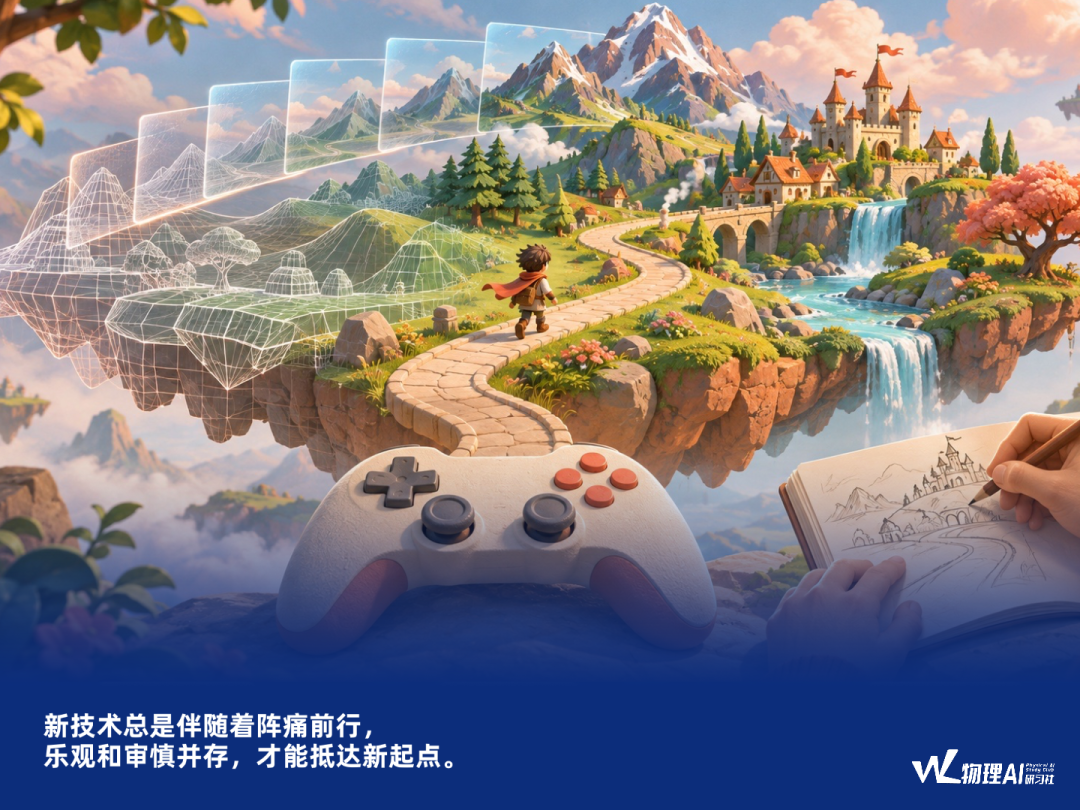
World models are standing on the doorstep of the gaming industry—and sometimes they already have one foot inside.
"A barbarian has arrived at the door," one game industry practitioner remarked.
At the beginning of the year, the emergence of Google Genie 3 was described as a "critical hit" to the gaming industry. By October, Genie 4 was released, but a similarly revolutionary narrative did not materialize this time. Not only did it fail to stir up much excitement in the gaming industry, but it also had to incorporate Gemini to maintain long-term temporal performance.
Players, too, did not offer the expected cheers for a "truly open world." Infinite maps, fully free-conversation NPCs, countless side quests—these descriptions that once ignited imaginations now seem more like unilateral promises from technology companies.
Such promises, when translated into technology, amount to repeated attacks. In September this year, PixVerse released the real-time world model PixVerse R2, turning video into a continuous, interactive, audiovisual integrated stream, and showcased the interactive film game Zero Mark developed based on the model; in October, VAST open-sourced the real-time generative renderer EdenLive, which can generate game visuals with richer details based on reference videos, target first frames, and prompts.
But now, the people inside the door, besides being vigilant, have also begun to calculate: what exactly can this barbarian do for them?
Major companies at home and abroad are vigorously advancing the reshaping of the AI ecosystem, including world models. From AAA titles to mobile games, the production side uses world models to generate scenes, assets, and so on; developers are also trying to integrate generative tools into the production of scenes, assets, and promotional content.
Rather than accepting a revolution from beginning to end, the industry side prefers to first see which links can be handed over to models and which work still needs to be kept in their own hands. And along with the expectation of speed and efficiency improvement, the work content and talent structure of practitioners have also begun to adjust.
Back to world models. Hot concepts, hot investment, hot industry... endless narratives have remained hot up to now, but from R&D to implementation, they face an industry with existing production processes, business rules, and aesthetic pursuits. Technology wants to change games, and the gaming industry is also selecting and transforming technology, deciding in what way to let it enter.
World models can "play" games, but the "gameplay" has also become more complex.
World models are still knocking on the door, but the gaming industry is no longer prepared to open it unconditionally.

World Models Have Arrived—What Have They Changed?
In games, when a player pushes open a door, in the past the scene behind the door was of course pre-made by the production team. Video-generated world models, on the one hand, can allow players, when pushing open the door, to generate new scenes in real time based on game progress, the player's previous decisions, and so on. Players can continue to explore and act in the new scenes, and the player's actions in turn constantly change subsequent scenes and stories. Models such as Google's Genie series are all putting effort in this direction.
On the other hand, when the player pushes open the door, the scene behind the door is still a pre-made product of the production team, but the team's production means and methods have already changed. Some game teams directly use content generated by video models as plot content, coordinating with player operations; some game developers use videos generated by models as production references.
No matter how it is done, they are all working on visuals, on assets and scenes, hoping to let players experience a more real and more diverse "world" through the creation of models.
Visuals are certainly important: from 2D to 3D, from the pixel-level graphics of the last century to today's AAA titles that restore reality to the extreme and even move toward XR to activate real-world experiences, game visuals need to be realistic, which calls for almost "no upper limit" investment, and also represents greater returns and stronger studio narratives.
But visuals are absolutely not the only thing.
What makes people willing to stay in a game world is also a world worth exploring, a group of characters people care about, and the resonance produced when participating in it. Such resonance requires planners to carefully organize the worldview, character settings, and gameplay mechanisms, so that characters' actions have credible motives, players' choices are meaningful, and people have reasons to keep playing.
Disco Elysium, with its million-word-level text volume and serious-literature-style narrative ability, is still on some lists as the best of all time seven years later; Balatro translates and updates classic card game mechanics, letting players discover that even old-fashioned playing cards are still addictive; Nintendo's game products have always been popular for a century with exquisite game mechanism design, emotional construction, and IP revitalization.
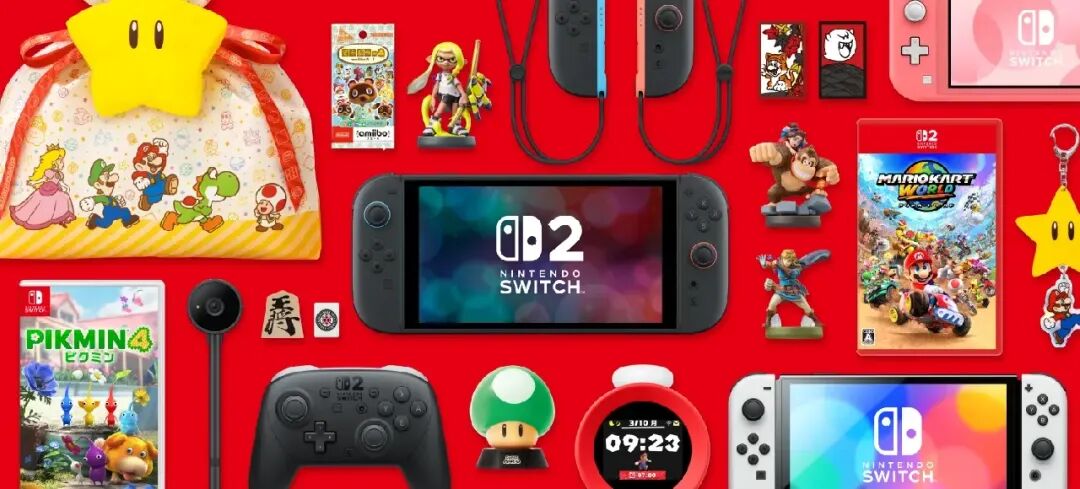
There are many similar examples. More realistic and more complex visual expression is not their signature skill, and their status in the gaming industry has not declined at all because of this.
VAST CTO Liang Ding recently said bluntly in an interview with industry media that "(letting game companies directly use our world model to make games) is not our starting point." Traditional games still sell fun content, and the game products players buy are always comprehensive experiences combining design, mechanics, narrative, character development, and even IP integration.

Back to video-generated world models. Of course, they can create new game mechanics and narrative experiences in generation and interaction, but the feedback game companies give us is more consistent: the world model itself is still something new, and at a time when its definition, prospects, and capabilities are not clear enough, using its technical features as the main selling point to develop games would probably not be a sufficiently rational decision for the industry side, especially for medium and large companies.
In addition to the characteristics of the gaming industry itself, the model itself has not yet flattened the threshold.
Long-term temporal stability is almost the lifeline of game mechanics, yet it is also one of the most prominent technical problems of video world models. Google officially admits that the "continuous" in Genie4's continuous interaction capability means "within a few minutes." When runtime lengthens, users continuously move in the scene, or continuously make multiple complex modifications, visual details and object existence may deviate. Memory consistency and error accumulation under long sequences are difficulties that almost all companies, such as Runway and leading domestic enterprises, emphasize.

Just after defeating the boss and collecting rewards, it stands up again a few minutes later; the area the player has explored—if they want to go back, the desert has become an ocean. If real-time generation were truly the only main gameplay, that game would probably be very hard to advance.
Of course, using assets generated by world models as material references to improve efficiency and quality is indeed already "routine work" for many production teams. However, a veteran player told us that AI-generated content is a relatively criticized presence on the game consumer side: "It neither respects art nor shows sincerity, and there are also copyright risks." "As soon as I see that AI generation is the main selling point, I don't want to spend money on such a lazy team." Therefore, some creators revealed, "We can only try our best to restore the generated assets into hand-made assets. There is a measurement of efficiency in between. Indeed, sometimes using models to generate is better, but sometimes it is faster to find ready-made ones in the game library and modify them."
It can be said that the content increment triggered by world models cannot at this stage be directly equated with an increase in the total value of game works. If models want to create value in the gaming industry, they must be organically combined with existing game production processes.

As far as the industry side is concerned, under the same wave, major game companies and small and medium teams do not feel the same, and the overall changes in the industry landscape are therefore more complex.
However, as long as costs can be reduced and efficiency improved, major companies are likely happy to see it happen.
According to public statistics, video generation models such as Jimeng and Kling rank among the top in AI keyword frequency statistics for major companies. Although they are not directly equivalent to world models, in terms of integrating generative tools into daily workflows, demand is mainly concentrated in related positions such as marketing art, design, and video user acquisition materials, providing a forward-looking effect for world models to be integrated into game production in terms of technical processes and efficiency improvement.
In addition to the production side, the industry's acceptance of models has also transmitted its impact to major companies' recruitment and staffing. In recruitment information on BOSS Zhipin, a leading company posted a "Multimodal World Model Algorithm Researcher" position with a monthly salary marked at 40,000–60,000 yuan, with AI models as the main work content, involving the R&D and implementation of core algorithms such as video generation, video prediction, and video editing.
Another leading game company posted an "AIGC Video Designer (Game CG/PV)" position with a monthly salary marked at 25,000–35,000 yuan, combining AI capabilities with production links and requiring familiarity with generation tools such as Stable Diffusion, Runway ML, and Pika for producing game CG and promotional videos.
On the consumer side, major companies already have huge player groups, highly popular IPs, and game series. AI tools, including world models, can reduce production costs while improving visual expression. Coupled with already popular themes, gameplay, and stories, from a macro perspective, the more technology develops, the stronger the empowerment, and the more significant the positive accumulation.
By comparison, the situation of small and medium teams is very different.
VAST founder Song Yachen once said bluntly that what they really want to do is "let everyone become a super creator." They believe that once the goal is achieved, the scale of the gaming industry can at least increase tenfold. By then, what games are, who plays games, who can make games, and how game practitioners make money from games... everything will change dramatically.
World models indeed represent a brand-new form of creation. Film-games are representatives of this new form. They use film-style visuals as the carrier and rely on model-driven operation, allowing players to influence characters, plot, and endings through dialogue choices and commands.
This is indeed a natural opportunity. Film and television practitioner Ximing wrote a doomsday zombie-themed film script Notes of the Survivors seven years ago, but before the AI era, a team of just a few people could not possibly have completed the production of such a work. In 2026, he adapted the script into an interactive film-game. A team of about six people worked for four months, mainly using models such as Seedance 2.0 to generate film and television content, and then integrated it into game mechanics and storylines. Currently, the game has an 88% "Very Positive" rating on the Steam store, and one player commented that it "broke my prejudice that AI film-games are crudely made."
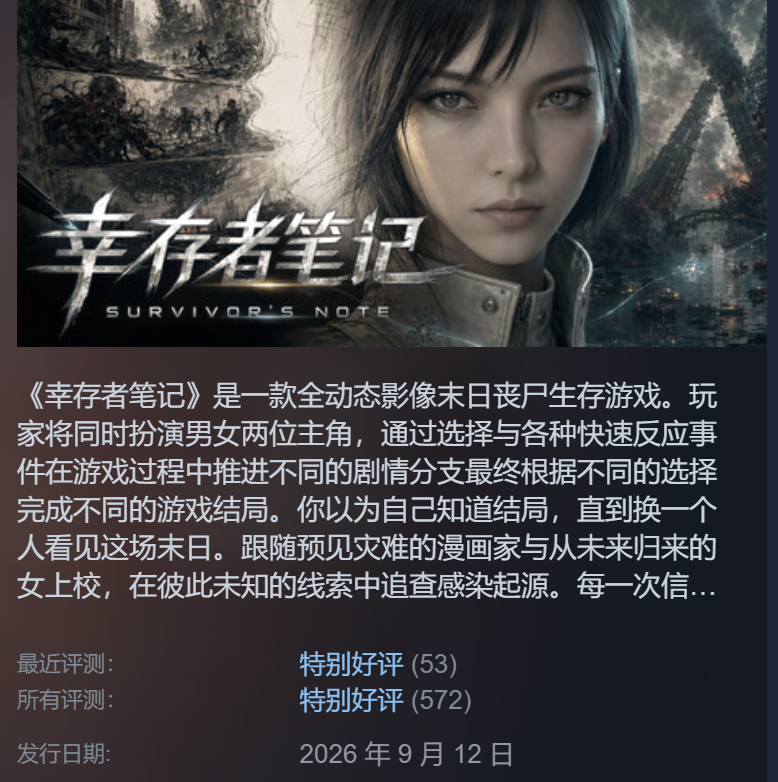
Ximing once said that he believes now is the era of technological equality, and he did not turn to film-games because "traditional film and television have fallen out of favor," but because he saw the technological breakthroughs of models and thought "the time has come." He and his team are relatively optimistic about the future of AI film-games: "Works with sales of millions of copies are not out of reach."
In addition, video generation models can significantly lower the entry threshold for game production. Moli works on motion effects at a major game company. She told us that "making the idea first and taking a look" is the biggest opportunity given to independent creators by the progress of model capabilities. "For example, if you have an art background but want to make a game, previously you could only first talk with development professionals and ask them to help verify whether it could be implemented. But now you can first use model tools to make a demo, and then talk with people using the demo, and the chances are much greater."
YF is an independent game creator. Her work The Uncovering is a text-narrative reasoning game, and the demo version is now available on Steam. As a former media practitioner, she does not have much game production experience, but thanks to the development of AI model capabilities, she can present more of her ideas and inspirations as a complete game product.

But she also told the Physical AI Research Society that the rapidly advancing model capabilities have brought a large number of people with ideas and talent into game creation, and "this track is also extremely competitive."
This raises the question of publishing and user acquisition. As it becomes easier and easier to build a small game on top of existing gameplay, a title polished over several months may still be buried under wave after wave of new releases—not to mention that attention itself is now the scarce resource. With short dramas, mobile games, AAA titles, and hot-IP games bombarding audiences nonstop, how big a slice of the cake a swarm of emerging indie games can carve out is really hard to say.
The same technological tool may mean, for major companies, a shift in direction or an empowered future; for small and medium teams, it may mean a from-zero-to-one pioneering opportunity—or a market-cultivation grind in which they must keep hunting for traffic entry points and player stickiness.
Of course, how products and projects proceed is a calculation that teams and enterprises have to make. For each individual practitioner, whether or not models are used, the AI era will arrive regardless. So how will the work at hand change? And what will they rely on to make money?

Hand a static draft and a few useful prompts to the model, and the motion effect appears before your eyes.
Moli's daily workflow has already begun to move in this direction. But generating a first version quickly does not mean getting it to a usable state is also quick. Before formal delivery, Moli still has to refine the motion-effect trigger actions and interface coordination logic, and align her design with work in other links. Moli told us that occasionally, when repeated adjustments slow down overall efficiency, it would actually be faster for her to do it herself.
Although her team has not set hard targets such as AI utilization rates, she has noticed that some design practitioners around her who initially resisted AI have begun to accept and use AI tools under delivery pressure.
This shift has also made its way into job postings. Public data once tallied 7,372 open positions at 13 companies including Tencent, NetEase, and miHoYo, of which 1,076 involve AI. Judging by job descriptions, more than half of AI-related positions are still traditional functions such as art, programming, and design—just with added requirements to use AI.
For workers in these positions, the original professional skills and delivery responsibilities remain, but learning model tools, judging generated results, and then revising them until usable have also become skills that must be mastered. The extra skill listed in job requirements has thus become a process of relearning and adapting in daily work.
But some have also noticed a common weakness: big companies may not fully know what they actually want. Some media have observed that the rapid iteration of AI technology also keeps changing game companies' talent needs: the work content of some related positions is not yet clear, and talent evaluation standards are still being explored.
For example, one company recruiting an "AI intern" only requires proficiency with mainstream AI tools such as Midjourney and Jimeng and editing software, with the rest being "passion, aesthetic sense, and learning ability." What the job specifically entails is not made clear in the description.
At outsourcing companies, the same efficiency expectations are written directly into prices. An industry media outlet recently visited Chengdu's art outsourcing industry. A business staff member responsible for client liaison said that a leading company once handed AI-generated rough models to a supplier, hoping to compress a work order originally estimated at 10 person-days to 5 person-days. The supplier eventually compromised, and the order actually took 7 days. Sometimes the client uses AI to produce reference images of an object's front, side, and back, but the structure does not match up, and modelers still have to spend time sorting it out themselves.

It looks like the production stage has cut costs and improved efficiency, but the actual work has instead become more complex and labor-intensive.
Orders are also being re-split. In the same report, the producer at Zhouchuan Studio said they now hand core action design to outsourcing teams, then use AI to assist with frame interpolation, splitting work that used to be sent out all at once. Another supplier received a commission to use AI to produce game marketing videos. Some production stages have been taken back by clients, while some new demands flow to suppliers. Image, 3D, and video generation tools are rapidly affecting game production stages, repricing different labor contents and labor parties—but have ordinary practitioners benefited? Hard to say.
For independent creators, the production threshold has been lowered, but the labor process has not been reduced much. 《 Survivor's Notes 》 used model tools to produce a volume of footage that a small team could hardly afford in the past, but they suffered through face distortion, generation time consumption, and repeated revisions. Ximing told Game Top that during the months of formal production, five video producers worked more than 12 hours a day.
Even if it is made, whether the ROI can be justified is still unknown. The interactive film-game 《 Evil school games 》 was released on Steam on August 14 and received a 93% positive review rate, but six days later the production team announced its dissolution. The reason is that similar interactive film-games crowded onto the market, but the market size and user base of the interactive film-game track are limited. The team estimated that even including subsequent long-term special sales and discount sales, the book loss could reach about 5.5 million yuan.

At the beginning of the announcement, the producer directly declared: "Almost all interactive film-games are losing money. Works that can earn decent profits can actually be counted on one hand (I mean one hand, not two hands)."
Models will also keep updating. Features that require repeated debugging today may become an automated button tomorrow. For game practitioners, familiarity with a tool can bring immediate opportunities, but longer-term accumulation still has to be placed in understanding the game itself. Whether the visuals are generated or hand-made, where to place them, what function to achieve, and what emotion to evoke—these judgments are the practitioner's real skill. They come both from long-term project experience and from understanding players and the industry.
Production methods keep changing in countless ways, but people and the accumulation of experience will continue to grow over the long term.
Of course, this also requires companies to leave room for people to accumulate. If all the time saved turns into tighter schedules, and the staff freed up only means fewer positions, practitioners will hardly have the energy to try new creations. At least part of the efficiency brought by technology should allow the people who make games to spend their effort on the work itself.
Conclusion
Games have come this far, and creators have always strived to turn literary narrative, cinematic rules, and artistic imagination into experiences players can personally participate in. As video-generated world models enter the game industry, they too must pass this test.
Right now, big companies can use generative tools to transform existing production processes, and small teams can also try projects they could not afford in the past. As for who bears rework, who is responsible for delivery, and who bears sales risk, these accounts also need to be recalculated.
Video-generated world models have given producers new ways to build the world behind the door of games faster and better. But players still need to be willing to push that door open, and the tens of millions of practitioners in this industry also need to receive the rewards they deserve for their creation and labor.
-
![]()
AR Anti-Reflection Coating: "Reduce Reflection, Increase Transmission" — But the Essence Is Systems Engineering
-
![]()
The Year Computing Power Was Tightest: Baidu's Full-Stack Bet Begins to Pay Off
-
![]()
Metalenz Acquires Israeli Startup PxE Imaging to Advance Optical Metasurface Technology
-
![]()
Business Focus: Optical Giant ams OSRAM Posts €829 Million in Q3 2026 Revenue
-
Jet Fuel Price Surge Inflates Costs, Net Profit Falls Over 20%; Spring Airlines Issues 10 Billion Yuan in Bonds to Fund 27.6 Billion Yuan Aircraft Purchase
-
![]()
A $5 Trillion Foreign Trade Hub Hosts a Landmark Gathering of Chinese and Global Titans
-
Baidu's AI Revenue Tops 50% for the First Time, Yet Shares Hit Record Low—Baidu Is Still Essentially Selling Computing Power
-
![]()
China's 6G Communications Breakthrough: Q/V-Band Experiment Hits 27Gbps, Setting New Domestic Record