MiniMax Has Shed Over HK$360 Billion in Eight Months—and It's Not Revenue That's Falling
 11/17 2026
 475
On November 16, MiniMax (00100.HK) took a sharp hit. The stock tumbled more than 15% intraday and was down 13.95% by the midday break. Selling pressure persisted into the afternoon, and the decline widened to 18.04% by the close, leaving the shares at HK$124.9. The stock touched an intraday low of HK$124.4, and its total market capitalization shrank to HK$44.025 billion on the day.
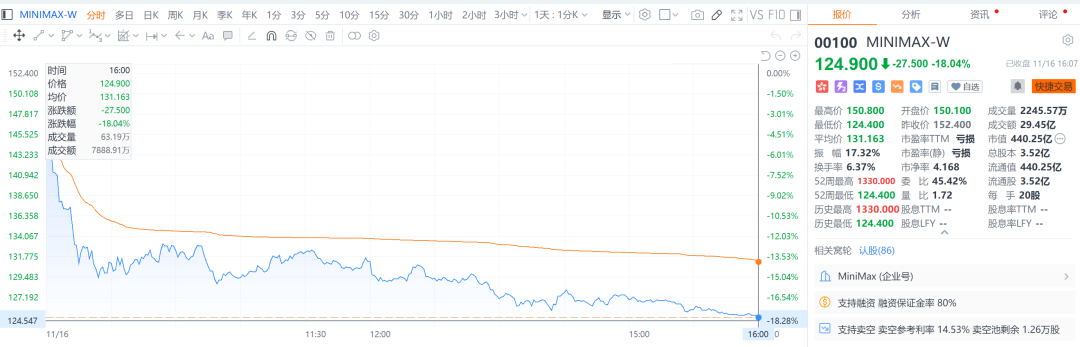
Back in March, MiniMax peaked at HK$1,330, with a market capitalization north of HK$410 billion. Eight months later, more than HK$360 billion of that value is gone.
In the first half of the year, MiniMax's revenue jumped 283.1% year-on-year. Revenue is climbing; the share price is not.
MiniMax listed on January 9 at an issue price of HK$165. The stock rose 109% on its first day, pushing its market capitalization past HK$105 billion. By March it had surged to HK$1,330, with a market value exceeding HK$410 billion.
At the time, the Hong Kong market had only two pure-play large-model companies—MiniMax and Zhipu—and that scarcity propped up valuations.
The IPO was the first fundraising round. MiniMax issued 25.39 million shares, raising HK$4.189 billion. Fourteen cornerstone investors subscribed US$350 million, including the Abu Dhabi Investment Authority (US$65 million), Alibaba (US$30 million), Boyu (US$35 million), and others.
The second round came on July 10, the day after the lock-up expired. MiniMax placed 35.6 million shares at HK$268 apiece, netting HK$9.491 billion, and separately issued HK$6.5 billion in zero-coupon convertible bonds with a conversion price of HK$335.
The two deals raised roughly HK$16 billion in total, with the offering seven times oversubscribed. Eighty percent of the proceeds went to AI infrastructure and model R&D.
The turning point, however, was July 9, when 153 million shares unlocked—48.9% of total share capital at the time and 63% of the Hong Kong tradable float. The free float expanded more than tenfold overnight, from under 6%. MiniMax's stock fell 17.98% that same day and dropped nearly another 40% over the next three trading sessions.
On July 13 it closed at HK$222.6, then rebounded to HK$303 by the end of August, with market capitalization recovering to HK$105.8 billion. By October 22 it had fallen below its HK$165 issue price intraday.
Then came November 16: leadership changes at Nvidia reignited chip-supply concerns, Alibaba and Tencent both launched new products that day and kept cutting prices, and AI stocks sold off across the board on valuation worries.
The Hang Seng Index rose 0.49% that day, yet Zhipu fell 13.42% and MiniMax 18.04%—so this was not a broad-market problem.
At HK$124.9, MiniMax has not only fallen below its IPO issue price of HK$165 but has also halved from the HK$268 second-placement price. At the current level, institutions that joined the July placement are sitting on a 53% paper loss, and January's cornerstone investors are down 24%.
Among financial investors, Sequoia China holds 3.81%, and Hillhouse, IDG, and Matrix Partners are all on the register, alongside Tencent, Xiaomi, and Xiaohongshu.
Before the lock-up expired, Alibaba and miHoYo publicly pledged not to reduce their holdings, and the founding team set a 12-month lock-up, with the first unlock not involving the founding team or employee shareholdings.
But a considerable portion of those 153 million shares belonged to financial investors. Industrial capital can talk about "long-term companionship," but behind financial capital are the exit cycles of LPs (limited partners).
Those who promised not to sell are industrial capital: they invest their own money and can afford to talk about "long-term companionship." The enormous selling pressure, by contrast, comes from financial investors, whose LPs have reached their exit window and are pressing them to cash out. They have no choice but to sell.
Another force is southbound capital. On August 6, MiniMax was included in Stock Connect, and through August southbound funds net-bought HK$10.6 billion, holding 9.7%—more than they spent buying Alibaba and Tencent over the same period.
Some 420,000 people subscribed to the IPO. Those who won allotments and held on are sitting on a 24% paper loss at the current price, while those who chased the March high are down 90%. High-level chips now have enough counterparties.
MiniMax and Zhipu are both large-model companies, so why is there a nearly fourfold difference? Their books tell different stories. In the first half of this year, Zhipu's revenue was RMB 954 million, up 399.7% year-on-year, with an adjusted net loss of RMB 1.964 billion and a market capitalization of HK$172.4 billion.
Over the same period, MiniMax's revenue was US$116.6 million, up 283.1% year-on-year, with an adjusted net loss of US$293 million and a market capitalization of HK$44 billion.
Converted at exchange rates, Zhipu's revenue is only about 15% higher than MiniMax's, yet its market capitalization is 3.9 times larger.
The extra money is paying for 400% revenue growth and roughly double the ARR (annualized recurring revenue). Zhipu's ARR stood at about US$1.6 billion at the end of August, while MiniMax's topped US$800 million.
The primary market is still handing out valuations—Moonshot AI was valued at US$20 billion after its May financing, and DeepSeek's first-round valuation is rumored at US$45 billion. The secondary market, however, is marking prices down.
The price war is still escalating. Alibaba's Qwen4-Max cut the average cost per task by 58% versus the previous generation, and Tencent's Hy4 Flash costs only one-eighth of DeepSeek-V4.1-Flash (Max tier, busy-hour pricing) per task.
Open-source models' share of enterprise token usage rose from 11% to 19%, while their share of spending fell from 6% to 4%—used more, paid less.
The price war is not hitting revenue; it is hitting gross margin. Growth is real, but profitability is not.
In the first half of 2026, MiniMax's revenue was US$116.6 million, up 283.1% year-on-year, surpassing all of 2025 in just six months.
Gross margin for the first half was 17.9%, up from 12.1% a year earlier but down 5.4 percentage points from 23.3% in the first nine months of 2025. The adjusted net loss was US$293 million, widening 111.2% year-on-year.
The mix has shifted as well. Open platform and enterprise services revenue reached US$73.9 million, up 703.1% year-on-year and accounting for 63.4%, while AI-native applications (Talkie, Hailuo AI) brought in US$42.6 million, up 100.9%.
ARR exceeded US$800 million in August, with enterprise business accounting for 80%. Yet AI-native applications were MiniMax's original calling card—Talkie for AI companionship and Hailuo AI for video generation.
At the end of July it open-sourced the video model H3, and on August 20 it released the creation workbench MiniMax Design, selling model capabilities into production workflows in e-commerce, education, and short films.
Revenue is nearly four times the year-earlier level, and enterprise business is eight times the year-earlier level—commercialization is not without progress.
But on the other side, gross margin is 17.9%: for every 100 yuan earned, only 18 yuan of gross profit remains. Revenue rose 283%, and the adjusted loss widened 111%.
From 2022 to 2025, the cumulative net loss over four years was US$2.68 billion, of which nearly US$1.6 billion in 2025 was a fair-value loss on preferred shares—not a cash outflow.
Money is not the problem. At the end of June it had US$1.323 billion on the books, and in July another HK$16 billion came in, bringing the total to more than HK$26 billion. Roughly calculated against the first-half adjusted loss of US$293 million, that is enough to burn for more than five years.
If compute investment keeps rising, that runway will shorten. So the issue is not "running out of money soon" but "the more it grows, the more it loses."
The real question is not whether MiniMax will run out of money, but whether the formula of "trading losses for growth" still holds in a price war.
Annualizing first-half revenue, the current market capitalization corresponds to a price-to-sales ratio of about 24x; based on US$800 million in ARR, about 7x.
For the same company, revenue is still rising, but the valuation anchor has changed—from "how many times can ARR multiply" to "gross margin and cash flow." Revenue is rising; the valuation anchor is falling. What is falling is not revenue, but the premium the market is willing to pay for "trading losses for growth."
Source/Jinguanshe
-END-
-
![]()
AR Anti-Reflection Coating: "Reduce Reflection, Increase Transmission" — But the Essence Is Systems Engineering
-
![]()
The Year Computing Power Was Tightest: Baidu's Full-Stack Bet Begins to Pay Off
-
![]()
Metalenz Acquires Israeli Startup PxE Imaging to Advance Optical Metasurface Technology
-
![]()
Business Focus: Optical Giant ams OSRAM Posts €829 Million in Q3 2026 Revenue
-
Jet Fuel Price Surge Inflates Costs, Net Profit Falls Over 20%; Spring Airlines Issues 10 Billion Yuan in Bonds to Fund 27.6 Billion Yuan Aircraft Purchase
-
![]()
A $5 Trillion Foreign Trade Hub Hosts a Landmark Gathering of Chinese and Global Titans
-
Baidu's AI Revenue Tops 50% for the First Time, Yet Shares Hit Record Low—Baidu Is Still Essentially Selling Computing Power
-
![]()
China's 6G Communications Breakthrough: Q/V-Band Experiment Hits 27Gbps, Setting New Domestic Record