Pony Ma Has Found the Right Direction: Betting Big to Buy AI's Future
 11/23 2026
 329

Consumer Finance Insights
Depth | Consumer | Value
See more, know more
>>>>
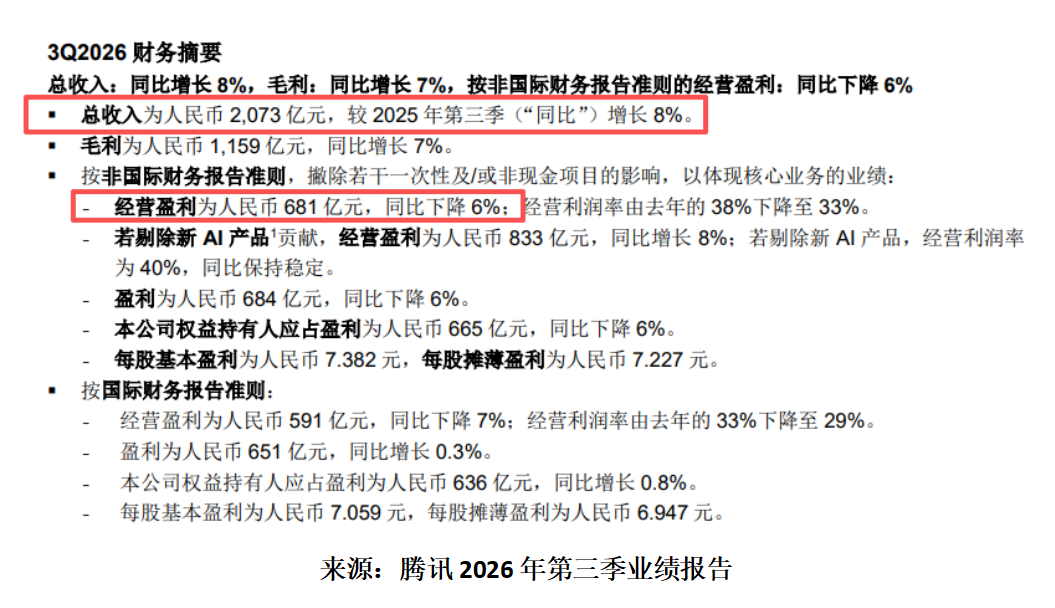
On November 18, Tencent released its Q3 2026 financial results. Revenue for the quarter came in at RMB 207.336 billion, up 8% year on year. Non-IFRS operating profit, however, was just RMB 68.1 billion, down 6% year on year. Q3 also posted negative free cash flow of RMB 69.1 billion.
The market's knee-jerk reaction was that Tencent had "hit a profit wall." But the reality may be more nuanced than the headline numbers suggest. Beyond the profit figures, it is worth understanding the strategic trade-offs and specific arrangements behind Tencent's decisions.
01■
The income statement doesn't look great—but the core business remains on solid footing
In its Q3 report, Tencent proactively disclosed a key metric: after excluding revenue, costs, and expenses tied to new AI products such as Hunyuan, Yuanbao, CodeBuddy, WorkBuddy, and Xiaowei, Non-IFRS operating profit stood at RMB 83.3 billion, up 8% year on year, with an operating margin holding steady at 40%.
Capital expenditure for the quarter reached RMB 81.4 billion, up 527% year on year. Tencent also clarified in its report that capex primarily covers investment in IT infrastructure (including computer equipment, spare parts, and software), data centers, land use rights, office parks, and intellectual property (excluding media content).
These figures tell us two things.
First, Tencent's traditional core business remains healthy. Excluding new AI products, the company's core profit engines—advertising, gaming, fintech, and cloud services—are still firing on all cylinders.
Second, the short-term profit decline stems mainly from resources being redirected toward AI. New AI products are still in a heavy-investment phase, and the contraction on the income statement largely reflects a shift of resources away from current-period profit and into computing power, models, IT infrastructure, campus construction, and other areas.
As for the aforementioned negative free cash flow of RMB 69.1 billion in Q3, this was because net operating cash for the quarter was only RMB 2.6 billion—insufficient to offset RMB 65.1 billion in capex payments, RMB 4.6 billion in media content payments, and RMB 2 billion in lease liability payments.
Given that Q3 operating cash flow included prepayments for large-scale computing power procurement, excluding those prepayments would put Tencent's Q3 free cash flow back in positive territory at RMB 16.9 billion.
The core business is stable, and resources are steadily flowing toward new ventures like AI. What the market should really focus on, then, is whether Tencent's current investment can deliver sustainable revenue growth in the quarters ahead—not merely how much money Tencent is making right now.

02■
WorkBuddy: Tencent's first report card on AI
As of early November, WorkBuddy—a full-scenario AI office workbench—had surpassed 10 million daily active users, with average daily Token consumption exceeding 100 trillion. Tencent also noted that, measured by total daily Token consumption, WorkBuddy is already the largest AI application in China.
On the earnings call following the Q3 release on November 18, Tencent made its position clear: "WorkBuddy's revenue over the past seven days, annualized, exceeds US$500 million—more than double that of Tencent Meeting. Q3 revenue was more than 5 times Q2's, and 60% of China's top 100 enterprises are already customers."
WorkBuddy's structure is clean and straightforward, built on three tiers. The free tier acquires customers at extremely low cost; the paid tier offers a generous Token quota; and heavy users keep buying more. Some users spend as much as RMB 40,000 a month on WorkBuddy—just for Tokens. This business model is a world away from traditional SaaS, which can only charge fixed monthly or annual subscription fees. With the former, the more you use, the higher the revenue ceiling.
Notably, on the earnings call a few days ago, Liu Chiping openly acknowledged that "Yuanbao did not achieve the expected success." He added: "Yuanbao's focus has now shifted from expanding user scale to improving capabilities. Those capabilities are improving well, and the recently launched AI search feature has enriched the overall product offering. At the same time, the company has significantly reduced investment in Yuanbao."
Clearly, Tencent's management is not blindly spreading resources across AI products. Products like WorkBuddy that have already produced a revenue curve will continue to receive more investment, while spending on products like Yuanbao that fell short of expectations has been decisively cut—concentrating resources on directions with higher commercialization efficiency.

03■
AI is already feeding back into the core business
In Q3, Tencent's marketing services revenue reached RMB 43 billion, up 19% year on year. The company also stated in its report: "We enhanced AI-driven advertising and content recommendation capabilities and launched AI-enabled advertising solutions for content publishers to automatically access ads and optimize ad display timing and duration."
In other words, AI is no longer just a cost item—it has begun contributing revenue on the advertising side, and has even helped the ad business achieve relatively strong growth in a macro environment of weak consumer spending.
Meanwhile, cloud service revenue rose 35% year on year during the period, driven mainly by rising AI-related demand—specifically MaaS (Model as a Service), GPU leasing, and WorkBuddy's computing power consumption. This not only reflects growing market demand for AI-related services but also shows that Tencent's AI investment is being converted into billable revenue.
In Q3, revenue from the entire fintech and enterprise services segment reached RMB 63.7 billion, up 9% year on year. Revenue from consumer loans and wealth management services showed visible increases, indicating that Tencent's financial ecosystem continues to expand.
Looking at it now, Tencent's advertising side has already validated AI-driven efficiency gains, its cloud business can continuously absorb rising computing power demand, and WorkBuddy has produced a preliminary commercialization model for enterprise-level AI. It probably won't be long before AI becomes Tencent's main profit growth engine. Tencent did not choose the wrong path—and it has a clear understanding of where it is headed.
I recall that on November 11, Tencent's 28th anniversary, Pony Ma and the company's core executives, in the customary online LinkTime dialogue hosted by the general office, set the tone directly with statements such as "if we do not invest in and embrace the ongoing intelligent revolution, we will be disrupted. This is a matter of life and death," and even proposed "half the people guard the core business, half the people fight new battles."
These remarks from Tencent's senior management are easy to explain. The so-called "life and death" points to the consequences of not embracing AI. Going forward, the company will increase investment in AI—even at the cost of committing half of the entire company's manpower and resources to fighting a new battle in the AI era.
Bear in mind that Tencent used to be asset-light. The AI era is different. To train models, perform inference, and run Tokens, it must buy GPUs, build data centers, and lay out computing power infrastructure. These become fixed assets with long-term depreciation. Capital expenditure of up to RMB 81.4 billion in Q3, plus nearly RMB 32.4 billion in R&D investment, represent a fundamental shift in approach for Tencent.
Yet Pony Ma remains clear-headed. He knows full well that in the AI era, if you do not invest, you will be disrupted; if you do invest, short-term profit will be under pressure—but you can survive in the long run.
Management has also given a timetable: Tencent will be at peak investment during 2026–2027, and by 2028 and beyond, operating pressure will ease. Equipment pricing in 2026 and 2027 will remain relatively high; by 2028, even if similar equipment needs to be purchased, prices are expected to drop significantly, computing efficiency will double, and infrastructure can be reused. By then, the company's input-output ratio in AI business will gradually improve.
How should we view Tencent's financial report? Simple. Short-term profit and cash flow will indeed come under pressure from huge investment, and the stock price reflects market concerns. But in the long run, what Tencent is doing now is the right thing. The market should not focus solely on the profit decline—it should see that Tencent's AI investment is turning into assets and capabilities. Moreover, businesses such as gaming, advertising, and fintech are still growing.
In short, what Tencent most wants you to see is not "profit fell," but "Tencent has already earned its first report card in AI, and its core business is still supporting it."
#Tencent #TencentFinancialReport #AIStrategy #WorkBuddy #PonyMa
-
![]()
Pony Ma Has Found the Right Direction: Betting Big to Buy AI's Future
-
![]()
Globalization of Auto Parts 2.0: It's No Longer About Competing on Price
-
![]()
Domesticating Flagship Models: The Traditional Luxury Brands' Last Resort?
-
Dual-Motor and LiDAR Tech Trickle Down: Is the ORA 7 at 140,000 Yuan a Good Deal or Not?
-
![]()
APEC's AI Highlights: How Will They Transform Shenzhen as a City?
-
![]()
What Is Leapmotor Really After? Q3 Revenue of 31.7 Billion Yuan, Yet Only 40 Million Yuan in Profit!
-
![]()
Himile Technology: Tire Mold Leader with Steady Revenue Growth and Over 2 Billion Yuan in Cumulative R&D Investment Over Five Years
-
![]()
WeRide's Q3 2026: Revenue up nearly 90%, gross margin 43%—Is Spring Finally Coming for L4 Companies?