What Is Leapmotor Really After? Q3 Revenue of 31.7 Billion Yuan, Yet Only 40 Million Yuan in Profit!
 11/23 2026
 515
Written by | Guancheshi
Leapmotor recently released its latest Q3 2026 financial report—a set of figures that has left observers scratching their heads.

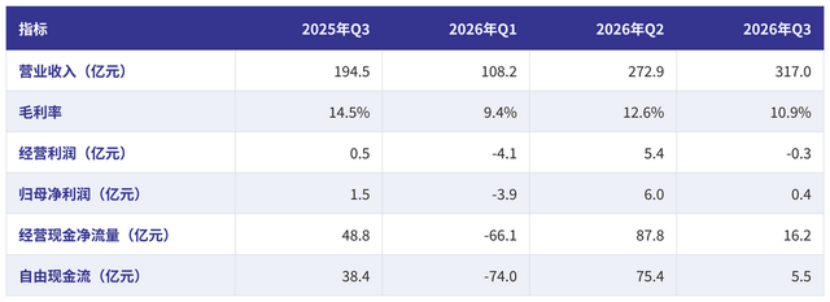
During the period, revenue reached 31.70 billion yuan, up 63.0% year on year. Global deliveries exceeded 310,000 vehicles, with monthly sales consistently topping 100,000—a record high.
On the surface, everything looks great. But what about the bottom line? Net profit attributable to equity holders of the company was a mere 40 million yuan. In the second quarter, that figure was still 600 million yuan.
Operating profit even turned negative, posting a loss of 30 million yuan—compared with a profit of 50 million yuan in the same period of 2025 and 540 million yuan in the second quarter.
Gross margin also kept sliding, from 14.5% in the same period of 2025 and 12.6% in the second quarter down to 10.9%.
The more cars it sells, the less money it makes. How does Leapmotor square that circle?
01
First, let's look at costs. In the third quarter, Leapmotor's cost of sales was 28.24 billion yuan, up 69.8% year on year. That increase outpaced revenue growth for the period, directly dragging down gross margin.
Some may argue that a gross margin of 10.9% is not low—after all, many automakers even run negative gross margins.
Fair enough. Let Guancheshi give you a reference point.
Among new energy vehicle makers, BYD's gross margin has long hovered around 20%, and Tesla's sits between 17% and 20%. Leapmotor's 10.9% is roughly half of theirs.
Leapmotor's main models, the A05 and A10, are all priced under 100,000 yuan. That means for each car sold, gross profit is about 10,000 yuan.
The gross margin is falling not because Leapmotor cannot do the math, but because the cars it is selling now are all priced at rock bottom. That is the crux of the problem.
02
Why did net profit fall from 600 million to 40 million? The financial report itself cites three reasons: rising raw material costs; changes in the vehicle product mix; and increased expenses coupled with lower other income.
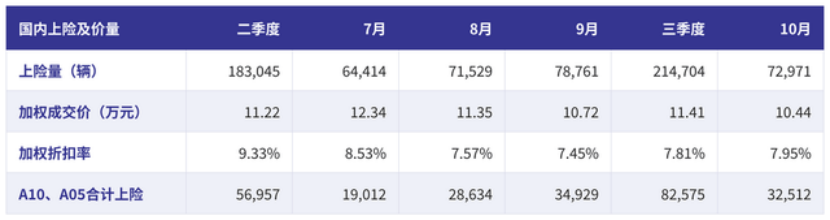
In Guancheshi's view, the second point is the most critical. As mentioned earlier, Leapmotor's ability to break 100,000 monthly sales in the third quarter rested almost entirely on sub-100,000-yuan cars such as the A05 and A10.
The more it sells, the lower the average vehicle price becomes. That is how the gross margin was dragged down to 10.9%.
So the question is: why doesn't Leapmotor follow BYD's playbook and push into the high-end market above 200,000 yuan?
That is exactly the problem. You think Leapmotor doesn't want to? It simply cannot—for now. The volume of profitable models such as the C series and D series has not yet picked up. For the three facelifted models in the C series, average monthly sales are only 25,000 vehicles. Compared with high-volume cars like the A05 and A10, which often sell tens of thousands per month, this is still a small share.
Wanting to rely on cheap cars to drive sales, wanting to rely on high-end cars to protect profits, and wanting to stand firm on both ends—that is a difficult balancing act.
On the expense side: in the third quarter, Leapmotor's R&D expenses were 1.48 billion yuan, up 22.3% year on year; selling expenses were 1.36 billion yuan, up 43.2% year on year; administrative expenses were 690 million yuan, up 9.5% year on year.
R&D invests in tomorrow, sales burns today, and administration supports the team. The money that should be spent still has to be spent.
03
There is another key signal for Leapmotor in the third quarter—operating profit: -30 million yuan.
In other words, looking only at the car-selling business itself, Leapmotor was actually losing money in the third quarter. The final positive figure of 40 million yuan on the books was propped up by other income—and that other income also declined quarter on quarter.
Cash flow is shrinking too, from 4.88 billion yuan in the same period last year to 1.62 billion yuan, while in the second quarter it was still 8.78 billion yuan.
Free cash flow was 550 million yuan, compared with 3.84 billion yuan in the same period of 2025 and 7.54 billion yuan in the second quarter. The shrinkage is severe. The financial report attributed it to "advance stocking based on strategic planning, with procurement spending increasing." Simply put, it is stockpiling materials in advance to drive sales later.
The good news is that Leapmotor's financial foundation remains relatively solid. As of the end of the third quarter, cash and equivalents, restricted cash, financial assets, and time deposits together totaled 39.14 billion yuan.
04
The final question is whether this set of accounts is worth it for Leapmotor. Guancheshi's view: ugly in the short term, but betting on the right direction in the long term.
Because in the new energy vehicle startup race, the most expensive thing has never been the car—it is scale. Leapmotor has already squeezed onto the "economies of scale" table. The cost dividends of self-development will amplify with volume, and a future recovery in gross margin is likely only a matter of time.
Of course, there are plenty of risks. At this stage, the decline in gross margin and the thinning profit capability per vehicle are real. If the situation of revenue growth without profit growth drags on for too long, the market's patience will eventually run out.
Making cars cheap and selling them around the world is the dumbest—and also the toughest—path. Whether these accounts are worth it, we will see clearly next year!
Charts in this article without marked sources are all from public disclosures across various channels. We hereby explain and express our thanks! The views in this article are for reference only and do not constitute investment advice.
This article is original by Leverage Guancheshi. Reproduction is prohibited without authorization! If you need to reprint, please obtain authorization. In addition, when reprinting with authorization, please indicate the source and author at the beginning of the article. Thank you!
-
![]()
What Is Leapmotor Really After? Q3 Revenue of 31.7 Billion Yuan, Yet Only 40 Million Yuan in Profit!
-
![]()
Himile Technology: Tire Mold Leader with Steady Revenue Growth and Over 2 Billion Yuan in Cumulative R&D Investment Over Five Years
-
![]()
WeRide's Q3 2026: Revenue up nearly 90%, gross margin 43%—Is Spring Finally Coming for L4 Companies?
-
![]()
From 89.6% Digitalization to AI Empowerment: Unveiling the "Nerve Center" of the Modern Industrial System
-
The AI Hardware Bull Market Is Over
-
![]()
Guangdong Leads by a Landslide, Shanghai Dominates Finance, Beijing's Giants Set the Pace
-
![]()
Breaking: Huawei Unveils First HarmonyOS AI Phone — Netizens Say They Guessed Wrong as Price Exceeds Expectations
-
![]()
Anthropic Prospectus Insights: How Compute Power, Jobs, and Organizations Will Change