Guangdong Leads by a Landslide, Shanghai Dominates Finance, Beijing's Giants Set the Pace
 11/23 2026
 390
Chinese enterprises' "great voyage" has entered deep waters. Going global is no longer a solo effort by individual companies but a comprehensive contest of cities' overall strength. The "National Provincial and Municipal Going-Global Capability Evaluation Report" quantitatively scores 31 provinces and municipalities nationwide across six dimensions: policy support, enterprise quality, logistics infrastructure, foreign trade scale, talent reserves, and financial facilitation.

Guangdong Leads by a Landslide; Five Provinces and Municipalities Form the First Tier of Going Global
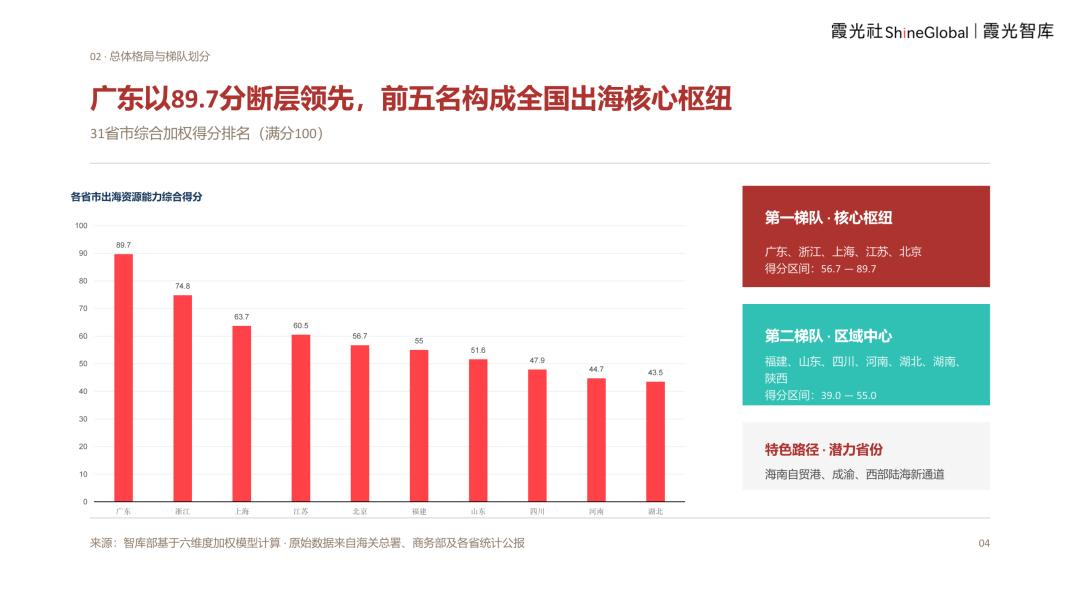
In terms of overall scores, Guangdong leads by a landslide with 89.7 points, firmly ranking first nationwide in going global. Zhejiang, Shanghai, Jiangsu, and Beijing follow closely, jointly forming the core hubs of China's first tier of going global. Fujian, Shandong, Sichuan, and other provinces and municipalities rank as regional centers in the second tier, while the Hainan Free Trade Port and the Chengdu-Chongqing region, relying on unique policy and corridor advantages, have become distinctive going-global provinces with great potential.

Analysis of the Six Going-Global Dimensions
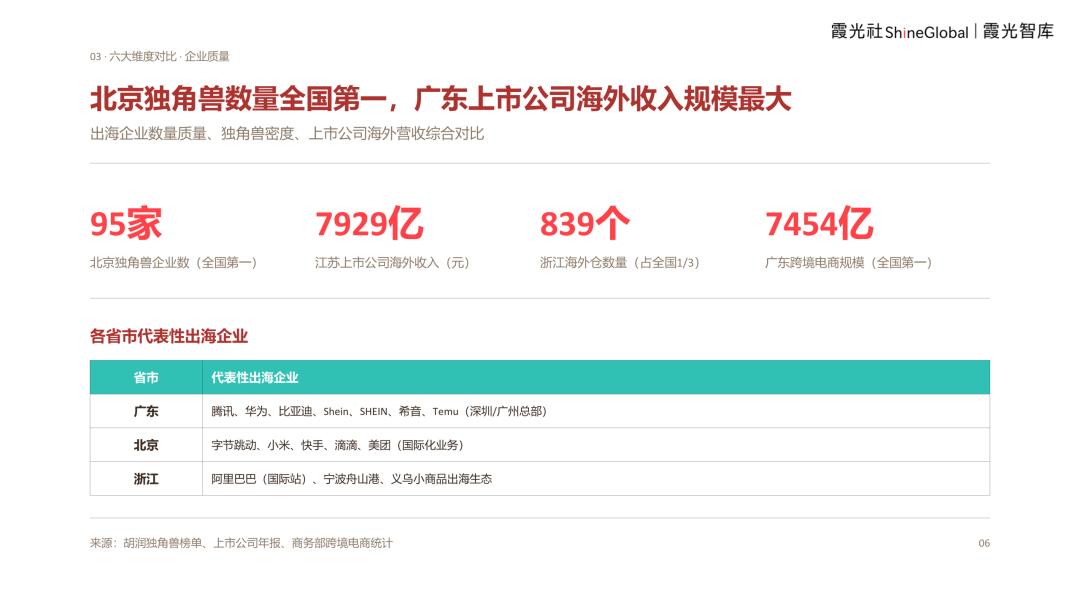
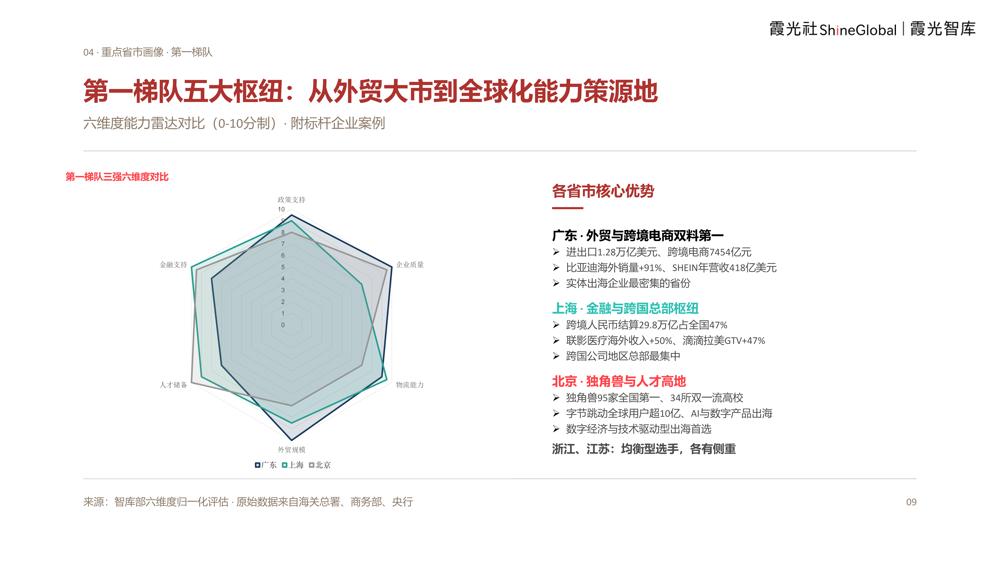
· Enterprise quality: Beijing leads the nation with 95 unicorn enterprises; the overseas revenue of listed companies in Jiangsu is nearly 800 billion yuan; Zhejiang's overseas warehouses account for one-third of the national total; Guangdong's cross-border e-commerce scale alone exceeds 700 billion yuan, ranking first nationwide. Among representative going-global enterprises, Guangdong gathers Huawei, Tencent, BYD, Shein, and Temu; Beijing has ByteDance, Xiaomi, Didi, and others; Zhejiang is represented by Alibaba.com and the Yiwu ecosystem.
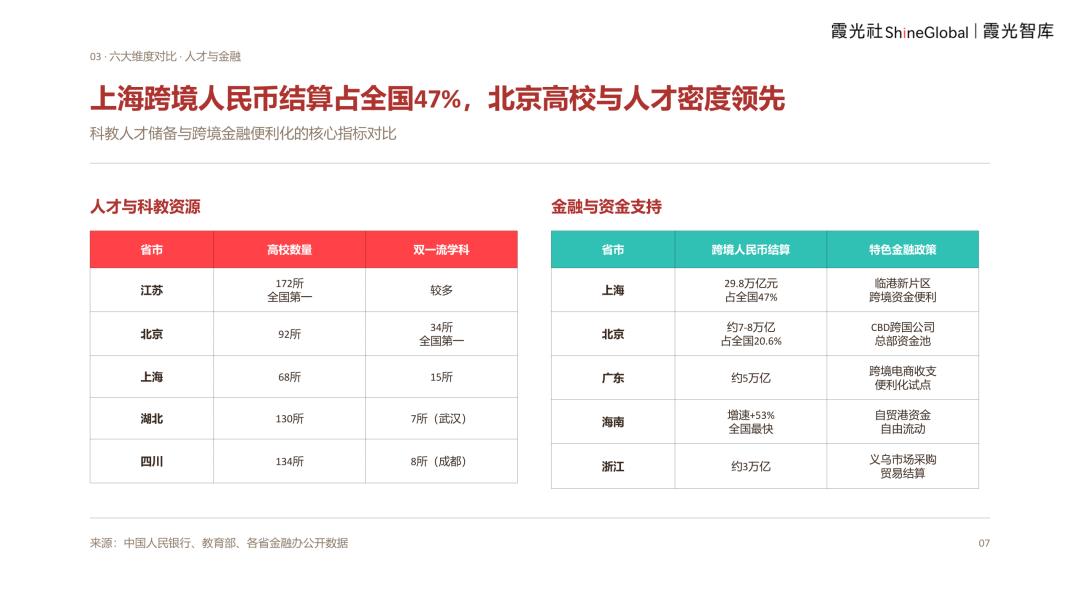
· Talent and finance: In terms of talent, Jiangsu has 172 universities, the highest in the country; Beijing is home to 34 Double First-Class universities, with the nation's top high-quality talent reserves. In finance, Shanghai accounts for 47% of national cross-border RMB settlement, while Hainan, with a growth rate of +53%, has become the nation's incremental engine.
· Logistics and foreign trade: In logistics infrastructure, Zhejiang's Ningbo-Zhoushan Port ranks first globally in cargo throughput, Shanghai Port ranks first in container throughput, and Shaanxi ranks first nationwide in the number of China-Europe freight trains. In foreign trade, Guangdong leads in import and export volume, followed closely by Zhejiang, while Henan ranks first among inland provinces with a cross-border e-commerce scale of nearly 300 billion yuan.
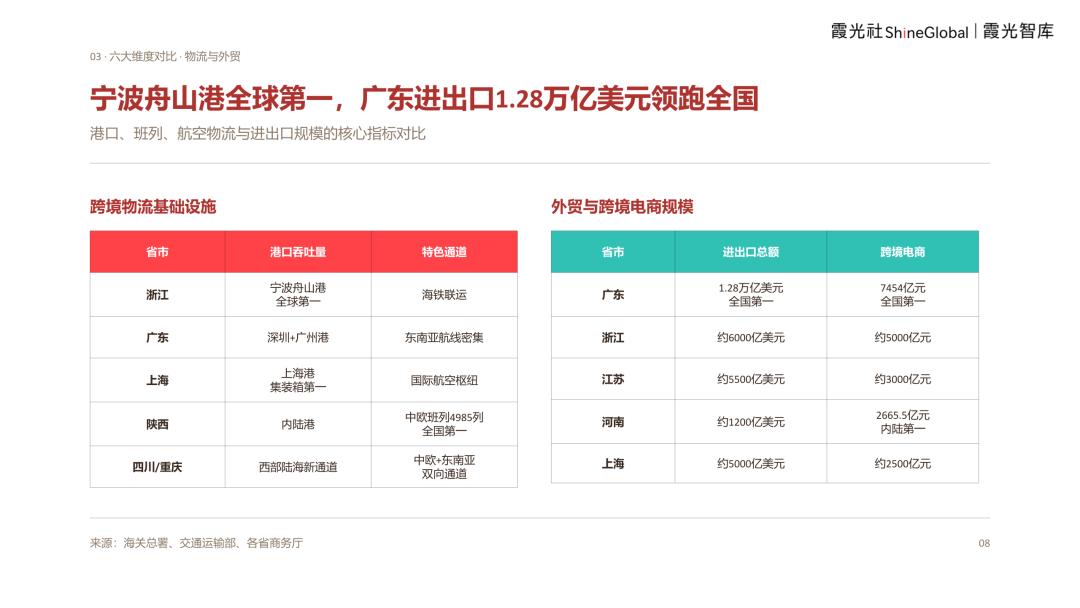
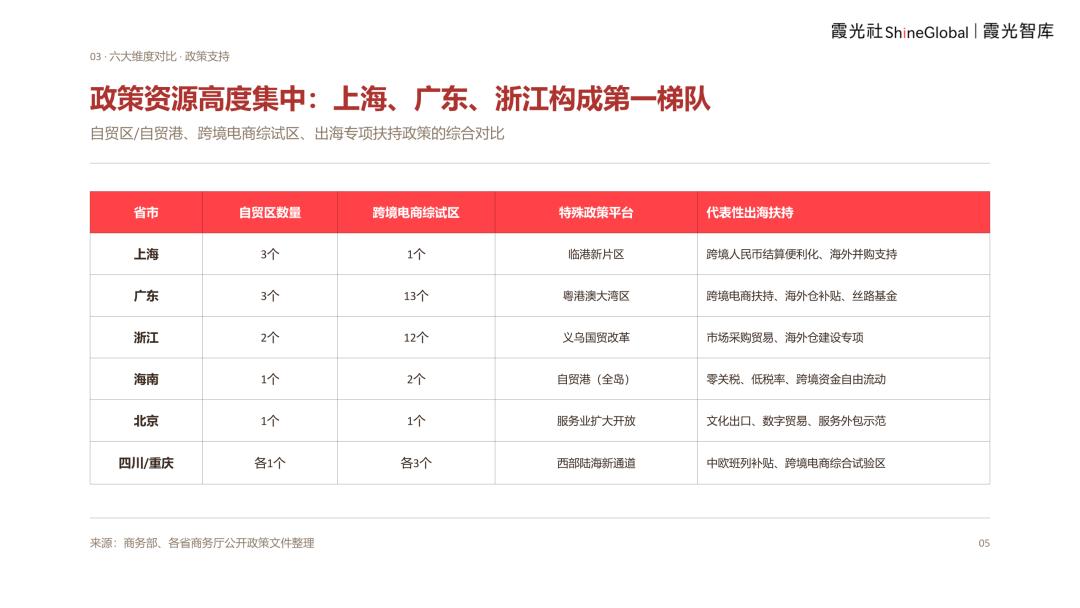
· Policy resources: Shanghai, Guangdong, and Zhejiang lead in the number of free trade zones. Hainan, with the zero-tariff and free flow of capital of its island-wide free trade port, and Sichuan/Chongqing, relying on China-Europe freight train subsidies under the New Western Land-Sea Corridor, have become distinctive policy highlands.

Profiles of Leading Provinces and Municipalities in Going Global
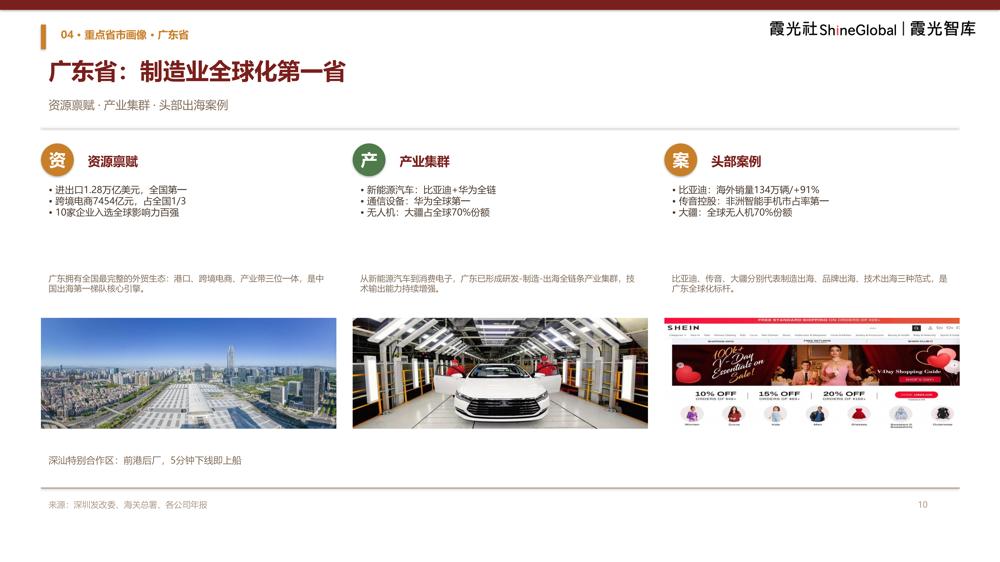
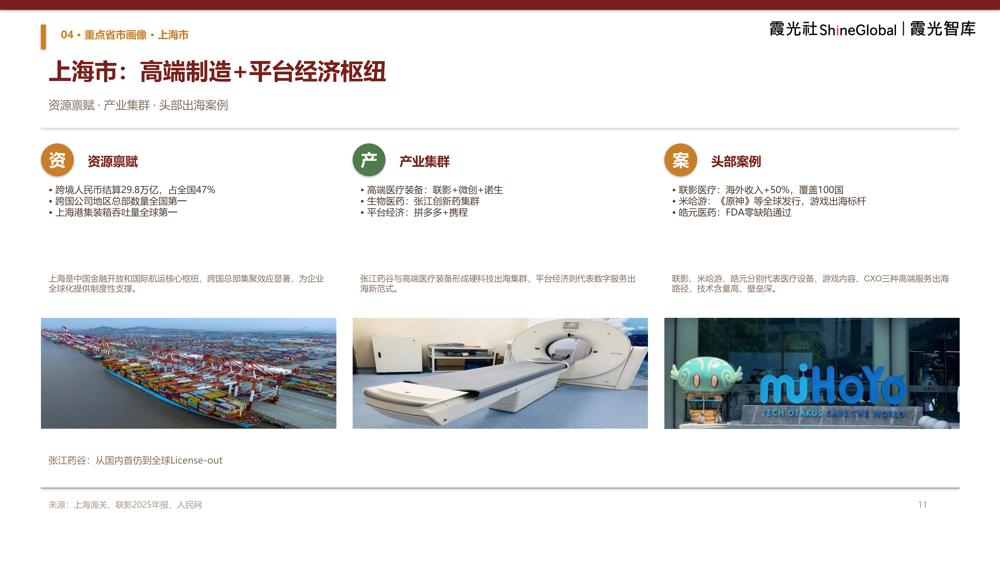
Guangdong: The No. 1 Province in Manufacturing Globalization
Guangdong has the nation's most complete trade ecosystem, with ports, cross-border e-commerce, and industrial belts integrated into one, forming a full-chain industrial cluster from new energy vehicles to consumer electronics. BYD, Transsion Holdings, and DJI—three going-global benchmarks—represent the three top paradigms of manufacturing going global, brand going global, and technology going global, respectively, making Guangdong a well-deserved first tier in China's going global.
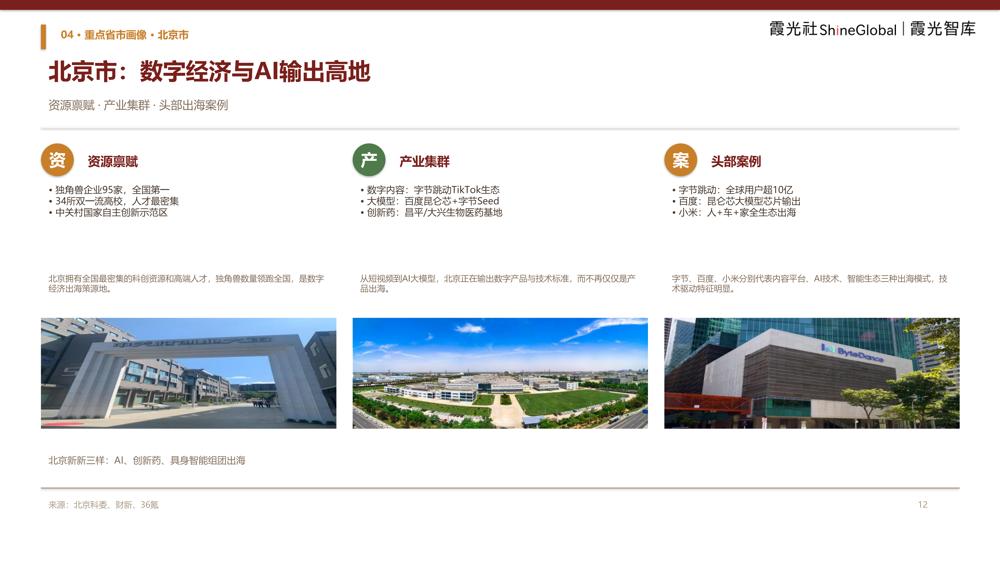
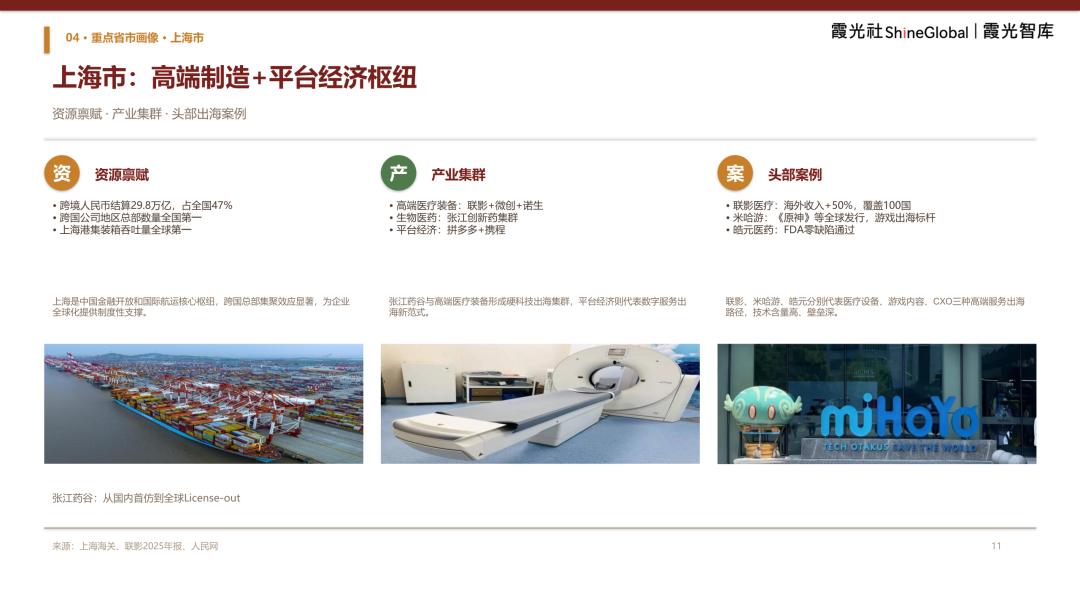
Shanghai: A Hub of High-End Manufacturing and Platform Economy
Shanghai is the core hub of China's financial opening-up and international shipping, accounting for nearly 50% of national cross-border RMB settlement, with a significant agglomeration effect of multinational headquarters. Zhangjiang Pharma Valley and high-end medical equipment form a hard-tech going-global cluster. United Imaging Healthcare, miHoYo, and Haoyuan Pharma represent three high-end service going-global paths—medical equipment, gaming and entertainment, and CXO—respectively, with high technological content and deep barriers.
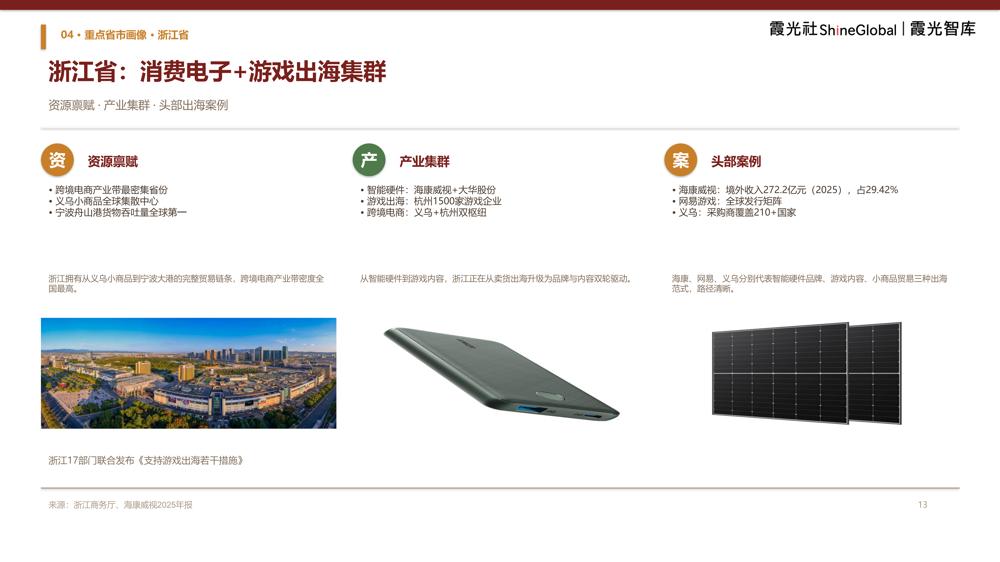
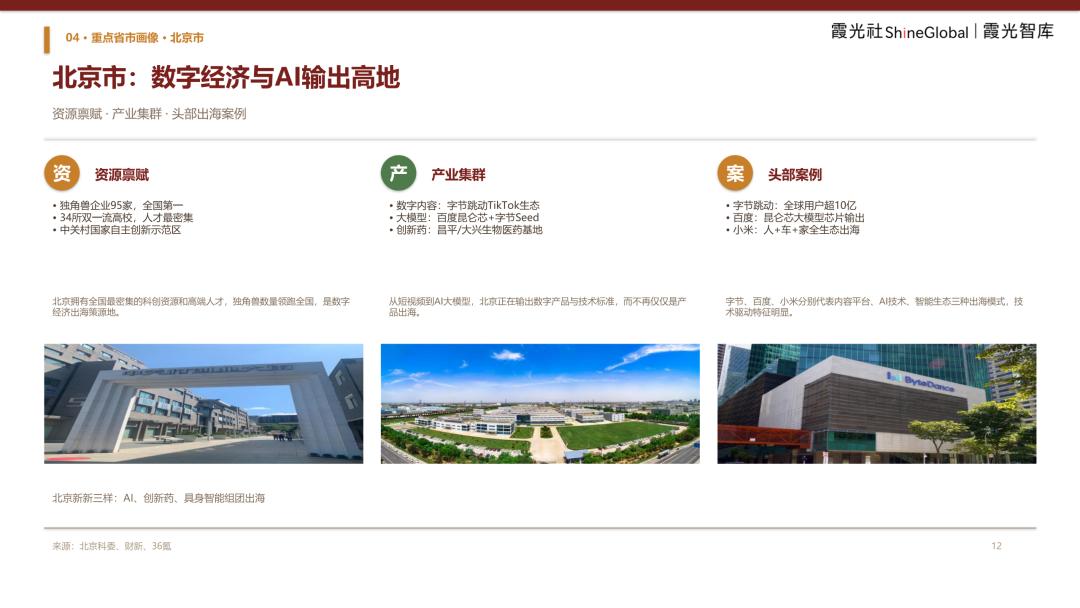
Beijing: A Highland of Digital Economy and AI Led by Giants
Beijing is the source of the global digital economy's going global, with its going-global fundamentals strongly dominated by super giants. Relying on the Zhongguancun National Independent Innovation Demonstration Zone and the nation's densest cluster of 34 Double First-Class universities, it has nurtured global giants such as ByteDance, Xiaomi, and Baidu, representing the top output capabilities in content platforms, smart ecosystems, and underlying AI technologies. Meanwhile, Beijing's 95 national unicorn enterprises, relying on technology and capital spillover from the giants, are becoming the backbone of going-global reserves.
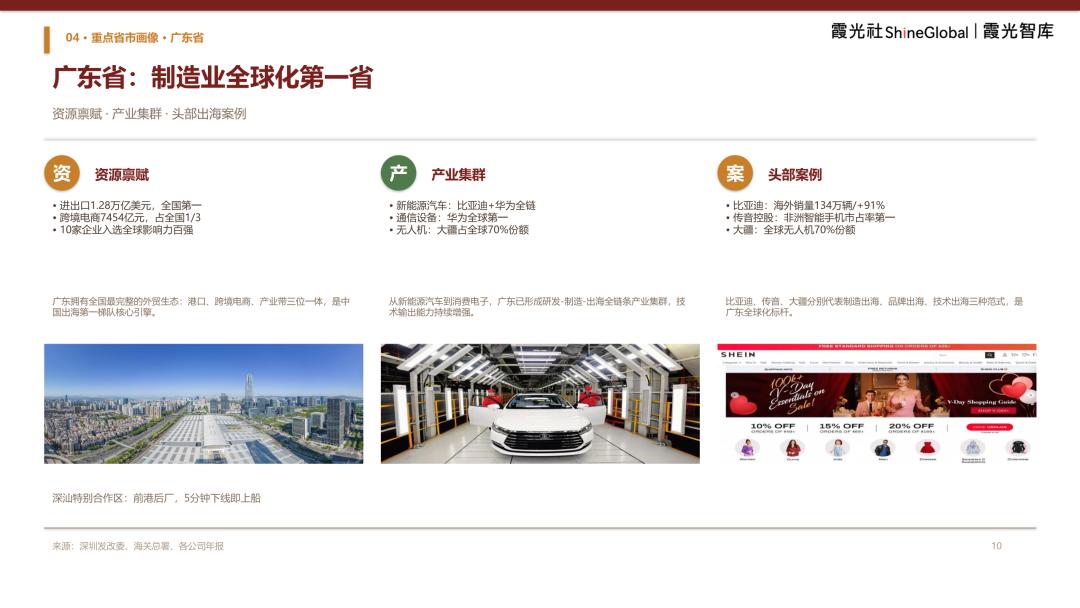
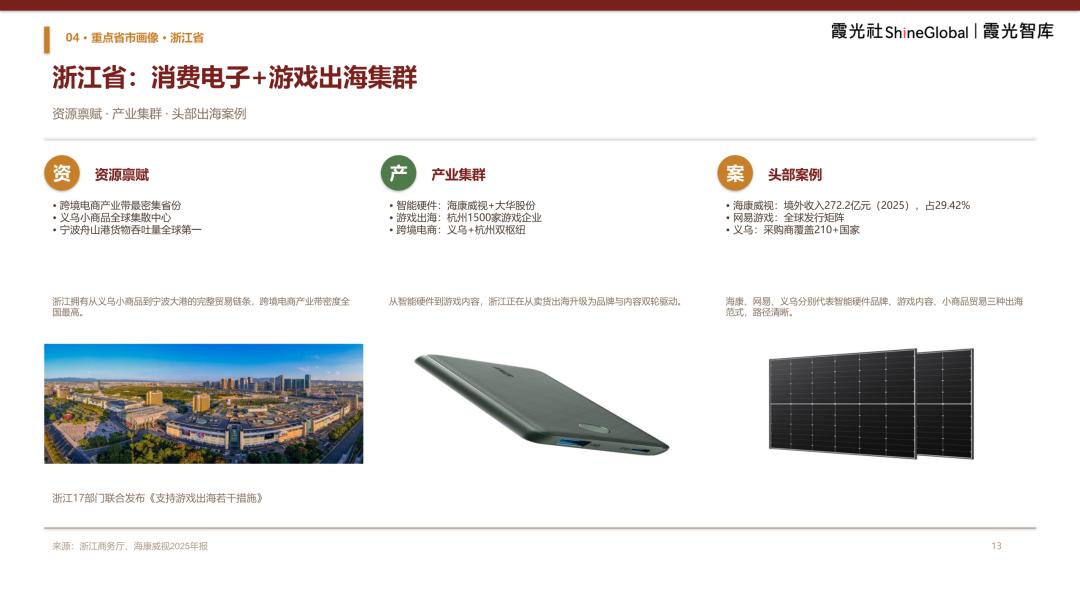
Zhejiang: A Cluster for Consumer Electronics and Gaming Going Global
Zhejiang has a complete trade chain from Yiwu small commodities to Ningbo-Zhoushan Port, with the highest density of cross-border e-commerce industrial belts nationwide. Today, Zhejiang is upgrading from simply "selling goods overseas" to a dual-driven model of "brand and content." Hikvision, NetEase Games, and Yiwu Commodity Market represent three going-global paradigms—smart hardware brands, gaming content, and small commodity trade—respectively, with clear paths and strong resilience.
In the 2026 landscape of China's going global, the era of pure "low-price involution" has ended, giving way to a comprehensive contest of technology, brands, capital, and supply chains. Guangdong's hardcore manufacturing, Shanghai's finance and high-end services, Beijing's giant ecosystem and AI source, and Zhejiang's e-commerce and content—different provinces and municipalities are relying on their own endowments to occupy unique ecological niches in the global industrial chain. For enterprises about to go global, choosing where to take root means choosing what kind of resource allocation and going-global acceleration.
-
![]()
What Is Leapmotor Really After? Q3 Revenue of 31.7 Billion Yuan, Yet Only 40 Million Yuan in Profit!
-
![]()
Himile Technology: Tire Mold Leader with Steady Revenue Growth and Over 2 Billion Yuan in Cumulative R&D Investment Over Five Years
-
![]()
WeRide's Q3 2026: Revenue up nearly 90%, gross margin 43%—Is Spring Finally Coming for L4 Companies?
-
![]()
From 89.6% Digitalization to AI Empowerment: Unveiling the "Nerve Center" of the Modern Industrial System
-
The AI Hardware Bull Market Is Over
-
![]()
Guangdong Leads by a Landslide, Shanghai Dominates Finance, Beijing's Giants Set the Pace
-
![]()
Breaking: Huawei Unveils First HarmonyOS AI Phone — Netizens Say They Guessed Wrong as Price Exceeds Expectations
-
![]()
Anthropic Prospectus Insights: How Compute Power, Jobs, and Organizations Will Change