Anthropic Prospectus Insights: How Compute Power, Jobs, and Organizations Will Change
 11/23 2026
 346
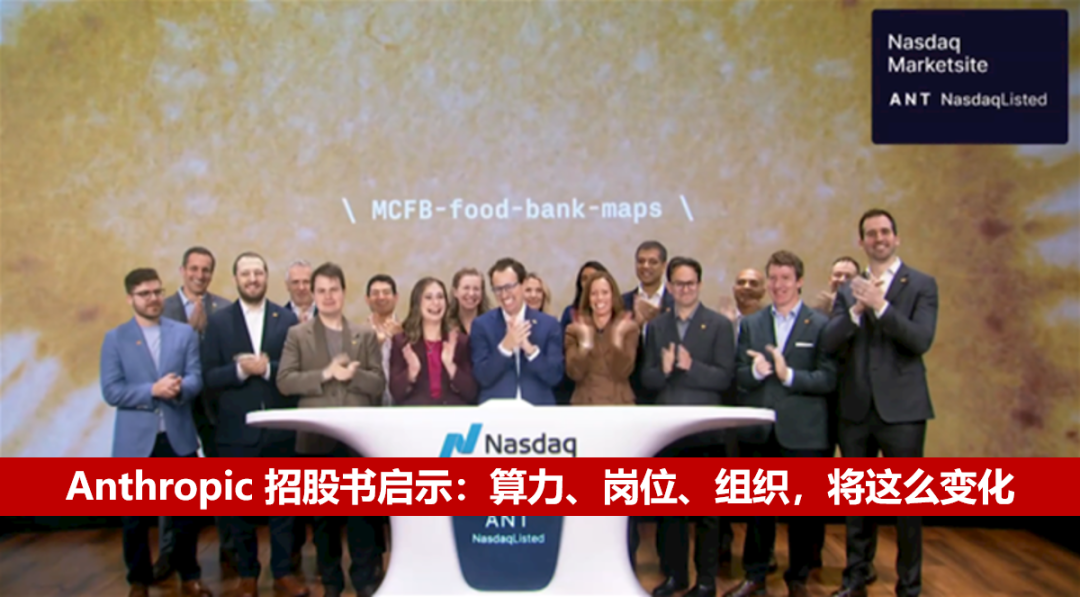
Anthropic's IPO was a major global event last week.
Its prospectus is more than just one company's listing story—it is a roadmap laid out for the entire industry. Some people are watching its revenue and valuation; some are focusing on its model plans; others are analyzing how the future 900 billion in debt will be repaid.
For my part, inspired by the Anthropic prospectus, I see impending changes in compute power, jobs, and organizations.
1. Heterogeneous chip compute centers must be made operational as soon as possible
Anthropic no longer relies on a single brand of graphics cards. Its internal model, Mythos, took only three days to rewrite and port nearly 100% of the GPU compute kernels, allowing Claude to run directly on AMD's new chips. At the same time, Anthropic wrote in its prospectus that it mixes and matches chips from Nvidia, Google, Amazon, and AMD, uses its own compilation system to bypass CUDA, and builds a single compute pool with unified scheduling and mixed training—successfully achieving both cost reduction and efficiency gains.
This choice is highly instructive for domestic practitioners: US controls on high-end graphics cards exported to China will only continue to tighten, and the path of renting overseas compute will also narrow significantly. It is hard to rely on various forms of overseas compute.
Anthropic has helped us prove a new path: we can validate heterogeneous chip solutions as early as possible, build a unified compute scheduling platform, do a good job in scheduling adaptation, and optimize inference efficiency. We should persist in cross-rack optical interconnection and super-node architecture, increase domestic network card production capacity, break through glass substrate packaging, and so on. Taking another path may give us a chance to make up for our gap in single-chip performance.
Although the AMD and other chips used by Anthropic are also very powerful, it at least proves that the path of heterogeneous chips is feasible.
2. AI crosses inflection points one by one, and the next to be replaced is knowledge work jobs
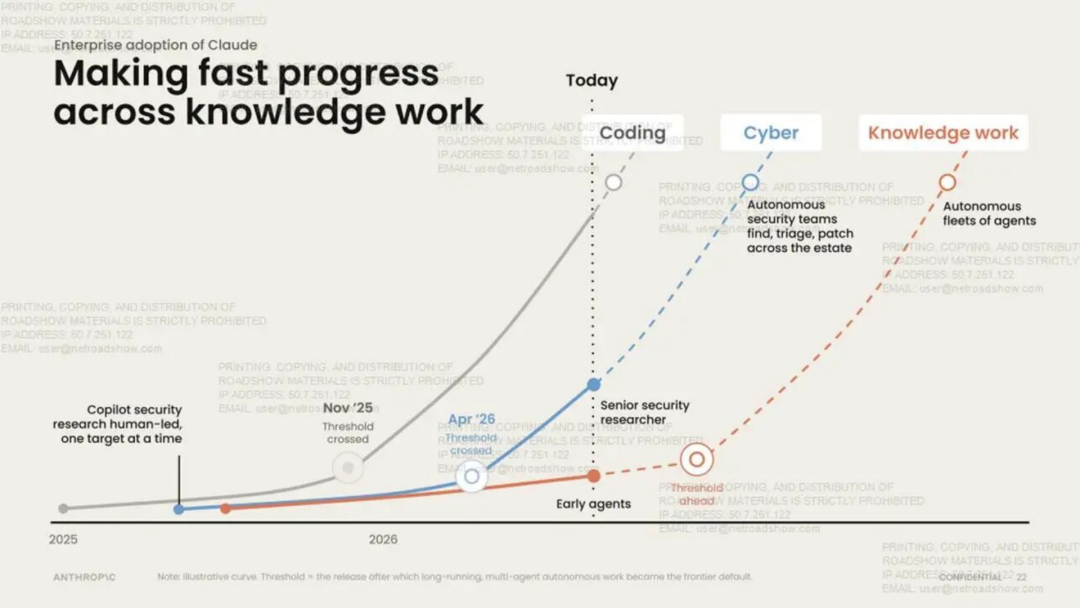
Anthropic mentioned that AI's work capabilities in programming and cybersecurity have already crossed the inflection point. Now, within Anthropic, 90% of coding work is generated by AI. Moreover, in the programming field, it is approaching the next inflection point—recursive self-improvement. Just thinking about it is exciting.
What I care more about is that Anthropic believes the next field to break through the inflection point is "knowledge work," an industry market worth up to 40 trillion US dollars. In the future, mental work such as proposal writing, technical assessment, data analysis, and project review will all face restructuring. Positions in securities firms, investment banks, insurance, law, auditing, consulting, and others that rely heavily on knowledge processing and document reasoning will bear the brunt and be directly impacted by AI.
For these positions, it is necessary to sort out business in advance, adjust division of labor, and transform processes in order to adapt to this AI wave.
3. Work redefined: organizational managers are safer
Following the previous point, after "knowledge work" positions cross the inflection point, in Anthropic's working model, basic work will be taken over by AI. At that time, people's focus will no longer be on personally completing execution tasks.
People's main responsibilities will be determining goals, breaking down tasks, setting standards, issuing instructions, verifying results, controlling risks, identifying errors, and doing review well.
Doesn't that sound a lot like your leader? Doesn't it feel like your leader is holding a weekly meeting with you, assigning work, listening to reports, and giving instructions?
Of course, to be precise, this does not mean that the position of leader is safer in this new model. Rather, as a team manager, the goal judgment, trade-off ability, and risk awareness accumulated over the long term happen to be the most scarce abilities in the AI era, and because of this ability, he is safer.
If your current work still remains at standardized content such as large amounts of repetitive calculation, repeated testing, simple communication, and data organization, then the risk of being replaced by AI Agents will become higher and higher.
Final thoughts
The bubble grows within AI finance, not within AI technology.
The bubble will eventually burst, and AI technology will ultimately bring humanity to that visible future. Anthropic's prospectus truly tells us that the future is already on the road ahead. Translated to us, this means that in compute, we should break away from dependence on single hardware and lay out heterogeneous chips; in business, follow the rhythm of programming, security, and knowledge work, and adjust business strategies in advance; in organization, grow and transform yourself from an executor into a manager of AI agents as quickly as possible.
Only by keeping up with the rhythm can we enjoy the dividends of the next few years.
-
![]()
What Is Leapmotor Really After? Q3 Revenue of 31.7 Billion Yuan, Yet Only 40 Million Yuan in Profit!
-
![]()
Himile Technology: Tire Mold Leader with Steady Revenue Growth and Over 2 Billion Yuan in Cumulative R&D Investment Over Five Years
-
![]()
WeRide's Q3 2026: Revenue up nearly 90%, gross margin 43%—Is Spring Finally Coming for L4 Companies?
-
![]()
From 89.6% Digitalization to AI Empowerment: Unveiling the "Nerve Center" of the Modern Industrial System
-
The AI Hardware Bull Market Is Over
-
![]()
Guangdong Leads by a Landslide, Shanghai Dominates Finance, Beijing's Giants Set the Pace
-
![]()
Breaking: Huawei Unveils First HarmonyOS AI Phone — Netizens Say They Guessed Wrong as Price Exceeds Expectations
-
![]()
Anthropic Prospectus Insights: How Compute Power, Jobs, and Organizations Will Change