From 89.6% Digitalization to AI Empowerment: Unveiling the "Nerve Center" of the Modern Industrial System
 11/23 2026
 413
In 2025, China's total industrial added value reached 41.7 trillion yuan, and the added value of manufacturing approached 30% of the global share, ranking first in the world for 16 consecutive years. Behind this massive manufacturing scale, an AI-driven "smart manufacturing" transformation is quietly taking place.
When we talk about Made in China, beyond marveling at the hardcore strength of high-speed rail and new energy vehicles, we should pay more attention to the "invisible brain" that supports the operation of these physical worlds—industrial software. It is not merely a pile of code, but a software encapsulation of industrial knowledge, technology, and experience.
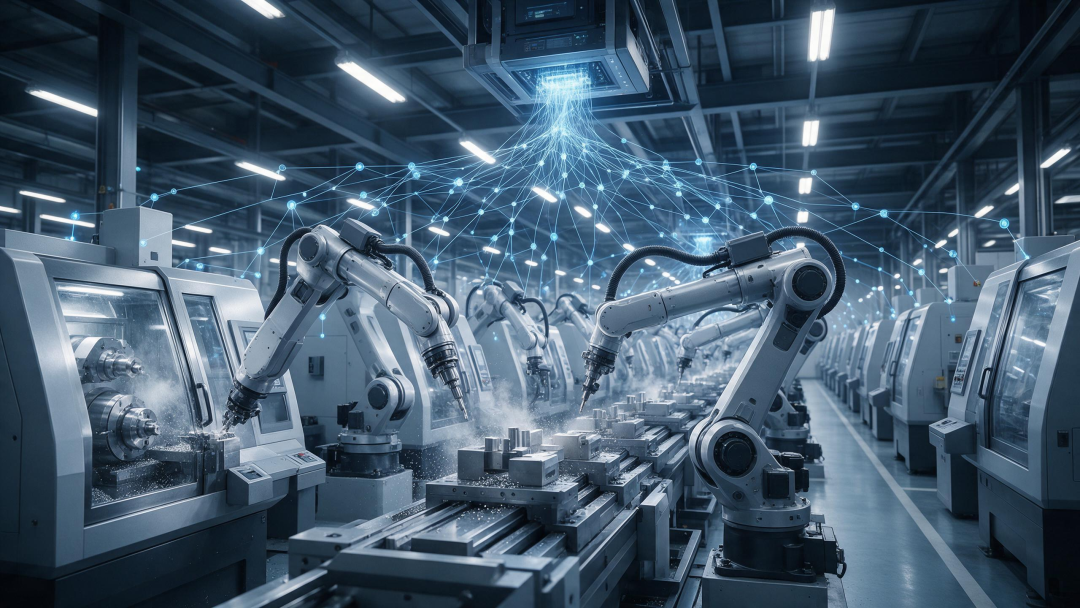
In the "2026 AI Industrial Software Industry Report," CIC Burning Consciousness offered a profound judgment: industrial software is the decision-making hub and neural network of the modern industrial system, directly affecting industrial links such as design, production, supply chain, and operations and maintenance.
Today, let's talk about what technological codes and industrial prospects are hidden in this "central nervous system" that determines the future height of Made in China.
01 Macro Coordinates: The Global Manufacturing Center of Gravity Is Shifting to Asia, and Made in China Is Achieving "Quality Improvement with Stable Quantity"
To understand the value of industrial software, we must first see the big picture of global manufacturing.
The report points out that global manufacturing has entered a stage of moderate expansion, but the center of gravity continues to shift to Asia. In 2024, Asia and Oceania accounted for 57.2% of global manufacturing added value. Behind this, China has maintained scale leadership by relying on complete industrial chain support and huge manufacturing scenarios.
However, being large but not strong has always been the Sword of Damocles hanging over China's manufacturing industry.
Encouragingly, structural changes are taking place. The report shows that China's per capita GDP reached 99,665 yuan in 2025, exceeding US$13,000 for three consecutive years. More critically, the proportion of China's high-tech manufacturing added value in the added value of industrial enterprises above designated size climbed from 15.1% in 2020 to 17.1% in 2025.
The industrialization structure is accelerating toward high-end upgrading, and its core lever is digital transformation. As of 2025, the proportion of industrial enterprises above designated size nationwide carrying out digital transformation had reached 89.6%, and the penetration rate of digital production equipment had reached 57.7%. As digital transformation enters the stage of large-scale popularization, demand for industrial software as the underlying support is ushering in explosive and sustained release.
02 Pain Point Analysis: Why Can't Traditional Manufacturing Do Without Industrial Software?
If we compare manufacturing to a giant, under the traditional industrial model, this giant is facing a sluggish "nervous system."
The report deeply analyzes the five major pain points of the traditional industrial model:
R&D relies on trial and error: relying on physical prototyping, versions managed manually, and information disconnected between design and the workshop; production relies on experience: scheduling depends entirely on planners, equipment lacks unified dispatching, and on-site conditions cannot be controlled in real time; supply chain relies on manpower: upstream and downstream information does not flow, and inventory depends on human judgment; quality relies on sampling inspection: post-event inspection, scattered data, and difficult traceability of problematic parts; operations and maintenance rely on individuals: core processes are highly dependent on experienced masters, creating a risk of loss.
"The limitations of people" and "the fragmentation of links" have severely constrained efficiency.
The emergence of industrial software is precisely to solve these pain points. It empowers R&D and innovation upward, optimizes production and supply chain in the middle, and controls equipment operations and maintenance downward, opening up the full-link closed loop of "R&D, production, supply, and service." For example, in the R&D link, CAE software is used to complete simulation verification of strength, heat dissipation, and other aspects in digital space, achieving the leap "from physical trial and error to virtual simulation" and greatly shortening the R&D cycle.
03 In-Depth Perspective: The "Hard Bones" of Industrial Software and Its Triple Essence
Many internet software products can quickly grow large through traffic and business model innovation, but industrial software cannot.
The report points out that industrial software has extremely high barriers and possesses three hardcore characteristics: "high threshold, long cycle, and strong closed loop."
High threshold: it is an interdisciplinary product of mathematics, physics, mechanics, and computer science, and core algorithms (such as geometric modeling and constraint solvers) have extremely high technical barriers; long cycle: the development cycle of large industrial software often reaches 3-5 years, requiring a long cycle of "R&D-use-feedback-iteration"; strong closed loop: industrial software is highly vertical and must be rooted in real industrial scenarios, relying on rich applications to feed back and optimize.
More importantly, the report reveals the triple essence of industrial software:
Code carrier of industrial knowledge: transforming explicit knowledge and tacit experience into computable and reusable software assets. Digital-physical mapping: building models in digital space, calibrating with on-site data, and reversely optimizing physical systems. Productivity tool: applying computing power to the entire process to support key industrial decisions.
This means that the soul of industrial software lies not in code, but in the industrial know-how accumulated within it. This is also why domestic industrial software must follow a "long-termism" path and deeply bind with local manufacturing enterprises.
04 Industry Prospects: With AI Empowerment, Moving Toward the Ultimate Form of a "Decision-Making Hub"
Entering 2026, with the explosion of AI large model technology, industrial software is ushering in an unprecedented opportunity for transformation.
In the past, industrial software was more of a "tool" to help humans complete design and records. In the future, with AI empowerment, industrial software will truly become a "decision-making hub."
R&D link: AI can automatically generate design plans and quickly verify them based on historical data and physical laws, greatly improving innovation efficiency. Production link: optimizing scheduling through AI algorithms can not only improve equipment utilization, but also shift from post-event inspection to pre-event warning, achieving precise control of process quality. Operations and maintenance link: by analyzing data such as equipment vibration and temperature, AI can accurately predict maintenance timing, reduce losses from unplanned downtime, and even feed operations and maintenance data back into R&D to support improvement of the next generation of products.
The report mentions that the world's major economies (China, the United States, and Germany) all regard smart manufacturing as the core direction of manufacturing upgrading. In such great-power competition, industrial software is not only a tool for enterprises to reduce costs and increase efficiency, but also the underlying infrastructure of national manufacturing competitiveness.
Conclusion
From the eastward shift of the global manufacturing center of gravity to the structural upgrading of China's manufacturing industry; from the many pain points of the traditional model to the accumulated strength of industrial software with its "high threshold and long cycle." We are witnessing a great period of industrial transformation.
For China's manufacturing industry, digital transformation is not a multiple-choice question, but a question of survival. And industrial software is precisely the "key to solving" this question.
The future has already arrived. When we talk about AI and technology, we should not only see those glamorous consumer-level applications. What truly determines the industrial depth of a country is often hidden in those invisible factories, and in those industrial software products that iterate day after day and codify industrial knowledge.
This road may be long, but it is precisely where the stars and the sea lie.
-
![]()
What Is Leapmotor Really After? Q3 Revenue of 31.7 Billion Yuan, Yet Only 40 Million Yuan in Profit!
-
![]()
Himile Technology: Tire Mold Leader with Steady Revenue Growth and Over 2 Billion Yuan in Cumulative R&D Investment Over Five Years
-
![]()
WeRide's Q3 2026: Revenue up nearly 90%, gross margin 43%—Is Spring Finally Coming for L4 Companies?
-
![]()
From 89.6% Digitalization to AI Empowerment: Unveiling the "Nerve Center" of the Modern Industrial System
-
The AI Hardware Bull Market Is Over
-
![]()
Guangdong Leads by a Landslide, Shanghai Dominates Finance, Beijing's Giants Set the Pace
-
![]()
Breaking: Huawei Unveils First HarmonyOS AI Phone — Netizens Say They Guessed Wrong as Price Exceeds Expectations
-
![]()
Anthropic Prospectus Insights: How Compute Power, Jobs, and Organizations Will Change