Domesticating Flagship Models: The Traditional Luxury Brands' Last Resort?
 11/23 2026
 559
Introduction
Introduction
Perhaps not for sales volume, but rather to keep their dealer networks afloat and to tap into China's supply chain.
"Tell me—if BBA started building their high-end models domestically, even flagships like the Audi A8, could they immediately 'flip the script and go on the offensive'?"
Back in late 2023, at a brand event, I was chatting with a group of media colleagues about the then-emerging threat of domestic mid-to-high-end models squeezing traditional German luxury brands. Someone floated exactly this idea—one that at the time could only be described as a "wild fantasy."
No sooner had this "whimsical notion" been voiced than everyone present burst out laughing. "That would definitely turn things around," was the unanimous verdict at the time.
Yet including me—the one who proposed it—everyone immediately shot the idea down. "How could that possibly happen? German luxury brands still have their 'face' to protect—their flagships absolutely have to stay in production in Europe!"
But even from the vantage point of 2023, the answer to that question was never absolute. After all, the long-wheelbase domestically built BMW X5 had already been introduced to China two years earlier, with the first domestic units delivered as early as April 2022. And Mercedes' plan to localize the GLE should also have been initiated around that time.
One might argue that the X5 or GLE count as high-end models, but they aren't the symbolic brand flagships. Then the recent news that the Audi A8 may be introduced for domestic production (for details, see "A8 Goes Domestic, Embraces Huawei—Is This Audi's Biggest Opportunity?") should carry enough weight.
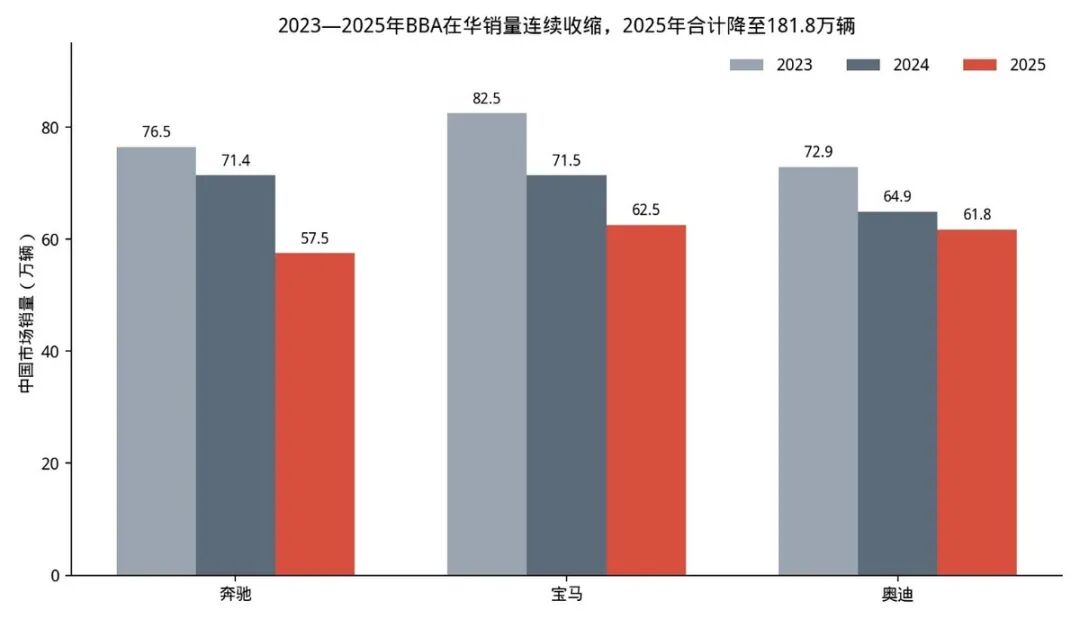
Figure | This year's data doesn't yet cover a full year; I believe the decline will be even steeper than in 2025
Standing at this point in late 2026, the predicament facing overseas luxury cars—German luxury brands included—in the domestic market needs no elaboration from me.
So when the BMW 7 Series may also be domestically produced, and Lexus' future flagship SUV is set to roll off the line in Shanghai, the question from three years ago still has real-world relevance.
01 Can Buy Time, But Cannot Solve the Problem
The first thing to clarify is that the phrase from three years ago—"high-end models, even flagship products"—actually conflated two different things.
According to each company's own product lineup, the X5 long-wheelbase version and the long-wheelbase GLE are high-end models, but not flagships. After all, Mercedes still has the S-Class, Maybach S-Class and GLS above them; BMW has the 7 Series, i7 and X7. Audi has the A8, plus a just-launched full-size SUV, the Q9.
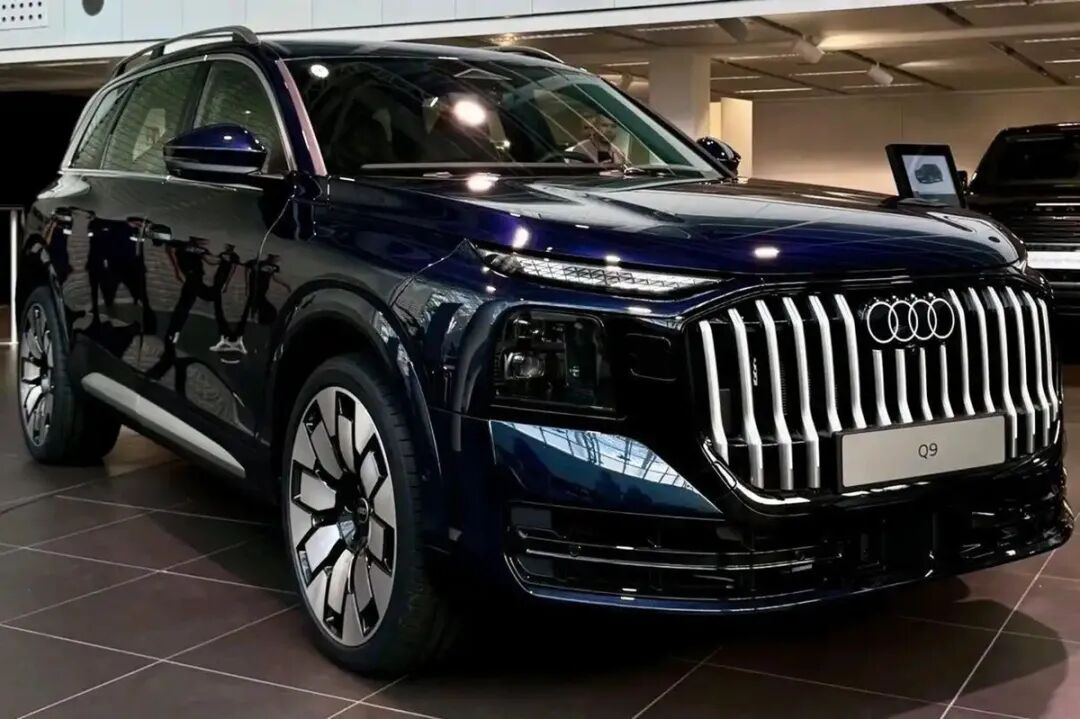
Figure | The German Big Three bringing their flagships to China for production might have caused a sensation in the auto world two years ago. But now, it's merely big news—not enough to shake the industry
If we're talking only about high-end models, the three BBA companies have actually been making moves all along.
On March 31, 2022, the X5 long-wheelbase version went on sale, with all 130 millimeters of added wheelbase devoted to the rear seats, and deliveries began that April. Production was handled by the Shenyang Dadong plant, sharing a line with the 5 Series long-wheelbase—and the later i5 used the same line without a separate one being set up.
Before domestic production, the X5 had always been imported, selling more than 50,000 units in China in all of 2021—the best-selling imported luxury brand SUV that year. After domestic production, the X5's starting price was nearly 100,000 yuan cheaper than during the import period.
The domestic production of the Mercedes GLE was indeed delayed for quite a long time, only officially launching two months ago on September 16, 2026, with pricing roughly in line with the domestically produced BMW X5. However, compared with the original introduction model that mainly lengthened the wheelbase, the domestic GLE is equipped with the new MB.OS, the Doubao large language model, and urban and highway navigation assistance jointly developed by Mercedes and Momenta—said to be upgradable to the R7 world model later.
A 3.0T-displacement fuel vehicle being able to pack all this in—no wonder both Mercedes-Benz China and Beijing Benz are quite satisfied with it.
However, there has long been talk in the industry that as early as April 2022, when the domestic X5 launched, Beijing Benz had already considered bringing in the project team that Mercedes-Benz China had formed at the time for the GLE domestic long-wheelbase project. During the same period, Daimler and BAIC renegotiated the shareholding ratio, and GLE domestic production was once put on the table.
But for various reasons, it was ultimately shelved, only completing the NDRC filing in April 2024, officially announcing in September of the same year an investment in China exceeding 14 billion yuan, and confirming that the Chinese team would lead the domestic modification and upgrade work.
What truly carries weight is the A8 domestic production plan—though this matter is temporarily destined to have no definite answer.
Of course, regarding A8 domestic production, there's actually another background that needs explaining: the Neckarsulm plant responsible for producing the A8 is being included in Volkswagen Group's shutdown plan.
In fact, the current fourth-generation A8 stopped production at this plant last month, with the freed-up production line transferred to the A5 sedan, Avant, and S and RS versions—the brand flagship temporarily held up by the Q9.
At the same time, it is rumored that the global version of the next-generation A8 will switch to the Porsche Panamera's MSB platform, which would mean moving to the Porsche Leipzig plant to enjoy shared-line treatment.
With the home base not secured and the new line undecided, Gernot Döllner himself put forward this China version of the plan. In short, this is a matter that clearly exists but has not yet been finalized. It is symbolic, but there are still considerable variables.
It is obvious that even from today's perspective, not only Audi must think carefully about bringing A8 production capacity into China; Mercedes moving the S-Class and GLS, and BMW relocating the 7 Series and X7, face the same dilemma.
The benefits of moving flagship models to China and lowering actual purchase prices by avoiding various taxes and fees are very tangible.
The import tariff on complete vehicles is 15%, plus the 13% VAT after the tax base is raised, and additionally a 10% levy at the retail stage for ultra-luxury passenger cars with a tax-exclusive price of 1.3 million yuan or more—which some models can also directly avoid. In addition, ocean shipping and related insurance costs can be saved, and uncertainties caused by exchange rates can also be avoided.
However, what can be saved does not equal what will definitely be passed on. After all, how the guide price is set and how much margin the channel gives up are matters between manufacturers and dealers. No company has publicly said how much money can be saved by producing a car domestically; even if detailed accounts can be calculated, that is not something that necessarily equates.
In the first half of 2026, the Mercedes GLS sold 3,168 units in China, while the BMW X7 sold 1,832 units; the two combined came to just over 800 units per month. One prerequisite for pushing the BMW X5 into domestic production was a sales base of more than 50,000 units in 2021; the flagships do not have that.
One thing is quite fatal: the overall pie of imported cars is currently shrinking.
According to data from the China Passenger Car Association, from January to September 2026, cumulative vehicle imports were 290,000 units, down 20% year-on-year, with September alone at 21,000 units—down as much as 49% year-on-year. Dealers across the country are running promotions and price cuts, often with discounts of 200,000 to 300,000 yuan. In October, media in Beijing found that the bare-car price of the Audi A8L 55 TFSI had already been quoted at 783,000 yuan, with the entry version even pressed below 550,000 yuan.
What can be certain is that, standing at this node at the end of 2026, BBA collectively introducing their flagship cars for domestic production will certainly be effective in maintaining volume in the domestic market, but at most it will pull down a segment of the price band that many people originally could not reach—making those who are still looking at BBA while also eyeing domestic luxury models above 300,000 or even 500,000 to 600,000 yuan willing to enter the store a few more times and talk with consultants in the VIP room for a few more rounds.
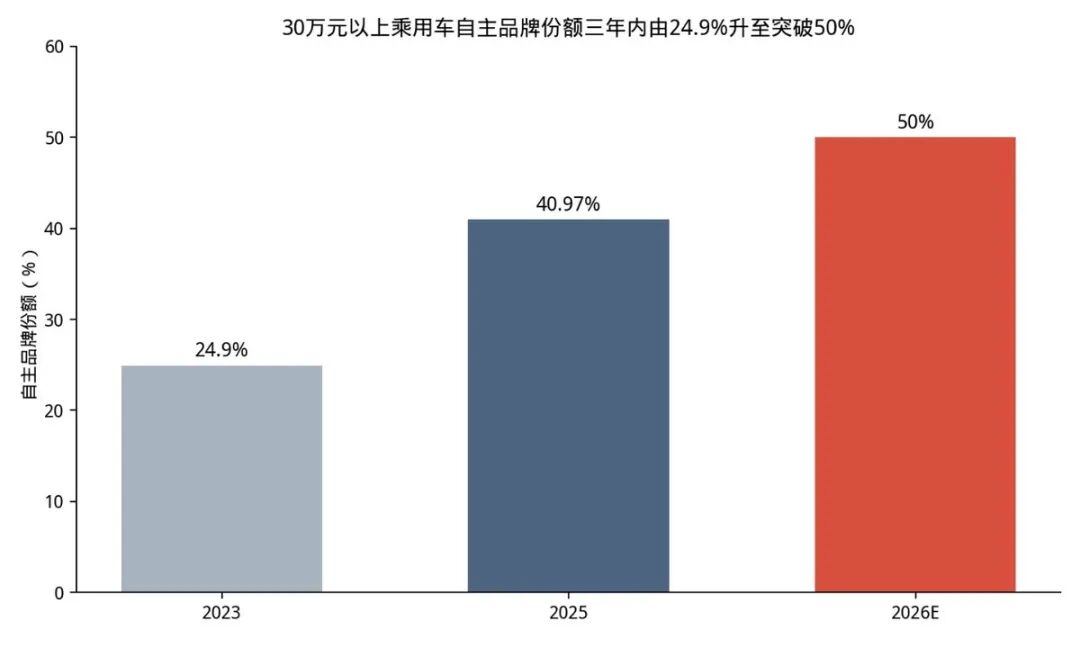
Figure | To think pessimistically, imported luxury cars have lost half their pie in three years.
But to think optimistically, isn't there still half the market left? Moreover, China is a country with an enormous north-south span; fuel vehicles—especially luxury fuel vehicles—cannot be completely driven out of the market.
Among the people who still choose fuel vehicles at present, the mechanical refinement, after-sales network and second-hand circulation system that BBA has built up over the years have not become ineffective; it's just that the premium people are willing to pay extra is thinner than three years ago.
02 Buying a Time Window for a Second New Energy Transformation
In the final analysis, BBA making all flagships domestically produced is not simply aimed at selling a few more units. After all, the GLS plus X7 together only sell just over 800 units a month; even if all were moved over and prices cut further, and volume temporarily pulled up to four or five thousand a month—so what?
What it can truly do positively is try to "keep" people—so that those still looking at BBA do not rush to turn away, and to sustain store traffic until 2027. Ultimately, it is about ensuring that for a period in the future, both the companies and the brands can still stay at this increasingly fierce and harsh "poker table."
Introducing flagships and high-end cars is essentially about buying back for BBA the time that was wasted during the previous round of new energy transformation—and even partially repairing the image that has already been damaged.
Starting from 2024, many domestic car owners have attached the label "off-brand electric cars" to the new energy products of joint venture brands and even BBA.
Harsh as it sounds, it did not come out of nowhere. The Mercedes EQ series, the early BMW iX3, and Audi's previous-generation e-tron series each had their own naming schemes and deliberately distanced themselves from fuel cars in styling, but made no real improvements in performance or driving experience. Not only could their cabins not catch up with domestic mid-to-high-end models of the same period, but driver assistance could only be described as better than nothing—so soon after launch they relied on discounts to move volume.
The retail figures from the Passenger Car Association branch are there for all to see: in 2025, the three companies' new energy sales in China were 14,340, 49,497 and 16,855 units respectively. The scale itself shows that although these cars bear the BBA badge, almost no one already treats them as proper luxury cars to buy.
And to turn the page on these past matters, what is relied on is still the integration of technology from China's side.
Huawei Qiankun's official website currently lists six Audi models, including the all-new A6L, Q5L, Q6L e-tron, Q6L Sportback e-tron, A5L and SAIC A5L Sportback. Audi has been doing deep adaptation to integrate driver assistance into the E3 electronic architecture since 2019, rather than attaching an external module. Although this path was taken somewhat late, it is at least the right one.
Among this generation of cars, BMW's new-generation iX3 is relatively the most worth mentioning. It is not the same thing as the previous old iX3; it is the first domestic model of the new generation, produced in Shenyang, with an 800V high-voltage platform, sixth-generation eDrive electric drive, the Heart of Joy control unit and panoramic iDrive, and driver assistance also jointly developed with Momenta.
Since the new-generation iX3 opened pre-orders at this year's Chengdu Auto Show, although there have constantly been rumors of "brisk pre-orders," based on the current situation, it is still too early to call any joint venture brand car a success before deliveries have been stable for more than half a year. However, its reception in the European market is really quite good—and that is basically without exaggeration.
According to a September 16 report by Germany's Die Welt, counting from its world premiere at the IAA Mobility in Munich in September 2025, within one year this car received more than 100,000 orders in Europe—already praised by BMW as "the most successful model launch in the group's history." For a BMW that is forward-developed, priced into the mainstream range, and keeps up in intelligence, European users are still willing to regard it as a "BMW." So for BMW, the future is still full of hope.
Mercedes has pinned its next bet on the new all-electric E-Class. Ola Källenius mentioned at the end of last month when discussing third-quarter results that this car was started about three years ago, built almost from scratch, and adopts a dedicated pure electric architecture. Mercedes positions it as the successor to the EQE, planned to go on sale in the domestic market in the second half of 2027, with the domestic version's supply chain basically relying only on local procurement.
The much-criticized exterior design of the EQ era—with its bow-shaped body competing for recognition with the three-pointed star—will basically be completely abandoned. As for whether this new car can ultimately receive the same comments as BMW's new iX3, everyone will still need to wait and see.
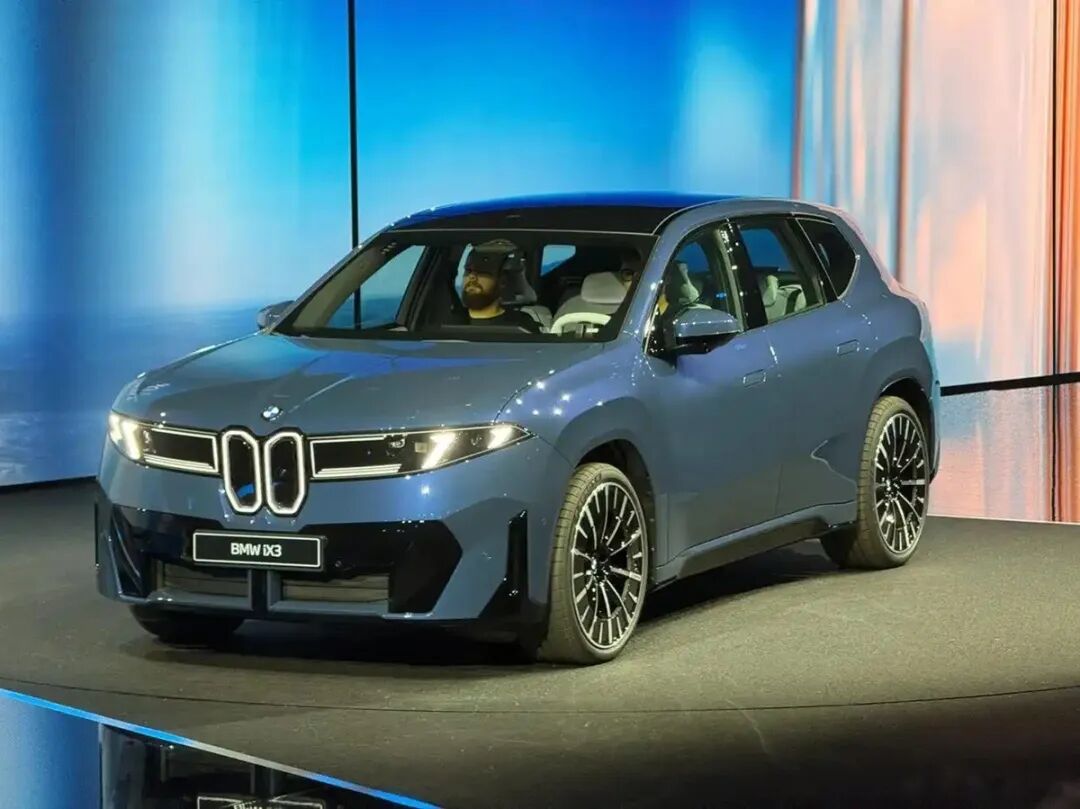
Figure: BMW's new-generation iX3 has drawn an enthusiastic reception in Europe and a favorable response at home.
But ultimately, deliveries have not yet begun; we need post-delivery data, and we need to see whether it can sustain five-digit—or at least several-thousand-unit—sales for more than half a year before we can judge success or failure.
Among the three BBA companies, this author finds the Audi Q6L e-tron somewhat regrettable. Its name looks similar to the old e-tron batch on the MEB platform, but it is actually a PPE-platform product built in Changchun, offered with an optional dual-lidar Huawei Qiankun smart-driving system and a CLTC range of more than 700 kilometers; on paper, its hardware is no weakling.
Yet the market has not affirmed it. What it lacks is of course not hardware—and perhaps not even software—but rather the fact that once customers walk into a store, no one can clearly explain what makes it good, and its name does not distinguish it from previous-generation products with poor reputations. There may also be the problem that it launched half a year too early, thus missing this wave of new pure-electric dividends after this year's Spring Festival.
That PPE line in Changchun is planned for an annual capacity of 150,000 vehicles, with Audi having invested about 2.6 billion euros in total, and now it sits idle most of the time. Similarly, the "lettered badge" in the south has for the time being failed to perform better, indicating that Audi still needs further effort.
If there is still rationality in BBA bringing high-end models over, and it is also a measure that has basically been implemented at present, then bringing all the flagships into domestic production is ultimately just a "wild thought."
Setting up a separate set of tooling, certification, supply chain and spare parts for a car selling a few thousand units a year—what that number comes to when spread over each vehicle is not easy to calculate. The portion of import cost that can be saved must be spread out through more sales, but such cars originally do not exist by relying on more sales. Investment is fixed, and price concessions are up to oneself, but whether more can be sold depends on others. The most important thing is not up to oneself, so this idea has never moved forward.
The A8 being discontinued in its home country is easily misread as meaning it should be moved over here. The line clearance over there is Europe's own capacity arrangement, while whether to take it on here is another round of discussion that hasn't been settled yet—no causal link can be drawn.
The real difficulty lies elsewhere. Before the next batch of cars is delivered, will anyone still be willing to walk into the store? After delivery, will anyone be willing to test drive and place an order? Neither of these depends on the place of origin, nor is it up to the automaker alone. "Flagship domestic production" happens to be one of the few cards BBA can play on their own without waiting for anyone else to cooperate. So I'm surely not the only one who would riff on this. However, we must also admit that this is ultimately unrealistic.
The notion of luxury recognized in the combustion era no longer counts when it comes to EVs. The badge is still there, but the things that once made people willing to pay more—with a different powertrain and different usage—need to be re-articulated through the product. What the three brands need to deliver is a car that can still be regarded as a luxury car in the new energy era. Keep the name, keep the badge—but the substance has to be rebuilt from scratch according to today's standards.
No one has ever doubted that these three can build cars. How to tune the chassis, how much weight a car should feel like it has when driven—these skills are still there and are just as useful in EVs; it's simply a matter of rearranging them according to how people use cars today. China is probably the hardest market to please right now. If you can make a car here that gets people nodding, it won't be far off in other countries either. The R&D and parts for several new cars are now being handled on the China side—this may well be a good thing.
Building good cars has always been a matter of "dumb persistence" that requires digging in. But I don't want BBA to suddenly change their nature in this regard—after all, being too "clever" in certain respects is not a good thing.
Responsible editor: Du Yuxin; Editor: He Zengrong

THE END
-
![]()
Pony Ma Has Found the Right Direction: Betting Big to Buy AI's Future
-
![]()
Globalization of Auto Parts 2.0: It's No Longer About Competing on Price
-
![]()
Domesticating Flagship Models: The Traditional Luxury Brands' Last Resort?
-
Dual-Motor and LiDAR Tech Trickle Down: Is the ORA 7 at 140,000 Yuan a Good Deal or Not?
-
![]()
APEC's AI Highlights: How Will They Transform Shenzhen as a City?
-
![]()
What Is Leapmotor Really After? Q3 Revenue of 31.7 Billion Yuan, Yet Only 40 Million Yuan in Profit!
-
![]()
Himile Technology: Tire Mold Leader with Steady Revenue Growth and Over 2 Billion Yuan in Cumulative R&D Investment Over Five Years
-
![]()
WeRide's Q3 2026: Revenue up nearly 90%, gross margin 43%—Is Spring Finally Coming for L4 Companies?