Apple Bows Its Head, Alibaba Bottom-Fishes: The AI Ticket for China-Market iPhone
 11/06 2026
 516
New Game
On November 2, Alibaba's Hong Kong stock closed at HK$99.45, up 2.47%, pushing its market value close to HK$2 trillion.
The market excitement stems from a long-rumored deal that has finally landed after two and a half years: Apple Intelligence will integrate with Alibaba's Qwen, and the AI foundation for China-market iPhones is officially set. "Apple AI entering China" is no longer speculation.
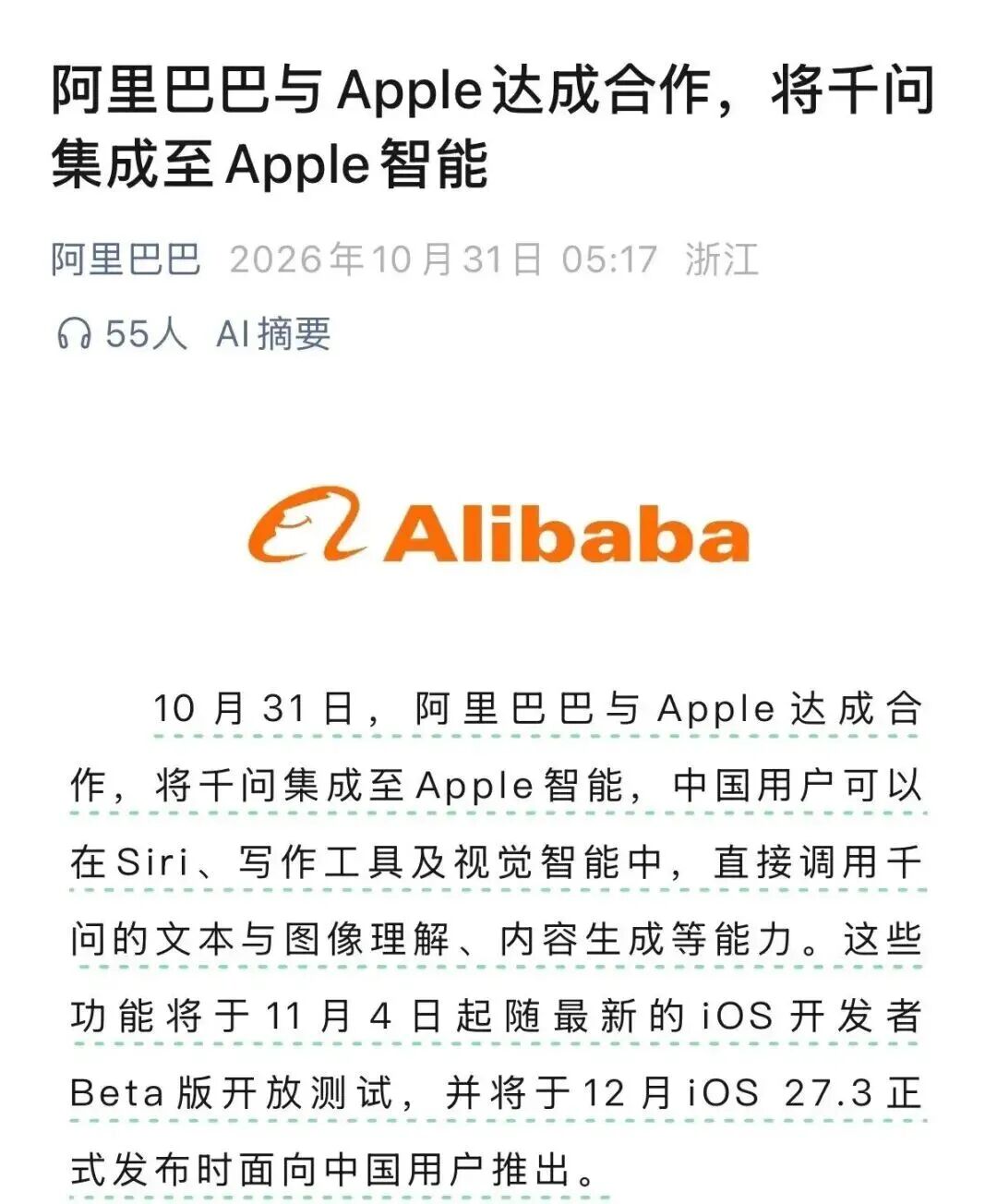
But this is not a simple "giant alliance." Strip away the PR rhetoric, and it looks more like a defensive compromise by Apple and an ecosystem-level bottom-fishing play by Alibaba.
Not a "brain swap," but Apple filling in the cloud
Many say Apple has swapped the iPhone's brain for Qwen. That is inaccurate.
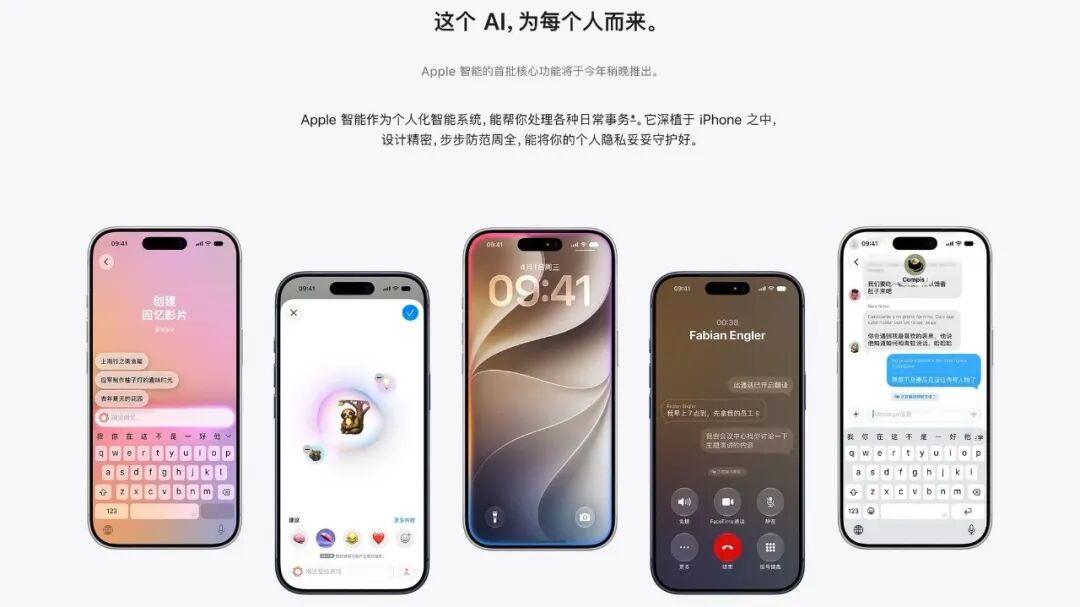
Apple still insists on on-device models leading the daily experience, calling on Qwen only for cloud tasks such as complex text, image understanding, and content generation. The system also retains a user-controlled switch.
Why won't Apple let go of on-device processing? Because that is its moat for privacy and ecosystem. But it must integrate Qwen because, in Chinese-language contexts, local compliance, and complex tasks, Apple's own models are not yet strong enough.
With Huawei, Xiaomi, OPPO, vivo, and other domestic manufacturers already embedding AI into their systems, if China-market iPhones still lack a large model that truly understands Chinese, pressure in the high-end market will only grow. Integrating Qwen is not Apple's sudden generosity, but a "toll" it must pay in the Chinese market.
Two and a half years of screening, Alibaba is the "safest safe card"
Counting from WWDC 2024, Apple has been looking for AI partners in China for over two years. Baidu, DeepSeek, ByteDance, Tencent, Zhipu, Moonshot, and Baichuan were all reportedly approached. Why Alibaba in the end?
Because Apple wants not just model strength, but the inability to go wrong.
It needs top-tier model capability, the ability to withstand high concurrency, complete generative AI filing, and massive C-end product experience. IDC data shows that in the first half of 2026, Alibaba Cloud held 46.6% of China's large language model MaaS market, ranking first; Qwen open-source models have cumulative downloads exceeding 3 billion, with over 300,000 derivative models. With cloud infrastructure, compliance qualifications, and ultra-large-scale user product experience all in one, Alibaba is indeed the safest card.
However, Alibaba is not solely taking on all capabilities. According to multiple media reports, Baidu's Ernie will participate in providing underlying capabilities such as search and visual recognition.
What Alibaba really wants may not be licensing fees
The consideration for this cooperation has not been publicly disclosed, and market rumors suggest the initial phase may not involve direct cash transactions.
What is Alibaba after?
First, once hundreds of millions of iPhone users invoke Qwen in Siri, writing tools, and visual intelligence, it will bring considerable cloud token consumption, directly boosting Alibaba Cloud's computing revenue.
Second, and more critically, To B endorsement. Becoming Apple's model partner in the Chinese market is itself a global-level vote of trust. When Alibaba Cloud later negotiates with government and enterprise clients, the line "Apple's AI foundation is also us" is harder than any advertisement.
Third, it will accelerate Qwen's transformation from "an app" to a "system-level entry point." Users can invoke it in native iPhone scenarios without downloading a separate app, which is highly significant for user penetration of domestic large models.
The time window left for domestic phone makers is shrinking, and the timeline is already clear: developer Beta testing starts on November 4, with official rollout alongside iOS 27.3 in December. The first batch supports iPhone 15 Pro, iPhone 15 Pro Max, iPhone 16 series, and later models; iPad and Mac are not in the first batch.
But what truly deserves attention is where domestic phone makers have already run to. As of July 2026, the on-device large models of six major manufacturers—Huawei, Xiaomi, OPPO, vivo, Honor, and others—have all completed filing. Huawei's Xiaoyi is deeply integrated with HarmonyOS, supporting over 2,100 system-level capabilities, with a one-time completion rate of 91% for cross-app agents; OPPO's AndesGPT has deployed on-device models, with AI image generation 30% faster than Huawei's; Honor's YOYO agent reaches L3-level autonomous decision-making, with over 3,000 automatic execution scenarios; Xiaomi's Pengpai AI is integrated into the Mi Home IoT ecosystem, capable of coordinating over 1 billion devices.
In other words, before Apple AI officially enters China, domestic phone makers have already turned AI into system-level capabilities, even reaching the agent stage. What Apple is catching up on this time is a lesson others began laying out two years ago.
This means that in a month, the AI experience of China-market iPhones will noticeably fill its shortcomings. Siri with Qwen's support, combined with Apple's existing hardware and ecosystem, is likely to re-create upgrade momentum in the high-end market. But domestic manufacturers will not wait in place—while Apple has just obtained its "entry ticket," competitors are already running the next lap.
Conclusion: From "whose parameters are higher" to "whose ecosystem is deeper"
In the longer term, Apple's entry will push China's large model competition from "whose parameters are stronger" to "whose ecosystem is deeper."
Over the past two years, large model vendors competed on benchmarks, parameters, and monthly active users. But from today on, the real battlefield has shifted to terminal entry points—whoever can be written into the operating system and become the default capability users invoke without noticing will control the distribution rights of next-generation AI services.
Apple chose Alibaba not for the strongest model, but for the ecosystem least likely to go wrong. Alibaba took Apple not for a licensing fee, but for a system-level ticket to hundreds of millions of high-net-worth users.
Is this cooperation a life-saving pill for China-market iPhones, or new pressure on domestic phones' premiumization? After iOS 27.3 rolls out in December, user experience will give the most direct answer. But regardless of the outcome, the competitive landscape of China's AI large models has already been quietly rewritten by this one agreement.
-
Agents Are "Redoing" Databases
-
![]()
SAIC and Audi: Building the Purest-Blooded AUDI Electric Cars
-
![]()
Yiwu Is on a Tear Again! GDP Grew 7.9% in the First Three Quarters, and Foreign Trade Is Still Surging
-
![]()
Driving Momentum in Atomic-Level Ultra-Precision Optical Manufacturing: Lingding Optics Secures New Round of Financing
-
![]()
Q3 Non-Recurring Net Profit Surges 686%, Yet Aopu Optoelectronics Burns Through 240 Million Yuan in First Three Quarters
-
![]()
One Person, 11 Labs: The "Pick-and-Shovel" Gold Rush of AI-Driven Science
-
Volkswagen Recalls 610,000 Vehicles as Profits Plunge 98.7%—Is There Still Hope?
-
![]()
Li Jiaqi Moves 2 Trillion Tokens: AI Starts Landing in Shopping Carts