Murata’s Capacitor Orders Soar by 85.5%, Navigating the Intersection of AI and Automotive
 10/08 2026
 535
535
Produced by Zhineng Technology
The MLCC (Multilayer Ceramic Chip Capacitor) sector is experiencing a surge, thanks to AI. Murata Manufacturing, a key player in producing these often-overlooked electronic components, is reaping significant benefits by meeting the demands of both data centers and automotive electronics!
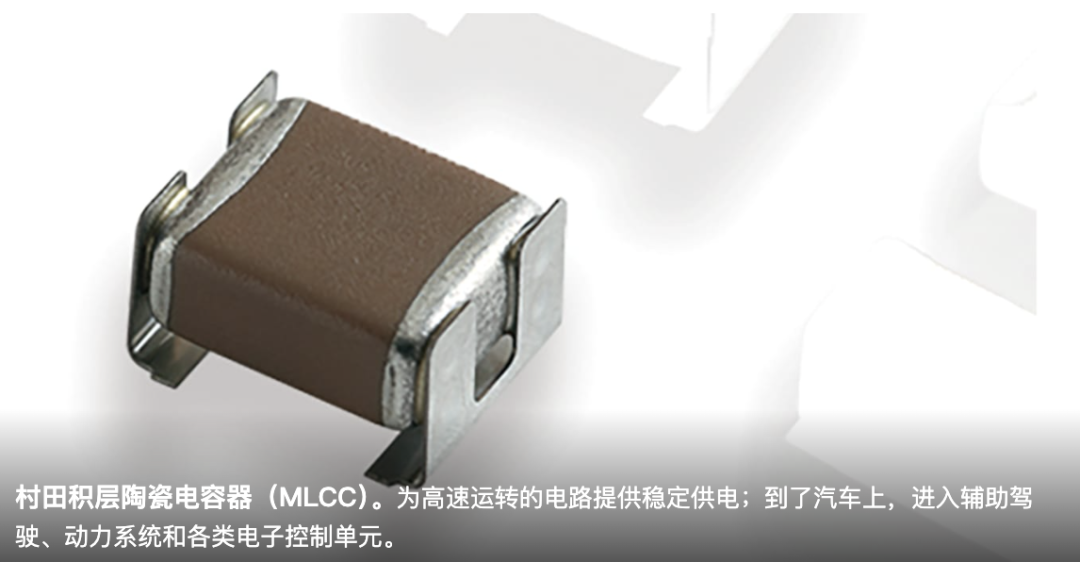
Since Goldman Sachs highlighted MLCCs, the industry has taken notice of the dense array of capacitors on AI server boards. These capacitors are crucial for filtering and smoothing high-performance circuits, ensuring a stable power supply. Despite their small size and numerous presence, the failure of even a single capacitor can significantly impact system reliability, which is of utmost importance. In electric vehicles, pioneered by Tesla in assisted driving, power systems, and various electronic control units, the use of capacitors increases in tandem with vehicle electrification.
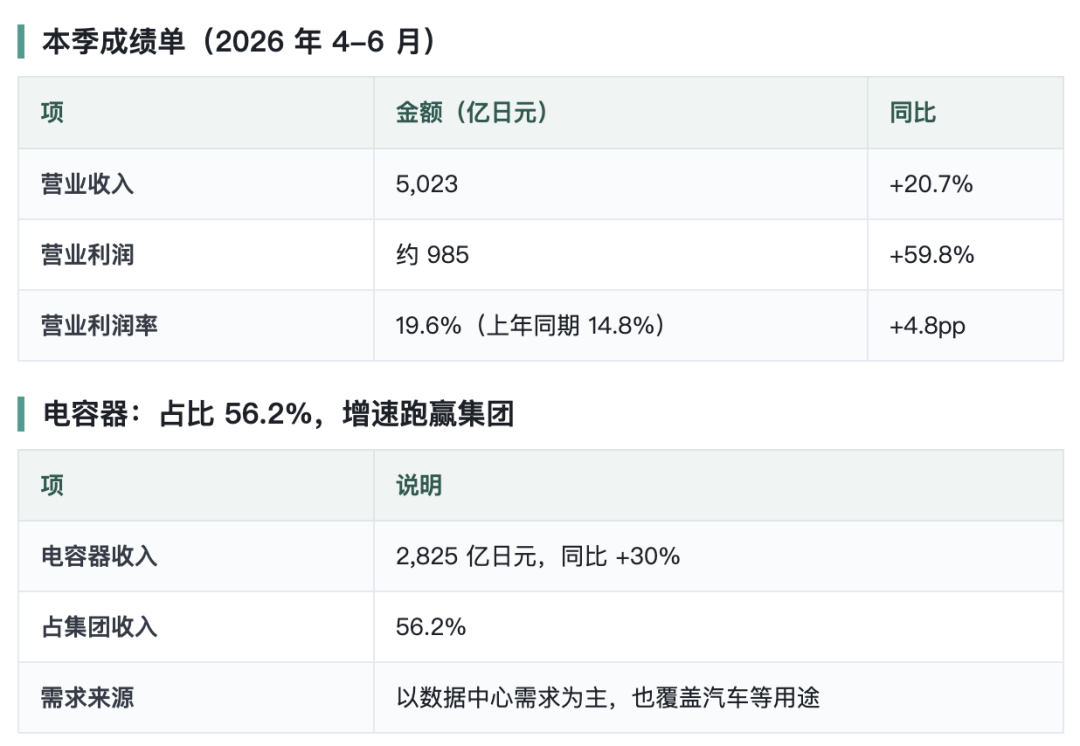
Positioned at the crossroads of these two burgeoning markets, Murata Manufacturing reported a revenue of 5,023 billion yen from April to June 2026, marking a 20.7% year-on-year increase. Its operating profit reached approximately 985 billion yen, up 59.8% year-on-year, with the operating profit margin rising from 14.8% to 19.6%. Capacitor revenue alone surged by 30% year-on-year to 2,825 billion yen, accounting for 56.2% of the group's total revenue. This growth was primarily driven by demand from data centers, with additional contributions from automotive and other applications.
This dual-market strategy has transformed the fortunes of automotive electronics suppliers, who have traditionally relied heavily on vehicle manufacturers for revenue. With the automotive market now experiencing sluggish growth, factories are struggling to operate at full capacity. While Murata is still influenced by automotive cycles, it also benefits from the robust demand in data centers, communications, and consumer electronics. As a provider of fundamental electronic manufacturing capabilities with relatively straightforward competition, Murata is now in high demand!
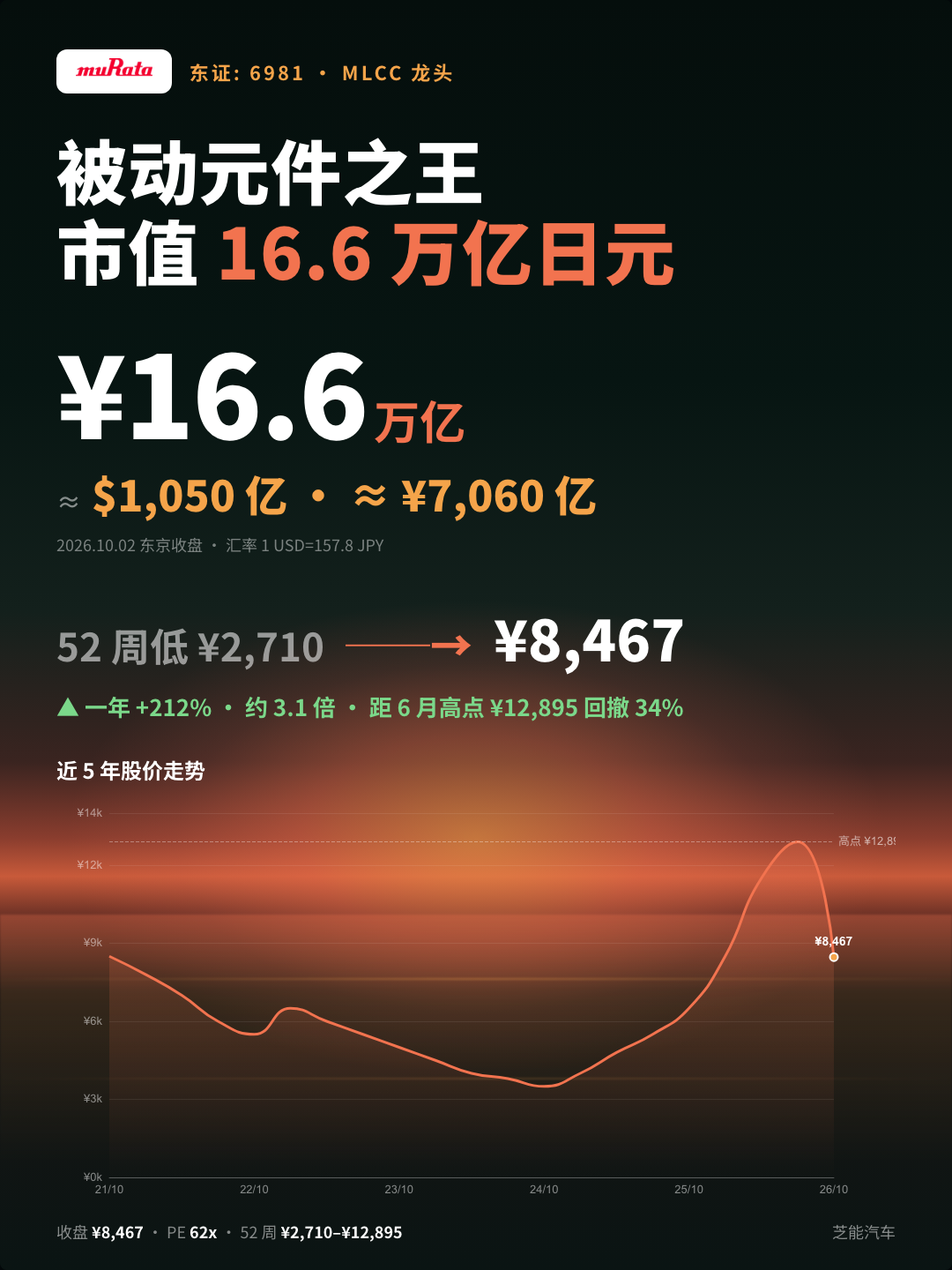
"AI is driving up capacitor prices, and the unsung heroes are indeed reaping substantial benefits." Murata's market value once soared past 1 trillion yen and currently stands at 700 billion yen.
Orders Pave the Way, Profits Follow
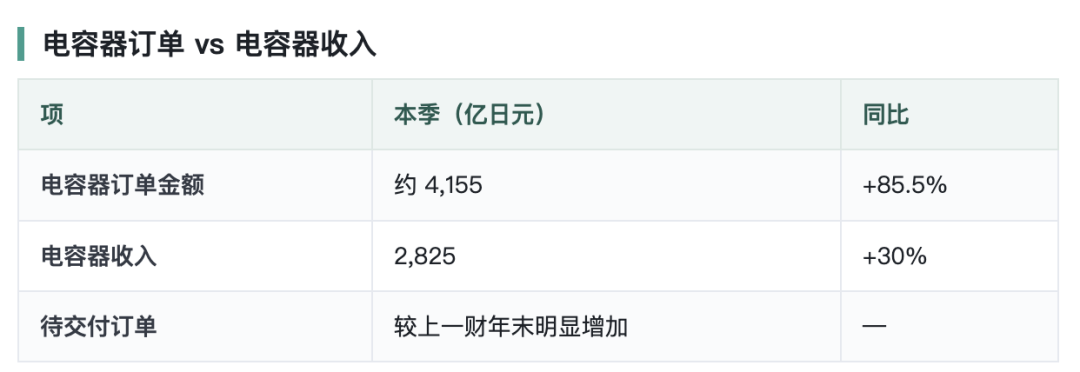
In the second quarter, Murata's capacitor order value skyrocketed by 85.5% year-on-year to approximately 4,155 billion yen. The end-of-period backlog for capacitors also saw a significant increase compared to the end of the previous fiscal year. The order growth far outpaced the quarterly revenue growth, indicating that customer procurement plans are extending into subsequent quarters.
As previously analyzed, profit improvement for such fundamental components primarily stems from pricing and production capacity utilization. Increased sales volume and factory utilization allow fixed costs to be spread across more products. The yen's year-on-year weakness also boosts overseas revenue when converted back to yen. With rising demand, a company with production scale and manufacturing yield advantages can more fully convert capacity into profits.

The automotive business is also thriving. Murata's mobility revenue, disclosed by end market, increased by 16.1% year-on-year, driven by growth in automotive capacitors, EMI filters, and sensors. Automotive-grade products emphasize long-term reliability, service life, and complex operating conditions, while data centers focus on power supply efficiency, equipment density, and operational stability. Materials, production processes, certifications, and customer design integration may all differ. During boom times, suppliers need to strategically allocate R&D and capacity among these applications.
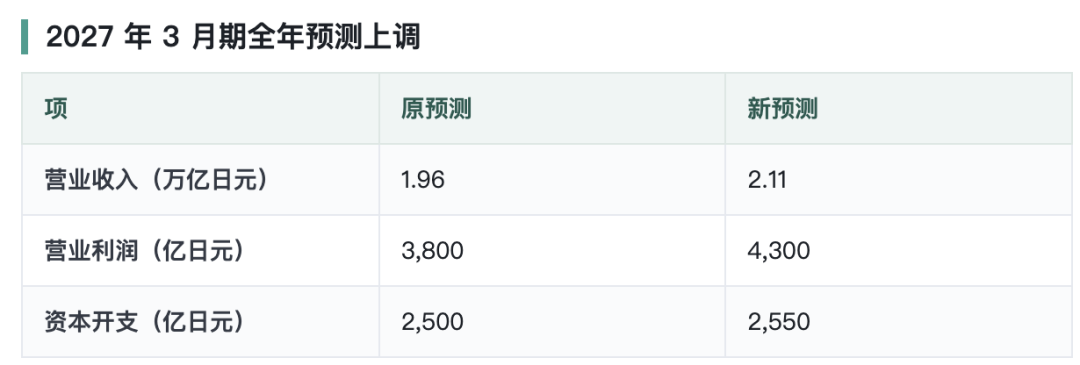
Murata has revised its full-year revenue forecast for the fiscal year ending March 2027 upward from 1.96 trillion yen to 2.11 trillion yen, and its operating profit forecast from 380 billion yen to 430 billion yen. Capital expenditure plans have also been increased from 250 billion yen to 255 billion yen.
The high prosperity of the electronic components industry poses challenges in deciding when and how much to expand production and which specifications to produce. Expanding too slowly risks missing out on customer platforms; expanding too quickly risks depreciation and idle equipment eating into profits if server procurement slows. Even with long-term terminal growth, short-term inventory cycles can cause orders to fluctuate.
Capacitors have a wide range of applications, and switching each production line between server and automotive products takes time. Different specifications, certifications, and reliability requirements necessitate time for capacity adjustments. This is somewhat analogous to the battery industry!
Murata's competitiveness largely lies in these less headline-grabbing areas: material formulations, thin-layer stacking, batch consistency, yield rates, customer certifications, and stable delivery. These factors determine whether a company can deliver when demand arises and whether it can maintain returns after the boom passes. AI servers have once again brought capacitors into the spotlight, while automotive electrification provides a longer-term demand foundation.
Summary: We previously only briefly tracked Murata, but with MLCCs surpassing inductors in importance, we will continue to monitor Murata and TDK, driven by the AI revolution! The humble MLCC capacitor remains a testament to capital-intensive manufacturing.
-
Multi-route Auto Racing, Abandoning BEV: Analyzing Leapmotor's World Model from a Paper Perspective
-
![]()
Huawei and Qualcomm Announce Broad Patent Licensing Agreement: Covering 5G, AI, and More
-
Is It Hard to Charge EVs on Expressways During National Day? Netizens: Is It Illegal to Charge Off the Expressway? Blame Poor Planning by Car Owners!
-
Data Center Space in Short Supply, Yet Capital Turns Selective
-
Huawei and Seres: The Path of Synergy and the Perils of Divergence
-
![]()
Murata’s Capacitor Orders Soar by 85.5%, Navigating the Intersection of AI and Automotive
-
![]()
Bosch’s Mid-Year Report: €46.41 Billion in Revenue, Automotive Sector Contributes 60%, Growth Spurred by HVAC Acquisition
-
![]()
Delta Electronics Hits Trillion-Yuan Market Cap: AI Fuels Growth Amid Automotive Struggles