High-Speed NOA Collision: Blaming the Driver When Only a Sudden 0.2-Second Hard Brake Could Avert Disaster!
 10/09 2026
 496
496
In the Anshun section incident on the Shanghai-Kunming Expressway, the driver reported that the assisted driving system disengaged just about 10 meters from a freight truck while traveling at 120 km/h, resulting in a rear-end collision!
Relative speed: approximately 11 meters/second; collision imminent in 0.9 seconds.
After factoring in the 7.7 meters required to nullify the speed differential through braking, the driver was left with a mere ~0.2 seconds to respond.
Produced by Zhineng Technology
On the highway, the most harrowing scenario is when the NOA system abruptly signals 'Take over now' and deactivates assisted driving—a recipe for disaster. Even if the driver spots the truck ahead and slams on the brakes, a collision may still be unavoidable.
According to a China Business Network report, in the Anshun section crash on the Shanghai-Kunming Expressway, the driver claimed the assisted driving system disengaged just around 10 meters from a truck while traveling at approximately 120 km/h.
1) The most exasperating aspect of highway NOA: How quickly must effective braking be initiated?
To assess the feasibility of human intervention in such scenarios, we must calculate the latest moment at which the driver must commence effective braking post-NOA disengagement to avert a collision.
This window of opportunity is far narrower than it seems.
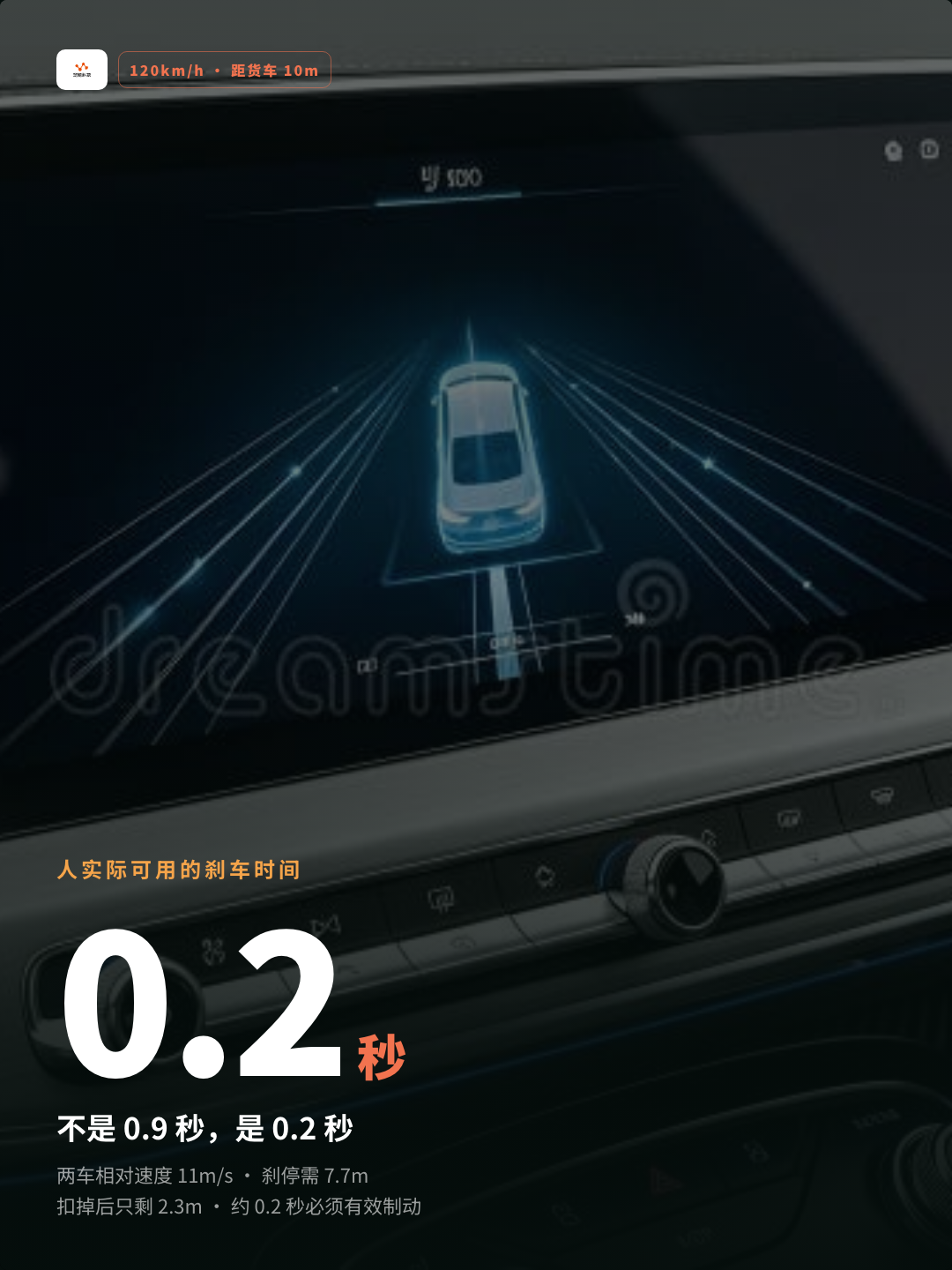
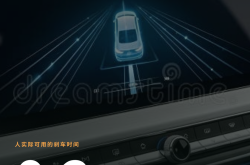
Assuming the car is traveling at 120 km/h and the truck ahead at 80 km/h, the relative speed differential is 40 km/h (approximately 11 meters/second). At a 10-meter distance, a collision would ensue in roughly 0.9 seconds at these speeds.
While 0.9 seconds is already exceedingly brief, it's not the actual time the driver has at their disposal.
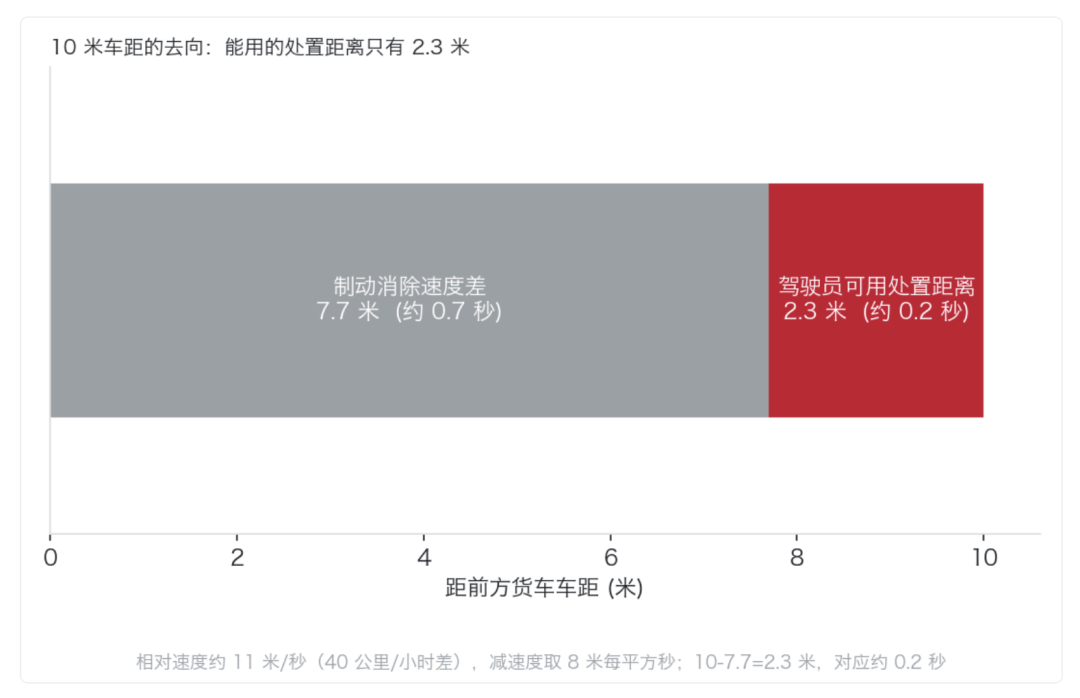
Once braking commences, additional distance is required to negate the 40 km/h speed differential. Assuming the car decelerates at 8 meters/second², this 'closing distance' alone necessitates approximately 7.7 meters.
Deducting 7.7 meters from the initial 10-meter gap leaves roughly 2.3 meters; at approximately 11 meters/second, the driver must initiate braking with the requisite intensity within about 0.2 seconds.
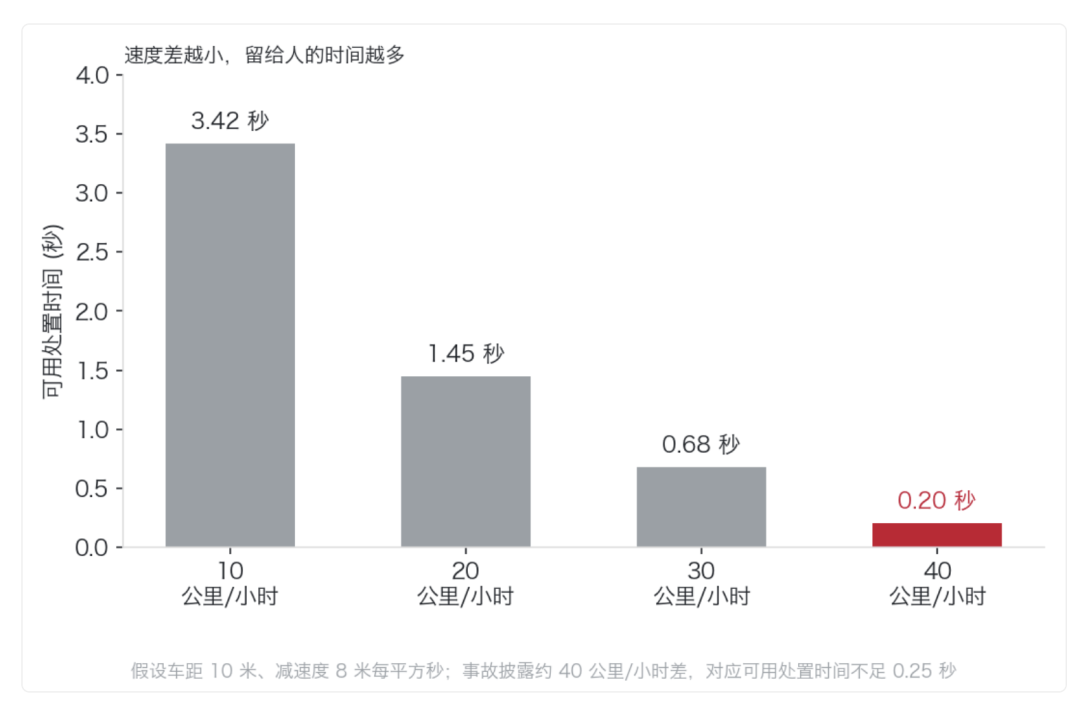
This simplified calculation does not account for the time taken to move the foot to the pedal, brake force buildup, ranging errors, or safety margins.
Under these assumptions, effective braking must occur within approximately 0.2 seconds.
2) Why does highway NOA wait until the last 10 meters to prompt disengagement?
The question arises: Why does the NOA system reach a critical point where it must relinquish control at a mere 10 meters?
When confronted with an object ahead, assisted driving may initially detect a target but remain uncertain if it's in the same lane; it may recognize a truck but incorrectly predict no rapid approach; or it may assess risk but maintain speed until it can no longer process the situation, only then alerting the driver.

These scenarios may all trigger the same 'Take over now' message, yet the underlying technical causes vary significantly.
The crux of safe design lies in resolving uncertainties before the takeover window closes.
Issue timely alerts and moderate deceleration as risks escalate; implement stronger braking upon confirming collision danger. This necessitates balancing the risks of false braking—sudden stops for uncertain targets are impractical. The challenge lies in sequencing target recognition, risk assessment, deceleration, and driver alerts into a cohesive workflow.
Navigation, lane control, and emergency braking handle distinct tasks. Key considerations include whether the vehicle continues decelerating post-disengagement, if automatic emergency braking intervenes, and when the driver first applies the brakes. Accident logs must clarify this timeline.
L2 systems mandate continuous driver road awareness—a point beyond dispute, as clarified in SAE's classification.
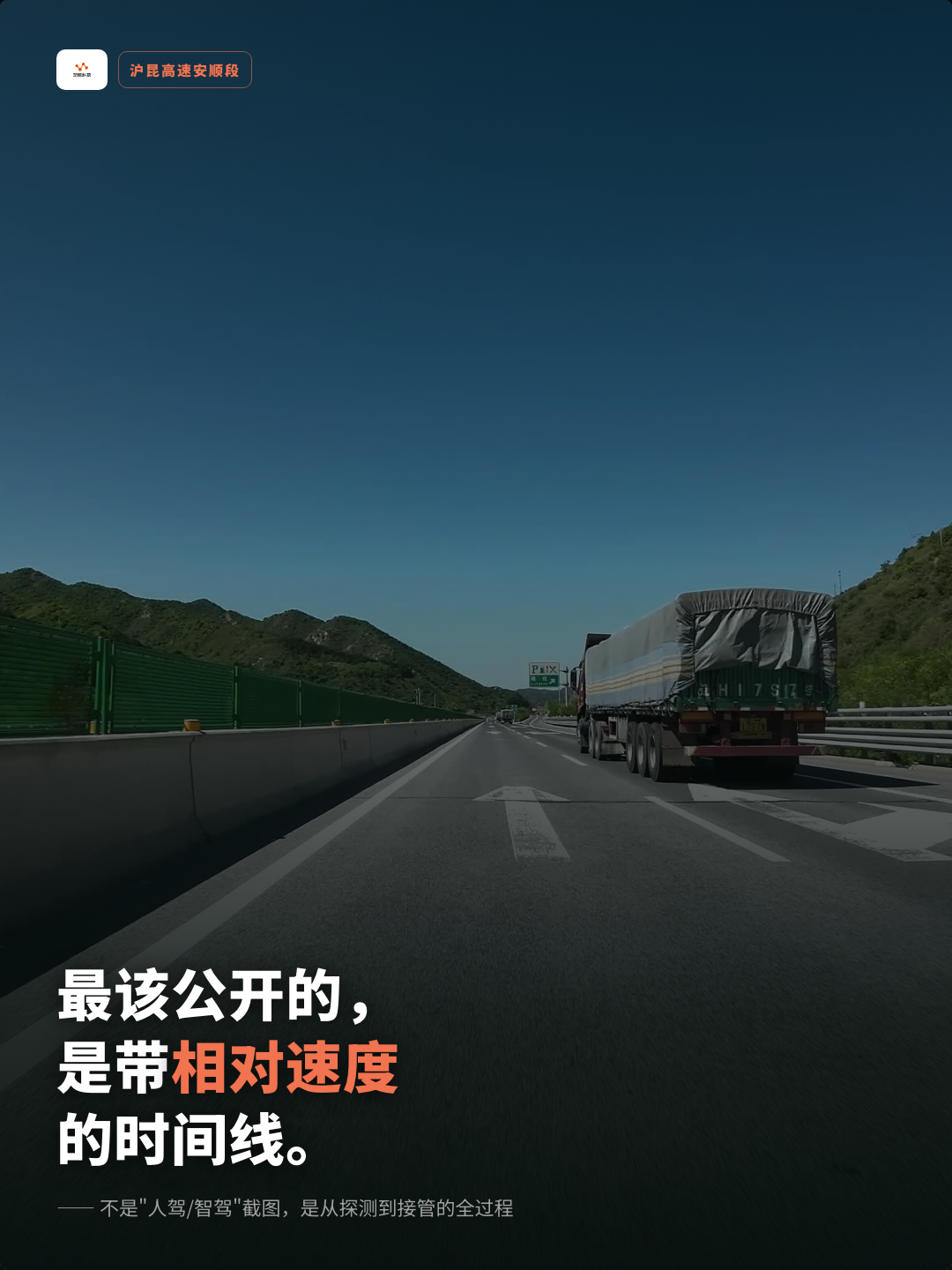
Such accidents most critically necessitate a public timeline detailing distances and relative speeds:
When the truck was initially detected.
When collision risk was evaluated.
When the alert was issued.
When deceleration commenced.
When assisted driving disengaged.
When emergency braking was triggered.
When the driver applied the brakes.
This reveals whether the issues stemmed from perception, judgment, action, or handover, helping consumers perceive assisted driving capabilities differently. When the system issues a takeover prompt, how much reaction time remains for the driver? If the answer approaches zero, it's a case of shifting blame!
Summary
Human-machine interaction safety in assisted driving hinges on driver monitoring (DMS), operational control, and whether the NOA system resolves uncertainties before the window closes. Following accidents, can automakers provide a timeline with relative speeds based on data?
Now, NOA—much like AI—serves as our assistant. Automakers must commence executing it properly!
-
![]()
AI Interviewer: A Step Too Far for Workers
-
![]()
Musk Spearheads AI Renaming Trend! SpaceXAI Officially Rebrands to SpaceXSI
-
![]()
Aptiv Divests Versigent: Following the Shedding of Wiring Harnesses, the Previously Unwanted Power Business Achieves a 10.8% Growth in Q1
-
![]()
Post-2000s Entrepreneur Builds $67 Billion AI Unicorn, Even Meta Takes Notice
-
![]()
Despite 800V and 6C Capabilities, Why Do We Still Face 5-6 Hour Charging Queues?
-
![]()
McLaren’s Market Plummet: From 310 to a Mere 9 Annual Sales!
-
![]()
High-Speed NOA Collision: Blaming the Driver When Only a Sudden 0.2-Second Hard Brake Could Avert Disaster!
-
![]()
AI Transforms the Tech Industry: Software's Glory Fades as Hardware Starts Profiting from Scarcity