Despite 800V and 6C Capabilities, Why Do We Still Face 5-6 Hour Charging Queues?
 10/09 2026
 441
441
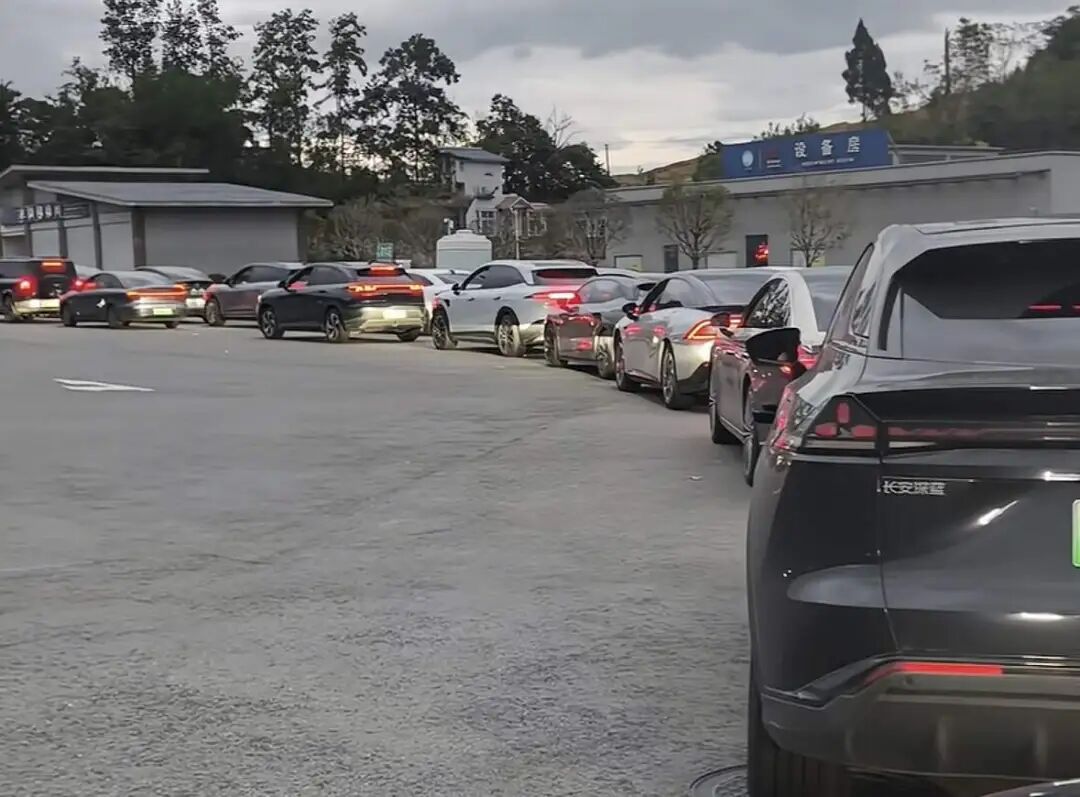
Holiday Charging Queues Leave EV Owners Frustrated
”
Author|Wang Lei
Editor|Qin Zhangyong
Now that the National Day holiday has ended, how long was the longest queue you endured to charge your vehicle?
Every year during the National Day holiday, the long queues for charging electric vehicles (EVs) on highways become a hot topic online, and this year was no different. Once again, it became a major point of discussion, frequently trending on social media:
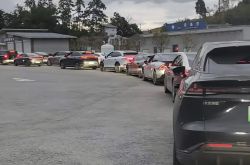
Hundreds of vehicles line up, with queue numbers exceeding 100. Many service areas implement a numbering system for charging. News reports reveal car owners waiting for 6-7 hours to charge, with some enduring waits for over 60 vehicles, sleeping in their cars without daring to turn on the air conditioning.
There are even instances of EVs running out of power with only 1% charge remaining, being pushed to charging stations, only to find dozens of vehicles ahead in the queue. Conflicts over charging stations persist.
2026 was anticipated to be the year when 800V high-voltage platforms, ultra-fast charging, and flash charging from major brands would be widely adopted, alleviating range anxiety. So, why has charging anxiety become more pronounced each year?
Many netizens have seized the opportunity to comment: 'See, EVs are no good,' 'The National Day highway exposes the flaws of EVs,' or 'Gasoline cars are still superior.'
01 Extended-Range Vehicles Competing for Charging Stations
The difficulty in charging EVs on highways during the National Day holiday is undeniable, as countless real-life cases have emerged over the past seven days.
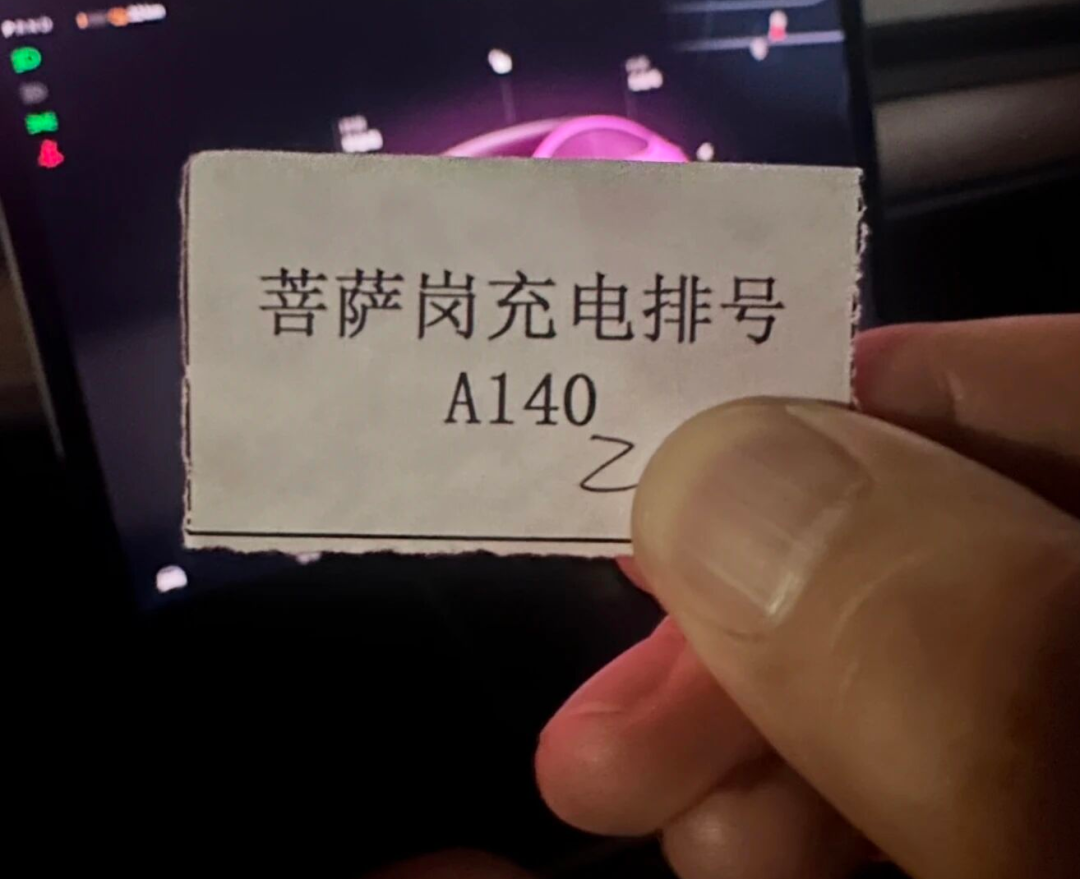
At 3 a.m. on October 1st, a queue number slip circulated on social media, displaying the number A140. The staff member distributing numbers informed car owners that only 29 numbers had been issued at that time.
Despite over 100 vehicles still waiting to charge, for an EV and its owner whose remaining battery wouldn't last until the next exit to find a charging station, even being 100th in line meant they had no choice but to wait.
According to a report by Red Star News, an even more extreme scene unfolded at the Dazhou North Service Area on the Baomao Expressway, where dozens of vehicles lined up at the charging stations. According to car owners at the scene, an EV ran out of power with only 1% charge left and 'broke down' on the roadside not far from the charging station that night.
In the end, service area staff and several kind-hearted car owners pushed the vehicle to the charging station, but even after reaching it, dozens of people were still ahead in the queue.
Another car owner, Mr. Liu, who drove into the Lingjiang Service Area, had planned to travel from Chengdu to Inner Mongolia. He passed by two service areas along the way but was not allowed to enter due to heavy traffic. After finally entering the Lingjiang Service Area, he received queue number 99 and ended up waiting for a full 5 hours.

A car owner driving from Wuhan to his hometown said he received queue number 112 at the service area entrance at 2 p.m. that day and waited until 7 p.m. before being called, with the queue lasting over five hours. During that time, he didn't dare to go far to eat, fearing he would miss his turn and have to queue again, so he just stayed in his car.
And this was just the first night of the 2026 National Day holiday. Over the following week, such scenes repeated themselves at highway service areas across the country.
In addition, desperate measures were taken to alleviate the congestion.
At the Zaoyang North Service Area in Hubei, a temporary strict rule was implemented: all vehicles must leave after charging to 80%, with numbered entry in rounds, allowing only 48 vehicles per round. During peak times, nearly 200 vehicles were stuck, with the queue extending onto the main road of the service area, making it difficult even to enter.
Ms. Huang, who passed through the east zone of the Zaoyang North Service Area in Hubei, said that upon entering the service area, she had to take a number, and staff distributed numbers and called them in rounds for charging, with the queue once reaching the fifth round. 'Based on 48 numbers per round, there were about 200 vehicles waiting to charge at the scene at that time,' Ms. Huang said. During charging, all vehicles had to leave after reaching 80%.
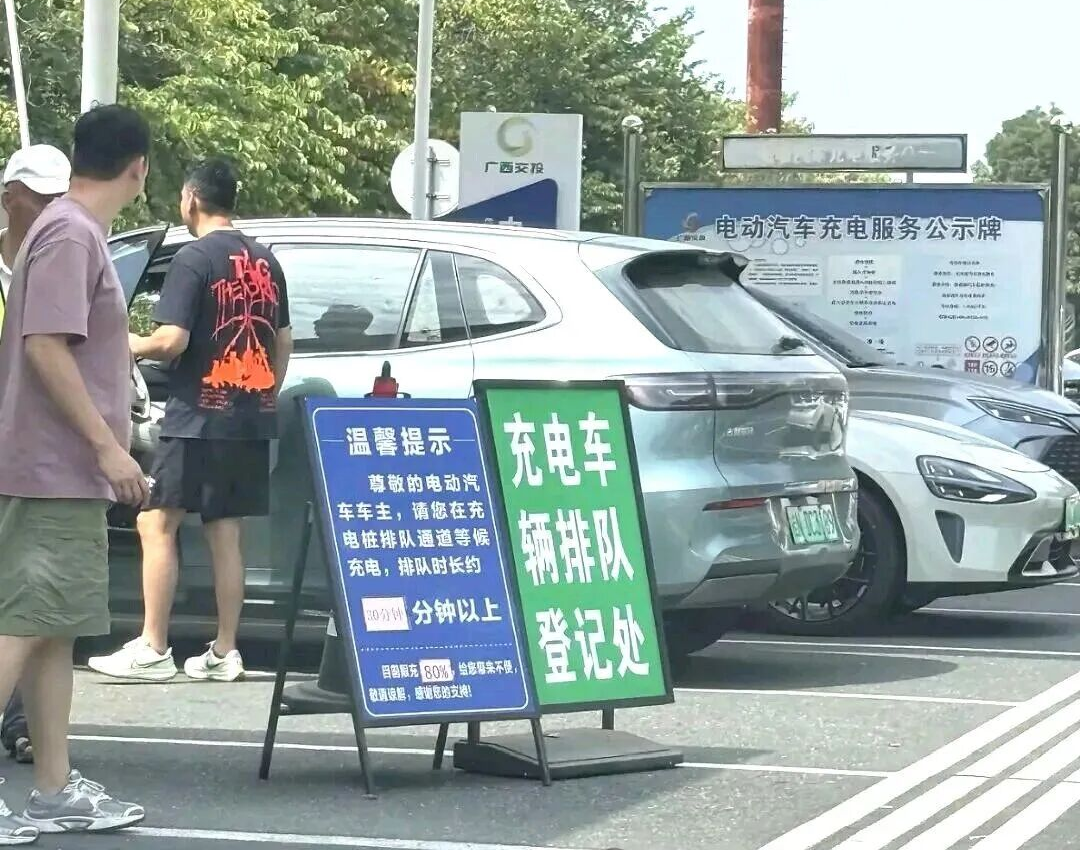
In fact, such measures were not isolated cases. Reports indicated that service areas such as Baolun and Luoyang Longmen also set limits of 70%-80%, and official departments in Hunan, Beijing, and other places mentioned measures like setting thresholds and trading efficiency for time to alleviate charging pressure.
There were also cases of automakers' proprietary ultra-fast charging stations experiencing collective 'slowdowns' during holidays. Many car owners reported on social media that at highway service area charging stations, they found that the power output was far from maximum when it was their turn. 'It entirely depends on how much power is left in the energy storage cabinet. If the previous few vehicles depleted the storage, the remaining charge would be slow grid-supplied charging, no different from ordinary stations.'
This point was quickly confirmed by customer service from relevant automakers, who stated that charging peaks rely on energy storage cabinet discharge, and during high-concurrency holidays, energy storage recharging cannot keep up, causing the system to automatically reduce power, which cannot be manually intervened.
The return journey was no easier. Data from the Ministry of Transport showed that on October 6th, 44 highway sections nationwide were marked as prone to congestion, and 79 service area charging stations were operating over capacity, with long charging queues reappearing. Some car owners waited for 3 hours to charge, and there were even cases of charging stations being damaged just as vehicles arrived, forcing them to rejoin the queue after only charging for a few minutes.
Moreover, this year, against the backdrop of already acute range anxiety, extended-range vehicles found themselves at the center of controversy. The core issue was simple: why do extended-range vehicle owners, who have a gasoline tank as a backup, compete for charging resources with pure EV owners during holidays?
The source of the controversy came from a report by Dahe Daily, which interviewed an extended-range vehicle owner at the Zaoyang North Highway Service Area who chose to queue for charging along with 200 other vehicles, even though he could have refueled and continued his journey.
Subsequently, a well-known automotive influencer, Han Lu, publicly shared his views on the matter, pushing the debate to a new level.
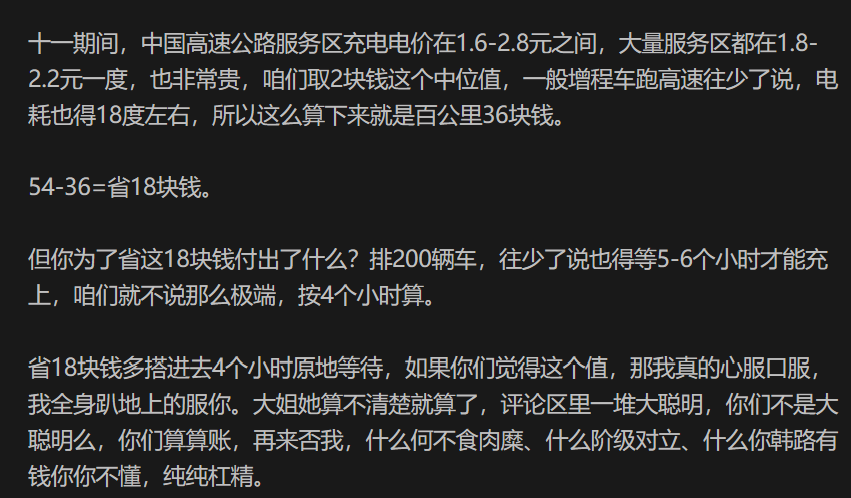
He calculated that an extended-range vehicle uses about 54 yuan worth of gasoline per 100 kilometers on the highway, compared to about 36 yuan for electricity. In other words, this extended-range vehicle owner queued for 4 hours just to save 18 yuan, which averages to less than 5 yuan per hour.
When charging stations are already in short supply, the fact that extended-range vehicles, which have a gasoline tank as a backup, are also vying for spots makes it easy to imagine how frustrated pure EV owners, who rely solely on electricity, must feel.
02 Resource Misallocation Under Extreme Demand
Charging isn't usually this difficult, so why does everything fall apart during the National Day holiday?
Many people's first reaction is, 'Why aren't there more charging stations built?' In fact, from a macro industry perspective, domestic new energy charging hardware has long since moved beyond shortage and achieved widespread availability.
First, let's look at some data. As of now, approximately 89,000 charging facilities have been built at highway service areas nationwide. Just from January to August 2026, the Ministry of Transport added 11,000 high-power charging facilities, equivalent to the total cumulative amount before that. Charging facilities now basically cover all service areas, and on ordinary days, the utilization rate of highway charging stations is less than 20%.
So, what's the problem?
The most core reason is: there are too many vehicles within a unit of time.
A service area might only serve a dozen vehicles on an ordinary day but suddenly sees hundreds arrive during holidays. If configured for peak demand, there would be significant idleness on ordinary days; if configured for ordinary days, there will inevitably be shortages during holidays.
Let's look at statistics from the National Energy Administration. On the first day of the National Day holiday, the total charging volume on highways nationwide reached 28.0469 million kilowatt-hours, a year-on-year surge of 60.4%, setting a new single-day record for holidays.
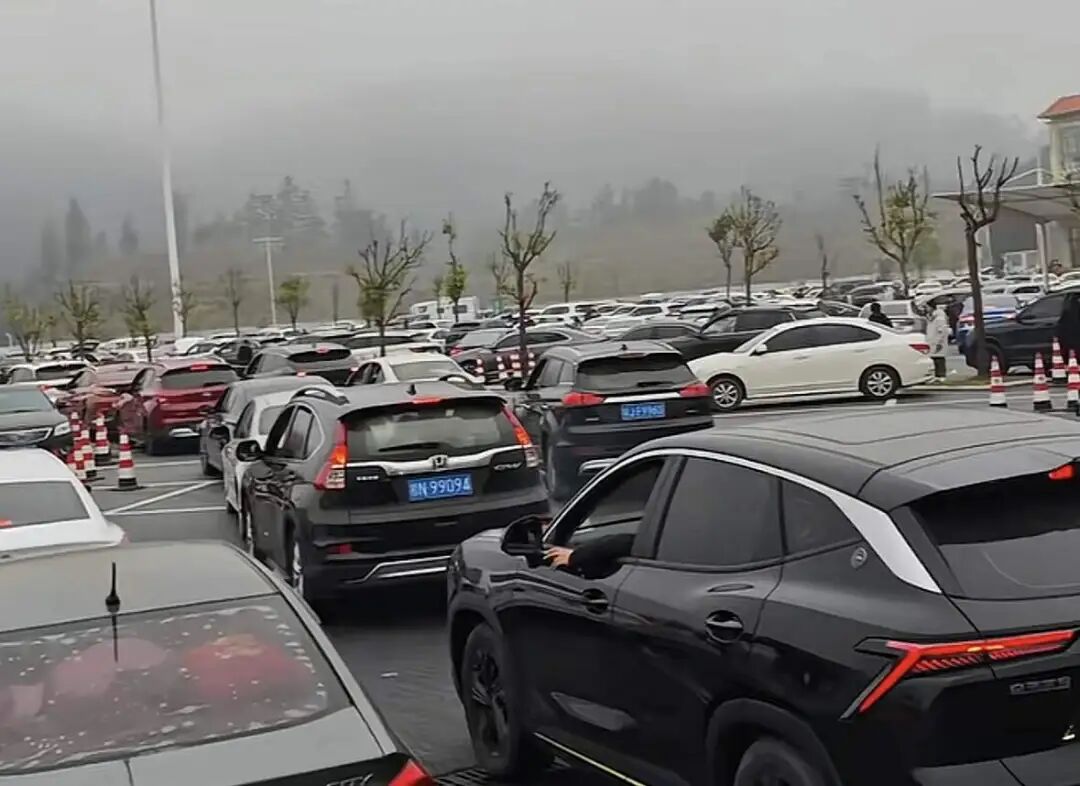
During the first three days of the holiday, 2.9686 million charging sessions were completed at 62,700 highway charging facilities under monitoring, averaging 989,500 sessions per day, a year-on-year increase of 48.41%; the total charging volume reached 71.6193 million kilowatt-hours, averaging 23.8731 million kilowatt-hours per day, a year-on-year surge of 49.39%.
On the first day of the National Day holiday, highway traffic volume reached 71 million vehicles, with new energy vehicle traffic peaking at 17.8 million, 1.8 times the usual amount.
Moreover, the average daily operating time ratio of highway charging facilities nationwide reached 89.27%, meaning they were operating nearly 24 hours a day at full capacity, with people rotating but charging stations never resting.
What does it mean that nearly 28 million kilowatt-hours of electricity were charged on highways nationwide in a single day? Assuming an average of 50 kilowatt-hours per vehicle, on October 1st alone, charging stations along highways nationwide provided life-saving charges for over 560,000 new energy vehicles.
Moreover, these charging demands were highly concentrated at the same time, on the same road sections, and at the same service areas. At this point, what measures supply capacity is not just the 'absolute number of charging stations' but the 'number of vehicles that can be served per unit of time.'
This also causes infrastructure that was originally sufficient to immediately break down in the face of extreme tidal traffic flows.
Of course, apart from the objective factor of high traffic volume, one cannot overlook the charging characteristics of batteries. Many car owners are accustomed to charging to 100%, fearing 'running out of power,' which is understandable.
However, the charging characteristics of power batteries dictate that charging power significantly decreases after 80%, entering a trickle charge state, doubling the time required while providing very limited additional range. If one vehicle occupies a charging station for an extra half hour, several more vehicles will be stuck behind.
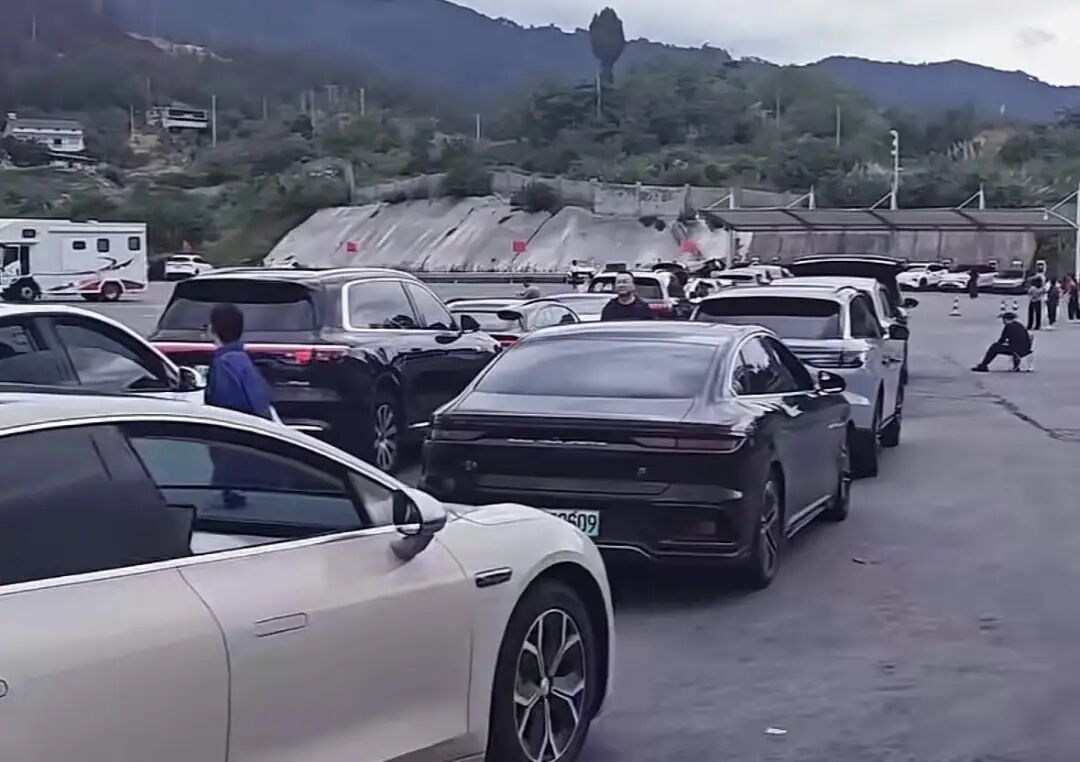
This is why many service areas adopt the measure of 'limiting charge to 80%.' Additionally, the actual driving range of electric vehicles significantly decreases at high speeds.
An objective fact is that as a new energy vehicle owner, one cannot wait until only 5% battery remains before seeking a charging station. In most cases, planning for a charge begins at 15% or even 20%, and when combined with service area 'charge limiting' measures, the actual usable battery range sharply decreases.
This leads to a significant increase in the frequency of charging for car owners, further amplifying range anxiety.
Moreover, charging speeds vary significantly between different vehicle models, and even with charge limiting, it is difficult to eliminate the disparities in charging speeds between models.
The issue of highway charging under extreme tidal travel demand is essentially a typical growing pain on the path to new energy vehicle adoption. Similar issues did not just arise in the new energy era; during the Golden Week in the era of gasoline vehicles, long queues for refueling at popular service areas were common, and some service areas even ran out of fuel.
However, compared to EV charging, refueling takes less time, so the pain was less acute. But now that EVs have become the absolute mainstream for holiday travel, the slower per-vehicle charging efficiency and the hidden issues of tidal travel have been brought directly to the forefront.
The second half of new energy vehicle adoption should shift from 'having vehicles' to 'ease of charging.'
-
![]()
AI Interviewer: A Step Too Far for Workers
-
![]()
Musk Spearheads AI Renaming Trend! SpaceXAI Officially Rebrands to SpaceXSI
-
![]()
Aptiv Divests Versigent: Following the Shedding of Wiring Harnesses, the Previously Unwanted Power Business Achieves a 10.8% Growth in Q1
-
![]()
Post-2000s Entrepreneur Builds $67 Billion AI Unicorn, Even Meta Takes Notice
-
![]()
Despite 800V and 6C Capabilities, Why Do We Still Face 5-6 Hour Charging Queues?
-
![]()
McLaren’s Market Plummet: From 310 to a Mere 9 Annual Sales!
-
![]()
High-Speed NOA Collision: Blaming the Driver When Only a Sudden 0.2-Second Hard Brake Could Avert Disaster!
-
![]()
AI Transforms the Tech Industry: Software's Glory Fades as Hardware Starts Profiting from Scarcity