FAW, Toyota, and GAC Ink Tripartite Pact: Fostering Integration and Synergy Between Northern and Southern Toyota via Capital Linkage
 10/09 2026
 527
527
It came as a surprise to many that, over four decades after automotive joint ventures were established in China, Northern and Southern Toyota would come together in such a bold yet commercially sound manner.
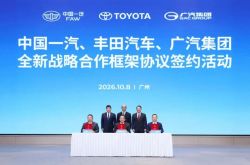
On October 8, China FAW Group, Toyota, and GAC Group signed the agreement in Guangzhou. The most significant clause stipulates GAC's intention to acquire the 50% stake held by FAW in FAW Toyota through a private share placement. Following the transaction, FAW will emerge as a key strategic shareholder of GAC Group, while FAW Toyota and GAC Toyota will achieve full integration in core areas such as R&D, procurement, production, and sales.
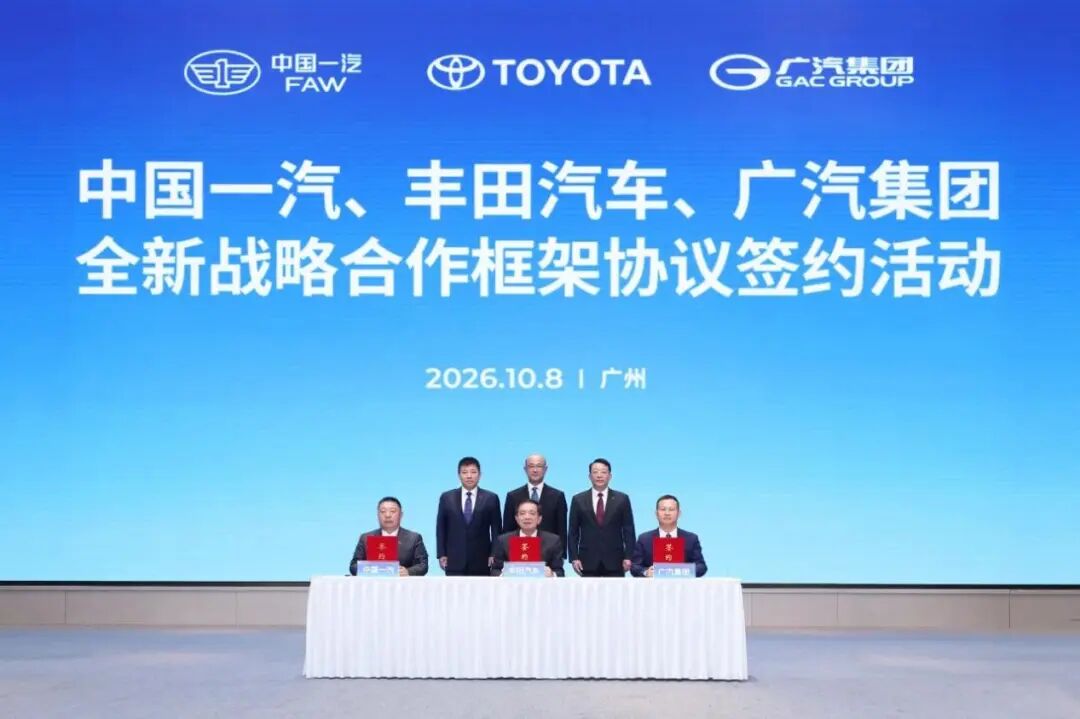
This event marks a rare instance of 'top-tier capital restructuring' involving a central state-owned enterprise (SOE), a local SOE, and a multinational automaker in the annals of China's automotive industry. Amidst the overwhelming challenges faced by the joint venture sector, Toyota has finally taken the decisive step to merge its two separate Chinese operations, which had been operating independently for over twenty years.
Reflecting on the past two decades, Toyota's strategy in China has been evident—'hedging its bets.' The Corolla versus Levin, RAV4 versus Wildlander, Avalon versus Camry. During the heyday of fuel-powered vehicles, this dual-car strategy proved to be a powerful tool for capturing market share, balancing the interests of its two Chinese partners while maximizing dealer network penetration. The cumulative sales of 23.56 million vehicles stand as a testament to the success of this model.
However, amidst the fierce competition in the new energy and intelligent vehicle sectors, the 'dual-car strategy' quickly transformed from a competitive advantage to a source of internal friction.
While domestic brands engaged in price wars with extremely rapid iteration cycles and aggressive supply chain optimization, Northern and Southern Toyota were still developing two sets of exterior molds, maintaining two procurement systems, and allocating two marketing budgets for the same prototype vehicle. In a growing market, this was termed comprehensive coverage; in a cutthroat, inventory-laden market, it is seen as resource wastage.
GAC's move to unify FAW Toyota's equity through share issuance holds immense value in halting the bleeding and consolidating strengths. R&D efforts will no longer be duplicated, supply chain procurement scale effects will be amplified, and channel resources will be optimized and reset. The 'big backend synergy' between FAW Toyota and GAC Toyota represents Toyota's sole solution to maintaining its foothold in China.
Analyzing the structure of this deal, all three parties have played their cards with exceptional shrewdness.
For GAC, this represents a significant leap in scale and influence. Incorporating FAW Toyota into its listed reporting system instantly elevates GAC's revenue and manufacturing scale to unprecedented heights. Meanwhile, GAC's centralized coordination of the two Toyota joint ventures will substantially reduce per-unit costs in electrification and intelligent driving R&D.
For FAW, this is a strategic asset securitization achieved through a calculated retreat. Faced with shrinking profits in its joint venture segment, FAW did not cling to its equity but instead exchanged it for strategic shares in GAC, forging an asset-capital linkage between a central SOE and a local SOE. This not only preserves its right to share in joint venture profits but also liberates more energy and capital to invest in frontline battles for its independent new energy brands like Hongqi.
For Toyota, this marks the long-awaited yet crucial 'One Toyota' initiative. While Toyota China previously oversaw the entire operation, coordinating electrification efforts between two strong Chinese shareholders incurred exorbitant communication costs. Now, with smoother Chinese capital-level coordination, Toyota's decision-making chain in China will significantly shorten, drastically reducing resistance in introducing local intelligent driving solutions or advancing shared PHEV and pure electric platforms.
The ruthless reality of China's auto market is that it leaves no room for hesitators. As the premium halo surrounding joint venture brands fades, the traditional joint venture 1.0 model—relying on 'foreign technology with Chinese qualifications and market access'—has reached its expiration date.
This groundbreaking restructuring among FAW, GAC, and Toyota has paved a new path for the entire industry: Joint venture automakers' self-rescue efforts cannot remain confined to tactical maneuvers such as facelifts and price cuts; they must leverage capital tools to undertake radical structural reorganizations.
Produced by | Kanche China
-
Domestic Large-Scale AI Models: Evolving into 'Product Cycle Stocks'
-
![]()
FAW, Toyota, and GAC Ink Tripartite Pact: Fostering Integration and Synergy Between Northern and Southern Toyota via Capital Linkage
-
![]()
Silicon Valley AI: Embracing Open Source
-
![]()
AI Interviewer: A Step Too Far for Workers
-
![]()
Musk Spearheads AI Renaming Trend! SpaceXAI Officially Rebrands to SpaceXSI
-
![]()
Aptiv Divests Versigent: Following the Shedding of Wiring Harnesses, the Previously Unwanted Power Business Achieves a 10.8% Growth in Q1
-
![]()
Post-2000s Entrepreneur Builds $67 Billion AI Unicorn, Even Meta Takes Notice
-
![]()
Despite 800V and 6C Capabilities, Why Do We Still Face 5-6 Hour Charging Queues?