New Forces Top Annual List, Tesla Holds Three-Year Reign! September's Pure Electric Model Resale Value Rates: A Tale of Contrasts
 10/12 2026
 550
550
By | Guanchejun
Domestic brands have indeed experienced a comprehensive surge.
In the past few days, the China Automobile Dealers Association unveiled a set of data concerning the resale value rates of new energy vehicles, a revelation that Guanchejun found particularly intriguing.
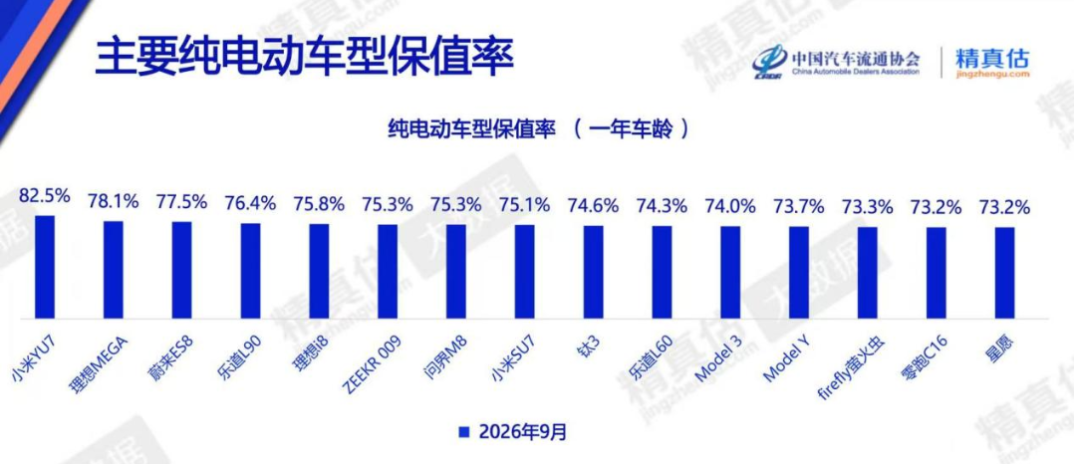
Focusing on the one-year-old vehicle list, the top three positions in terms of resale value rate are occupied by domestic brands: Xiaomi YU7 leads with 82.5%, clinching the championship for the third consecutive time and standing as the sole model on the entire list to exceed 80%. Ideal MEGA follows closely with 78.1%, while NIO ES8 secures the third spot with 77.5%.
The seasoned Tesla Model 3 and Model Y, on the other hand, rank 11th and 12th, respectively, being outshone by the Leadao L60.
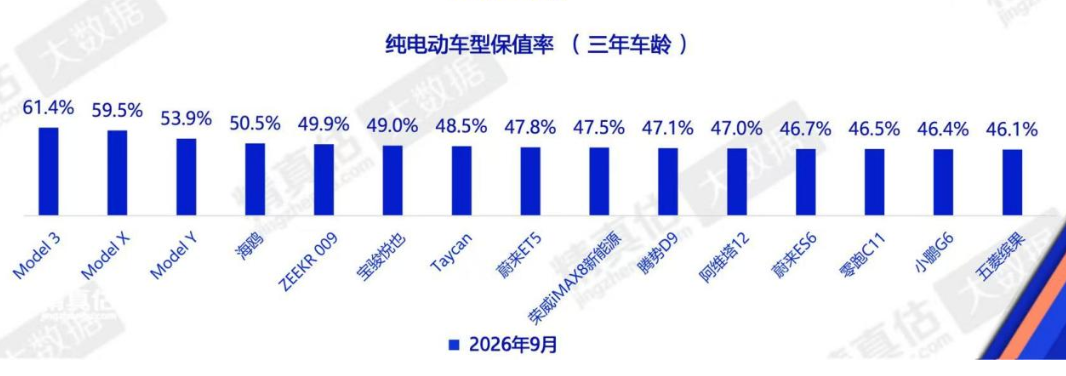
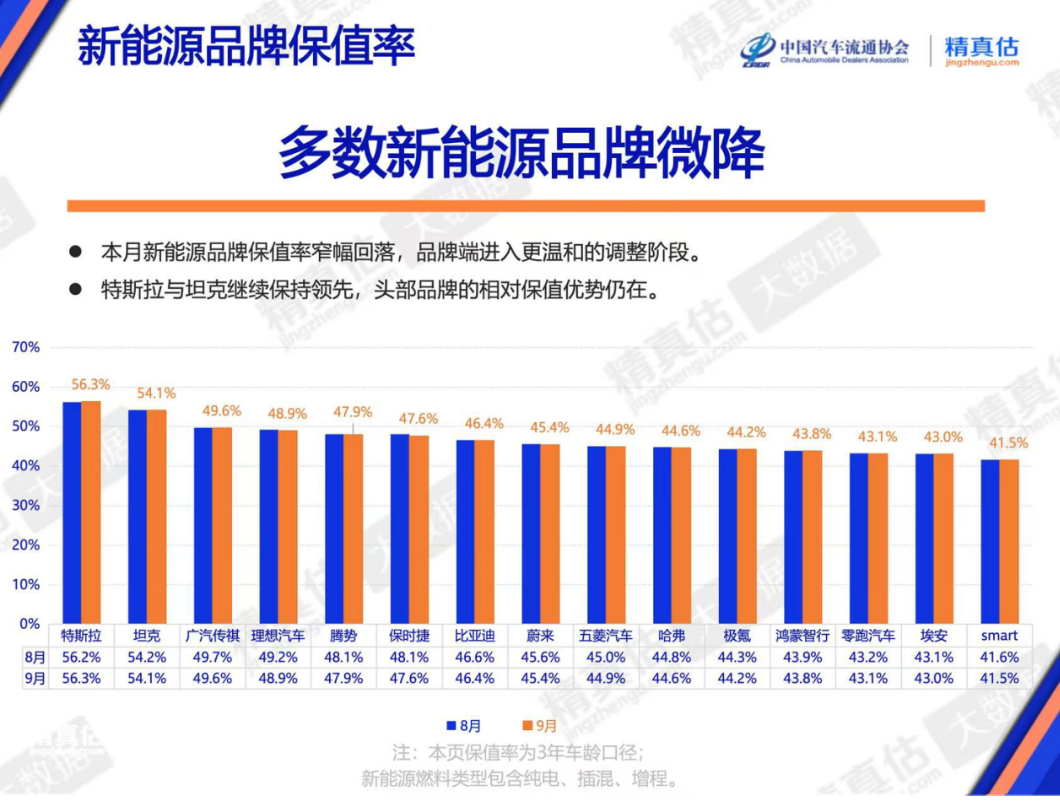
Interestingly, the scenario shifts when it comes to three-year-old pure electric models, with Tesla asserting its dominance: Model 3 leads with 61.4%; Model X follows with 59.5%; and Model Y takes the third spot with 53.9%. Tesla secures the top three positions and is the only brand with all its models consistently above the 50% mark.
Domestic brands occupy 11 out of the 15 spots, yet they are all clustered in the middle to lower tiers. The BYD Seagull ranks fourth with 50.5%, a significant 10.9 percentage points behind the Model 3.
Two lists, two distinct realities. The question emerges: Who truly reigns supreme in terms of resale value?
Let's first delve into the one-year resale value champion, the Xiaomi YU7, which boasts an impressive 82.5% resale value rate during this period. Guanchejun posits that a significant contributing factor is the production capacity constraints.
During its initial market launch, the delivery cycle skyrocketed to 53-56 weeks, with nearly new cars in the second-hand market being likened to 'financial products.' With a one-year wait for a new car, second-hand vehicles naturally became readily accessible, and their scarcity directly propelled transaction prices upward.
This high resale value rate essentially represents a time premium, with Xiaomi's unsold production capacity being monetized by second-hand car dealers.
Once Beijing Phase II reaches full operational capacity, Phase III is initiated, the Wuhan factory commences production, and annual production capacity surges to 600,000 units, the YU7's resale value rate is likely to experience a decline.
From a three-year resale value perspective, Tesla's competitive edge remains pronounced.
What factors influence the three-year resale value rate? In Guanchejun's opinion, it hinges on the maturity of the three electric systems (battery, motor, electronic control), the parts supply system, and the ease of maintenance, with the most critical factor being whether dealers are willing to stock the vehicles.
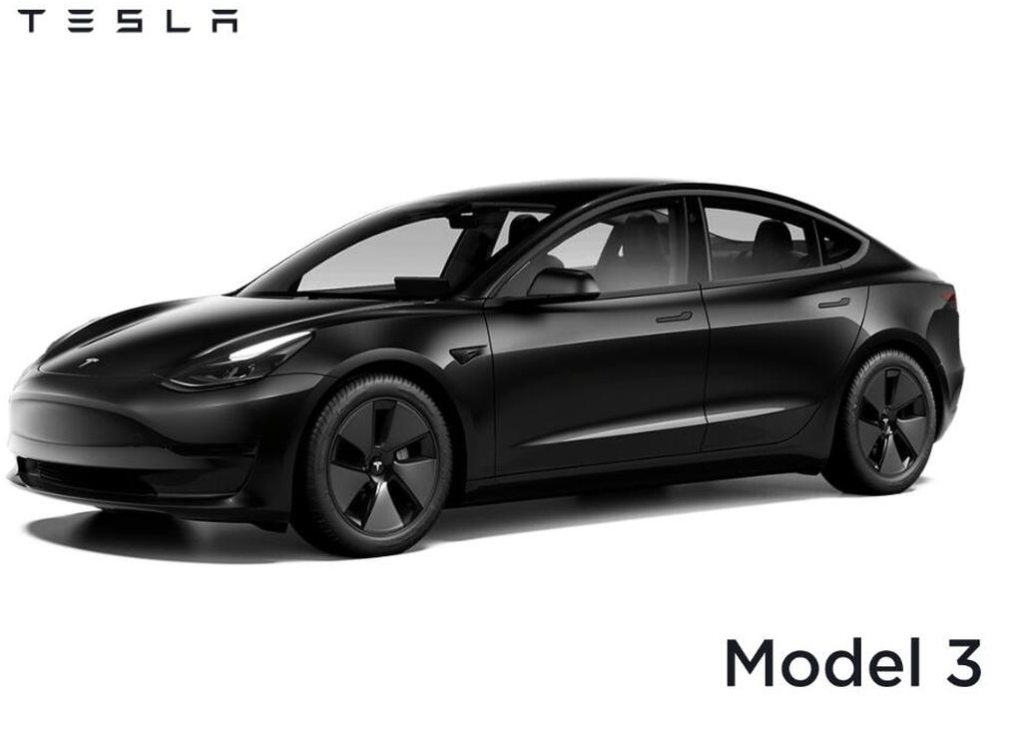
The Model 3 has been on the market for numerous years, boasting a large sample size, a well-defined fault distribution, and a consistent residual value curve, making it a low-risk acquisition for dealers. Low risk naturally translates to higher quotes.
For our domestic brands, the best performance in the top ten of the three-year list is the Seagull with 50.5%. Behind this figure lies a logic that Guanchejun finds even more concerning: the Seagull itself is priced at just a few tens of thousands of yuan, leaving little room for further depreciation. Coupled with the high demand for daily commuting, second-hand sales are extremely brisk, making it a winner due to its affordability.
Looking further down the list, the Zeekr 009 is close to 50%, while the NIO ET5 and ES6 hover steadily around 47%. Five years ago, it would have been unthinkable for domestic electric vehicles to retain half their value after three years. This level of progress is truly commendable!
Finally, Guanchejun must highlight another layer: the risks not explicitly mentioned in this list but accelerating their realization beyond the five-year mark.
Regardless of how impressive the one-year or three-year figures may be, they ultimately suffer from the 'new car allure.' When vehicles reach the five-year milestone, battery degradation, frequent faults, and aging parts all converge, marking the true precipice for the residual value of pure electric vehicles.
Some data is quite sobering: after five years of use, the resale value rate of new energy vehicles generally plummets below 40%, with the poorer performers retaining only 20-30%. Why such a drastic decline? The core reason boils down to two words: batteries.
Replacing a battery pack for mainstream family cars now costs at least 30,000 to 40,000 yuan for lithium iron phosphate and 60,000 to 70,000 yuan for ternary lithium. However, the residual value of a five-year-old pure electric vehicle may only be around 50,000 to 60,000 yuan. The cost of replacing the battery is nearing the value of the entire vehicle. Owners calculate: it's more cost-effective to sell than repair. Dealers assess: acquiring it means getting stuck with it. It's a vicious cycle.
From this vantage point, Tesla is not necessarily faring better than domestic brands at this critical juncture. One to two years assess the product, three to five years evaluate the system, and the entire industry is still navigating uncharted waters.
The charts in this article, unless otherwise specified, are sourced from public disclosures through various channels. We hereby acknowledge and express our gratitude! The views expressed herein are for reference only and do not constitute investment advice.
This article is original content from Leverage Auto Observations and is prohibited from being reproduced without authorization. If you wish to reproduce it, please obtain authorization. Additionally, when reproducing with authorization, please indicate the source and author at the beginning of the article. Thank you!
-
Kimi Valued at $50 Billion, Yang Zhilin's Past Disputes Reach IPO Threshold
-
Founder from Generation Z Leads 14-Member Team to Challenge Meta
-
![]()
Over 1 Billion Yuan in Series C+ Funding Secured! Kunyu Optoelectronics’ 12-Inch Optical Production Line Slated for Operation by 2027
-
![]()
Can AI Be Integrated into Smartphones, or Will It Completely Transform Them?
-
FDE Suddenly Becomes a Topic ‘No One Wants to Discuss’
-
![]()
Android Takes the Lead, Honor Makes a Comeback
-
![]()
Android Takes the Lead, Honor Makes a Comeback
-
![]()
Virtual Humans Now Have Official Identification! AI Idols with Certificates Can Participate in Commercial Performances, But Who is Liable if Issues Arise?