Bosch to Split Its Automotive Business: Why Restructure Despite €55.8 Billion in Annual Sales?
 10/23 2026
 386
Produced by Zhineng Zhixin
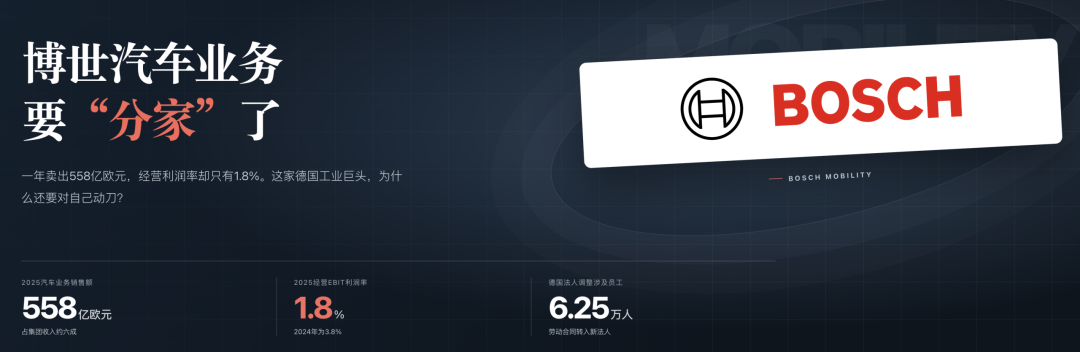
Bosch, the world's largest automotive component supplier, tops the industry with €55.8 billion in annual sales, yet this falls short of the Bosch family's expectations, leaving an operating profit of around €1 billion.
The operating EBIT margin for this business was 3.8% in 2024 but is projected to drop to 1.8% in 2025, effectively halving in a year.
Bosch's overall operating EBIT margin for the year was 2.0%, with an after-tax loss of approximately €400 million. Restructuring costs and related provisions reached as high as €2.7 billion.
On October 22, Bosch announced that its automotive operations in Germany would be separated from Robert Bosch GmbH to form an independent GmbH subsidiary. Three central service departments—Digitalization, Global Business Services, and Global Real Estate—will also be established as legal entities.
The employment contracts of 62,500 German employees will be transferred accordingly. The new legal entity is planned to commence operations on August 1, 2027. The future Robert Bosch GmbH will retain around 3,000 employees, focusing on group headquarters, central research, and forward-looking engineering functions. The automotive business will remain 100% owned by the group.
In 2025, Bosch's automotive business revenue in China reached 122.3 billion yuan, with over half coming from Chinese brand OEMs. China is setting the benchmark for pricing in the global automotive industry.
In the past, Chinese automakers learned quality management and functional safety from Bosch; now, Bosch must adapt to the project rhythms and procurement conditions of Chinese OEMs. This marks the second round of reforms in three years.
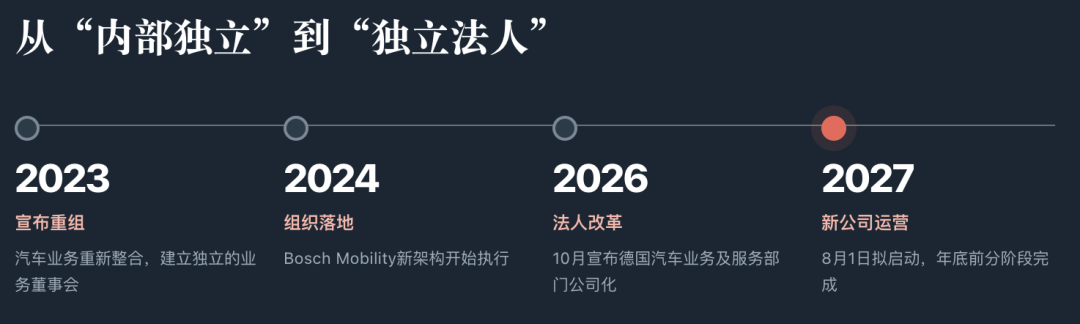
In 2023, Bosch integrated its automotive business into Bosch Mobility. From 2024, it adopted a unified structure and established a business board, emphasizing independent operations and financial self-sufficiency. By 2026, the business progressed from internal independence to independent legal status.
Two reforms in just three years have not met the family's expectations!
Part 1: The €55.8 Billion Business: Earning Profits in the Automotive Components Industry Becomes Increasingly Difficult
In 2025, Bosch's automotive business revenue reached €55.8 billion, up 0.1% year-on-year, effectively stagnant. Group revenue stood at €91 billion, with automotive accounting for about 60%.
In the first half of 2026, automotive revenue was €27.8 billion, down 0.5% year-on-year, with an operating EBIT margin of 4.7%, 1.1 percentage points lower than the 5.8% in the same period last year. €270 million in impairments for production facilities were confirmed, attributed to slower-than-expected progress in the electrification market.
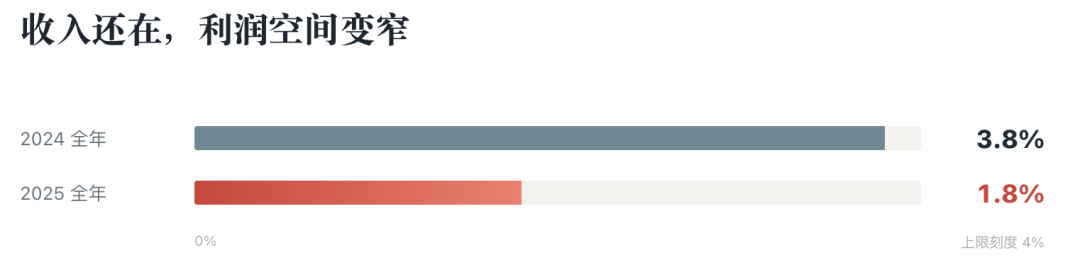
The profit margin in the first half improved compared to the full year of 2025, but pricing pressures and asset utilization issues persist!
Of course, for the industry leader, the greatest challenge lies in the fundamental shift in its business model.
Over the past decades, the development pace of automotive components was dictated by vehicle platform cycles.
Bosch has accumulated extensive patents, production lines, and a global R&D system in powertrains, chassis control, and automotive electronics. A product's integration into a vehicle platform meant years of stable supply, with greater scale enhancing synergistic advantages.
This model's premise was that automakers updated slowly, and suppliers followed suit.
Now, Chinese automakers have changed the requirements entirely. Even global automakers are learning from Chinese tactics, demanding faster adoption of new technologies, more flexible product portfolios, more frequent software updates, and continuously declining prices.
Bosch faces the triple burden of maintaining traditional engine businesses, investing in electric drive and battery products, upgrading brake and steering to steer-by-wire solutions, and entering entirely different R&D competitions for domain controllers and intelligent driving software.
The hardware and software combinations required for a single vehicle project may span automotive electronics, chassis, electric drives, and software departments. Headquarters approvals, cross-departmental coordination, financial budgets, and product responsibilities all lengthen project cycles.
During the 2023 restructuring, Bosch set a target of exceeding €80 billion in automotive revenue by 2029. Starting from €55.8 billion in 2025, this requires a compound annual growth rate of about 9.4% over four years, yet the current actual growth rate is 0.1%.
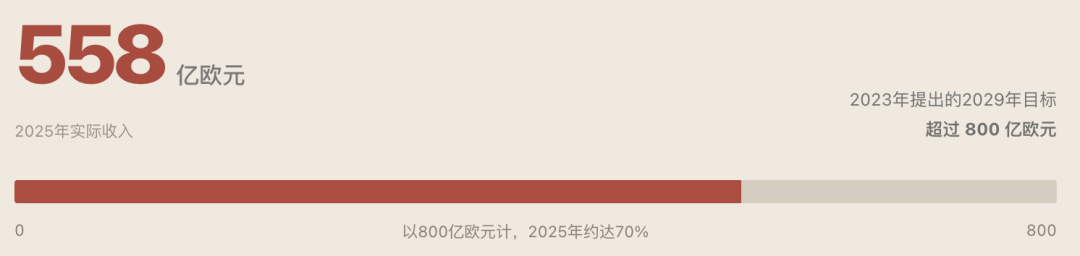
The gap between target and reality remains unbridgeable!
In July 2026, Christian Fischer succeeded as Chairman of the Group Board of Management, announcing the new legal entity arrangement three months later.
The group parent company shifts to strategic holding, with automotive operations gaining clearer operational responsibilities. Central service departments operate independently, serving internal clients.
Operational efficiency, R&D investment, and profitability, once hidden within the vast group, now fall directly onto individual business entities.
Part 2: Why Now, and Why This Approach
In September 2025, Continental split its automotive business into AUMOVIO, listing it on the Frankfurt Stock Exchange, giving automotive electronics and intelligent driving businesses independent shareholders and capital market valuations.
Bosch chose a different path: the new legal entity remains a wholly-owned subsidiary, with an unchanged ownership structure. In exchange, it gains clearer operational, asset, contractual, and responsibility boundaries. Officials also highlighted that this approach leaves room for strategic cooperation and new business models.
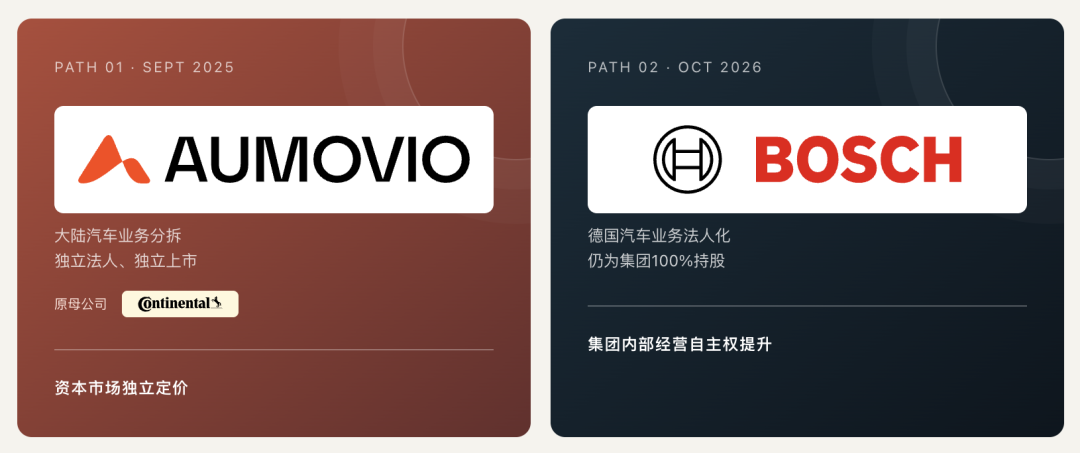
For European automotive component companies, the approach differs, but the pressure stems from the same source: the good old days are gone.
Traditional component giants are reevaluating their vast product portfolios, lengthy development chains, and the years required for software and electrification investments to translate into profits. China is the driving force behind this global pressure.
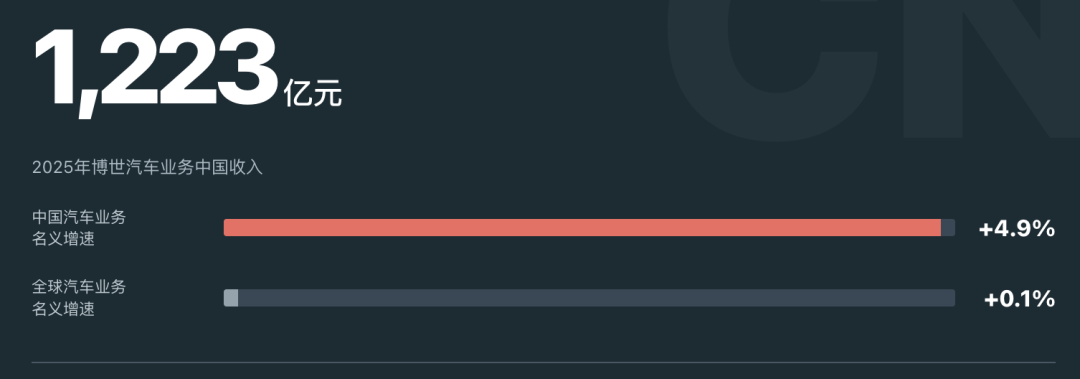
Chinese operations contribute 122.3 billion yuan in revenue, with over half from Chinese brands. The intensity of competition is the crux.
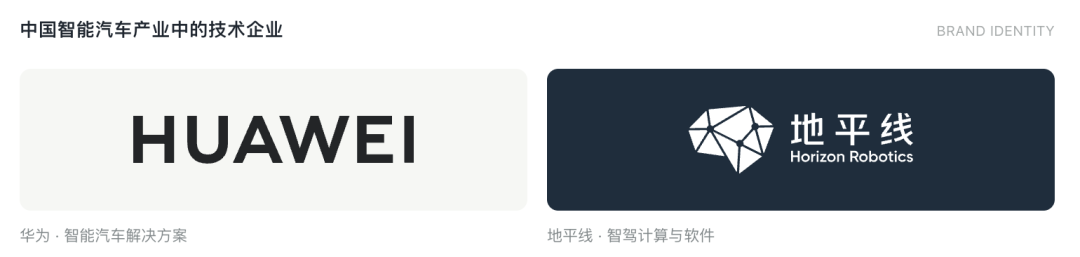
◎ In braking and steering, Bosch holds decades of accumulation with ESP and ABS, but Chinese suppliers are expanding their presence in steer-by-wire and electronically controlled suspensions; ◎ In intelligent driving, automakers habitually assess perception hardware, computing platforms, and algorithms separately. Huawei, Horizon Robotics, and local software and hardware teams are vying for projects; ◎ In electric drives, the share of automaker self-development and local suppliers continues to rise.
Bosch's foundational strengths remain solid: it can simultaneously supply chips, controllers, sensors, braking, steering, and powertrains, with functional safety and mass production quality systems applicable globally. The 4.7% operating profit margin in the first half of 2026 also proves the company's capacity for continued investment.
What it truly needs to address is restructuring capability: ◎ When customers demand complete solutions, it must swiftly integrate braking, steering, powertrains, and chassis software into vehicle motion control; ◎ When customers require only a software module, it must deliver it independently.
The new legal structure aims to facilitate such restructuring.
Organizational adjustments only change management approaches. Winning nominations, achieving timely mass production, reducing costs, and improving profits must be accomplished item by item by specific product and engineering teams. Relying on past successes is no longer sufficient; Bosch must now rely on itself.
Summary
For a long time, Bosch was the most stable link in the global automotive industry's division of labor: as long as cars were produced, there was enormous demand for braking, controllers, sensors, and powertrains. Regardless of how many generations of platforms automakers introduced, Bosch remained in the supply chain.
Chinese automakers have transmitted development cycle and cost pressures globally, making software and hardware boundaries increasingly flexible. Old scale advantages must now be paired with new organizational speed to remain effective.
Bosch should indeed blame Chinese automakers for changing industry models, but now is not the time for complaints. Change is the only constant!
-
![]()
Focus | Warburg Pincus Considers Selling Chinese Parking Operator Yangguang Haitian, Valuation May Reach US$300 Million
-
![]()
What? The Audi A8 is Set to Be Manufactured in China, in Partnership with Huawei
-
![]()
AUMOVIO’s Latest MTXN3 Automotive Remote Key: Powered by NXP NCF29A1/A2 Chip, Supporting 125kHz, 433MHz, and UWB Frequencies!
-
![]()
Bosch to Split Its Automotive Business: Why Restructure Despite €55.8 Billion in Annual Sales?
-
![]()
Securing a Massive 1.114 Billion Yuan Order: Guangzhi Technology's Strategic Leap in Qingdao
-
Phase I Project Pours 20 Million Yuan into Investment! Chenhui New Material's Polarizer Project Kicks Off Operations
-
"Chinese Can Fly" Video Sparks Interest; Insta360 Clarifies: Support for Creator Unrelated to Hoverboard Ventures
-
![]()
Emergency Brake! Five Major U.S. Banks Step In to Prevent AI from Accessing Your Wallet