Securing a Massive 1.114 Billion Yuan Order: Guangzhi Technology's Strategic Leap in Qingdao
 10/23 2026
 502
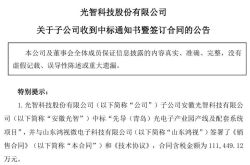
Recently, Guangzhi Technology made a significant announcement: its subsidiary, Anhui Guangzhi, has successfully secured the bid for the "Pilot (Qingdao) Optoelectronics Industrial Park Production Line and Supporting System Project." It has inked a sales contract and technical agreement with Shandong Hongshi Microelectronics, with the total contract value, inclusive of taxes, reaching 1.114 billion yuan.
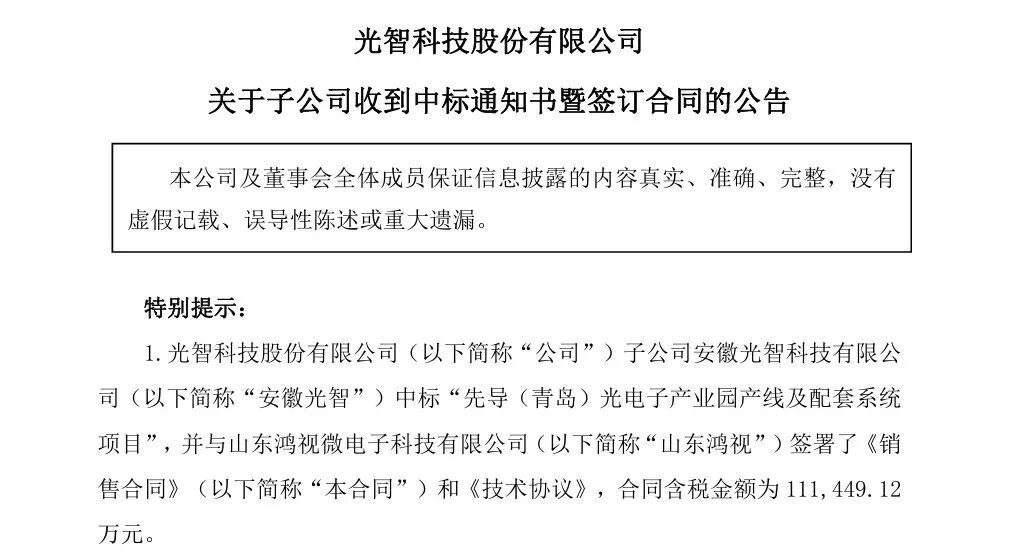
Notably, the buyer is not an external entity. Shandong Hongshi, established on March 27, 2026, with a registered capital of 300 million yuan, is a joint venture. It is equally owned (50% each) by Guangzhi Technology's controlled subsidiary, Anhui Zhongfei, and the Qingdao Huizhu Innovation and Entrepreneurship Investment Fund. The latter is backed by the state-owned asset platform of Qingdao Shibei District.
In essence, Shandong Hongshi is a special-purpose vehicle (SPV) created specifically for the Pilot (Qingdao) Optoelectronics Industrial Park project. The 1.114 billion yuan contract, therefore, represents Guangzhi Technology's "sale" of production line equipment to a jointly controlled entity, with project financing sourced from the SPV and supported by local state-owned assets.
The contract mandates delivery and production commencement before December 30, 2026. It encompasses six production lines, including WLP wafer-level packaging, ceramic packaging, infrared optical cold processing, and infrared complete system assembly.
In the industry, the design and delivery cycle for a customized wafer-level packaging production line typically ranges from three to six months. The simultaneous advancement of six production lines is an exceptionally rare feat in the industry. Critically, according to enterprise accounting standards, revenue from such large-scale equipment sales is generally recognized only after the buyer's final acceptance.
Even if the equipment is delivered on schedule, the feasibility of completing all installation, commissioning, and final acceptance by year-end is limited. This suggests that the 986 million yuan contract amount (excluding taxes) will likely be deferred and gradually recognized in 2027. Therefore, the immediate impact on the 2026 financial statements should not be overestimated. The announcement itself explicitly warns that the ability to meet revenue recognition conditions and the amount to be recognized in 2026 remain uncertain.
The true significance of this transaction lies in its strategic geographic positioning rather than immediate profitability. The Pilot (Qingdao) Optoelectronics Industrial Park is envisioned as a full-chain base for "infrared materials—chips—advanced packaging—complete systems," with expected annual sales revenue of approximately 1.8 billion yuan upon full operation. It is explicitly designated as the northern headquarters of Pilot Technology Group, serving markets in North, Northeast, and Northwest China.
Guangzhi Technology has traditionally excelled in infrared materials, with revenue from infrared optical materials reaching 1.851 billion yuan in 2025, accounting for 89.01% of total revenue. However, its downstream capabilities in complete systems and system integration have been relatively weak. The infrared complete system assembly production lines introduced in this contract directly address this gap.
Meanwhile, Qingdao is home to major terminal demanders such as Haier, Hisense, and Aucma, providing a potential local sales channel for the park's production capacity. The model of reducing upfront capital expenditures with state-owned asset support and leveraging industrial parties' technology and production line capabilities is practically rational in the capital-intensive optoelectronics manufacturing sector. However, the return cycle depends on the actual speed of production line ramp-up and order acquisition.
Within a broader strategic framework, Guangzhi Technology is pursuing two parallel tracks. In the infrared segment, it continues to consolidate its vertical chain from germanium materials to detectors, core modules, and complete systems, leveraging Pilot Technology Group's upstream resources in rare and scattered metals. In the indium phosphide segment, in 2026, it acquired full control of Xianrui Technology through a capital increase, integrating all of the group's indium phosphide substrate assets. With 6-inch substrates already securing orders from global leading customers, it aims to establish a second growth pole in the AI optical communication materials sector.
Both tracks converge toward positioning Guangzhi Technology as a "full-spectrum optoelectronic sensing and AI optical communication materials platform," with the Qingdao base serving as a physical anchor for this platform's manufacturing expansion northward.
However, a gap persists between strategic vision and financial reality. Guangzhi Technology reported a net loss attributable to shareholders of 33.1997 million yuan in 2025 and continued to incur a loss of 9.2131 million yuan in the first half of 2026, with revenue growth not yet translating into profit. The infrared industry is currently thriving, with the civilian market share rising from approximately 36.5% in 2022 to 62.5% in 2025. However, Raytron Technology, also based in Shandong, reported revenue of 6.304 billion yuan and net profit attributable to shareholders of 1.125 billion yuan in 2025. The scale and profitability gap suggest that Guangzhi Technology's competition in complete systems and system integration remains an uphill battle requiring sustained investment.
The significance of the 1.114 billion yuan contract lies in Pilot Group's completion of a critical capability gap through Qingdao: transitioning from a material supplier to a system integrator and securing a manufacturing foothold in the northern market that combines state-owned credit with local supply chain proximity.
Production line delivery is merely the starting point. Yield ramp-up, order fulfillment, and market acceptance of complete system products will be the true yardsticks for evaluating the success of this "internal major order."
-
![]()
Focus | Warburg Pincus Considers Selling Chinese Parking Operator Yangguang Haitian, Valuation May Reach US$300 Million
-
![]()
What? The Audi A8 is Set to Be Manufactured in China, in Partnership with Huawei
-
![]()
AUMOVIO’s Latest MTXN3 Automotive Remote Key: Powered by NXP NCF29A1/A2 Chip, Supporting 125kHz, 433MHz, and UWB Frequencies!
-
![]()
Bosch to Split Its Automotive Business: Why Restructure Despite €55.8 Billion in Annual Sales?
-
![]()
Securing a Massive 1.114 Billion Yuan Order: Guangzhi Technology's Strategic Leap in Qingdao
-
Phase I Project Pours 20 Million Yuan into Investment! Chenhui New Material's Polarizer Project Kicks Off Operations
-
"Chinese Can Fly" Video Sparks Interest; Insta360 Clarifies: Support for Creator Unrelated to Hoverboard Ventures
-
![]()
Emergency Brake! Five Major U.S. Banks Step In to Prevent AI from Accessing Your Wallet