AUMOVIO’s Latest MTXN3 Automotive Remote Key: Powered by NXP NCF29A1/A2 Chip, Supporting 125kHz, 433MHz, and UWB Frequencies!
 10/23 2026
 528
Produced by Zhineng Zhixin
Nowadays, many cars support smartphone digital keys. With your phone in your pocket, the car automatically unlocks as you approach and starts when you take the driver’s seat. For many, the traditional physical car key has become a relic of the past.
In 2026, European automotive electronics supplier AUMOVIO submitted new certification materials for automotive remote keys, including datasheets for the NXP NCF29A1/A2 chip family. The first chip in this family was officially launched as early as 2015.
Eleven years have passed, and automotive electronic and electrical architectures have undergone several upgrades. Yet, a key chip from over a decade ago is still undergoing new certifications. Other certification documents from the same company reveal that new 125kHz vehicle-side keyless entry modules will be certified in 2026, while UWB gateways certified in 2022 are now undergoing license updates.
While consumers are increasingly ditching physical keys, key systems are becoming more complex within the vehicle’s electronic architecture.
Part 1: A Chip Family Evolving Since 2015
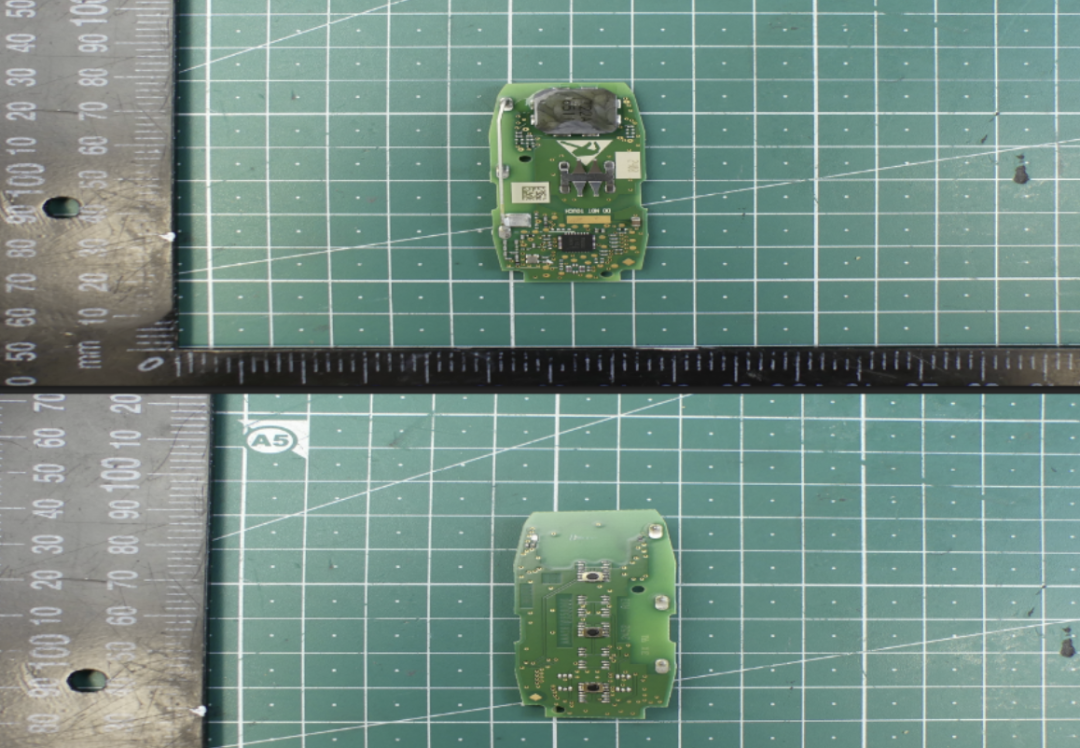
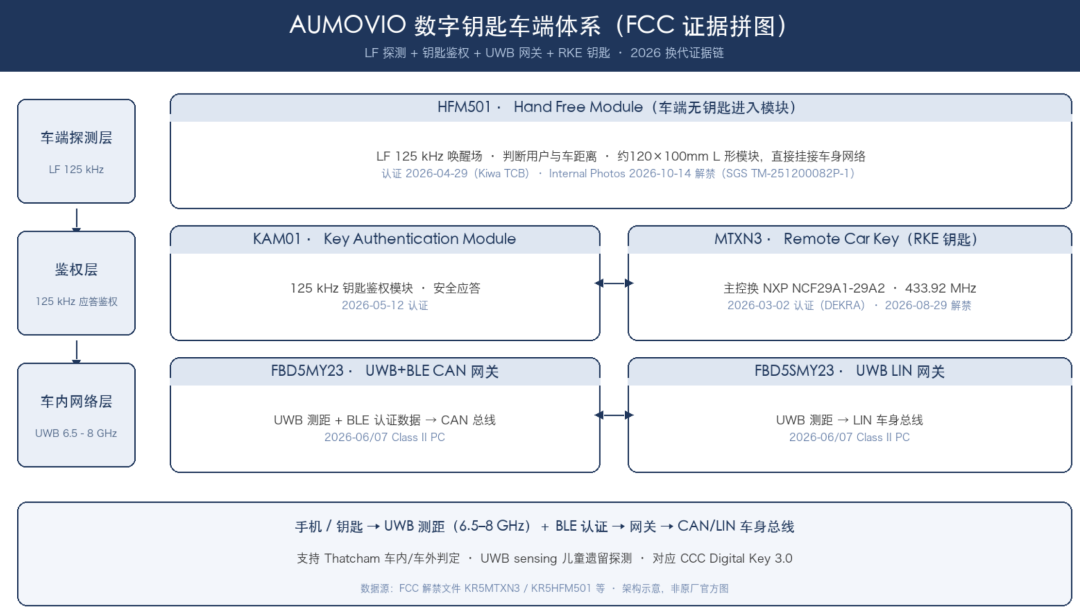
The MTXN3 is a key project that received FCC certification on March 2, 2026. Test reports confirm it uses 433.92MHz RF communication and a 3V coin cell battery.
For consumers, this is the familiar physical key: unlocking with a button press, no smartphone or network required.
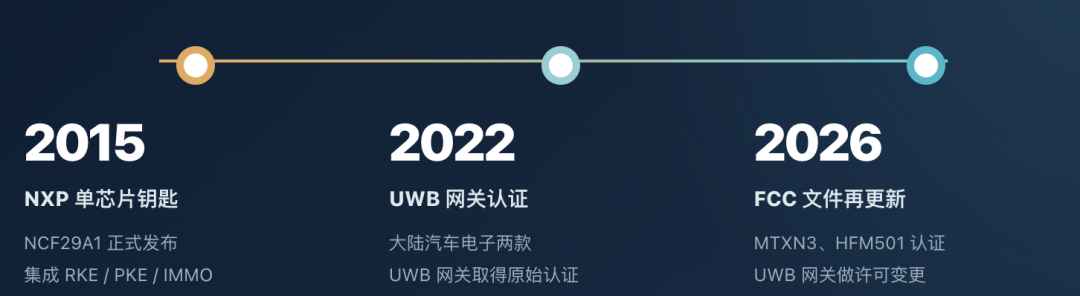
The NXP NCF29A1/A2 chip family, referenced in the certification materials, is a highly integrated automotive access chip with three core functions:
◎ RKE (Remote Keyless Entry): Handles wireless commands after button presses.
◎ PKE (Passive Keyless Entry): Uses low-frequency signals to detect nearby keys.
◎ IMMO (Immobilizer): Manages engine start authorization.
The 125kHz low-frequency band supports proximity wake-up and localization, while the 433MHz band manages remote transmission.
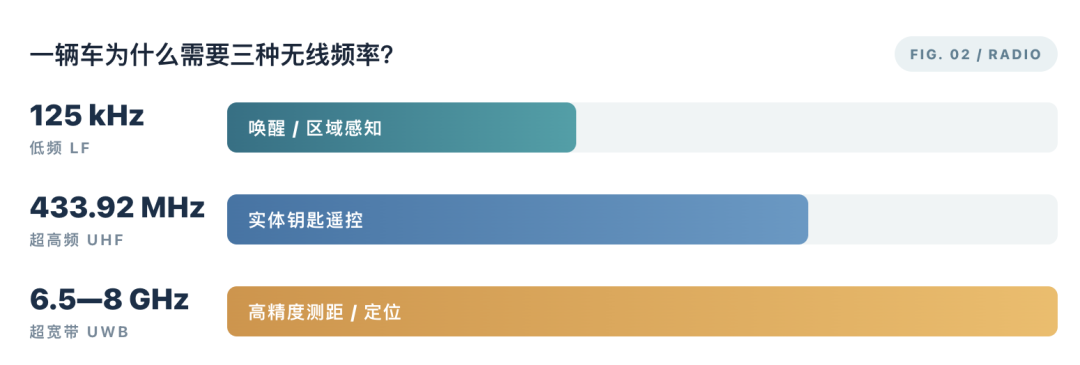
Why are functions developed over a decade ago still relevant today?
Automotive keys must meet stringent requirements: they must remain operational for years without battery replacement, respond reliably to commands, complete security authentications, and withstand extreme temperatures, drops, vibrations, and daily wear and tear.
Power consumption, cost, reliability, and supply stability are critical criteria for automakers when selecting components. The NCF29A1’s focus on single-chip integration, low power consumption, and minimal peripheral devices ensures its relevance over a decade later.
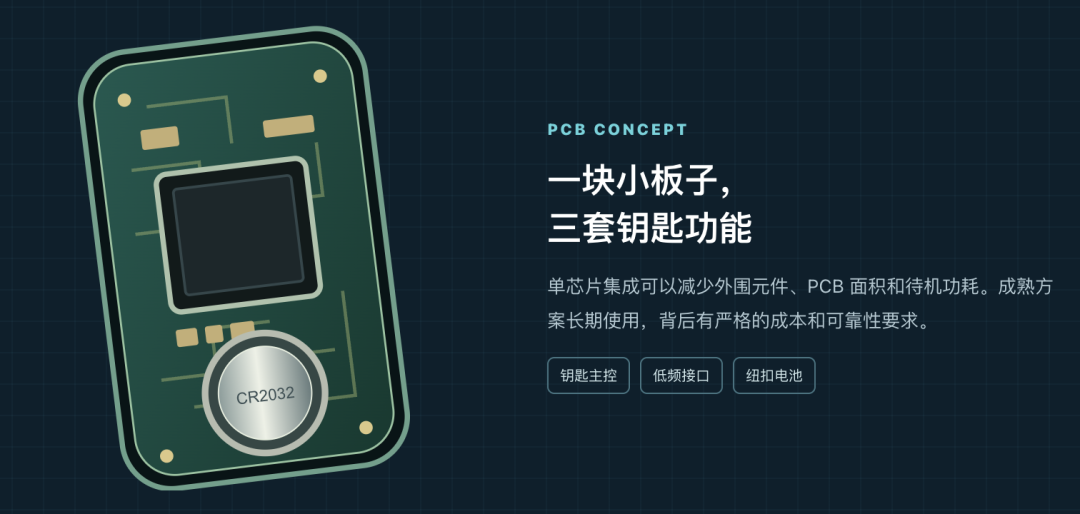
Automotive semiconductors follow their own update cycles. A mature chip does not exit the market simply because newer wireless technologies emerge. As long as functionality meets requirements, mature solutions remain competitive. Automotive-grade product lifecycles span decades—unimaginable in the consumer electronics industry but standard in the automotive sector.
Part 2: As Keys Evolve, So Do In-Car Modules
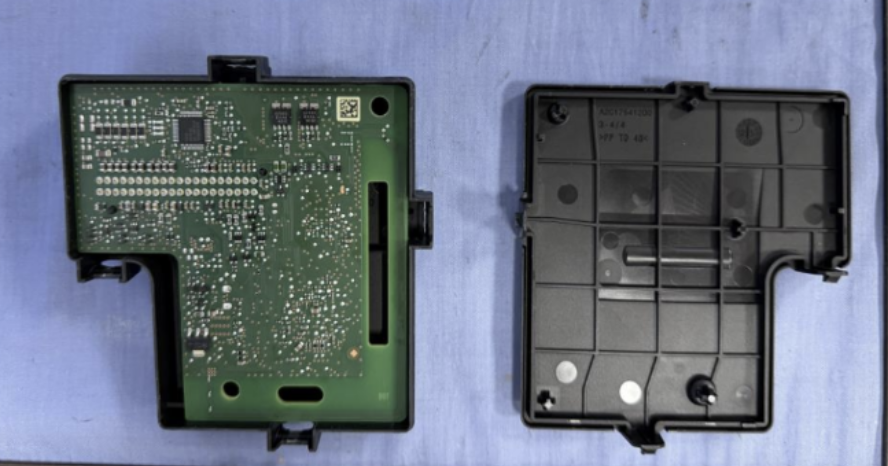
In April 2026, AUMOVIO’s HFM501 keyless entry module received FCC certification, operating at 125kHz. It features an in-vehicle PCB with a main control chip, connectors, and peripheral circuits.
Two UWB (Ultra-Wideband) gateways, FBD5MY23 and FBD5SMY23, corresponding to CAN and LIN interfaces respectively, were certified in 2022 and underwent license updates in 2026. They operate in the frequency band of approximately 6.5GHz to 8GHz.
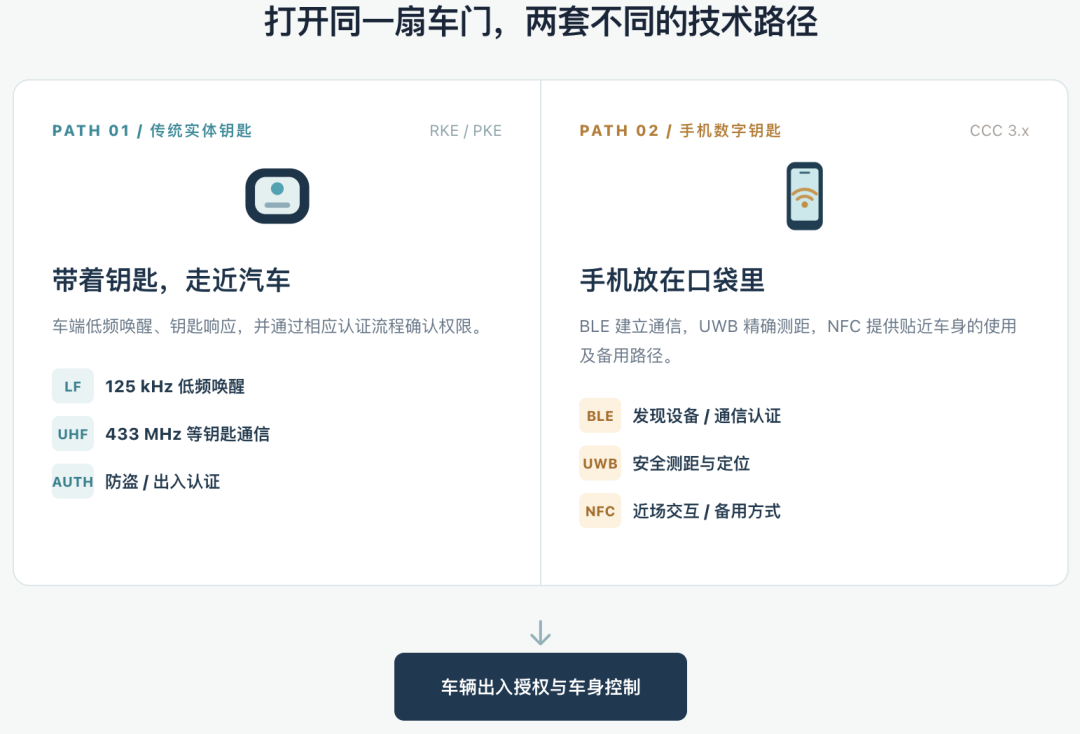
While physical keys rely on LF and UHF signals, why do smartphone keys require an additional UWB system?
The vehicle must accurately locate the authorized device.
Traditional passive entry systems use low-frequency field strength to determine key position, but wireless signals are vulnerable to relay attacks: attackers forward signals from the vehicle to a distant location, tricking the car into thinking the key is nearby and unlocking the doors.
This remains a real and ongoing method of car theft, central to the security controversies surrounding keyless entry systems.
UWB provides reliable distance measurements through precise time calculations, enabling the vehicle to determine whether the digital key is inside, outside, or dozens of meters away.
Smartphone digital keys also rely on BLE (Bluetooth Low Energy) for device discovery and communication, with NFC serving as a contact-based backup solution near the vehicle.
Thus, a vehicle supporting multiple key methods runs two access pathways simultaneously: physical keys use LF and UHF, while smartphone keys use BLE, UWB, NFC, and secure elements. Both pathways must integrate seamlessly with the vehicle’s body control system, maintaining stability under different usage conditions.
From January to April 2025, the penetration rate of digital keys in domestic passenger vehicles reached 52.3%, up from 39.7% a year earlier.
Technological stratification is also evident:
◎ Bluetooth keys dominate with a 50.4% penetration rate, while UWB accounts for only 6.0%.
◎ In 2024, 1.056 million passenger vehicles came standard with UWB digital keys, with an estimated 2.85 million in 2025.
UWB is expanding to vehicles priced between 100,000 and 200,000 yuan, with market share in this segment rising from 1% to 4%, while high-end models maintain a strong foundation.
AUMOVIO’s CoSmA system extends UWB from door access to in-cabin sensing, using UWB technology to detect whether children have been left inside the vehicle. A wireless technology originally designed for door access now serves safety-sensing purposes.
Regarding the division of labor between chip manufacturers and Tier 1 suppliers, NXP provides key control, wireless communication, and security chips, while Tier 1 suppliers like AUMOVIO integrate them into stable, long-term automotive access systems.
Note: We continuously track FCC content to bring you interesting updates. Information on projects under development may offer greater reference value!
Summary
The automotive industry is selective in phasing out technologies—swift in some areas, slow in others. In safety and anti-theft domains, reliability and stability take precedence over advancement in automotive component selection criteria.
For chip manufacturers, maintaining power efficiency and reliability in legacy product lines can secure orders lasting over a decade in the automotive supply chain. For automakers, the cost of supporting multiple wireless technologies is a price paid for compatibility and security.
-
iPhone Duo Sees Just 900 Yuan Price Hike, Scalpers in Frenzied Resale Race
-
![]()
Focus | Warburg Pincus Considers Selling Chinese Parking Operator Yangguang Haitian, Valuation May Reach US$300 Million
-
![]()
What? The Audi A8 is Set to Be Manufactured in China, in Partnership with Huawei
-
![]()
AUMOVIO’s Latest MTXN3 Automotive Remote Key: Powered by NXP NCF29A1/A2 Chip, Supporting 125kHz, 433MHz, and UWB Frequencies!
-
![]()
Bosch to Split Its Automotive Business: Why Restructure Despite €55.8 Billion in Annual Sales?
-
![]()
Securing a Massive 1.114 Billion Yuan Order: Guangzhi Technology's Strategic Leap in Qingdao
-
Phase I Project Pours 20 Million Yuan into Investment! Chenhui New Material's Polarizer Project Kicks Off Operations
-
"Chinese Can Fly" Video Sparks Interest; Insta360 Clarifies: Support for Creator Unrelated to Hoverboard Ventures