Selling Cars, He Xiaopeng Is Getting the Hang of It
 11/17 2026
 349
Text / Jiu Cai Source / Node Auto
For He Xiaopeng, the most important thing over the past few years has been to make XPeng Motors sell more cars.
But now, he may be starting to run a different set of numbers.
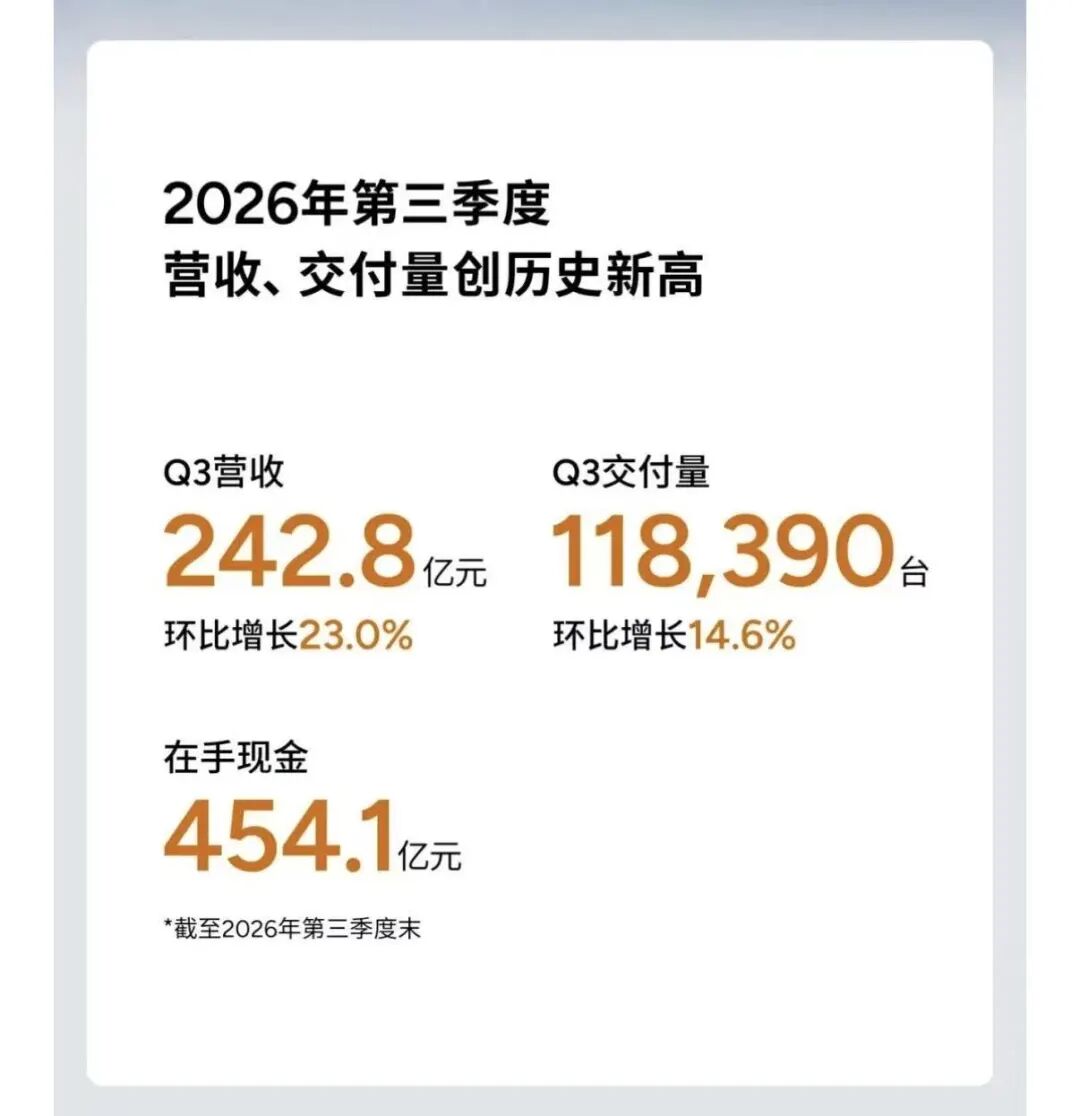
On November 16, XPeng Group released its Q3 2026 financial report. Revenue came in at 24.28 billion yuan, up 19.1% year-on-year and a new single-quarter high; deliveries reached 118,400 vehicles, up 14.6% quarter-on-quarter. The net loss narrowed from 1.34 billion yuan in Q2 to 870 million yuan, a quarter-on-quarter decrease of about 35%.
This is a report card that sends positive signals.
But on closer study, some points worth pondering emerge. Although the loss narrowed significantly quarter-on-quarter, XPeng lost only 380 million yuan in the same period last year; vehicle gross margin rose quarter-on-quarter to 13.1%, but overall gross margin fell from 20.7% to 18.9%.
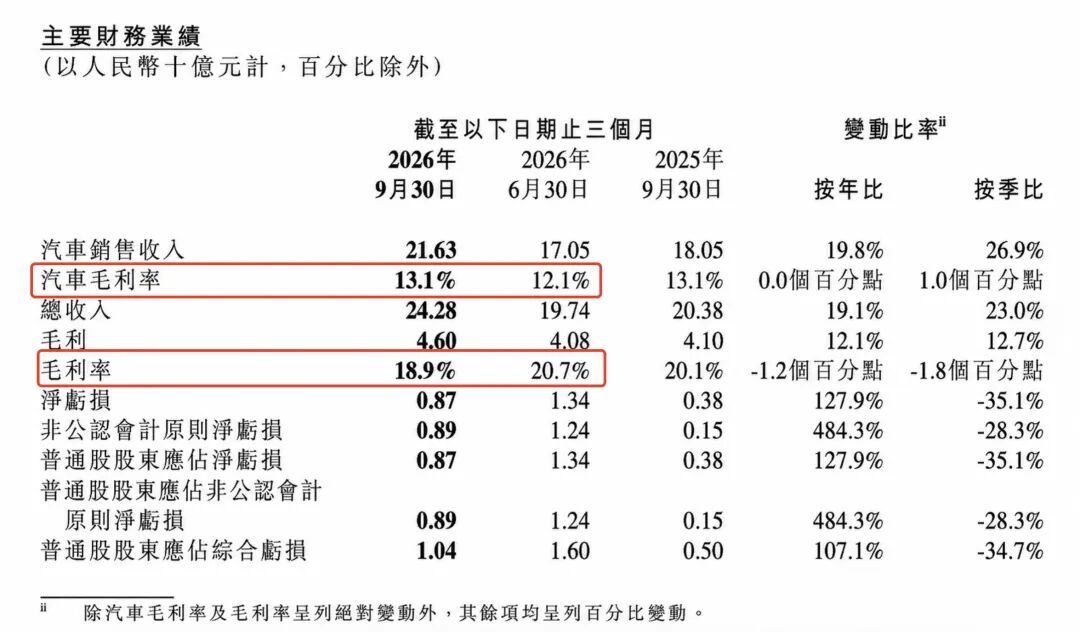
This shows that XPeng is improving its operational quality, but there is still some way to go before it reaches stable profitability.
In the past, when the outside world discussed XPeng, it focused more on intelligent driving, product technology, and sales growth. Now, as the company's scale expands, the market is beginning to care about a deeper question:
Can XPeng ultimately translate its technological and product advantages into sustained profitability?
This may be the most important business topic for He Xiaopeng in the next stage.

When It Comes to Selling Cars, XPeng Is Getting the Hang of It
First, look at a set of numbers.
In Q3, XPeng's deliveries grew 14.6% quarter-on-quarter, but vehicle sales revenue grew 26.9% to 21.63 billion yuan.
Revenue growing significantly faster than deliveries shows that some positive changes are taking place in XPeng's automotive business.
Based on a simple calculation of vehicle sales revenue and deliveries, revenue per vehicle in Q3 was about 183,000 yuan, compared with about 165,000 yuan in Q2. Although this is not equivalent to the actual average transaction price, it can reflect changes in the revenue structure from the side.
At the same time, vehicle gross margin rose from 12.1% to 13.1%.
For the automotive industry, this one percentage point is not easy.
Over the past few years, competition in the new energy vehicle market has been fierce, and many companies have faced the same problem: more and more cars are sold, but profits do not necessarily increase in tandem.
The reason is not complicated. Product price cuts, channel investment, R&D costs, and supply chain management can each affect final profits.
Therefore, to judge whether an automaker is operating well, one cannot look only at sales volume, but also at how much profit the company actually retains after sales grow.
The positive changes in XPeng's Q3 are precisely reflected here.
However, vehicle gross margin being flat year-on-year also shows that this improvement still needs more quarters of data to verify.
From the perspective of financial analysis in the automotive industry, sales growth can usually dilute some fixed costs, but whether profits can ultimately improve still depends on product mix, per-vehicle gross profit, and expense control. Especially in a market with fierce price competition, scale advantages do not automatically translate into profitability advantages.
Node Auto believes that for XPeng, what is more worth watching than a new monthly sales high is whether vehicle gross margin can continue to improve after monthly sales stabilize at 50,000 or even 60,000 vehicles.
Another change worth watching is the overseas business.
In Q3, XPeng's overseas deliveries were 27,882 vehicles, up about 153% year-on-year, accounting for nearly a quarter of global deliveries.
XPeng management disclosed on the earnings call that, under the export business caliber, export gross margin is more than twice that of the domestic business.
This means that overseas markets not only bring sales growth but also have the opportunity to improve the overall profit structure.
Of course, high export gross margin does not mean that the final net profit of overseas business will definitely be higher. Channel construction, after-sales service, and localized operations all require continuous investment.

But at least, XPeng has seen new opportunities brought by globalization.
Build scale in the domestic market and expand profit space in overseas markets. If the two can form a virtuous cycle, XPeng's future growth will be of higher quality.

He Xiaopeng's Business Focus Is Changing
When observing a company, financial numbers are important, but management's judgment about the future is equally worth studying.
On this earnings call, He Xiaopeng said that next the company will continue to expand revenue and delivery scale, while improving operating results through scale effects and business structure, so that the automotive business can continue to generate cash and support physical AI businesses such as Robotaxi and humanoid robots.
These remarks are worth pondering.
Since its founding, XPeng has carried a distinct technology-company DNA. From intelligent driving to software algorithms, and now to physical AI, He Xiaopeng has always been willing to invest in technology and hopes to build long-term competitive barriers through technology.
But the automotive industry has a characteristic: technological leadership does not necessarily mean commercial success.
From R&D and production to delivery, a car involves complex systems such as supply chain, manufacturing, sales, and service.
Technology determines product competitiveness, while operational capability determines whether a company can develop sustainably.
In the first three quarters of this year, XPeng's delivery scale grew from 62,682 vehicles in Q1 to 118,390 vehicles in Q3.
As scale expands, the company also needs to build operational management capabilities that match it.
For example, how can the supply chain further optimize costs? How can the sales network improve efficiency? How can R&D investment be translated into commercial value more quickly?
These are capabilities that a company needs to continuously improve after entering a larger-scale development stage.
In Q3, XPeng's R&D investment reached 2.85 billion yuan, up 17.5% year-on-year.
For a company still in a loss-making stage, this is a considerable investment.
Fortunately, XPeng has relatively ample cash reserves. As of the end of September, the company's cash reserves reached 45.41 billion yuan, an increase of 4.93 billion yuan from the end of Q2.
This provides room for continued R&D and long-term strategic layout.
Particularly noteworthy is the physical AI strategy that He Xiaopeng is advancing.
From intelligent vehicles to Robotaxi and humanoid robots, there is indeed the possibility of technological synergy behind them. The perception, decision-making, algorithms, and software-hardware capabilities accumulated in intelligent driving have the opportunity to be applied in more scenarios.
But different businesses also have different commercialization cycles.
Cars already have mature market demand, while Robotaxi and humanoid robots still need continuous verification of application scenarios, operating costs, and business models.

From the perspective of industrial investment research, evaluating this kind of cross-domain technology layout cannot rely only on whether the technology is advanced, but also on whether R&D investment can be reused, whether products can be delivered at scale, and when commercial returns can cover the investment.
This is also what is worth watching about XPeng in the future.
Node Auto believes that He Xiaopeng's physical AI strategy has long-term imaginative space, but its commercial value still ultimately needs to be demonstrated through product implementation and market verification.
The automotive business is XPeng's current operating foundation, while physical AI has the opportunity to become a new growth curve in the future.
The more solid the former is, the greater the development space for the latter.

The Q4 Sprint Tests More Than Just Sales
After the Q3 report was released, XPeng gave a rather positive Q4 guidance.
It expects deliveries of 169,000 to 174,000 vehicles, up about 45% to 50% year-on-year; revenue is expected to reach 30.4 billion to 31.8 billion yuan.
In October, XPeng achieved monthly deliveries of more than 50,000 vehicles for the first time.
Based on the Q4 target, an average of about 60,000 vehicles per month still needs to be delivered in November and December.
He Xiaopeng also said on the earnings call that November is expected to stand above 60,000 vehicles per month for the first time.
If this target is achieved smoothly, XPeng will enter a new scale stage.
But for a company that is improving profitability, sales growth is only one dimension.
What is more worth looking forward to is whether operational efficiency can be improved simultaneously after scale expansion.
On the one hand, as deliveries increase, production and manufacturing, procurement, and R&D and other links have the opportunity to further release scale effects.
On the other hand, competition in the domestic new energy vehicle market remains fierce, and product prices, selling expenses, and investment in new models may all affect profit performance.
This means that XPeng needs to find a better balance between maintaining product competitiveness and improving operational quality.

For an automaker moving from annual sales of more than 100,000 vehicles to a larger scale, the complexity of operational management will also increase significantly.
In the past, it relied on a single product to break through the market; in the future, the product matrix, supply chain, channels, and organizational capabilities will need to work together.
A truly excellent automotive company must not only have the ability to create hit products, but also the system capability to continuously create hit products and continuously generate profits.
This is also what is worth continuously observing about XPeng in the coming years.

Final Words
Over the past few years, China's new energy vehicle industry has experienced fierce scale competition.
More and more Chinese automakers have proven their technological strength and product competitiveness.
But as the industry has developed to this day, the focus of competition is also changing.
The market not only cares about how many cars a company can sell, but also whether it can continue to make money, whether it can form healthy cash flow, and whether it can support the next round of technological innovation.
For He Xiaopeng, today's XPeng already has a larger sales scale, a broader overseas market, and a long-term layout facing physical AI.
These are all commendable progress.
Another signal released by the Q3 financial report is that XPeng is gradually shifting from pursuing scale growth to growth that places more emphasis on operational quality.
This does not mean that XPeng will slow down technological innovation.
On the contrary, only by building a more robust operating system can the company have the ability to continue investing in the future.
Node Auto believes that what is most worth looking forward to in He Xiaopeng's next stage is not only leading XPeng to create new sales records, but also forming a better positive cycle among technological innovation, scale growth, and profitability.
Technology determines how far a company can go, while operational capability determines whether it can go more steadily.
He Xiaopeng has begun to run a different set of numbers.
These numbers concern profit, and also concern the confidence for XPeng's development over the next decade.
-
![]()
AR Anti-Reflection Coating: "Reduce Reflection, Increase Transmission" — But the Essence Is Systems Engineering
-
![]()
The Year Computing Power Was Tightest: Baidu's Full-Stack Bet Begins to Pay Off
-
![]()
Metalenz Acquires Israeli Startup PxE Imaging to Advance Optical Metasurface Technology
-
![]()
Business Focus: Optical Giant ams OSRAM Posts €829 Million in Q3 2026 Revenue
-
Jet Fuel Price Surge Inflates Costs, Net Profit Falls Over 20%; Spring Airlines Issues 10 Billion Yuan in Bonds to Fund 27.6 Billion Yuan Aircraft Purchase
-
![]()
A $5 Trillion Foreign Trade Hub Hosts a Landmark Gathering of Chinese and Global Titans
-
Baidu's AI Revenue Tops 50% for the First Time, Yet Shares Hit Record Low—Baidu Is Still Essentially Selling Computing Power
-
![]()
China's 6G Communications Breakthrough: Q/V-Band Experiment Hits 27Gbps, Setting New Domestic Record