Net Profit Drops Over 90%: Is the 'Big-Spending' Post-90s Billionaire Now Facing Hard Times?
 08/31 2026
 407
407

Produced by Leida Finance | Written by Zhou Hui | Edited by Meng Shuai
Liu Jingkang, a post-90s tech mogul known for his repeated extravagant spending, and Insta360, the imaging giant he founded, are currently grappling with some "performance issues."
On the evening of August 27, Insta360 released its semi-annual financial report. In the first half of the year, the company achieved revenue of 5.517 billion yuan, marking a significant year-on-year increase of 50.29%. However, its net profit attributable to shareholders plummeted by 94.15% year-on-year, reaching just 30 million yuan.
Insta360 attributed the substantial decline in net profit primarily to its proactive increase in strategic R&D investment and market expansion, which led to higher related expenses. Additionally, rising prices of storage components, intensified competition in the imaging industry, and a decrease in the company's gross profit margin contributed to the downturn.
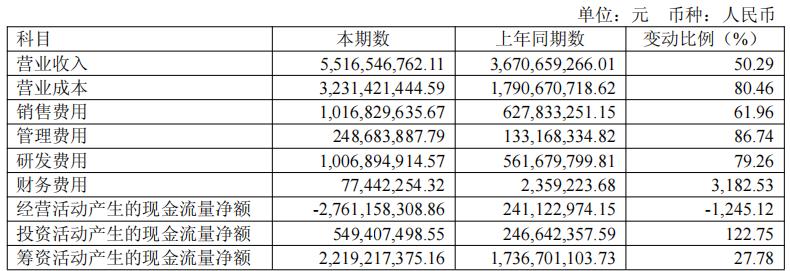
Financial reports indicate that in the first half of the year, Insta360's operating costs surged to 3.231 billion yuan, an 80.46% year-on-year increase, significantly outpacing the revenue growth rate for the same period.
During this time, the company's selling expenses and R&D expenses also saw significant increases, rising by 61.96% and 79.26% year-on-year to 1.017 billion yuan and 1.007 billion yuan, respectively.
It's worth noting that in the shareholder letter released in the first quarter of this year, Liu Jingkang had already provided an early warning about the company's potential performance decline. He stated that the company's short-term profit was under pressure, with the aim of "exchanging short-term profitability for long-term performance and healthy development."
Indeed, under sustained high-intensity R&D investment in recent years, Insta360's product lineup has expanded significantly. However, as the company's business scope continues to grow, competition between Insta360 and its rival DJI has intensified, even escalating into patent disputes.
Net Profit Plummets Over 90% in First Half: Insta360 Faces Performance Challenge
When discussing Insta360, its founder Liu Jingkang is an unavoidable topic. Moreover, Liu's repeated acts of extravagant spending have frequently sparked heated discussions online.
Last August, to celebrate the public beta launch of the company's panoramic drone, the Insta360 drone project team held a celebration event at their Shenzhen office.
At the event, Liu Jingkang stood on the upper level of a duplex room and showered the employees below with a "rain of cash." The related video, once surfaced, sparked considerable controversy.
Subsequently, Insta360 issued a public apology. Liu Jingkang also acknowledged in a subsequent interview with Luo Yonghao that "sprinkling cash is a tradition we have every time we launch a new series" and admitted that the move was inappropriate.
However, this controversy did not alter the "extravagant" nature of Insta360 and Liu Jingkang.
On "Programmer's Day" last October 24, Liu prepared 21 gold keycaps as festive gifts for employees, with the gold spacebar keycap valued at nearly 40,000 yuan.
In April of this year, Liu awarded a 25-gram gold keycap to an external developer for the first time.
Two months later, to combat online "blackwater troops," Insta360 created a pure gold slipper worth 100,000 yuan and presented it as the ultimate prize to the provider of the most valuable clue.
Leida Finance noticed that in the "2026 New Fortune 500 Richest List" released in the same month, Liu Jingkang made his debut with a wealth of 23.24 billion yuan, ranking 176th.
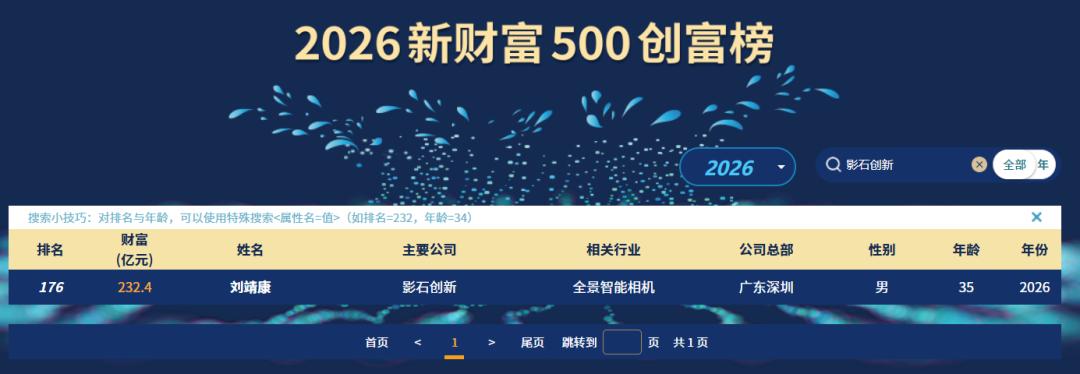
However, this very "extravagant" post-90s tech mogul and the imaging giant he founded, Insta360, are now facing new challenges.
On the evening of August 27, Insta360 announced its first-half performance report. During the reporting period, although the company's revenue increased by 50.29% year-on-year to 5.517 billion yuan, its profit indicators were alarming—net profit attributable to shareholders nearly "zeroed out," plummeting by 94.15% year-on-year to 30 million yuan, teetering on the brink of profitability.
Meanwhile, Insta360's profitability also declined significantly, with its gross profit margin dropping nearly 10 percentage points from 51.22% in the same period of 2025 to 41.42% in the first half of this year.
In terms of cash flow, Insta360 is also under considerable pressure. Financial reports show that in the first half of this year, the net cash flow generated from Insta360's operating activities was -2.761 billion yuan, a stark reversal from the positive 241 million yuan in the same period last year.
In response, Insta360 explained that the increased cash flow expenditure from operating activities this period was primarily due to chip and other material procurement and new product material preparation.
As of the end of the first half, Insta360's total assets were 14.209 billion yuan, including 1.462 billion yuan in monetary funds, a 41.69% year-on-year decrease. Total liabilities were 8.468 billion yuan, a 254.75% year-on-year surge.
Based on this calculation, as of the end of the first half, Insta360's asset-liability ratio climbed to 59.59%, a nearly 30-percentage-point increase from 30.47% in the same period last year.
As of the close on August 28, Insta360's stock price was 119.3 yuan per share, down 1.17%, with a latest market capitalization of approximately 47.839 billion yuan.
Soaring Costs 'Hijack' Profits, Continuous R&D Investment 'Burns' Money
Regarding the first half's performance "Waterloo," Insta360 attributed it to the dual impact of raw material costs and phased investment in new business categories.
Insta360 mentioned in its financial report that affected by fluctuations in the global supply and demand relationship in the storage chip market, prices of storage chips such as DDR continued to rise and remained high during the reporting period, posing significant challenges to the company's product costs and short-term profitability.
Financial reports show that in the first half of this year, Insta360's operating costs soared to 3.231 billion yuan, compared to just 1.791 billion yuan in the same period last year, representing an 80.46% year-on-year increase, far exceeding the company's revenue growth rate for the same period.
Simultaneously, Insta360 made strategic procurements of storage chips in the first half of the year, totaling nearly 2 billion yuan, increasing the company's cash outflow for procurement in the first half.
Although Insta360 stated that this proactive stockpiling would enable the company to obtain a stable supply and cost of storage chips, providing strong support for subsequent development, it also pushed up the company's inventory scale.
As of the end of the first half, Insta360's book value of inventory reached 6.212 billion yuan, an 112.82% increase from the end of the previous year, accounting for 43.72% of its total assets for the period.
Insta360 stated frankly that if the company's inventory management is poor and losses or damages occur, it will result in direct financial losses for the company, adversely affecting its operating performance.
On the other hand, if the prices of the company's key raw materials decline significantly and the company has a large stockpile, there may be a risk of inventory devaluation.
In addition, the significant increases in Insta360's selling and R&D expenses have also squeezed the company's profit margins to a certain extent.
Financial reports show that in the first half of this year, Insta360's selling expenses reached 1.017 billion yuan, a 61.96% year-on-year increase, primarily due to increased sales promotion expenses and sales personnel salaries with business growth.
During the same period, affected by increases in the company's R&D projects, R&D personnel salaries, and R&D material usage, Insta360's R&D expenses also grew from 562 million yuan in the first half of 2025 to 1.007 billion yuan, an nearly 80% year-on-year increase.
Insta360 also admitted in its financial report that to promote the new category of panoramic drones, which is still in the market education phase, the company has invested heavily in R&D, production line construction, and market channel expansion.
However, in the absence of economies of scale, the phased investment in this business segment has had a negative impact on the company's overall profits.
Public information shows that in December 2025, Insta360's first panoramic drone, the Antigravity A1, was officially released, garnering significant market attention. However, in this financial report, Insta360 did not disclose specific sales volume and revenue data for the Antigravity series.
According to Caifen reports, all four subsidiaries related to the Antigravity series reported losses in the first half of the year. Among them, Shenzhen Antigravity Technology, responsible for product R&D and sales, incurred a loss of 290 million yuan. Kunshan Antigravity Electronics, responsible for product imports and exports, reported a loss of 9.8644 million yuan. Singapore Antigravity and US Antigravity, responsible for overseas sales, reported losses of 25.8389 million yuan and 41.2244 million yuan, respectively.
Tianyancha information shows that Shenzhen Antigravity Technology and Kunshan Antigravity Electronics were both established in 2025, with their controlling shareholder being Zhuhai Antigravity Technology Co., Ltd. (hereinafter referred to as "Zhuhai Antigravity Technology").
It is worth mentioning that in October 2025, the shareholder information of Zhuhai Antigravity Technology changed, with Insta360 transferring its 100% stake in Zhuhai Antigravity Technology to Kunshan Xinyu Technology Co., Ltd., which is wholly owned by Hong Kong Antigravity Technology Co., Ltd.
Exchanging Short-Term Profit Pressure for Long-Term Performance Development
Indeed, as early as the shareholder letter released in the first quarter of this year, Liu Jingkang had provided an early warning about the company's net profit decline.
At that time, Liu stated that although the company's short-term profit faced multiple pressures and buffers, it aimed to exchange for long-term performance and healthy development.
Leida Finance noticed that in recent years, Insta360 has continuously increased its R&D investment. According to iFinD data from Hithink RoyalFlush, from 2021 to 2025, the company's R&D expenses were 150 million yuan, 256 million yuan, 448 million yuan, 777 million yuan, and 1.53 billion yuan, respectively, with year-on-year growth rates of 45.95%, 70.79%, 74.87%, 73.47%, and 96.95%.
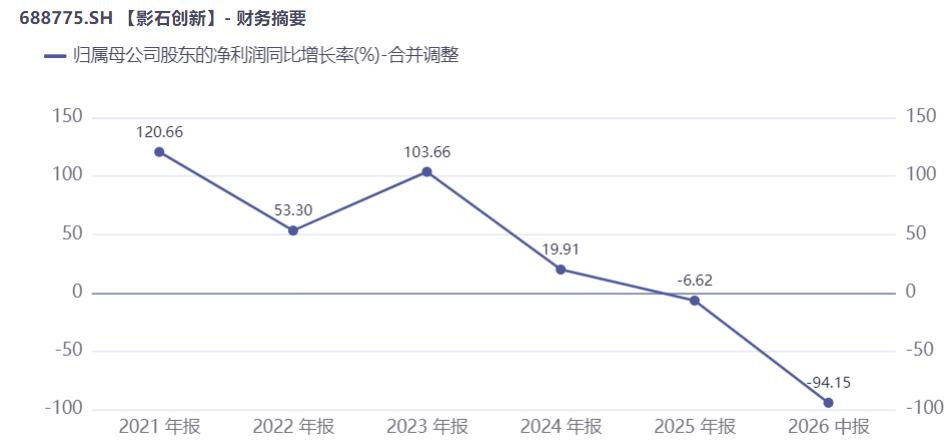
Based on this calculation, in just the past five years, Insta360 has "burned" approximately 3.161 billion yuan on R&D. During the same period, the company's net profit attributable to shareholders' growth rate has generally shown a continuous decline, from 120.66% in 2021 to -6.62% last year.
However, under sustained high-intensity R&D investment, Insta360 has gradually built its own patent "moat."
Financial reports show that as of the end of the first half, Insta360 held a total of 1,233 authorized patents domestically and internationally, including 299 invention patents, 459 utility model patents, and 475 design patents.
Thanks to its strong technical reserves, Insta360's product matrix continues to expand. Currently, Insta360's main products cover consumer-grade smart imaging devices, professional-grade smart imaging devices, accessories, and other products.
Among them, consumer-grade smart imaging devices include consumer-grade panoramic cameras, action cameras, gimbal cameras, handheld photography devices, webcams, panoramic drones, AI recording omnidirectional microphones, wireless microphones, and mobile phone selfie screens.
Professional-grade smart imaging devices include professional-grade VR panoramic cameras and AI video conferencing all-in-one machines.
According to Insta360 citing IDC data, in the first quarter of 2026, global shipments in the panoramic camera market exceeded 500,000 units, a year-on-year increase of over 50%. Among them, Insta360 ranked first in the panoramic camera field with a significant lead, accounting for nearly 70% of shipment share.
Reflected in the financial report data, in the first half of this year, consumer-grade smart imaging devices remained the absolute engine for Insta360's revenue growth, contributing 4.788 billion yuan in revenue, a 51.56% year-on-year increase.
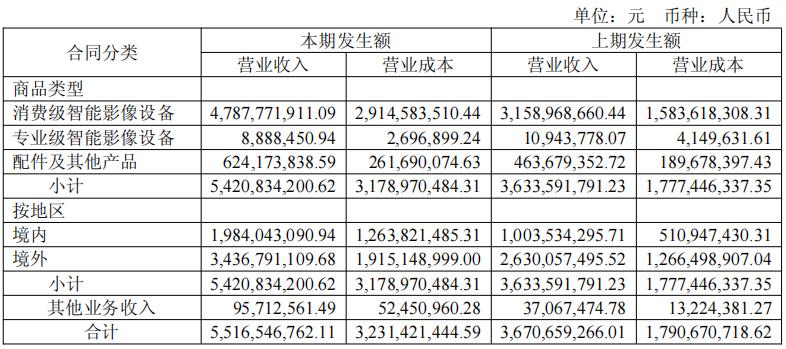
During the same period, Insta360's revenue from professional-grade smart imaging devices declined, decreasing by 18.78% year-on-year to 8.8885 million yuan. Accessories and other products achieved revenue of 624 million yuan, a 34.61% year-on-year increase.
However, as Insta360's business scope continues to expand, its competition with peer DJI has also intensified.
In June this year, Insta360 released the Luna series handheld gimbal camera, prompting DJI to file an infringement lawsuit against the product in a US court. Subsequently, the two imaging giants engaged in a patent dispute tug-of-war that spread from abroad to domestically.
According to Insta360's financial report, in the first half of this year, DJI Innovation filed a total of six patent ownership disputes against the company and related natural persons, involving a cumulative amount of 1.02 million yuan. Additionally, there was one dispute over
-
![]()
Net Profit Drops Over 90%: Is the 'Big-Spending' Post-90s Billionaire Now Facing Hard Times?
-
![]()
Low Prices Alone Can't Sustain Liang Wenfeng's AGI Aspirations
-
![]()
Li Shufu Advances to the 'Next Battlefield'
-
![]()
Tearing Off the Female Label and Embracing Both Electric and Hybrid: How Far Can GWM's Ora Go in Its Self-Rescue Journey?
-
![]()
SAIC Motor Makes a Comeback: Net Profit Jumps 72% to 7.87 Billion in H1, Gross Margin Reaches Seven-Year Peak
-
![]()
FAW Achieves New Milestone in Solar Charging! Why Is It So Challenging for Cars to 'Harness the Sun'?
-
AI: The Catalyst for Industrial Transformation
-
Is Lixiang Innovation the Next Luxshare Precision? Backed by the Wang Laichun Family, It Relies on One Client for 70% of Its Earnings