B2B Buyer's Guide: Waveguide Supplier Directory and Technology Roadmap Comparison
 11/06 2026
 596
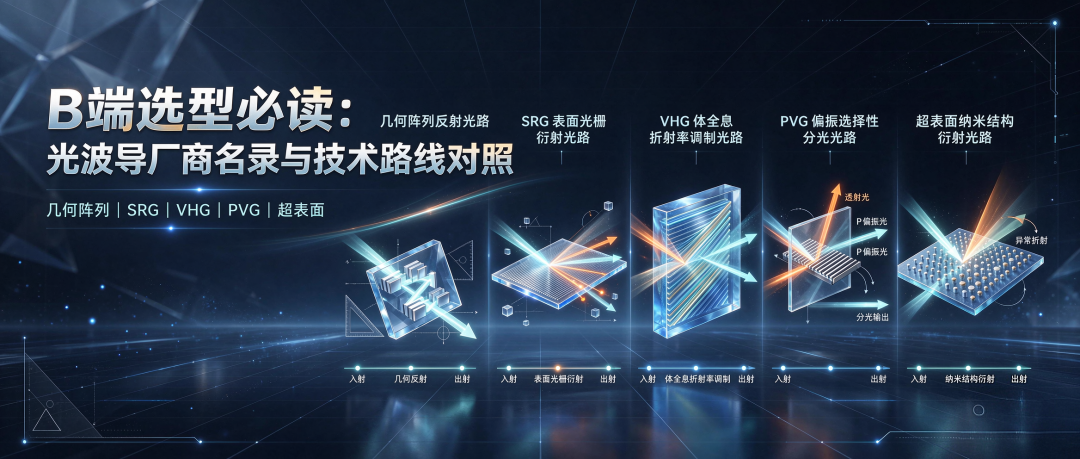
Abstract: The hardest part of waveguide selection isn't deciding which supplier is better—it's mapping out who's in the market and which technology route each player is pursuing. This article breaks down the five mainstream routes (geometric array, SRG, VHG, PVG, and metasurface) and reviews the progress of key domestic players. It doesn't take sides on pros and cons—it simply lays out what each company is doing.
For B2B procurement of AR glasses, the biggest headache is never "which company has the strongest technology"—it's that the information is too scattered. Some vendors appear only briefly at trade shows, some quietly work on samples and rarely speak publicly, and others conflate production capacity with shipment data, making it easy to misjudge.
In this article, we break things down by technology route and organize the mainstream domestic waveguide players. We don't praise anyone or disparage anyone—we simply present the routes, products, and mass production progress objectively.
Route concept overview: Broadly speaking, geometric waveguides form a separate branch; diffraction routes include SRG and metasurface; the volume holographic route splits into VHG and PVG. Metasurface is a newer form of diffraction and differs significantly from traditional surface grating principles, so it's covered separately for easier comparison during selection.
Geometric / Array: Strong image quality foundation, but a very high mass production threshold
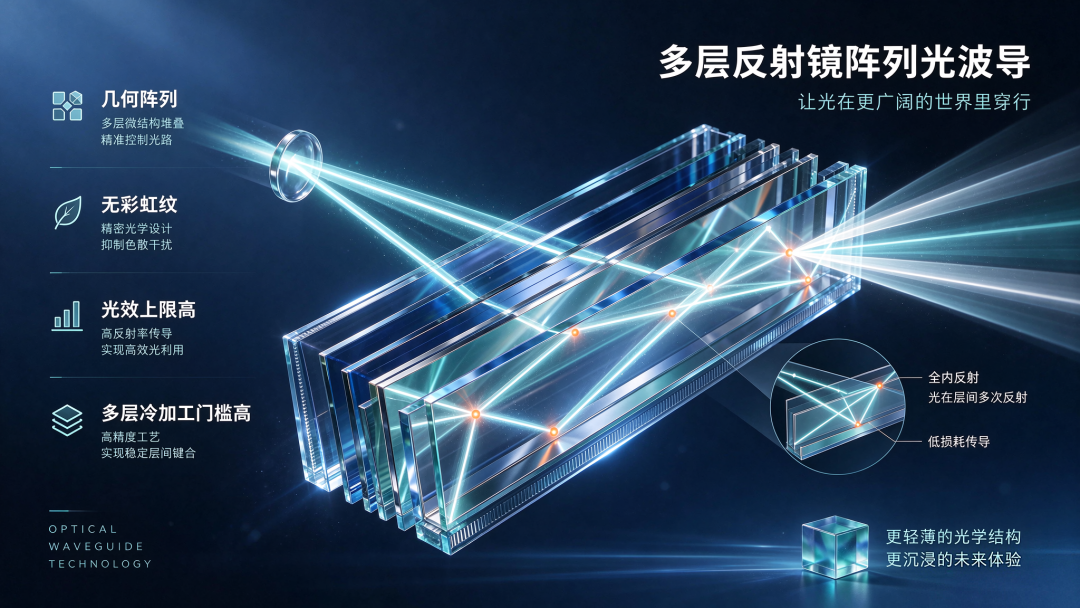
Geometric waveguides transmit light through array reflectors—that is, two-dimensional pupil expansion—which can enlarge the usable exit pupil area both horizontally and vertically.
The advantages are straightforward: virtually no rainbow artifacts, clean colors, and a high upper limit for light efficiency. The drawback lies in the multi-layer cold-processing stacking process, which makes it difficult to improve mass production yield. Lumus: A pioneer in the domestic geometric array track, founded in 2014.
Its flagship product AW82 targets industrial scenarios, with 40°FOV, 2000 nits, and support for a wide temperature range of -40℃ to 100℃; the AWO72 targets the consumer end, with the entire unit controlled within 10g and RGB full color.
Its array process level is leading, with a comprehensive straight-through yield of 90%+ on the pilot line (final yield is subject to actual measurement of mass production batches), key process yield exceeding 98%, and it has built a fully automated pilot-to-mass-production line (the "first line" claim is the vendor's wording).
Its focus is on polishing industrial reliability. A wide-temperature, high-brightness solution like the AW82 is very suitable for B2B projects within the geometric route.
Parameter references are based on the vendor's historical brochures; for new models, refer to the latest official release. Crystal Optoelectronics (GWG line): Reflective waveguides have completed process breakthroughs and NPI production lines, with deep cooperation with leading customers. At the same time, it has laid out both VHG and SRG routes, making it one of the rare vendors in the industry running three routes in parallel, offering greater flexibility in solution choice.
Yunzhan Photonics: A new player founded in 2024, advancing mass production very quickly. The Chanyi D1025 two-dimensional array waveguide has 25°FOV, a 16×16mm usable exit pupil area, a thickness of 0.95mm, and 4.1g per piece; the binocular module can be reduced to within 10g.
Its full-process production line was put into operation in July 2026, with an annual capacity of 200,000 pieces, capable of supplying AR glasses and also compatible with automotive HUD. It follows a standard-product route; the D1025 is a finalized model that can be delivered in batches, which is relatively friendly to small and medium-sized device manufacturers.
Raypai Photonics: A leading player in geometric arrays, with its Kunshan base planned for million-set-level capacity; its products cover affordable full-color and 50°FOV high-definition modules, and its molecular bonding process yield exceeds 85% (specific models are subject to the vendor's catalog). LLVision: A veteran player in geometric arrays, now shifting focus to SiC waveguides.
It has built a micro-nano optics pilot platform in Beijing Yizhuang, dedicated to engineering verification of silicon carbide waveguides. The platform has a total building area of about 2,000 square meters and is equipped with more than 60 sets of process and testing equipment, with ample experience in industrial B2B implementation.
Lumus: A representative of Israeli geometric waveguides, domestically manufactured by Quanta. It has publicly mentioned a yield exceeding 95% (key process yield, vendor / manufacturing partner wording), and details of domestic cooperation have not yet been fully disclosed.
Selection tip: The geometric route is suitable for B2B scenarios that value image quality and have sufficient budget space, such as industrial, medical, and automotive. Mass production yield is the first indicator to examine.
One additional note: straight-through yield is the pass rate of a single process; the final deliverable yield of finished products is generally lower.
SRG: The most mainstream in consumer AR, yield is the watershed
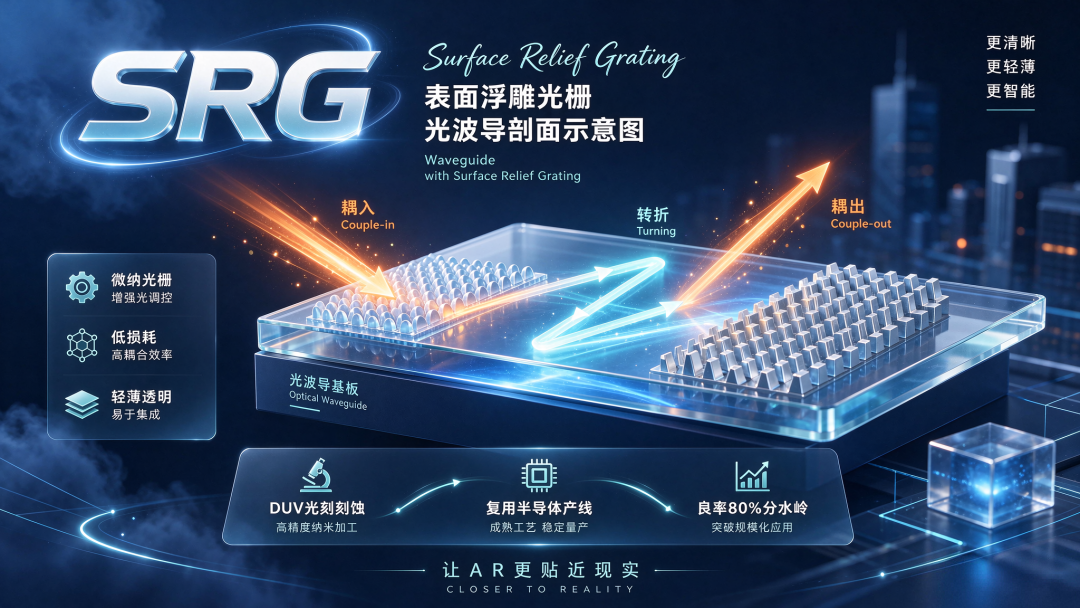
SRG is currently the most widely used diffraction route in consumer-grade AR. It relies on surface micro-nano gratings to modulate the phase of light and complete the entire light-guiding process of coupling in, turning, and coupling out. The process can reuse semiconductor production lines, the supply chain is mature, and it has the largest number of entrants.
ZhiGe Technology: A leading SRG player, spun out of Tsinghua's Precision Instrument Grating Laboratory, with an IDM model.
It plans monthly capacity at the 100,000-piece level; current delivery is at the ten-thousand-piece per month level according to vendor disclosure, with straight-through yield above 85% and some projects exceeding 90%. It has built its own 8/12-inch fully automated production line (the above are all vendor-disclosed figures, lacking independent third-party yield verification).
It has completed the construction of a fully automated diffraction waveguide mass production line. At this stage, its core work is to continuously ramp up yield. A straight-through yield above 85% places it in the first tier of the SRG track.
Goertek Optics: Advancing multiple routes simultaneously, with layouts in glass etching, DUV lithography, nanoimprinting, and SiC solutions. Its main product F20GeFL full-color etched waveguide features a full-lamination design, 0.65mm thickness, 4g per piece, and grating-area transmittance >94%; the F25Ge_DUV solution improves MTF by 30% compared with traditional nanoimprint + etching solutions. China's first 12-inch DUV lithography etching line in Shanghai Lingang has been put into operation; it not only sells waveguide wafers but also exports wafer manufacturing capabilities externally.
Optical Boat Semiconductor: Its Wuxi base is planned for an annual capacity of 1 million sets at full production, with customers including Rokid, INMO, Meizu, etc. (public report wording).
Its business covers waveguides, optical engines, and optical modules, and its Liuzhou project extends upstream to 12-inch glass wafers. Its one-drives-two solution (a single optical engine driving the left and right eyes) is a distinctive feature, and it has strong supporting capabilities for device manufacturers.
Kunyou Photonics: Among the top domestic diffraction waveguide shippers, with a target of more than 200,000 sets in 2026, covering six major series from resin, glass, and SiC, and from monochrome to full color. The Yingning YN-C30 solution is deeply adapted to the Avegant AG-30L2 optical engine.
Its Lingang 12-inch production line is expected to come online in 2027; in 2026 it completed a C+ round of financing exceeding 1 billion yuan (vendor disclosure), focusing on multi-material routes and batch delivery capability.
Guangna Siwei: Running both nanoimprint and silicon carbide etching routes in parallel. According to vendor disclosure, it was among the earlier companies to deliver SiC full-color waveguides to consumer devices; SiC has a high refractive index and can support a larger FOV.
The lens thickness is less than 0.6mm and the weight per piece is less than 3g. The C45C solution has already been deployed in models such as Coray Air2, Nimbo X1, and iFLYTEK glasses. In 2026 it obtained nearly 200 million yuan in financing, and all lines have million-set-level production line delivery capability, currently mainly delivering customer-directed projects.
Its core highlight is advancing the silicon carbide full-color solution from samples to device integration. AAC Technologies: SRG single-layer full-color waveguide, DUV lithography etching process, 0.7mm, 4g, transmittance >90%, basic version 25°FOV, light efficiency up to 4000nits/lm; the high-end SiC version achieves 52°FOV, with color deviation Δu'v'<0.02.
Mass production yield is stable above 80%, with planned annual capacity at the million-piece level, running both conventional SRG and high-end SiC lines in parallel.
Mude Weina: Its core advantage is nanoimprint masters + SiC etched waveguides, and it is one of the few domestic vendors capable of externally supplying AR diffraction waveguide templates. Its flagship product is a 50°FOV SiC waveguide with light efficiency >1000 nits/lm and system brightness >3000 nits; there is also an ultra-thin SiC full-color version at 0.35mm and 2g.
With 8-inch wafer imprinting and etching, the first phase is 5,000 wafers per month, equivalent to 250,000 sets per year, and capacity under construction is expanding toward one million sets.
It not only makes finished waveguides but also supplies upstream templates externally, effectively acting as a supporting supplier to waveguide manufacturers. Selection tip: SRG is the preferred route for consumer AR. The key selection focus is yield; 80% is the industry watershed, and customization support capability should also be evaluated.
Additional note: straight-through yield ≠ final delivery yield; during procurement, confirm the statistical basis with the vendor.
VHG: The volume holographic route, materials are the biggest bottleneck
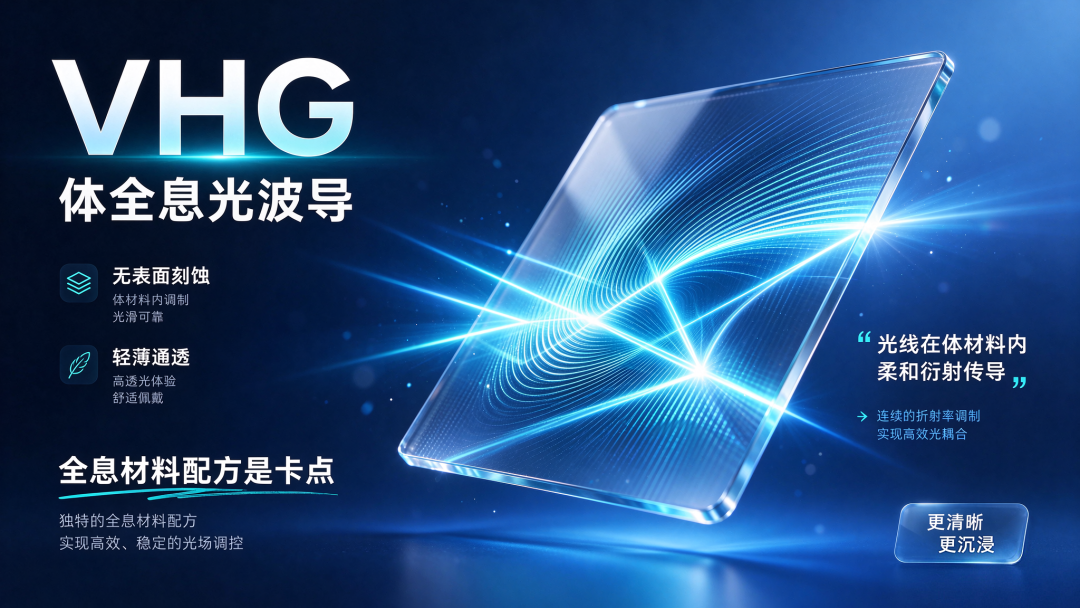
VHG belongs to the volume holographic branch. It relies on holographic interference to form refractive index modulation inside the material, without surface micro-nano etching structures. Theoretically, the image is transparent and rainbow patterns are easier to control, but after exposure and curing, material stress can bring stability risks, and the long-term bottleneck lies in the formulation of photosensitive holographic materials. Nika Optics: According to vendor disclosure, its million-piece-level VHG automated production line in Tianjin has been put into operation, with a combined planned annual capacity of about 1.3 million pieces across Tianjin and Guangzhou (vendor wording, subject to actual delivery), and orders on hand exceeding one million pieces.
Its flagship "Xingmang" volume holographic waveguide has light efficiency of 1500nits/lm, with a single piece as low as 3.1g, and good control of rainbow patterns and light leakage. It has achieved localization of holographic photoresist, and its products have been installed in mass-produced AI glasses. At this stage, it focuses on material autonomy and the stability of million-level production lines.
Crystal Optoelectronics (VHG line): Its Dongguan VHG production line has already reached mass production and shipment, currently mainly focusing on one-dimensional pupil expansion, with two-dimensional pupil expansion under development; front-side light leakage can be controlled within 2%, mainly targeting economical consumer-grade AR. On the SRG side, it is simultaneously laying out glass/SiC wafers as a cost-effective supplementary solution within its multi-route portfolio. Sanji Optoelectronics: With more than 30 years of accumulated holographic diffraction technology, it produced China's first large-area holographic waveguide (200×250mm) in 2020 and has million-level annual capacity for holographic diffraction elements.
Its product focus is on AR-HUD, holographic sights, and large-area HOE for aviation/automotive, and it has received overseas orders from Europe and elsewhere, overall leaning toward non-consumer and industry scenarios.
Aotizan Photonics: Full-chain in-house development of the volume holographic route, with photosensitive polymer materials, waveguide simulation, exposure processes, and manufacturing equipment all independently developed, breaking foreign material blockades.
Large-size volume holographic waveguides for AR-HUD have been signed with multiple Tier 1 suppliers and automakers; its 100,000-piece-level holographic functional device production line in Lianyungang has started construction, with an autonomous and controllable supply chain, focusing on automotive HUD and industry applications.
Selection tip: VHG is suitable for consumer projects that pursue thinness, lightness, transparency, and cost sensitivity. The core is to examine material self-development capability and progress in full-color implementation.
PVG: A volume holographic branch, polarization consistency is difficult to stabilize
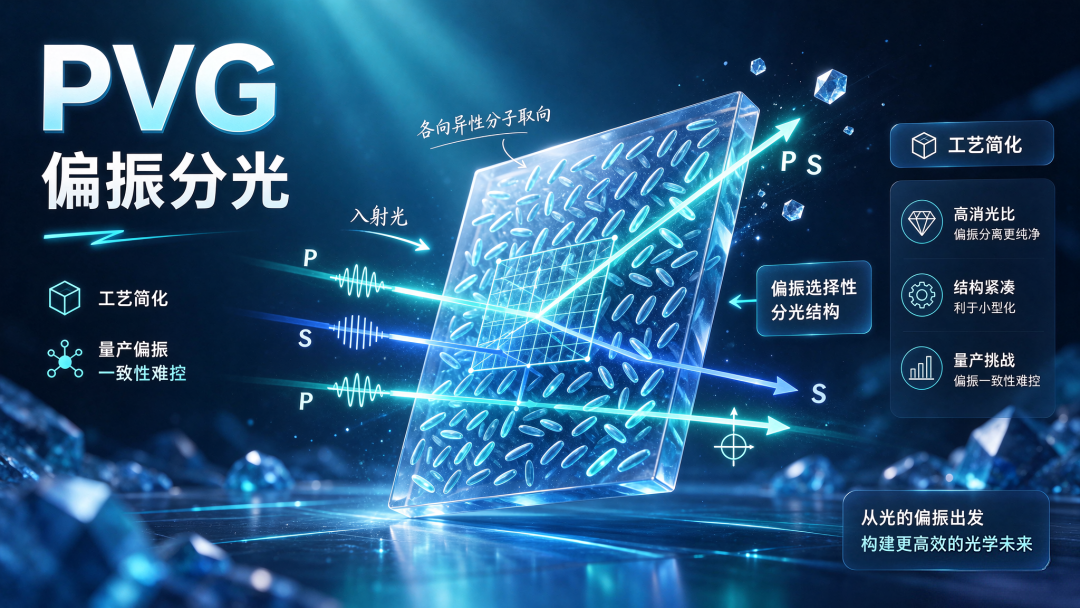
PVG also belongs to the volume holographic category, but its principle differs from VHG: it relies on polarization-sensitive anisotropic media for light splitting, not traditional refractive-index interference gratings. It does not require lithography etching, so the process is simplified and long-term cost potential is considerable, but polarization states are difficult to keep consistent in mass production. Gudong Intelligent: Dual routes of PVG volume holographic waveguide + two-dimensional full-color array waveguide.
The main H2025G single-green PVG module measures 0.8mm thick and weighs 3.3g, with a light efficiency of about 800 nits/lm; in engineering terms, it leverages the APC (anomalous polarization conversion) effect to improve coupling-in efficiency and brightness uniformity (per the vendor: coupling-in light efficiency +50% or more, uniformity +about 20%).
Together with Appotronics, it launched an "LCoS+PVG one-drives-two" solution (a single optical engine driving both eyes), and has signed a purchase order for 10,000 units.
It currently operates a 200,000-piece-level PVG pilot scale-up line (12-inch wafers), with a vendor-disclosed pilot yield of 90%+ (not a full-production figure); its Shenzhen million-piece-level PVG super factory is planned to break ground in November 2026, expanding capacity from 200,000 pieces toward the million-piece level—planned capacity that is not yet in full production.
Parallel Horizons: A representative player on the PVG (polarization volume holographic) waveguide route, built on technology transfer from Zhang Yuning's team at Southeast University (founded in 2022). The world's first PVG pilot line landed in Ji'an in December 2025, with an annual capacity of 50,000 pieces and a comprehensive yield of 80%+ after secondary optimization in the pilot stage, while a 500,000-piece-level mass production line is in planning.
Together with Luxshare Precision, it created the "Yunque" AR glasses (45g for the entire device). Parallel Horizons is responsible for the PVG waveguide and optical solution, while Luxshare handles device engineering and manufacturing delivery; PVG is compatible with Micro LED / OLED monochrome and full-color micro-image sources, and is simultaneously expanding into automotive HUD applications (per the vendor).
Selection tip: PVG suits consumer or automotive solutions that want to reduce rainbow patterns and pursue low cost. Polarization management capability and mass production consistency are the core of selection.
Metasurface: A new form of diffraction, with a very high performance ceiling, but still being verified

Alpha Dragon: A metasurface waveguide vendor with relatively advanced public progress in China, belonging to the new form of diffraction. The vendor discloses that the MGW solution's optical efficiency can reach more than three times that of SRG (there is no unified benchmark basis for the same FOV), supports FOV above 50°, and with a single-layer structure can reach up to 70°, with long-term cost expected to be about 60% lower than SRG.
It has completed over 100 million yuan in Series B funding and is planning an 8-inch SiC metasurface production line, expected to reach full capacity in 2027 with an annual capacity of one million wafers. Very few manufacturers work on metasurfaces; the nanostructure process threshold is high, and the mass production verification cycle is long.
Alphalong is currently still in the small-batch verification stage. Selection tip: suitable for B-end customers willing to participate in early solution definition and pursue ultimate optical performance. Be sure to keep a close eye on the mass production timetable and yield data.
Upstream supply chain watch list (substrates / wafers—supply cannot be ignored in B-end selection) Lante Optics: total private placement not exceeding 1.055 billion, of which the AR optics industrialization project invests 500.5 million; full-capacity plan of 50,000 12-inch SiC wafers/year and 200,000 high-refractive glass wafers/year, focusing on upstream substrate supply for optical waveguides.
Other manufacturers with public actions: covering modules, complete devices, substrates and the watch list, with progress ranging from samples to small batches
Sunny Group: XR product revenue in the first half of 2026 was about 960 million, with SG and AR glasses optical components growing over 50%; Sunny Opotech undertakes wafer-level optics and SiC waveguide solutions, leaning toward supplying modules to complete-device manufacturers.
Yuguang Technology: wholly owned system of Goertek Optics (acquired in 2023), focusing on micro-nano diffractive optics, DOE and grating design, with diffractive optical waveguide R&D capabilities, positioned as Goertek Optics' internal design and process platform.
Suda Weige: large-format surface-relief diffractive optical waveguide (SRG), format 330×210mm, diagonal FOV 30°+, transmittance above 70%, virtual image distance ≥15m; positioned for naked-eye spatial transparent display, non-wearable, already implemented in cultural and museum scenarios such as the Suzhou Silk Museum, while exploring automotive AR-HUD and special display (per the manufacturer).
Hongyi Optoelectronics: AR optical module manufacturer, main products are polarization BirdBath + Fresnel light field fusion solutions, full HD 50°FOV, module as thin as 14mm, BB modules already in hundred-K-level mass production; simultaneously self-developing array optical waveguide modules, with gluing and assembly closed-loop in-house, currently mainly samples/small batches. Core team from Huawei and Sunny.
Mojie Technology: representative of resin diffractive optical waveguides, self-developed formula-level resin material with refractive index 1.74 (1.8 under development), 8-inch resin wafers in stable mass production, 12-inch already breakthrough; covering end-to-end "material—wafer—waveguide—optical engine—complete device", and has already implemented mass-produced models for OPPO, Lenovo, and iFlytek (per the manufacturer, not simple waveguide sheet procurement).
Ned+Glasses: started with free-form surface optics, "Liuli" one-dimensional geometric waveguide full-color module, combination of free-form surface optical engine + high-brightness Micro OLED + one-dimensional geometric waveguide; optical engine part about 1.7g (different statistical calibers 1.3–1.8g), monocular module <8g, 30°FOV, transmittance >80%, 172° mirror angle reduces forward light leakage. Positioned as a cost-effective mass-producible solution for 30°-level information prompt full-color AR.
Zhongguangxue / Lida Optoelectronics: has mass production capability for optical waveguides and precision optical modules, has connected with customers for verification and small-batch supply; Lida Optoelectronics is the optical components entity under it, exhibiting geometric/diffractive waveguide sheets and color combination prisms (leading global market share). The optical waveguide business is in the early stage of customer introduction and mass production ramp-up.
United Optoelectronics: AR optics and complete-device integration manufacturer, simultaneously mastering mass production of Micro-LED micro optical engines (single chip 0.15cc, three chips 0.18cc) and manufacturing capability for binocular diffractive optical waveguide AR glasses complete devices, covering optical engine self-development, waveguide lamination, binocular AA calibration and mass production delivery, serving Yiwon, Dapeng, Gudong, Guangli, etc. (per the manufacturer).
Huaqin Technology: global smart hardware ODM leader, self-developed <0.7mm single-chip full-color diffractive optical waveguide sheet (nanoimprint + high-precision etching), layout of uniformity/lamination/light energy recovery series patents; at the same time delivering large-scale mass production of XR headsets for leading North American customers. Positioned as an end-to-end platform for XR complete devices, with waveguide self-development verification + optical engine adaptation + NPI manufacturing closed loop.
Weiyu Vision: a Shenzhen startup established in 2025, focusing on two-dimensional array optical waveguides; exhibited WYG-2601 (0.8mm/2.8g/30°FOV) at the Optoelectronics Expo, no rainbow patterns, high transmittance (>90%), Shenzhen small-batch production line has started, pilot yield about 30% (per manufacturer communication, target initial 50%, 80%+ in 2–3 years), included in the watch list.
O-Film: VR/AR optics and module integration manufacturer, layout of LCOS/LED optical waveguide modules, BirdBath and Pancake, AR glasses business is in the customer designation and transfer-to-mass-production stage; independent parameters at the waveguide sheet level are limited publicly, strengths are in optical modules and complete-device integration.
Huineng Technology: AR optical module manufacturer, BirdBath and coaxial spatial module cumulative shipments exceed 100,000 sets, diffractive optical waveguide modules are in the sample and mass production preparation stage, and a light-leakage-suppressing waveguide solution has been released.
Lianchuang Electronics: optical lens and precision manufacturing manufacturer, entering the terminal chain through AR lenses and waveguide module packaging, self-developed waveguide sheet parameters and mass production progress not disclosed.
Overseas comparison (for global B-end solution reference): Cellid, Dispelix, Vuzix, WaveOptics
How to choose: first match the route, then look at yield
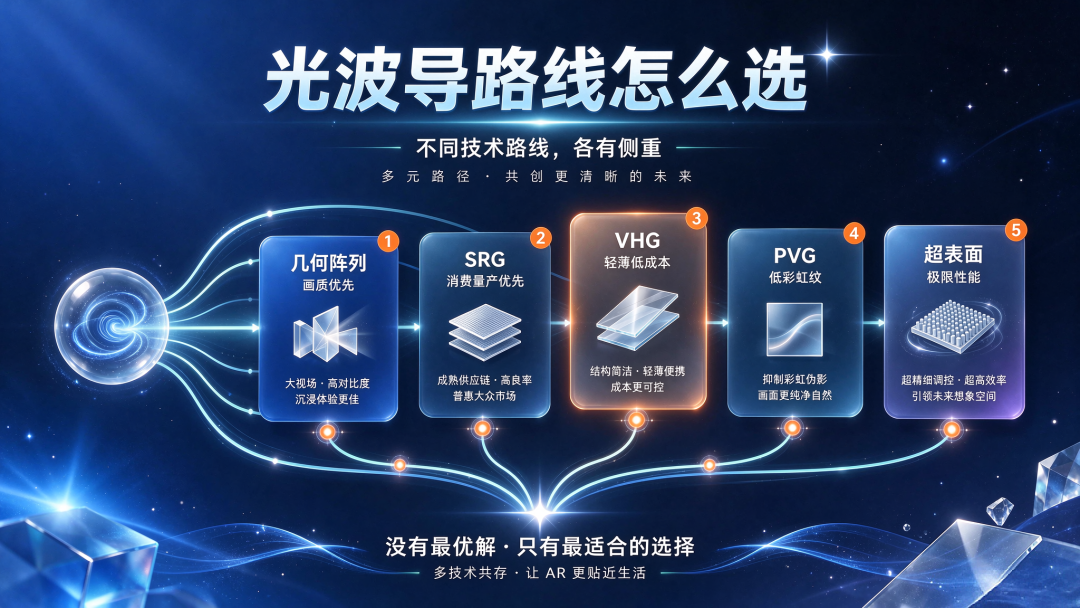
No need for complex tables—one-sentence judgment logic, just compare with your own product requirements: want image quality, sufficient budget → geometric array (Lingxi, Lipai, Yunzhan, Liangliang Vision, Crystal GWG) prioritize consumer mass production, mature supply chain → SRG (Zhige, Goertek, Guangzhu, Kunyou, Guangna Siwei, AAC, Mude Weina) pursue thinness and lightness, control cost → VHG (Nika, Crystal VHG, Sanji, Aotizan) want low rainbow patterns, simplified process → PVG (Gudong, Parallel Vision) pursue performance upper limit, can accept long verification cycle → metasurface (Alphalong) focus on upstream substrate supply → SiC / high-refractive wafers (Lante Optics) there is no absolutely best route, only the route that best matches your product definition.
Closing: this article is not intended to rank manufacturers, but only to organize information about players on the market. For B-end selection, don't start by stubbornly comparing parameters. First circle out a short list, then send samples for actual yield testing.
If any manufacturers are missing, welcome to leave a comment in the comment section, and the next version will add them. Interactive topic: in optical waveguide selection, which dimension of manufacturers do you value most—mass production yield, technical route matching, or willingness to cooperate on customization? Welcome to leave a comment and talk about your selection logic.
[Risk note] This article is organized based on public information, exhibition information and manufacturers' official statements. Yield, capacity, and product parameters have not been independently verified by third parties, and actual conditions are subject to manufacturers' official releases and actual measurement of mass production batches; technical route attribution is subject to manufacturers' official definitions; the list is as complete as possible within the scope of public information and does not exhaust all domestic optical waveguide manufacturers; expressions such as "world's first / first" are manufacturers' statements. Capacity figures such as "one million wafers / one million sets" are mostly design capacity or planned capacity, not actual annual shipments; yield includes first-pass yield and final yield, and the statistical calibers of manufacturers are not completely consistent. Efficiency comparison calibers are not unified and need to be based on actual measurement under the same FOV / same optical engine; key capacity / yield data have been cross-checked against Optoelectronics Expo news, electronic newspapers, and manufacturers' press releases, without independent third-party audit. Upstream substrate (SiC wafer, high-refractive glass) capacity is mostly planned / full-capacity caliber, and the actual supply pace is affected by substrate yield and equipment delivery schedules.
—— AR Andy|Focusing on the optical waveguide and AR microdisplay track, deeply deconstructing the underlying logic of the optical industry
-
Agents Are "Redoing" Databases
-
![]()
SAIC and Audi: Building the Purest-Blooded AUDI Electric Cars
-
![]()
Yiwu Is on a Tear Again! GDP Grew 7.9% in the First Three Quarters, and Foreign Trade Is Still Surging
-
![]()
Driving Momentum in Atomic-Level Ultra-Precision Optical Manufacturing: Lingding Optics Secures New Round of Financing
-
![]()
Q3 Non-Recurring Net Profit Surges 686%, Yet Aopu Optoelectronics Burns Through 240 Million Yuan in First Three Quarters
-
![]()
One Person, 11 Labs: The "Pick-and-Shovel" Gold Rush of AI-Driven Science
-
Volkswagen Recalls 610,000 Vehicles as Profits Plunge 98.7%—Is There Still Hope?
-
![]()
Li Jiaqi Moves 2 Trillion Tokens: AI Starts Landing in Shopping Carts