Why Can Longgang's Cross-Border E-Commerce Keep Its Lead Steady Despite Industry-Wide Headwinds?
 11/06 2026
 411
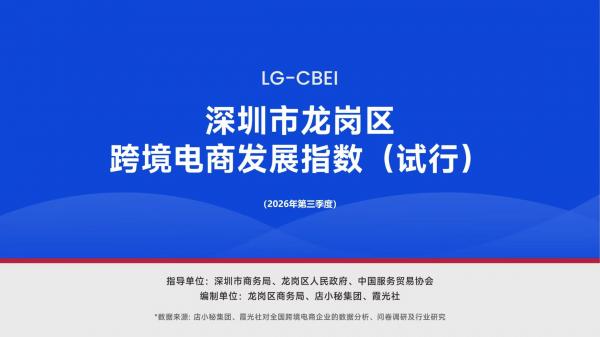
In Q3 2026, Longgang's cross-border e-commerce turned in a stellar report card that outpaced the nation. According to the Shenzhen Longgang District Cross-Border E-Commerce Development Index (trial), jointly released by the Shenzhen Longgang District Commerce Bureau, Dianxiaomi Group, and Xiaguang Society, Longgang sellers accounted for 22.0% of national GMV and 24.9% of orders, with their shares of both national GMV and order volume continuing to climb. GMV rose 1.4% quarter-on-quarter and order volume grew 4.4% quarter-on-quarter, with these two core indicators outpacing the national average by 0.2 and 0.5 percentage points respectively.
The true value of any report card must be measured against the broader industry. In Q3 2026, cross-border e-commerce entered a dual adjustment period marked by tightening policies and intensifying competition. On the one hand, overseas regulatory thresholds kept rising: starting July 1, the EU temporarily imposed a fixed tariff of 3 euros per item (per tariff heading) on imported parcels under 150 euros and explicitly made platforms primarily responsible for customs clearance; after the U.S. shut down the T86 de minimis exemption channel, regulation continued to tighten. Coupled with rising logistics costs, the old direct-mail, volume-driven selling model became unsustainable, and the national market contracted accordingly. On the other hand, regions across the country raced to double down on cross-border e-commerce, and regional competition grew increasingly fierce; the rapid spread of AI tools brought a technological "equalization effect," further intensifying industry homogenization. Against this backdrop, Longgang's cross-border e-commerce still delivered these results, making the quality and resilience behind them all the more evident.
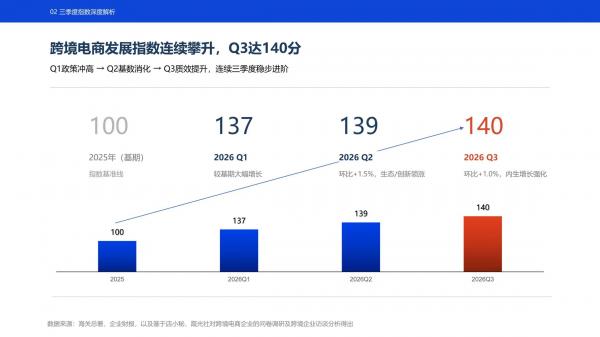
Ultimately, the Longgang Cross-Border E-Commerce Composite Index scored 140 points in Q3, extending the upward trend from 137 points in Q1 and 139 points in Q2—a steady improvement for three consecutive quarters. Only by standing firm when the wind howls and the rain beats down can one show true footing. Behind the "three consecutive rises" lie not the release of short-term windfall dividends, but a concentrated manifestation of Longgang's long-term forward-looking layout.

A quarterly panorama of "stable volume, rising quality, and optimized structure"
How should this score be read? First, look at the panorama.
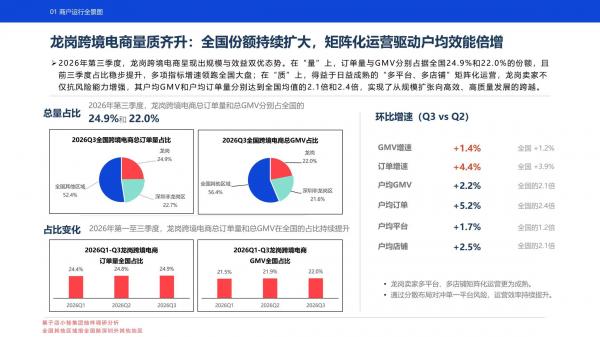
Look at total volume: it held steady. Under policy pressure and tightening platform rules, Longgang's active merchants remained basically flat, yet GMV and order volume both increased quarter-on-quarter, with order volume growing faster than GMV—total growth came mainly from "more orders," rather than simply relying on "higher unit prices." During the same period when the national market contracted and most regions saw merchant outflow, Longgang still contributed 22% of national GMV and 24.9% of orders, showing that the "No. 1 District in Cross-Border E-Commerce" has lost none of its luster.
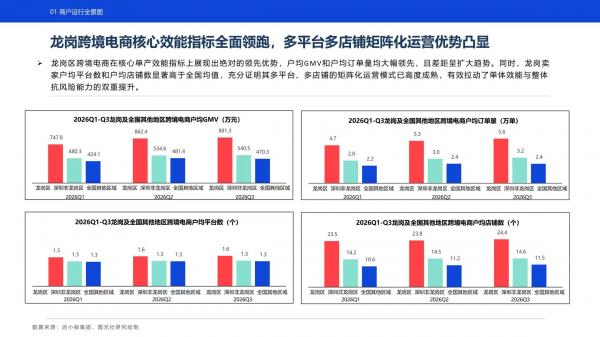
Look at quality: it improved. Being able to stabilize total volume depended on quality. Average GMV per merchant reached 2.1 times the national average; apart from average order value per merchant being slightly below the national average, average order volume per merchant, average number of stores per merchant, and average number of platforms per merchant all led the nation. The matrix-based operating model of multiple platforms and multiple stores has become highly mature, effectively driving both per-unit efficiency and overall risk resistance.
Look at markets: they broadened. Overall, concentration in the U.S. and Canada declined, the share of core European markets increased, and Southeast Asia, Central and Eastern Europe, Australia and New Zealand, Japan and South Korea, and Latin America all gained traction, shifting the market structure toward "multi-point support." This diversified market layout is precisely the source of Longgang's pressure resistance and room for maneuver.

The "rise and fall" logic of the five sub-indices
The rebound of the composite index is the result of the combined force of five sub-indices. Understanding these five dimensions makes it easy to see why Longgang can both hold its fundamentals steady and sustain its growth trajectory.
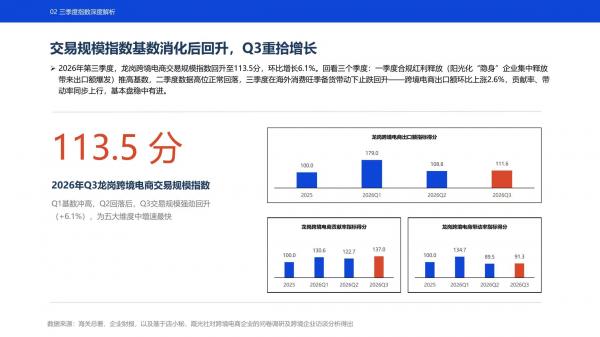
The Transaction Scale Index grew 6.1% quarter-on-quarter, recovering from 107.0 in Q2 to 113.5. The main reason was the start of stocking for the overseas consumption peak season, with shipment volume continuing to grow in Q3, driving a recovery in export volume; according to customs statistics, cross-border e-commerce exports rose 2.6% compared with Q2. At the same time, the cross-border e-commerce contribution rate and driving rate rose by 1.85% and 0.17% respectively. This fully demonstrates the strong endogenous growth momentum of Longgang's cross-border e-commerce.
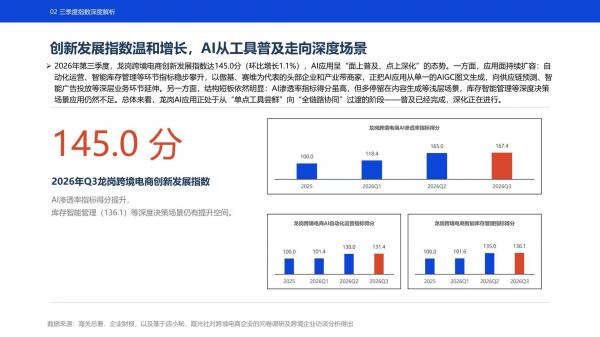
The Innovation Development Index increased 1.2% quarter-on-quarter, rising from 143.3 in Q2 to 145.0. In terms of feature usage, AI video generation surged 87.2% quarter-on-quarter, and AI image generation grew 26.5%. The application of AI in scenarios such as product selection, advertising placement, supply chain forecasting, and compliance risk control is accelerating. Behind the numbers is a reconstruction of working methods: AI is transforming from a mere "cost-reduction tool" into an enterprise's "decision-making brain."
AI application scenarios are deepening. On the product selection side, it reads reviews and identifies demand; on the compliance side, it checks infringement and verifies documents; on the fulfillment side, it forecasts sales and adjusts inventory; on the marketing side, it generates creatives and optimizes placement. AI is no longer limited to "writing copy and making images"; it is embedded in business processes and has become a capability that can be invoked at any time. Multiple factors are jointly driving this trend: peak-season stocking has raised demand for creatives and forecasting; tightening overseas intellectual property regulation has turned detection tools from "optional" into "mandatory."
The deeper shift is that Longgang has begun exporting AI tools. ZhiChuang XingYun, under Saiwei Times, released a complete product system centered on the AI business brain "Xingyun Claw" at the Yunqi Conference, covering all links of goods, orders, inventory, finance, content, and placement; Aukey is advancing R&D on an AI toolchain covering the entire chain. Leading sellers are turning from "sellers" into "AI service providers."
Reform, innovation, and platform resources are providing support in tandem. Longgang has been included in Guangdong Province's Pilot Reform and Innovation Zone for AI and Robotics Applications, and AI is increasingly widely used in product selection, marketing, customer service, supply chains, and other links, providing new practical scenarios for the industry's intelligent transformation; the Meta Overseas Expansion Experience Center (Shenzhen) opened at Kangli City in Longgang, relying on the Navos AI Agent engine and the "90-Day Overseas Expansion Accompanying Program" to deliver AI capabilities directly to the doorsteps of small and medium-sized sellers.
This has become Longgang's core differentiating label compared with other regions nationwide, and an intuitive manifestation of its endogenous growth trajectory.
The Talent Reserve Index increased 1.2% quarter-on-quarter, rising from 150.0 in Q2 to 151.8. Supporting this growth rate is the continued strengthening of the talent agglomeration effect. Carriers such as the Kangli City Cross-Border E-Commerce OPC Community and the Tianan Cloud Park Cross-Border E-Commerce Talent Research Institute are producing steady output, and the OPC Entrepreneurship Competition and talent training programs have been successfully implemented; the development of AI has also created massive demand for "composite talent," in turn pushing the talent system to upgrade toward "digital intelligence." The continued strengthening of talent reserves is the underlying guarantee that enables "endogenous growth" to progress steadily and sustainably.
The Enterprise Development Index increased 2.5% quarter-on-quarter, rising from 173.4 in Q2 to 177.7, up for three consecutive quarters. Even more impressive is the micro-level quality: with Longgang merchant activity basically flat, the average GMV score of sellers reached 148.9 and the average order indicator score reached 152.5, both rising sharply from the previous quarter, while brand perception and compliance perception also climbed. This shows that Longgang's growth is not "stacked up" by an influx of new enterprises, but "strengthened" by the development of existing enterprises, which also explains why the fundamentals remain unmoved under external shocks.
A series of measures—including the successful hosting of the "Good Products from Longgang · Good Goods to the World" sourcing matchmaking event, Longgang's continued interaction with Zhongshan under "cross-border e-commerce + industrial belts," and the continuous expansion of the strictly selected factory database—have deepened connections between sellers and manufacturing factories.
The Ecosystem Support Index fell slightly from 129.6 in Q2 to 122.9, which is normal fluctuation. It was mainly affected by a 5.2% decline in logistics and warehousing satisfaction—for example, rising oil prices pushed up international logistics costs, and the early start of Black Friday stocking caused temporary tightness in peak-season shipping space and overseas warehouse resources. Overall, the remaining indicators, such as talent and local stickiness, all rose steadily, indicating that Longgang's industrial foundation remains solid.
Looking at the rises and falls of the five sub-indices together, one main thread is clearly visible: Longgang's growth is shifting from being driven by external dividends to being endogenously driven by the combined support of AI, talent, and the industrial ecosystem. This shift in the mode of driving growth is more noteworthy than any single-quarter figure, because it determines the sustainability and risk resistance of growth.

Optimization paths toward high-quality development
The data depict the "present," while the paths determine the "future." Based on the performance of the five sub-indices this quarter, the report proposes three major development paths.
Path 1: Tiered symbiotic development. Adhere to leadership by leading enterprises and coordinated development of small and medium-sized enterprises, smooth tier mobility through inclusive and shared services, and prevent polarization.
Super-top merchants are the industry's core ballast, and leading chain-owner enterprises should continue to be supported to grow bigger and stronger; at the same time, in response to the differentiation observed in the index—pressure in the mid-tier and outflow at the long tail—carriers such as the Bantian Cross-Border E-Commerce Service Port and OPC Community should be relied upon to export shared compliance public services and reduce the digitalization and compliance costs of small and medium-sized sellers. Make good use of the strictly selected factory database and regular industry-trade sourcing matchmaking events to open supply chain resources that have been proven mature in top-tier markets to smaller entities, avoid the continuous one-way concentration of industrial resources toward the top, and maintain the vitality of tier mobility.
Path 2: Deep cultivation of local markets. Actively seize dividends and strengthen localized operations, empower emerging markets through brand incubation, and avoid the involution of extensive product listing.
Against the backdrop of overseas policy changes such as the EU's new tariff rules and the U.S. T86 adjustment, it is necessary to grasp the period of rapid growth in emerging markets such as Southeast Asia, Central and Eastern Europe, and South America, and, with the help of carriers such as the Meta Overseas Expansion Experience Center, provide supporting compliance consulting for emerging markets and DTC brand accompanying services. At the same time, be alert to a new round of involution caused by simply copying the extensive listing model, guide merchants to abandon the rough listing approach, adhere to compliant operations and deepen localized operations in line with local consumption habits, and not judge results solely by order growth, so as to transform emerging markets from risk-hedging tracks into brand incubation positions.
Path 3: Digital-intelligent industry-trade integration. Focus on inclusive AI empowerment and co-creation through industry-trade integration, accumulate industrial value through scenario innovation, and address the shortcoming of low unit prices.
Seize the opportunity of building the provincial Pilot Reform and Innovation Zone for AI and Robotics Applications, fully leverage Longgang District's existing cross-border e-commerce supply chain scheduling advantages, focus on the two directions of "AI empowerment" and "industry-trade integration," and continue piloting full-chain scenarios such as intelligent product selection and cross-border AI agents. On the one hand, make inclusive AI sharing an important direction of digital-intelligent work, and promote the opening of the results of AI creation competitions and public AI capabilities to small and medium-sized merchants; on the other hand, promote sellers and manufacturing factories to gradually address shortcomings such as low order value and insufficient brand premium through joint product development and co-building of quality control.
As the first full quarter of operations following the EU's new regulations on low-value parcel tariffs, Q3 subjected the industry to a genuine stress test amid multiple external pressures. Longgang relied on the organic growth of existing merchants and the rollout of a number of physical public carriers to deliver a report card of resilient growth. With Q4 marking the final stretch of the year—and with the stocking and shipping window for overseas Black Friday and Christmas promotions now open—the company is expected to ride this momentum and achieve even stronger results.
-
Agents Are "Redoing" Databases
-
![]()
SAIC and Audi: Building the Purest-Blooded AUDI Electric Cars
-
![]()
Yiwu Is on a Tear Again! GDP Grew 7.9% in the First Three Quarters, and Foreign Trade Is Still Surging
-
![]()
Driving Momentum in Atomic-Level Ultra-Precision Optical Manufacturing: Lingding Optics Secures New Round of Financing
-
![]()
Q3 Non-Recurring Net Profit Surges 686%, Yet Aopu Optoelectronics Burns Through 240 Million Yuan in First Three Quarters
-
![]()
One Person, 11 Labs: The "Pick-and-Shovel" Gold Rush of AI-Driven Science
-
Volkswagen Recalls 610,000 Vehicles as Profits Plunge 98.7%—Is There Still Hope?
-
![]()
Li Jiaqi Moves 2 Trillion Tokens: AI Starts Landing in Shopping Carts