Why Is Embodied AI Heading to Henan?
 11/06 2026
 579
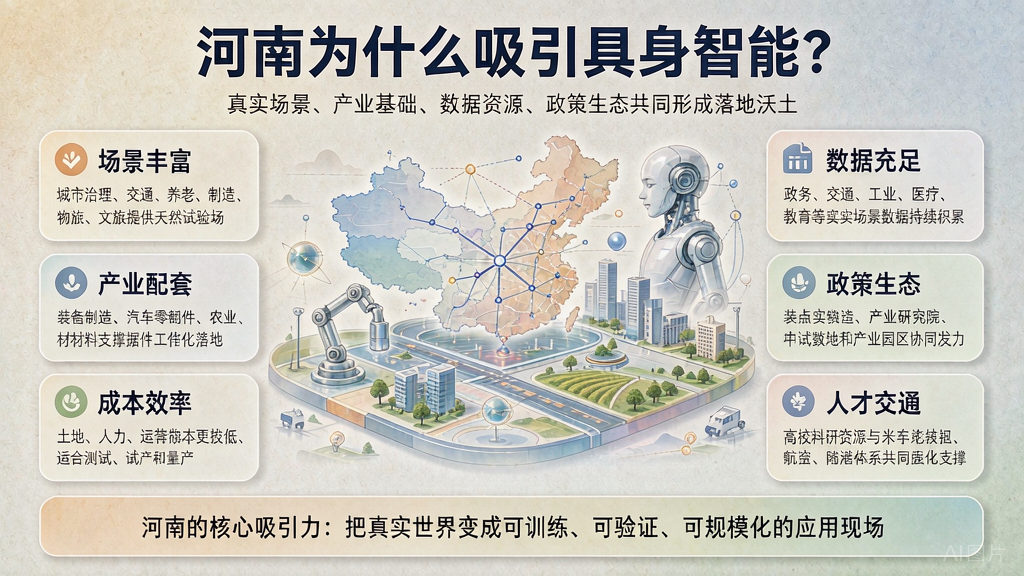
Henan, a powerhouse in the food industry, has become a magnet for embodied AI.
Recently, Henan gained yet another embodied AI company. The high-profile AgiBot Robotics chose to set up AgiBot Embodied (Zhengzhou) Intelligent Technology Co., Ltd. in Zhengzhou, with Deng Taihua as its legal representative and registered capital of 1 million yuan. Back in February this year, AgiBot Robotics had already officially established its Central China Embodied Intelligence Industrial Base in Zhengzhou.
Even before that, the Henan Provincial Development and Reform Commission noted in July this year that Zhengzhou has gathered more than 5,000 enterprises along the robot industry chain, with 25,000 across the province—ranking among the top ten in the country.
This vast stretch of land has already drawn in the industry's leading players.
Beyond AgiBot, UBTECH launched the country's first "robot-embedded industry town" in Zhengzhou, focusing on BYD's new energy operations and Foxconn's 3C manufacturing scenarios; iFlytek set up a new company in Zhengzhou to deepen robot R&D; Unitree Robotics, together with institutions such as Henan Polytechnic University, has moved into complex scenarios like mine safety and emergency rescue...
Shanghai Zhuoyide Robotics, which established a subsidiary in Henan even earlier, offered part of the answer as to why companies choose this region.
In 2024, seeking to solve the mass production problem for humanoid robots, Shanghai Zhuoyide Robotics founded Zhuoyide Humanoid Robot (Henan) Co., Ltd. in Henan.
At the time, Li Qing, founder of Zhuoyide, told the media, "R&D in Shanghai, mass production back in Henan. We're using a Shanghai-Henan collaboration model to find a pragmatic industrialization path for humanoid robots."
Behind this Shanghai-Henan collaboration model lies a pragmatic route: it avoids putting both R&D and mass production in Shanghai, where costs are so high they hinder commercialization.
Since then, as more embodied AI companies have set up operations in Henan, more and more answers have begun to surface.
Behind the "sinking" division of labor
Beijing, Shanghai, Guangzhou and Hangzhou remain the headquarters of embodied AI. Capital, policies, talent and technology determine where such companies locate, because these factors set a company's starting point and its opening ceiling—but they cannot determine how far a company can go.
From the perspective of the commercialization path for embodied AI, the complete closed loop runs from scenario traction to pilot verification to mass production delivery to continuous operation. Some relatively mature companies treat non-first-tier cities as locations for scenario traction, pilot verification and mass production delivery. The core factor behind this, beyond cost considerations, is the scarcity of real-world implementation scenarios.
Embodied AI long ago moved past the "ornamental" stage, and the standards can no longer stop at smooth movements; instead, it must truly play a role in various manufacturing scenarios. Xinhua News Agency pointed out that embodied AI first enters task areas with clear boundaries and quantifiable results—such as handling, sorting, inspection, and loading and unloading—and then gradually expands to flexible assembly, commercial services and complex environments such as homes.
This also means there are extremely strict requirements for embodied AI at multiple levels, including yield, precision and safety.
To meet these strict standards, robots must start with short-chain, highly deterministic tasks and gradually extend the task chain during operation, which must be confirmed through repeated verification.
In the process of repeated verification, robots need to expose problems and improve during long-term operation on real production lines. Lighting changes, differences in material placement and personnel interference are all factors that need to be considered. The more deployment scenarios there are, the richer the long-tail problems the model encounters. As model capabilities improve, more scenarios can be opened up, forming a virtuous cycle.
Among many second- and third-tier regions, why should Henan be one of the preferred choices for the "sinking" of embodied AI?
Yan Chen, Party Secretary of the Henan Provincial Department of Industry and Information Technology, pointed out at the Henan-Beijing Embodied Intelligence Industry Symposium in October this year that the embodied AI industry is at a critical stage of accumulating momentum for breakthroughs. Henan has a complete range of manufacturing categories, rich scenarios, a broad market and an open and active environment, and possesses a solid foundation for developing embodied AI.
Data is the best proof. It is reported that Henan Province has 41 major industrial categories and 197 medium industrial categories, with industrial supporting facilities covering an extremely wide range and presenting an overall state of being "large and refined." From the perspective of growth momentum, since March 2024, the growth rate of value-added of industrial enterprises above designated size in Henan has been higher than the national level every month for more than two consecutive years.
How can embodied AI be combined with Henan's manufacturing industry?
Henan has also provided specific scenario needs. On August 25, 2026, the Henan Embodied Intelligence Industry Matchmaking Event was held in the Zhengzhou Airport Economy Zone, and the first batch of scenario demand lists was released.
The list covers 30 scenarios in 7 major fields including industry, agriculture, education and training; it brings together 14 complete machines and core components, including humanoid robots, wheel-arm robots, rehabilitation robots, as well as key components such as high-performance sensors, precision bearings, intelligent operating systems and controllers.
For example, flaw detection and temperature measurement at Anyang Iron and Steel, production assembly at Yutong Bus, silk spindle replacement and truck loading and unloading at Xinxiang Chemical Fiber, power inspection and rail transit inspection. These are precisely the scenarios that embodied AI in first-tier cities lacks.
As mentioned above, the "sinking" division of labor in embodied AI also takes cost factors into account.
Because the robot industry is still far from achieving large-scale production, not many in the entire industry are profitable, so reducing costs is a must.
For example, data-related work accounts for 80% of the overall R&D workload of embodied AI. The cost of collecting data with real machines is extremely high. The cost range for a 30-second sample is 10 to 15 yuan, equivalent to nearly 1,000 yuan per hour. If million-hour-level pre-training is to be achieved, the overall investment will climb to the scale of 1 billion yuan.
The cost of data collected through real-machine teleoperation is high, so data collection without a physical body has attracted much attention. For example, among the planned production capacity of tens of millions of hours of data by AgiBot in 2026, data without a physical body will account for 60% to 70%.
Compared with Beijing, Shanghai and Guangzhou, data collectors in third- and fourth-tier cities can reduce costs. For example, data collectors in Xinxiang mostly earn 3,000 to 6,000 yuan, while those in Shanghai earn between 6,000 and 10,000 yuan.
Yicai previously disclosed that Wang Huijun, head of Boyue Technology, said that many embodied AI companies or data collection factories adopt an outsourcing model for data collectors. He believes that the wave of embodied AI data collection will undergo a process similar to autonomous driving data collection. Considering labor and land costs, such positions will gradually sink to third- and fourth-tier cities.
How to attract talent?
The collaborative model of R&D in Beijing, Shanghai and Guangzhou and mass production in Henan is not only a division of labor on the manufacturing side, but also requires long-term funding support. It is precisely with such a framework that Henan gives these science and technology innovation enterprises a helping hand in terms of policies, funding and talent.
Zhou Jian, founder of UBTECH, once said, "If a humanoid robot company's financing amount is less than 1 billion yuan, it will face huge challenges. Supply chain integration, resource allocation and investment in artificial intelligence, including vision, navigation and vertical domain models, all require substantial financial support. If you want to succeed in this field, without more than 1 billion yuan in investment and two to three years or more of R&D, it is difficult to have much chance."
In the primary market of embodied AI, the presence of Henan industrial funds is also becoming clearer. It is reported that at the capital level, Henan has established an artificial intelligence industry fund with a total scale of 3 billion yuan.
From the perspective of invested targets, Noitom Robotics Technology (Beijing) Co., Ltd. recently completed a Pre-A+++ round of exclusive investment, with Huirong Fund as the investor. Looking further back, Huirong Fund has continuously led the A2 and B rounds of Zhongqing Robotics, with a total investment of 350 million yuan.
Information shows that Huirong Fund was established in 2015 with a registered capital of 200 million yuan. It is a private equity fund management institution established by Henan Investment Group Co., Ltd., participating in and holding eight fund management companies including CICC Huirong, Guoyu Gaohua and Xinchan Huirong, and undertaking the management of Henan provincial emerging industry investment guidance fund and venture capital guidance fund.
Looking outward from Henan as the center, Hangzhou's Westlake Robotics, Shenzhen's Yizhi Intelligence and Linggan Robotics, Shanghai's Zhuoyide Robotics and Sainade Technology as well as Daxiao Robotics, Suzhou's Elite Intelligent Robotics, Beijing's Lingbao CASBOT and Suzhou's Juta Times all have Henan industrial funds behind them.
Continuous investment in embodied AI is not just about giving money; it also represents a kind of industrial tolerance.
Being willing to let industrial funds invest early, invest small and invest in uncertainty, being willing to give enterprises room for trial and error, and being willing to open real factories, mines, logistics and agricultural scenarios for robots to conduct real-scene training—this is the most valuable tolerance in the soft environment.
This tolerance is precisely the key bonus that attracts leading companies such as AgiBot, Zhongqing, UBTECH and Unitree to establish operations in Zhengzhou.
Previously, various policy tailwinds in Henan also frequently blew toward embodied AI.
For example, in August 2024, Henan issued the forward-looking "Henan Province Embodied Intelligence Industry Development Action Plan (2024-2027)," which pointed out that with humanoid robots as the lead, it will build a domestically influential embodied intelligence innovation and development highland.
In September of the same year, the General Office of the Provincial Government issued the "Henan Province Action Plan for Cultivating and Developing Future Industries (2024-2030)," which further pointed out that humanoid robots will be included in the "6+14" future industry matrix.
In 2025, policies continued to be strengthened. They mainly focused on talent recruitment and policy subsidies.
In terms of talent introduction, it was pointed out that those with an annual salary of more than 1 million yuan and more than 5 years of R&D experience can be recognized as provincial leading talent; those under 40 years old with an annual salary of more than 500,000 yuan and more than 3 years of R&D experience can be recognized as provincial young talent.
It is worth mentioning that Henan is also making great efforts to cultivate talent to undertake this, including Zhengzhou University, Henan Polytechnic University, Henan University of Technology, Zhengzhou University of Light Industry, Henan University of Science and Technology, Zhongyuan University of Technology, Luoyang Institute of Science and Technology and Xinyang University. Core courses usually include automatic control, robot operating systems, machine vision, sensors, motion control and artificial intelligence.
In terms of policy subsidies, Henan can be said to provide all-round care to "reduce the burden" on outstanding companies.
For example, enterprises that independently develop and publicly release artificial intelligence industry large models with good market application results will receive up to 1 million yuan in funding support for independent R&D; each year, each high-quality corpus used for large model development, training and fine-tuning will receive up to 1 million yuan in subsidies; each year, for benchmark projects with industry influence, according to a standard of no more than 30% of the project investment, the provincial level will provide up to 2 million yuan in funding support per project; for specialized, refined, distinctive and innovative "little giant" enterprises, subsidies will be given according to no more than 20% of the actual investment in equipment and software, with a maximum of no more than 5 million yuan.
Entering 2026, Henan has further "pinned" embodied intelligence at the top in terms of policy.
In May 2026, Henan's "15th Five-Year Plan" outline further clarified that it will focus on fields such as embodied intelligence to promote the demonstration and promotion of new products and new technologies and the implementation of scenario applications in key areas. In August, the Provincial Development and Reform Commission issued the "List of Key Investment Areas of Henan Provincial Government Investment Funds," including artificial intelligence and embodied intelligence as key investment directions for future industries.
More than just the "Central Plains Granary"
Henan's wheat output accounts for more than 25% of the country's total, and its total grain output has been above 1,300 jin for nine consecutive years. The Central Plains Granary is one of Henan's labels.
This region's massive agricultural and livestock food industry chain has incubated Henan's earliest wave of leading listed companies, accumulating industrial experience, industrial capital, and mature industrial supporting facilities for the locality. Mixue Ice Cream & Tea, Haoxiangni, Qianwei Yangchu, Zhongjing Food, Jindan Tech, and Muyuan Foods have become among Henan's most recognizable calling cards.
But Henan's ambitions extend far beyond being the "Granary of the Central Plains." With agriculture as its foundation, the province is transforming traditional farming into smart agriculture and biological breeding while carving out new tracks in new materials, equipment manufacturing, and biomedicine. As science and technology advance, more high-quality enterprises can emerge—and naturally, more listed companies will follow. Embodied intelligence is one such path.
Conversely, when these listed enterprises raise capital from the market, they plow it back into R&D and technology, using innovation to transform agriculture and strengthen the industrial chain. With the granary as the foundation, technology as the enabler, and the capital market as the relay, Henan's industrial story has long been about far more than a bowl of grain.
Data shows that as of mid-May this year, Henan was home to a total of 117 listed companies.
This aligns with the "six strong provinces" vision Henan previously put forward: strength in agriculture, manufacturing, science and education, digital intelligence, transportation, and culture and tourism.
Culture and tourism are another of Henan's calling cards.
Luoyang, Zhengzhou, and Anyang draw visitors year-round, while Kaifeng's Millennium City Park and Wansui Mountain are perennial fixtures on trending searches and remain popular throughout the year... During the 2026 National Day holiday, Henan's culture and tourism sector once again delivered impressive results: key scenic spots at 4A level and above across the province welcomed 18.333 million visitors and generated operating revenue of 1.16 billion yuan. It bears noting that for a region to incubate enterprises, real money alone is not enough—a sound, large-scale, and efficiently operating financial system is equally important. Zhengzhou, like Shanghai, Shenzhen, and Beijing, hosts a national-level financial exchange, which in turn creates opportunities for financial agglomeration zones.
Information shows that in 2025, the seven types of local financial organizations in the province operated steadily overall. As of the end of 2025, the province had a total of 539 legal entities across these seven types of local financial organizations.
This multi-level, simultaneous progress is what fills the region with vitality and the breath of everyday life.
—END—
-
Agents Are "Redoing" Databases
-
![]()
SAIC and Audi: Building the Purest-Blooded AUDI Electric Cars
-
![]()
Yiwu Is on a Tear Again! GDP Grew 7.9% in the First Three Quarters, and Foreign Trade Is Still Surging
-
![]()
Driving Momentum in Atomic-Level Ultra-Precision Optical Manufacturing: Lingding Optics Secures New Round of Financing
-
![]()
Q3 Non-Recurring Net Profit Surges 686%, Yet Aopu Optoelectronics Burns Through 240 Million Yuan in First Three Quarters
-
![]()
One Person, 11 Labs: The "Pick-and-Shovel" Gold Rush of AI-Driven Science
-
Volkswagen Recalls 610,000 Vehicles as Profits Plunge 98.7%—Is There Still Hope?
-
![]()
Li Jiaqi Moves 2 Trillion Tokens: AI Starts Landing in Shopping Carts