As China's AI Race Intensifies, the Talent War Emerges as the Decisive Battleground for Leading Contenders
 12/26 2025
 549
549
This late but formidable push is injecting fresh dynamics into China's AI ecosystem. With its extensive array of application scenarios and substantial financial resources, Tencent is now poised to accelerate its technological advancements with full throttle.
The Evolution of Tencent's AI Strategy
Two years ago, Tencent appeared relatively restrained in the AI arena. While ByteDance's 'Doubao' boasted nearly 170 million monthly active users, Alibaba set industry benchmarks with its open-source models, and startups like DeepSeek gained prominence through technological innovations, Tencent's HY series models struggled to demonstrate competitive market strength, leading to perceptions of it as a follower rather than a leader.
This lag was not without reason.
As the undisputed champion of China's mobile internet era, Tencent had long focused on product operations and user growth, leveraging WeChat's ecosystem and strong gaming revenues. However, compared to its peers, it fell short in long-term investments in basic research.
The development of AI large models demands top-tier research talent and an adaptive organizational structure—areas that were once glaring weaknesses for Tencent. The previous HY team, led by veterans skilled in operations and execution, had core members primarily focused on algorithm optimization in search, advertising, and other fields, lacking deep expertise in large model research. The decentralized organizational structure also hindered efficient internal resource collaboration.
The Turning Point in 2024
The turning point came in 2024.
After DeepSeek's R1 model facilitated explosive user growth for Tencent's 'Yuanbao,' Tencent gained a clearer understanding of the shortcomings of its self-developed models. Senior management also recognized that building a robust self-developed AI model had become crucial for the company's long-term competitiveness.
Since then, Tencent has embarked on a comprehensive transformation in the AI field: not only continuously increasing R&D investment (exceeding 400 billion yuan in cumulative investment since 2018) but also undergoing a complete upgrade in talent and organizational structures.
The effectiveness of these reforms is ultimately reflected in the explosion of technological achievements.
In December, Tencent officially released the new-generation foundational model HY2.0, achieving leapfrog improvements in core performance: adopting a Mixture of Experts (MoE) architecture with a total parameter scale of 406 billion and 32 billion activated parameters, supporting an ultra-large 256K context window, and excelling in complex reasoning and long-text generation scenarios.
Compared to its predecessor, HY2.0 has significantly enhanced capabilities in core tasks such as mathematical operations and logical reasoning, successfully joining the top tier of domestic AI large models and possessing the competitive strength to rival leading players like Alibaba and DeepSeek.
Notably, Tencent also excels in niche technological areas, with its 3D generation model maintaining global leadership. The related open-source model has surpassed 3 million downloads in the community, becoming a popular choice among developers and validating its industry value in technological implementation.
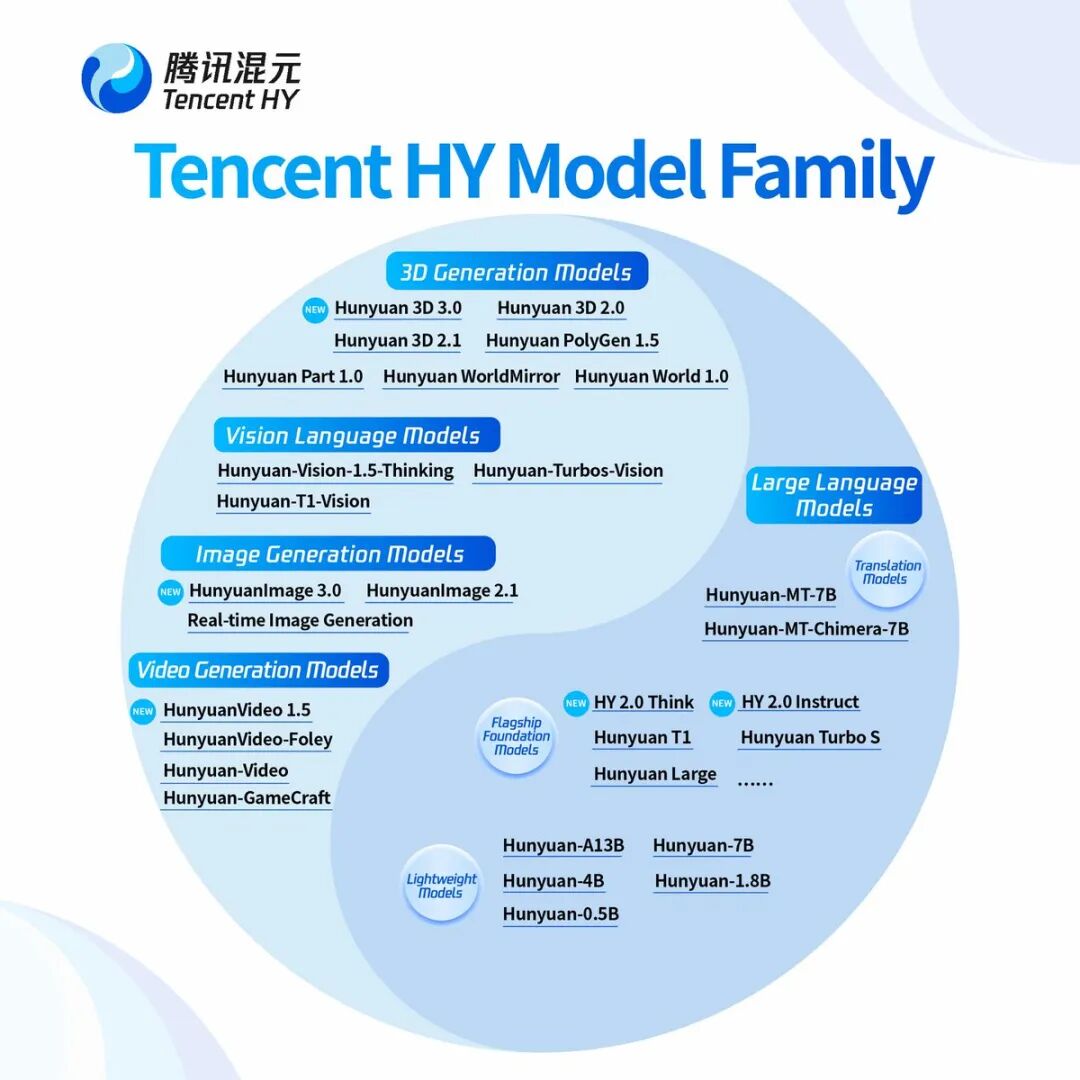
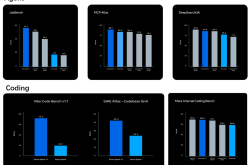
A Comprehensive Overview of Tencent's HY Model Series (Image Source: X@TencentHunyuan)
The Talent War: Tencent AI's Core Strategy for Counterattack
Tencent's AI counteroffensive is, at its core, a precise and high-profile talent acquisition war. From poaching leading figures from global top institutions to targeting core teams of competitors for breakthroughs, and safeguarding talent with substantial policies, Tencent is constructing a talent moat in the AI field through a series of strategic moves.
Previously, the Hunyuan (HY) team suffered from a loose structure and personnel scattered across multiple departments, leading to resource internal friction and project homogenization competition. Some veterans, skilled in operations and execution but lacking cutting-edge AI research experience, dominated the team, constraining scientific research innovation.
Starting in April 2024, Tencent initiated the first round of adjustments: establishing large language model and multimodal model departments, integrating decentralized technical units into a unified Data and Machine Learning Department, and ending architectural fragmentation.
On the afternoon of December 17, 2025, Tencent further upgraded its large model R&D structure by establishing the AI Infra Department, AI Data Department, and Data Computing Platform Department, focusing on large model training and inference platform construction, data and evaluation system establishment, and big data and machine learning data intelligence fusion platform creation, respectively.
The flagship move in this talent campaign was recruiting OpenAI's top researcher Yao Shunyu (Vinces Yao).
This young talent, born in 1998, a graduate of Tsinghua University's Yao Class with a Ph.D. in Computer Science from Princeton University, was a core contributor to OpenAI's first batch of intelligent agent products, Operator and Deep Research, with profound accumulations in cutting-edge fields such as language agents and digital automation (WebShop, SWE-bench, tau-bench).
In August 2024, Yao joined OpenAI and was soon recruited by Tencent. Tencent granted him extremely high authority: not only serving as the Chief AI Scientist in the 'CEO/President Office,' directly reporting to Tencent President Liu Chitping, but also concurrently heading the AI Infra Department and Large Language Model Department, reporting to Lu Shan, President of the Technology Engineering Group, shouldering the crucial mission of rebuilding a research-oriented team and upgrading the Hunyuan system into the company's foundational infrastructure.
Wang Di, the former Deputy General Manager of the Large Language Model Department, now reports to Yao Shunyu, while Liu Yuhong, the head of the AI Data Department, and Chen Peng, the head of the Data Computing Platform Department, both report to Company Vice President Jiang Jie, forming a 'talent-centric' management chain.
Although Tencent officially denied rumors of an 'over 100 million yuan compensation package,' this cross-level authority and responsibility configuration sufficiently demonstrates Tencent's emphasis on top talent.
Yao Shunyu's joining has also become a 'dual identity' business card of academic and industrial status for Tencent in the global AI talent market, prompting industry researchers who previously only viewed Tencent as a 'commercialization machine' to reassess the scientific research value of this tech giant.
Additionally, Tencent launched a precise 'poaching offensive' against direct competitor ByteDance.
In December 2025, leveraging a window period of internal adjustments at ByteDance, Tencent, with 'doubled salaries' as the core lure, targeted top researchers from ByteDance's AGI core force, the 'Seed Team,' ultimately successfully attracting over a dozen senior researchers to join the Hunyuan large model project.
This move was not impromptu but based on evidence: a December 2025 report by The Information explicitly confirmed Tencent's core condition of offering double salaries to ByteDance's Seed Team.
Even more attractive was Tencent's package of additional benefits, including a flat organizational structure and independent research authority, providing talent with 'self-defined route' development space, which is highly appealing to researchers who have reached career bottlenecks in mature organizations.
The core reason for Tencent's determination to compete for Seed Team talent at high costs is that the team's technological accumulations precisely align with the upgrade needs of the Hunyuan large model: deeply supporting core businesses such as Douyin recommendations and CapCut generation, with daily invocation volumes exceeding 200 million times. Its open-source multimodal foundational model, BAGEL, is an industry benchmark, scoring higher than GPT-4o in authoritative evaluations, capable of unified understanding and generation across text, images, videos, and other modalities, and possessing 32K long context processing capabilities, precisely addressing Tencent's shortcomings in multimodal and long-text reasoning fields.
To build a sustainable talent supply system, Tencent launched the 'Qingyun Plan' as strong support. This high-salary talent strategy, initiated in 2025, shows sincerity by imposing no computing power or manpower limits on core AI talent: not only offering salaries 50% higher than industry standards for fresh Ph.D. graduates from top universities but also providing subsidies of up to 1.36 million yuan for postdoctoral researchers in the AI field in Shenzhen.
After taking office, Yao Shunyu publicly called out on social media, 'Welcome laid-off talent to private message for communication,' adopting an open and urgent stance to attract talent, echoing the 'Qingyun Plan' and jointly forming Tencent's policy matrix for talent attraction.
(Image Source: X@TencentHunyuan)
This talent battle has not only enabled Tencent to address its previous research shortcomings but also reshaped its talent attraction within the industry, injecting the most core driving force into the iteration of the Hunyuan large model and the implementation of the AI strategy.
The Ecological Advantage of 'Scenarios + Data'
If talent and technology represent Tencent AI's 'hard strength,' then its vast user scenarios and massive data constitute its irreplaceable 'soft strength' and ecological trump card.
Unlike mere competitions focused on model parameters, Tencent's AI strategy closely revolves around its own ecosystem, promoting natural technology adoption and continuous iteration in high-frequency scenarios.
On the consumer side (C-end), 'Yuanbao' AI has been deeply integrated into product matrices such as WeChat, Tencent Meeting, QQ Browser, and WeChat Channels: automatically generating meeting summaries and action points in Tencent Meeting; enabling direct '@Yuanbao' interactive Q&A in official account comment sections; and integrating its AI voice recorder function with internal service links. This 'embedded' approach allows users to enjoy AI services almost imperceptibly, with remarkable results.
Data shows that in the first quarter of 2025, Tencent Yuanbao's single-quarter ad creative placements reached 1.183 million; its monthly active users climbed to 38.84 million in March, once surpassing 'Doubao' on the Apple App Store free chart.
On the enterprise and industrial sides (B-end), Tencent is deeply integrating AI capabilities into its business fabric and extending them externally. Tencent Cloud CodeBuddy has become China's first AI programming assistant supporting plugin, IDE, and CLI formats, assisting in generating 50% of the company's new code, with over 90% of Tencent engineers using it; Tencent e-Sign, intelligent customer service, and collaborative office product lines have also been fully AI-enabled.
More importantly, Tencent is exporting its accumulated AI engineering capabilities and solutions to over 30 industries, including finance, government affairs, healthcare, and transportation, which is becoming one of the core drivers of Tencent Cloud's growth.
This path of 'first deeply applying within itself, then empowering industries with the methodology' ensures its AI technology possesses both practicality and stability.
AI Competition Intensifies in the Deep-Water Zone
Tencent's comprehensive escalation in the AI arena has introduced new variables that will influence the trajectory of China's fiercely competitive AI market.
In the current landscape, ByteDance and Alibaba hold significant positions due to their first-mover advantages; startups like DeepSeek and Yuezhi Anmian continuously breakthrough with technological sharpness. Tencent's strong entry undoubtedly makes this comprehensive competition of technology, talent, and ecology even more suspenseful.
As Tencent President Liu Chitping stated at a recent earnings call, 'Currently, no company in China has formed an overwhelming advantage in models; everyone is in a very close competition.' This clearly indicates that AI competition has long surpassed mere model parameter comparisons, entering a stage of comprehensive competition in 'talent reserves, scenario adoption, ecological construction, and long-term endurance.' Tencent's advantage lies in its combined strength of sustained financial investment capacity, a scenario-rich user base, and its rapidly addressing research and organizational shortcomings through recent reforms.
Jin Sha Jiang Venture Capital's Managing Partner Zhu Xiaohu once judged that the domestic large model landscape is still in its early stages, and 'Tencent, with the strongest scenarios and financial reserves, has not truly unleashed its potential yet.'
Now, this 'sleeping giant' has awakened. With the continuous iteration of the HY series models and deeper integration of AI with ecological scenarios, Tencent is attempting to transform its technological capabilities into a 'ubiquitous yet imperceptible' systematic user experience and industrial advantage.
In the competition for AI, there is no overnight success or permanent victory.
The ultimate winner will belong to those enterprises capable of retaining and activating top scientific research forces, converting technological advantages into tangible user experiences and industrial values, and persevering in strategic focus over the long race.
Now, Tencent is vigorously advancing its AI strategic upgrade with its unique ecological precipitate (accumulation), massive data reserves, and determined self-iteration.
Every move by this tech giant will continue to disrupt China's AI industry competition landscape, injecting new variables and possibilities into industry development.
Reference Sources: The Information, Tencent Official Website
-
![]()
Seres Mid-Year Report Catastrophe: Projected Losses Surpass 1.5 Billion Yuan!
-
![]()
"Fruit Chain Brother No.1" Plummets Below Issue Price on Debut Trading Day! Chaoshan's Wealthiest Woman Stakes HK$24 Billion on AI
-
![]()
Auto Market Undergoes Major Shake-Up: Winners and Losers Revealed
-
![]()
The Successful Recovery of the First Stage of the Long March 10B: What Does It Mean for China's Commercial Space Industry?
-
![]()
Xiaomi Pengcheng: Crafting the Future of Mobility
-
![]()
Even Li Auto Is Facing Challenges. Can Xiaomi Make a Mark in the Extended-Range Hybrid Vehicle Market?
-
![]()
Surplus Capacity Leasing vs. Aggressive Expansion: Is Meta's 'Dual Strategy' a Deliberate Move?
-
![]()
German Business Leaders Contemplate 'Embracing the 996 Culture,' While Chinese Auto Workers Simply Aspire to Clock Out On Time