Chinese Startup Raising 5 Billion in Three Months Outperforms NVIDIA in North America
 06/03 2026
 542
542

Embodied AI is never short of money, but its investment logic is the hardest to explain.
In the first quarter of 2026, the total financing in China's embodied AI sector reached 37.3 billion yuan, compared to 12.6 billion yuan in the same period in 2025. Financing rounds exceeding 1 billion yuan are common, with multiple companies joining the club of firms valued at over 10 billion yuan.
Yet, at the same time, the 'bubble theory' has never been louder.
"What exactly are they investing in?" This has been the most frequently asked question in the venture capital circle for a long time. The outside world sees round after round of dazzling financing and wealth creation myths with valuations doubling. However, due to unresolved issues such as the lack of convergence in technological approaches, difficulties in comparing technologies on a standard baseline, and still unclear scenarios, the underlying logic of embodied AI investments remains unclear. Thus, the most convenient explanation emerged: FOMO (Fear Of Missing Out) sentiment dominates, and capital is buying a ticket to the future.
This is a typical lazy mindset. It simplifies complex industry judgments into mere emotions, attributes rational capital decisions to herd behavior, and traps the entire embodied AI industry in a vicious cycle of 'more financing, more doubts.'
In fact, when we zoom in closely enough and match financing news with business progress one by one, a clear pattern emerges: behind every capital injection into truly leading projects, there are tangible technological breakthroughs and commercialization advancements providing support.
Qianxun Intelligence serves as the perfect example.
This company, founded just over two years ago, has orchestrated a textbook-level 'dual-wheel drive' of financing and business growth. Its rhythm is as precise as a well-oiled machine:
On January 12, its self-developed Spirit v1.5 VLA model surpassed Pi0.5 to rank first globally in RoboChallenge real-machine evaluations, with the base model weights open-sourced simultaneously. Just one month later, Qianxun Intelligence announced the completion of nearly 2 billion yuan in financing, with its valuation exceeding 10 billion yuan. Investors included top-tier institutions such as Yunfeng Capital, Sequoia China, and Chaos Investment.
On March 19, it signed a strategic cooperation agreement with JD.com, deploying its Mozhi robot in JD MALL retail scenarios. The robot achieved stable operation in coffee-making tasks, established a closed-loop of service and data collection, and accumulated the most challenging data assets for embodied AI in real-world scenarios. Nineteen days later, Qianxun Intelligence announced an additional 1 billion yuan in financing, bringing its total to 3 billion yuan within just 30 days and its valuation soaring past 20 billion yuan.
In early May, global industrial giant Bosch Group forged a strategic partnership with Qianxun Intelligence, coupling at the business level, while Bosch also expressed its intention to invest in Qianxun Intelligence.
In early June, Qianxun Intelligence swept the U.S.-based 'Embodied AI Olympics' RoboArena, outperforming NVIDIA and Pi to rank first globally, shattering the bias that Silicon Valley possesses superior cognitive capabilities. Concurrently, Qianxun Intelligence completed a 1.5 billion yuan Series A+ financing round, with shareholders including top-tier U.S. dollar funds, large industrial investors, and state-owned funds, forming an elite capital lineup.
This is no coincidence. No top-tier institution would repeatedly pay for a mere 'ticket to the future,' nor would any invest out of herd behavior. Every vote of confidence from capital is backed by clear strengths: from technical benchmarking proving model capabilities, to industrial scenarios validating high reliability, then to retail scenarios confirming versatility, and finally securing strategic endorsements from global industrial giants.
Qianxun's story reveals that capital is not betting on vague narratives in embodied AI, nor is it solely listening to companies proclaim themselves as 'leaders of the embodied era.'
Instead, it looks at what companies are actually doing.
What truly deserves investment has never been just an imagined future, but the present that is already unfolding.

While domestic benchmarking for embodied models has become commonplace, Qianxun Intelligence's top ranking at RoboArena carries entirely different significance.
RoboArena's authority has set it apart from other rankings since its inception. Co-founded by the University of California, Berkeley, Stanford University, and NVIDIA, the platform emphasizes authenticity and objectivity through its community-driven approach, incorporating stringent requirements into its evaluation mechanisms.
Most importantly, it breaks away from single-laboratory assessment models by deploying models in real physical environments across dozens of top global universities and research institutions for testing. Through A/B testing with double-blind evaluations—where model developers remain completely anonymous—assessors cross-test different strategies executing the same task in real-world conditions, eliminating subjective biases entirely. Additionally, its dynamic Elo rating system for genuine capability ranking, based on 'letting real competitions speak,' enables the leaderboard to accurately and dynamically reflect each model's core generalization abilities in complex real-world scenarios.

To fundamentally eliminate industry-wide issues of benchmark inflation, data fabrication, and manipulation, RoboArena has open-sourced its complete evaluation framework, full-chain data flows, and core ranking algorithms globally. Any institution or individual can audit the evaluation process and replicate ranking results at any time.
This is why RoboArena has become the industry standard. Its rankings are never short-term marketing gimmicks but seek representatives of model capability ceilings on a global scale. Thus, it is dubbed the 'Chatbot Arena of the robotics world' and widely recognized as the 'Olympics of embodied AI.'
For a long time, the top spots on this leaderboard have been occupied by overseas giants like NVIDIA and Pi. Qianxun Intelligence single-handedly broke Silicon Valley's monopoly narrative on foreign soil. This achievement not only stamps Qianxun Intelligence's technical prowess with an indisputable seal but also disrupts the established structure of global cognitive capability competition in certain contexts.
Breaking down specific tasks, in the 'Open the Notebook' mission, the assessor's feedback was straightforward: Model A (Spirit v1.6) successfully opened the notebook, while Model B (Cosmos3) showed no attempt to open it whatsoever, so I prefer Model A.
From the test video, Spirit v1.6 executed the task seamlessly. Upon approaching the notebook, it proactively adjusted its posture, tilting gently like a human hand toward the direction to open it, then successfully lifted the thin notebook cover and fully opened the lightweight notebook in one attempt. The entire process involved no redundant probing, as if it truly 'understood' the physical essence of the 'open the notebook' action.

Video caption: Spirit v1.6 completes the 'Open the Notebook' task.
In contrast, Cosmos3 moved directly toward the notebook's supposed location upon activation but exhibited significant positional estimation errors. When attempting to correct, it pushed in the opposite direction and even moved distracting objects. Ultimately, it repeatedly opened and closed its gripper at empty air, inadvertently shifting the notebook's position through futile actions before giving up.
This task visually demonstrated the gap in physical world understanding and execution capabilities between the two models. Of course, the scores were even more telling: Spirit v1.6 achieved a 100% success rate; Cosmos3 scored 0%.
In the 'Place the Toy on the Table' task, Spirit v1.6 initially exhibited slight positional deviation but quickly adjusted its position and posture to complete the task successfully. Meanwhile, Pi 05 still fumbled in the air several times. Even when it found the correct position, perceptual and decision-making errors caused it to drift away and grip the empty air beside the target.
The assessor provided the simplest feedback: Model A (Pi 05) had recognition errors, while Model B (Spirit v1.6) achieved correct recognition and successful grasping. Spirit v1.6 scored 90%; Pi 05 remained at 0%.
These stark contrasts are not isolated flukes in a single task but definitive evidence of the models' relative capabilities.
This guest-field championship in Silicon Valley was the inevitable outcome of Qianxun Intelligence's industrialized R&D paradigm. This consistent generational advantage reflects not only its deep accumulation in the underlying architecture of general-purpose embodied large models but also its ability to translate cutting-edge technology into scalable industrial capabilities. This represents the most scarce core competitiveness in today's embodied AI industry. 
Over the past six months, a semi-joking saying has circulated in the embodied AI circle: 'The shelf life of a model benchmark's top ranking is now counted in days.'
Behind this statement lies collective industry anxiety. The window between a model's release and being surpassed keeps shrinking. Companies resemble participants in an endless sprint, all pushing their limits but unable to truly widen the gap.
The root problem lies in the fact that some companies' 'leadership' on benchmarks essentially amounts to 'exam-cramming.' While this approach can temporarily inflate scores, once models leave the benchmark 'examination hall' and enter the ever-changing real world, their capabilities diminish significantly.
Technological breakthroughs may secure temporary grades, but they cannot win long-term industrialization wars. For genuine industry leaders, the competition has shifted from 'can we lead?' to 'how long can we lead?' Only those who transform transient technical advantages into sustainable barriers will prevail in the end.
Qianxun Intelligence's answer lies in cultivating dual moats—internal and external.
Internally, Qianxun Intelligence has built a 'data flywheel' that does not represent self-contained growth in a single link. Rather, it emerges as an evolutionary force from the hardest and most fundamental challenge in embodied AI: data. It transforms this biggest obstacle into a reusable asset, converting it into systemic competitiveness that others cannot replicate.
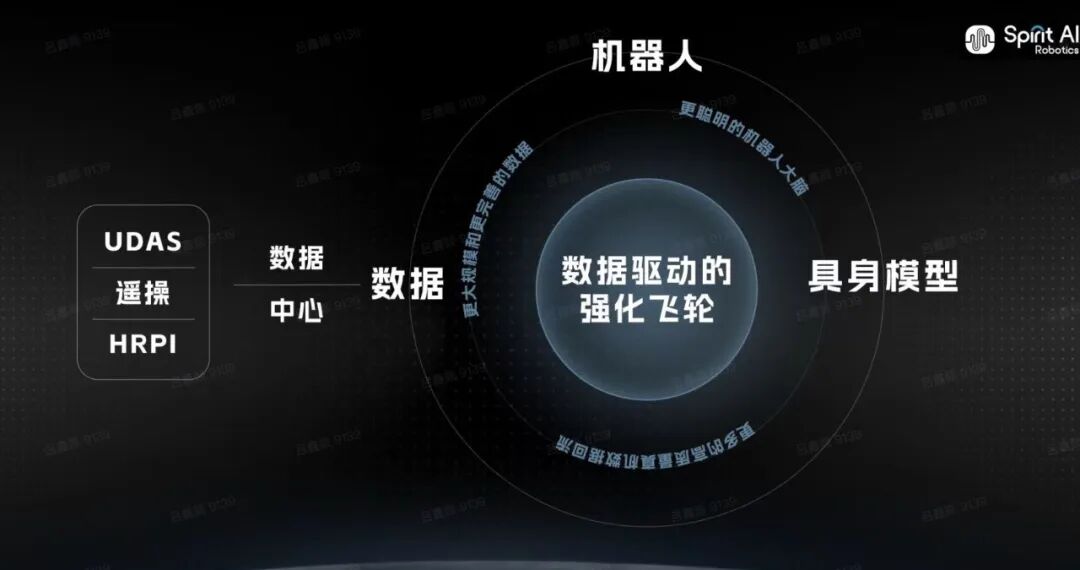
Unlike the industry's common practice of collecting data based solely on specific task requirements, Qianxun Intelligence has established a three-tier industrialized data production system: at the front end are three major entry points—UDAS, teleoperation, and HRPI—covering data acquisition needs across different dimensions. All collected data converges into a unified data center, undergoes rigorous processing, and becomes fuel for training the Spirit embodied model. Improved model capabilities, in turn, empower front-end data collection: smarter robots can autonomously complete more tasks, generating higher-quality unsupervised data and expanding into larger-scale datasets.
This represents a true 'reinforcement flywheel,' unlike the common one-way data flows in the industry. Most companies' 'data flywheels' are actually broken chains—they obtain data from clients to train better models, but model improvements do not make data collection itself faster or cheaper. Once Qianxun's flywheel gains momentum, it generates exponential acceleration: the better the model performs, the higher the data production efficiency; the more data available, the faster the model iterates.
This ultimately forms a long-lasting technological moat.
Externally, Qianxun Intelligence has forged deep, interdependent partnerships with the world's top industrial giants. These collaborations transcend simple 'buyer-seller' procurement relationships, encompassing full-chain cooperation in technology R&D, scenario validation, and channel distribution.
Its partnership with CATL granted Qianxun Intelligence entry into industrial manufacturing—the largest and most demanding application scenario. On CATL's Zhongzhou base, the world's first humanoid embodied AI production line featuring Mozhi robots has operated continuously and stably. Its strategic cooperation with JD.com validated the versatility of embodied AI in consumer-end scenarios. Currently, Mozhi can work independently in JD MALLs, achieving 'service-as-data-collection' in real-world settings to accumulate data barriers.
The group-level strategic partnership with Bosch Group reached in late April further extended Qianxun's industrialization advantages globally.
These collaborations collectively form Qianxun's second moat. For a model to operate stably in industrial scenarios requires countless adjustments and optimizations, deep industry understanding, and an established service system—none of which can be achieved through mere financial investment in a short time.
These two barriers mutually reinforce each other, creating an unbreakable closed loop (closed loop). The data flywheel continuously expands Qianxun's technological lead, while its industrial strategic layout translates this technical edge into tangible commercial advantages and cash flow.
Qianxun Intelligence has now begun running its own marathon. 
While claiming the top spot, Qianxun Intelligence simultaneously announced the closure of its Series A+ financing round. The investors represent a diversified coalition of elite capital sources—a consensus choice.
This 1.5 billion yuan round marks Qianxun Intelligence's fourth dense (intensive) financing within just three months, bringing its cumulative funding to nearly 5 billion yuan and setting a new record for financing frequency in the embodied AI sector.
Qianxun Intelligence stated: The funds from this round will focus on three core directions: continuous R&D and iteration of next-generation embodied AI base models, construction of a global real-world data infrastructure system, and acceleration of large-scale commercial deployments across multiple industries. Leveraging its full-stack technological advantages and capital support, the company will continue refining its closed-loop ecosystem of algorithms + hardware + data + scenarios + ecology to solidify its long-term competitive barriers.
This reminds people of the race for large language models in 2023. As technical approaches gradually converge, capital has shifted its focus from 'whose model has more parameters and whose demo is more impressive' to 'who can first establish a viable business model and achieve sustainable growth.' Embodied AI is now undergoing the exact same turning point. The race has entered its latter half, where mere technical appeal is no longer the sole criterion. What capital truly values is a company's ability to translate technological advantages into commercial success and to maintain its competitive edge throughout the lengthy process of industrial implementation.
In other words, the current investment logic is: in the short term, a company must demonstrate hardcore technical strength, while in the long term, it must prove the sustainability of its business model. Both are indispensable.
And Qianxun Intelligence is one of the rare contenders in today's embodied AI race that simultaneously meets both criteria.
On the technical front, it has proven its leading position in the field of embodied intelligence by 'topping the charts' on globally authoritative benchmarks. On the industrial front, it has successfully implemented solutions across multiple scenarios, ranging from high-end manufacturing to retail, and established deep collaborations with industry leaders such as Bosch, CATL, and JD.com. At the foundational level, its technological iteration has entered a rapid growth phase.
It is not a bubble company hyped up by concepts but an industrial entity that has already created value in the real world and can continuously self-reinforce.
Returning to the question posed at the beginning of the article: What exactly is capital investing in when it comes to embodied AI?
The answer has never been about a vague future but about the present that is already unfolding; not an uncertain ticket to ride but a proven business model. As the bubble gradually recedes, true value emerges. The real winners in the era of embodied AI will be those companies that can simultaneously uphold technological integrity and sustain commercial viability over the long term.
-
![]()
From Elusive to Aggressively Priced: Lexus Sheds Its 'Standoffish' Image
-
![]()
China Initiates Satellite IoT Operations, with Geely Satellite Networks Poised for 6G
-
![]()
Is China's Auto Industry Heading into the 'Fiercest Final Showdown'? Li Bin Says It's Not a Simple Elimination, But the Grand Finale
-
![]()
Could MG Have Fared Better If Chen Cui Had Become General Manager Sooner?
-
![]()
Is Xiaohongshu Rushing into AI Development?
-
![]()
Liu Yan: Has the Automobile Become a 'Fast-Moving Consumer Good'? | Voice of CAAM
-
![]()
Ali (Summary): AI CAPEX Recouped in 3 Years
-
![]()
Europe Transforms into a Haven for Chinese Cars: BYD Seal U Surpasses 10,000 Monthly Sales