Huawei Reclaims Leadership, Honor Faces Challenges in Fierce Smartphone Market
 06/03 2026
 610
610
Produced by | Paicaijing Original (ID: paicj314)
The smartphone industry, now facing mounting challenges, has entered a new phase of intense competition.
The smartphone market in May and June was a hive of activity, with vivo and OPPO unveiling new products to spark consumer interest in upgrades. The Honor 600 series and Huawei nova 16 series also made their debuts. These former "sister brands" now serve as a reflection of the true competitive landscape in China's smartphone market.
After years of relentless effort, Huawei has regained its position as the leader in domestic market share, swiftly extending the ecological advantages of its pure-bred HarmonyOS to the mid-range market. Meanwhile, Honor is struggling to carve out a place among the top three in domestic market share, attempting to replicate the blockbuster success of its digital series.
The contrasting fortunes of these two manufacturers highlight the deeper challenges facing the entire industry: the current smartphone sector has reached the end of its era of competition driven solely by hardware specifications. With AI becoming a standard feature and storage costs rising, the industry is entering a "deep water zone" where there are no shortcuts to success.
It is evident that no one can easily replicate the revolutionary impact of the iPhone 4; all victories must be achieved through steady, incremental progress.
Competing on the Same Stage, Yet Facing Different Fates
At the end of May, Honor released the 600 series, followed by Huawei's nova 16 series on June 1. The two brands once again found themselves in direct competition, with bezels, screens, battery life, and other performance aspects under scrutiny.
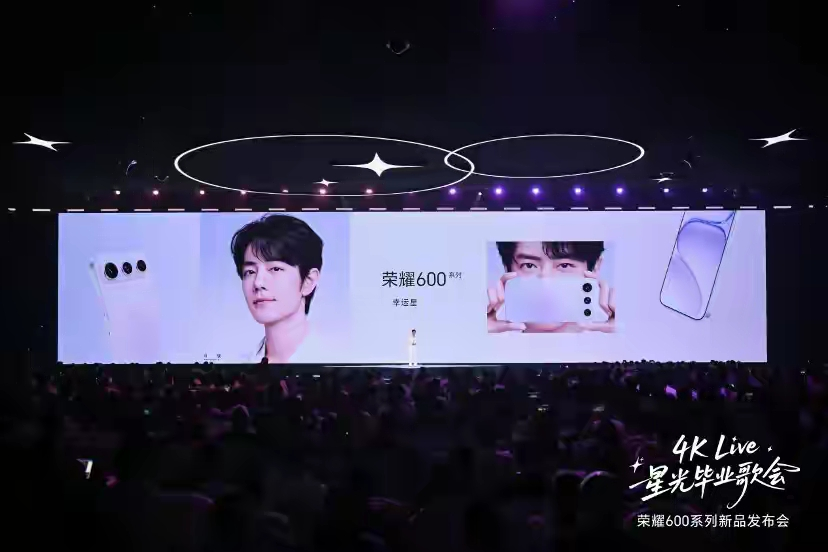
Frankly speaking, the summer showdown in the mid-range smartphone market did not begin on equal footing. While some manufacturers achieved configuration upgrades alongside price increases for their mid-range flagship models, others reduced certain features while raising prices. The differing market reactions were predictable.
According to IDC's Q1 2026 data, China's smartphone market shipped 69.01 million units, down 3.3% year-on-year. The overall performance slightly exceeded expectations, primarily due to strong contributions from Huawei and Apple.
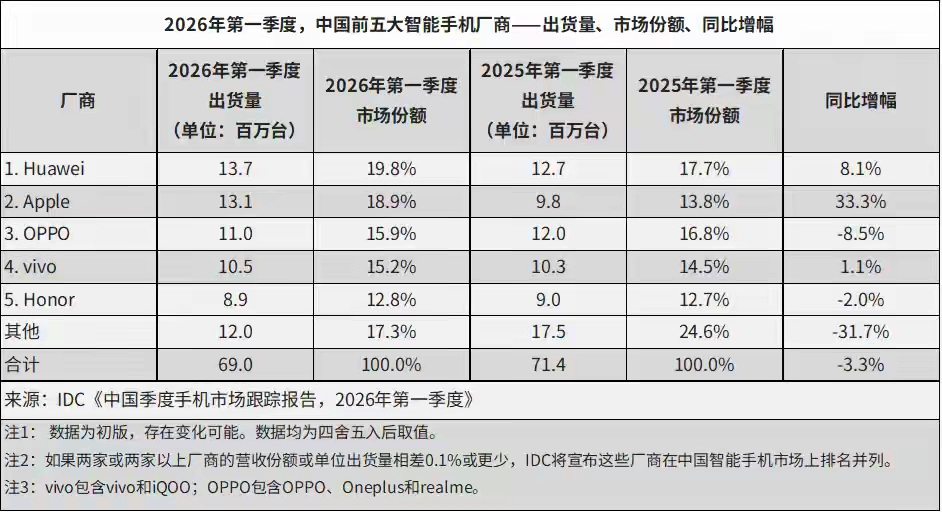
In comparison, the market share gap between Honor and Huawei stands at 7%, with other manufacturers also trailing Huawei. The widening shipment scale gap is an inevitable result of Huawei's recovery in full-stack capabilities.
Currently, the Mate and Pura series firmly dominate the premium market above RMB 5,000, while the nova and Enjoy series drive volume and acquire new users, contributing significantly to sales. The newly launched nova 16 series is equipped with the Kirin 9010S flagship processor and HarmonyOS 6.1 operating system. The nova 16 Pro and nova 16 Ultra feature an exclusive 200MP Red Maple imaging system. All models come standard with a 7000mAh Whale Battery and 100W Huawei SuperCharge. Despite a RMB 300 price increase from the previous generation, market expectations remain optimistic.
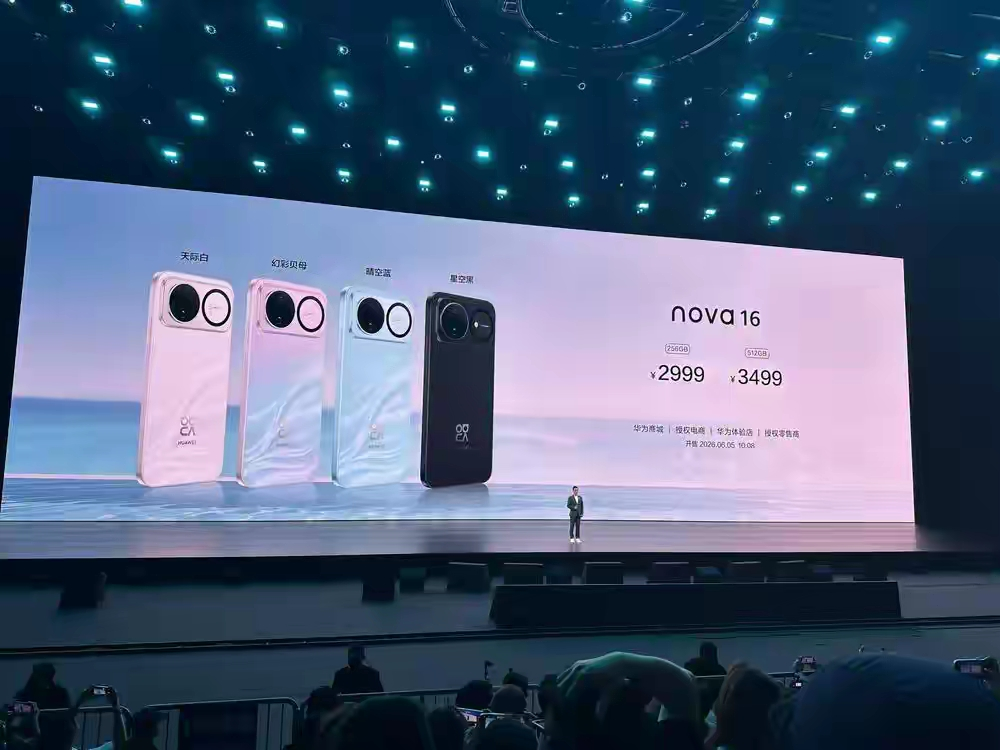
More importantly, the nova series has become one of the largest entry points for new users of pure-bred HarmonyOS. Every nova smartphone sold adds another layer to Huawei's ecological defenses.
Honor and other manufacturers face far tougher challenges. For instance, over the past year, Honor has attempted to escape the "others" category through strategies such as frequent new product iterations to boost market share. Through a series of personnel changes, organizational adjustments, marketing enhancements, and new product blitzes, Honor has achieved some success, with a noticeable rebound in the domestic market. However, it still falls short of last year's goal of reclaiming a top-three domestic position.
Since its separation from Huawei, Honor has been striving to shed the "Huawei shadow" label and establish its own brand identity. The Honor digital series once created a blockbuster miracle, securing a foothold in the mid-range market with its outstanding design and imaging capabilities. The challenge lies in the fact that Honor's path to truly reclaiming a leading domestic position remains fraught with obstacles.
But the market shows no sympathy for the weak; it only rewards strength. The share gap represents not just numerical differences in market share but fundamental disparities in technological accumulation and ecological barriers. Huawei has invested tens of billions in R&D over more than a decade to build full-stack technical capabilities spanning chips, operating systems, and terminal devices. These capabilities may not be conspicuous in favorable times but become the strongest defense during adversity, sounding an alarm for the entire industry: in the era of mature competition, only by mastering core technologies can one control one's own destiny.
Mid-Range Products Are Not the New "iPhone 4"
Innovation Cards Are Hard to Play
Expanding the perspective from Huawei and Honor to the entire industry, we uncover a disheartening truth: the mid-range smartphone market has fallen into severe parameter homogenization, making it difficult to replicate groundbreaking products like the iPhone 4.
More than a decade ago, the iPhone 4 redefined smartphones, ushering in an era of explosive innovation. Each new generation brought disruptive experiences: multi-touch, Retina displays, the App Store, fingerprint recognition, full-screen displays... Every innovation reshaped user habits and created new market demands.
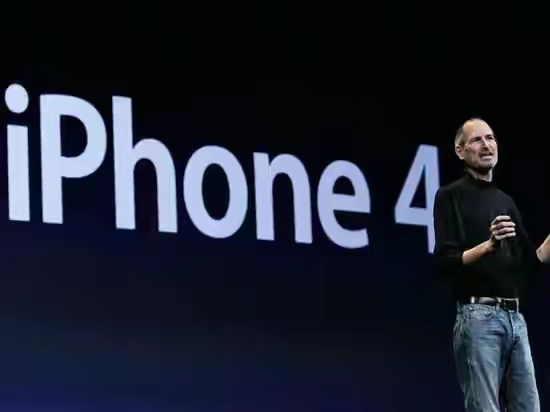
Today, however, technological innovation in smartphones has reached a bottleneck. From a hardware perspective, processor performance improvements have become increasingly marginal. The difference in daily use between the Snapdragon 8 Gen1 and Snapdragon 8 Elite is negligible. Screen resolutions have upgraded from 1080P to 2K, and refresh rates from 60Hz to 120Hz, with further improvements offering limited user perception. The imaging system has pushed to extremes, with one-inch sensors, periscope telephoto lenses, and computational photography employing nearly every conceivable technology, yet photographic improvements have slowed.
The innovation bottleneck is particularly evident in the mid-range market. In 2026, nearly all manufacturers follow the same playbook: stack parameters, compete on price, and hype concepts.
You use the Snapdragon 7+ Gen3; I'll use the Dimensity 8300. You offer a 120Hz high-refresh-rate screen; I'll offer 144Hz. You equip a 5000mAh battery; I'll equip 6000mAh. You claim an AI large model; I'll claim on-device AI. Open any smartphone launch presentation, and you'll find astonishingly similar parameters on the PPTs, with even marketing slogans being nearly identical. Users holding mid-range smartphones from different brands can barely find essential differences beyond logos and appearances.
As all manufacturers compete on imaging, design, and battery life, once-established differentiated advantages may gradually disappear, as evidenced by past features like large batteries and satellite communication. The more intense the competition, the more the industry risks falling into an awkward "neither here nor there" predicament.
The 2026 storage chip price surge has further exacerbated mid-range market challenges. DRAM contract prices have risen by 80%-95%, while NAND flash memory has increased by 33%-60%. Storage chips' share of smartphone BOM costs has skyrocketed from 10%-15% to over 20%. To offset cost pressures, nearly all domestic manufacturers have adjusted prices for their mid-range models, with typical increases ranging from RMB 300-800. Affordable "RMB 1,000 smartphones" have all but disappeared from stores.
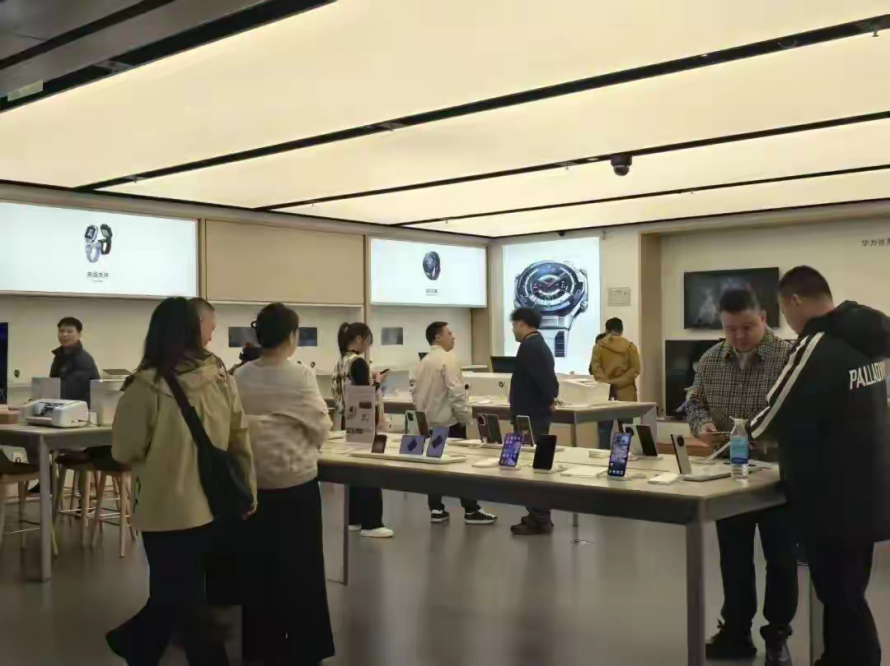
This "collective price hike" behavior has worsened already weak consumer demand. Users find themselves paying more without experiencing better performance, naturally extending their upgrade cycles. Data shows that the average upgrade cycle for Chinese users has lengthened from 24 months in 2019 to over 36 months in 2026.
Thus, innovation-free competition ultimately leads to a dead end. When all manufacturers compete on the same dimension, price wars become the only option. But price wars are a double-edged sword; they may help seize market share but severely erode corporate profits, undermining R&D investment and creating a vicious cycle.
The iPhone 4 was great because it created an entirely new category and opened up a new market. Today's mid-range smartphones merely tinker with existing categories without any disruptive innovation. Users don't need a smartphone with "better parameters"; they need one that offers "a brand-new experience."
Regrettably, the entire industry has yet to find the next "iPhone 4 moment." When innovation cannot keep pace with user expectations, the smartphone industry's struggles become inevitable.
Who Can Create the Next Blockbuster AI Smartphone?
Amid sluggish innovation, AI holds promise for the entire industry, seen as the next growth driver. Nearly all manufacturers promote "AI smartphones" as their new flagship feature. But can today's AI smartphones truly become blockbusters?
2024 was dubbed the first year of AI smartphones, with major manufacturers focusing on on-device AI technology. By 2026, on-device large models have become standard even in mid-range models priced around RMB 2,000 or even RMB 1,000. AI object removal, AI photo retouching, AI copywriting, AI voice assistants... These features have become standard across nearly all new models.
In reality, careful experience reveals that most AI functions remain at the "toy" stage, offering limited practicality. AI object removal often eliminates unintended elements, AI photo retouching produces uniform results, and AI voice assistants can only answer simple questions.
Many users who purchase AI smartphones in stores stop using these features once the novelty wears off.
Ironically, today's AI smartphone competition is essentially an extension of parameter-driven competition. Manufacturers compete not on AI experience but on who has larger model parameters, more AI functions, or flashier launch presentation demos.
This "AI for AI's sake" approach not only fails to enhance user experience but also increases smartphone costs, ultimately passed on to consumers. Industry insiders bluntly state that 90% of AI functions in current AI smartphones are "PPT functions," only demonstrable during launches but practically unusable.
Of course, we cannot deny AI's potential. AI could indeed become the next revolutionary technology for smartphones, but this requires time. A true AI smartphone should not merely add a few AI functions to a traditional smartphone but offer an entirely new interaction method and user experience. It should genuinely understand user intentions, proactively provide services rather than waiting for commands, and operate across applications and devices as a personal intelligent assistant.
Objectively speaking, current technological levels fall far short of this vision. The industry generally believes that the turning point for truly differentiated AI smartphone experiences will arrive around 2027, when AI Agent cross-application operations may become commercially viable.
Currently, Huawei leads in this AI race, having built a complete AI technology stack from cloud to on-device with its self-developed Ascend chips and HarmonyOS.
Honor has also invested heavily in AI, with notable AI capabilities in MagicOS 10.
However, the smartphone industry's struggles are an inevitable result of technological development reaching a certain stage. The revolution from feature phones to smartphones is complete, and the next revolution has yet to arrive. During this transitional period, intense competition and industry reshuffling are unavoidable. Huawei and Honor's new product competition is merely a small episode in this prolonged war. For the entire industry, the current priority is not seizing market share but focusing on R&D, accumulating core technologies, and awaiting the next wave of innovation.
-
![]()
Alibaba's AI Offensive: Over Half of Investment Allocated, Time to Reap Returns
-
![]()
Alibaba’s AI Push: Over Half of Investments Made, Time to Harvest Returns
-
![]()
Chinese Enterprises Going Global 3.0: From World Factory to AI Infrastructure Builder
-
![]()
Honor RobotPhone Review: Half Movie Camera, Half Robot
-
![]()
AI-Driven Cheating Surges in Universities! Online Exams Reduced to Mere Formalities, Degree Credibility on the Line
-
Insta360’s Decade in Panoramic Imaging: Making Cameras ‘Invisible’ and Returning Creation to the Masses
-
![]()
Foreign Media Claims Apple is Concentrating Resources on AI Development: Vision Pro and Siri Teams Lay Off 200 People
-
Big News! Huaneng and Huawei Hold Talks in Shenzhen with Ren Zhengfei in Attendance; Huawei Emerging as the 'Second Brain' of China's Energy System