Agent Hardware Boom! What Exactly Is Qualcomm's 'Computing Continuum'?
 06/03 2026
 525
525
AI will be ubiquitous, operating seamlessly across the entire computing spectrum.
'Today's discussion isn't centered around Qualcomm itself.'
On June 1st, at the opening keynote of Computex Taipei, Qualcomm CEO Cristiano Amon commenced by expressing gratitude to the supply chain, developers, and TSMC before delving into Qualcomm's core topic:
2026 is dubbed the 'Year of the Agent'.
This declaration may not be particularly startling this year, as nearly every tech company is striving to demonstrate that they are not mere spectators in the AI agent revolution. However, Qualcomm's approach stands out—it focuses on how agents can permeate every aspect of our lives, from smartphones, PCs, watches, and cars to robots, industrial cameras, and even data centers:
'In the future, computing resources will be omnipresent, AI will operate everywhere, and all of this will unfold across the entire computing spectrum.'
From PCs and robots to data centers, what exactly is Qualcomm's 'computing spectrum'?
In his speech, Amon did not unveil any new products but instead concentrated on the question of 'how AI will revolutionize all devices.' To grasp Qualcomm's strategy, we must begin with its product lineup.
Just last week, Qualcomm introduced the Snapdragon C platform for entry-level laptops, targeting web browsing, video playback, office tasks, video conferencing, silent cooling, and all-day battery life, specifically aimed at Windows laptops priced above $300.
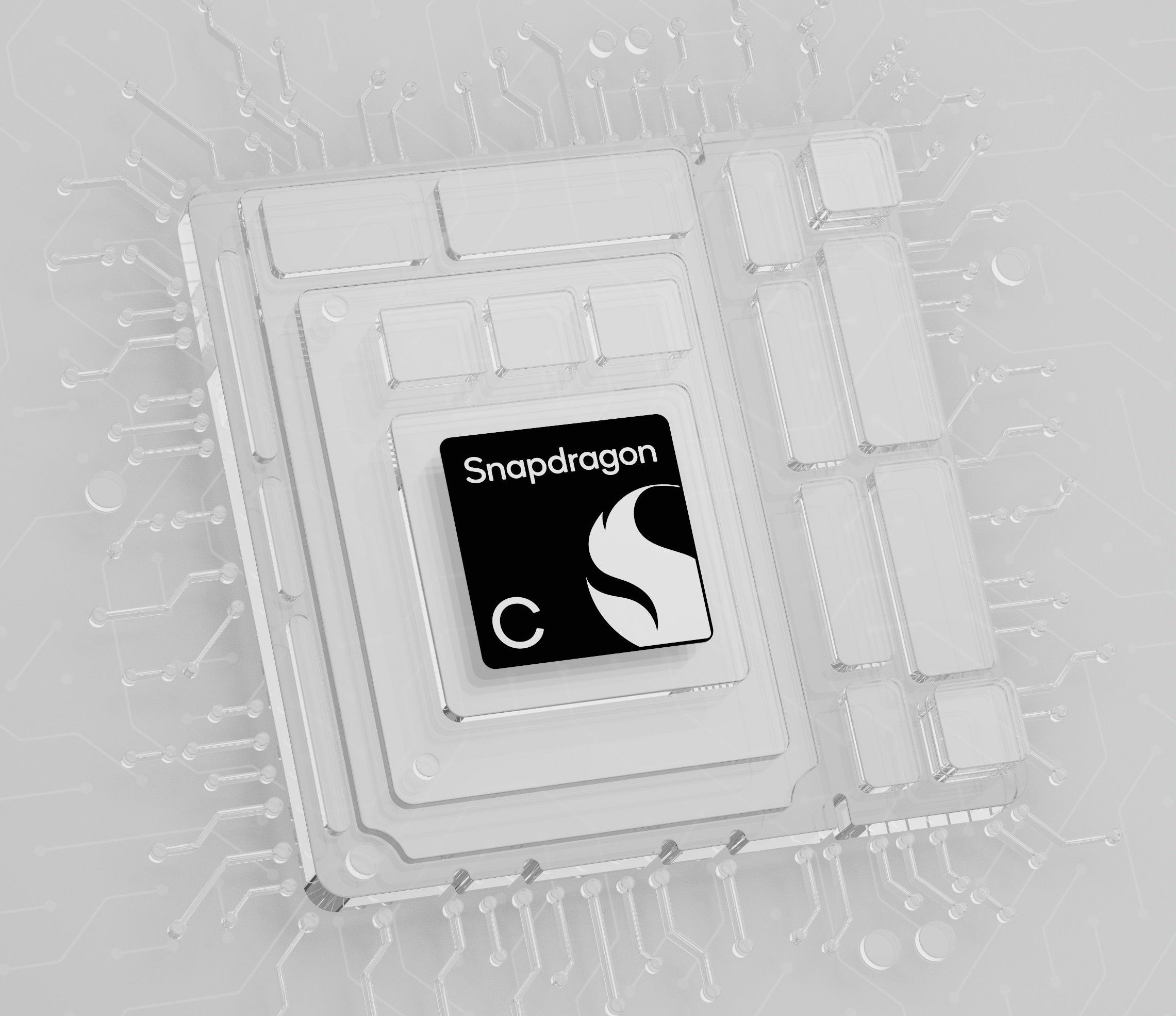
Image Source: Qualcomm
This may not seem particularly thrilling, but it is precisely what Windows on Arm needs to address.
Over the past two years, the excitement surrounding AI PCs has primarily been in the mid-to-high-end market, with prices struggling to decrease significantly. The issue is that the bulk of demand in the PC market does not originate from flagship devices. Many students and families simply desire an affordable, lightweight device with long battery life that does not lag—preferably with some basic AI capabilities.
This is where the Snapdragon C series comes into play, attempting to prove that Arm Windows can also penetrate more mainstream price ranges. However, the real challenge lies here as well—the primary hurdle for entry-level products is delivering a solid basic user experience. Whether Snapdragon C laptops can ensure a seamless basic experience, or even offer surprises, will be crucial to their success.
Another, even more pivotal, aspect is the newly released Yuelong IQ10 robot reference design. In his speech, Amon dissected robots into a three-tier computing architecture: real-time execution, action implementation, and reasoning. This breakdown is quintessentially Qualcomm—robots are not just about a single 'brain'; they also necessitate central computing, motion control, actuators, sensor synchronization, safety redundancy, and industrial interfaces.
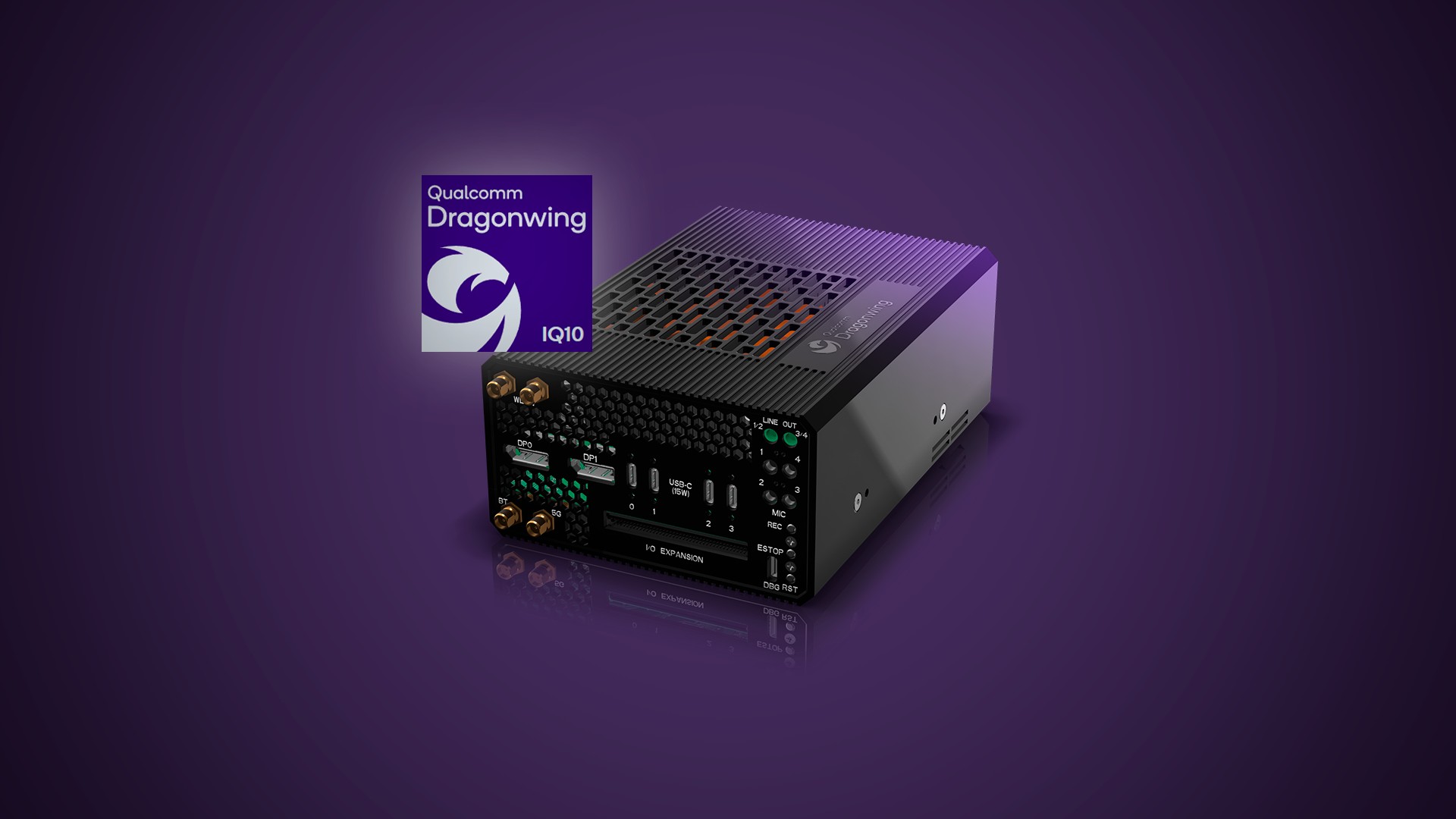
Image Source: Qualcomm
The Yuelong IQ10 is designed for industrial AMRs and full-sized humanoid robots, boasting an 18-core Oryon CPU and delivering up to 700 TOPS of AI performance through a dedicated NPU, supporting multi-modal sensing with multiple cameras, LiDAR, radar, and more. Behind these specifications, what Qualcomm truly aims to sell is a robotics platform that encompasses everything from prototype to mass production.
This builds upon Qualcomm's past expertise in smartphones and automotive systems. Smartphones demand extreme computing power within limited power consumption, while automotive systems must manage safety, redundancy, and real-time control. Robots amalgamate both of these challenges.
Another teaser that Amon did not elaborate on but is noteworthy is data centers.
Late last year, Qualcomm introduced two AI inference chips, the AI200 and AI250. The AI200 is a rack-level solution for inference, equipped with 768GB of LPDDR memory per card, emphasizing performance-per-watt and total cost of ownership. The AI250, slated for commercialization in 2027, focuses on near-memory computing architecture.
Qualcomm's inaugural CPU under its new data center brand, Dragonfly, is also on the horizon. Amon mentioned in his speech that more details about data centers would be disclosed at the Investor Day on June 24th.
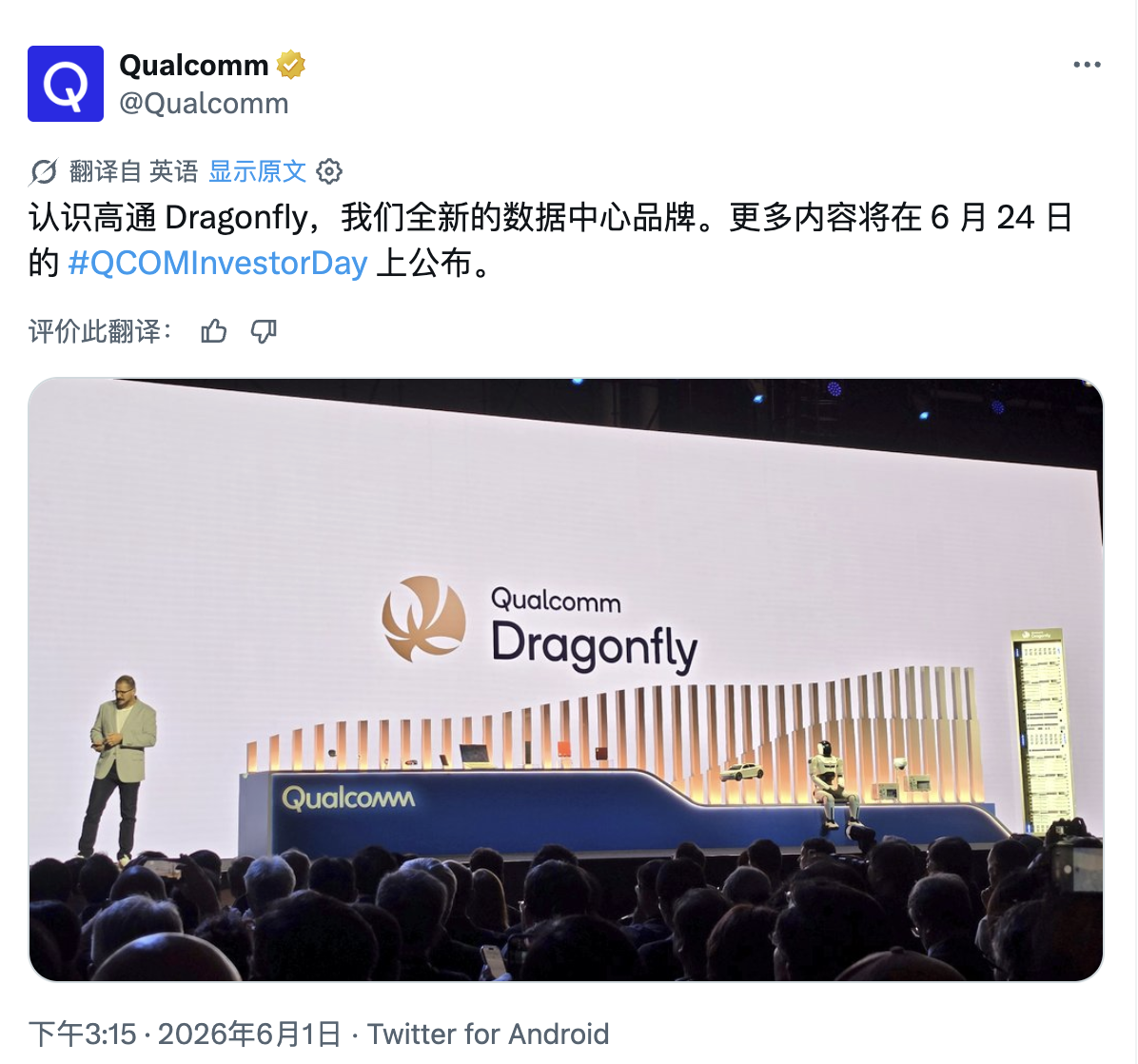
Image Source: Qualcomm
From Snapdragon C and Yuelong IQ10 to data center CPUs, Qualcomm is extending its hallmark performance-per-watt expertise from the mobile era into every nook and cranny of the computing world. As Amon put it: From connections under 2 milliwatts in earbuds to kilowatt-scale systems in data centers, Qualcomm aims to encompass the entire computing spectrum.
In the Age of Agents, Qualcomm Aims to Dissolve Device Boundaries in Computing
The so-called computing spectrum can be comprehended as a computing range spanning from milliwatt-scale to kilowatt-scale devices. On one end are personal devices like earbuds, watches, glasses, and smartphones; on the other end are cars, robots, industrial systems, and data centers. While their power consumption, form factors, and tasks vary, in the age of agents, they will collectively constitute a distributed AI system.
Whether AI operates in the cloud or on the edge is inconsequential. Just as we rarely concern ourselves today with whether a computation is completed locally or in the cloud when using a smartphone app, agents will naturally leverage all available computing resources, processing tasks wherever efficiency is maximized, latency is minimized, or security is paramount.
This is precisely the opportunity Qualcomm seeks to capitalize on. It does not necessarily need to offer the most potent computing power at every stage, but it aspires to provide the appropriate computing capabilities at every endpoint: earbuds require low-power connectivity, glasses need to comprehend your surroundings, smartphones must carry personal context, PCs need to execute multi-agent workflows, cars must integrate cabin intelligence and driving perception, and robots need to manage real-time execution, action implementation, and reasoning locally.
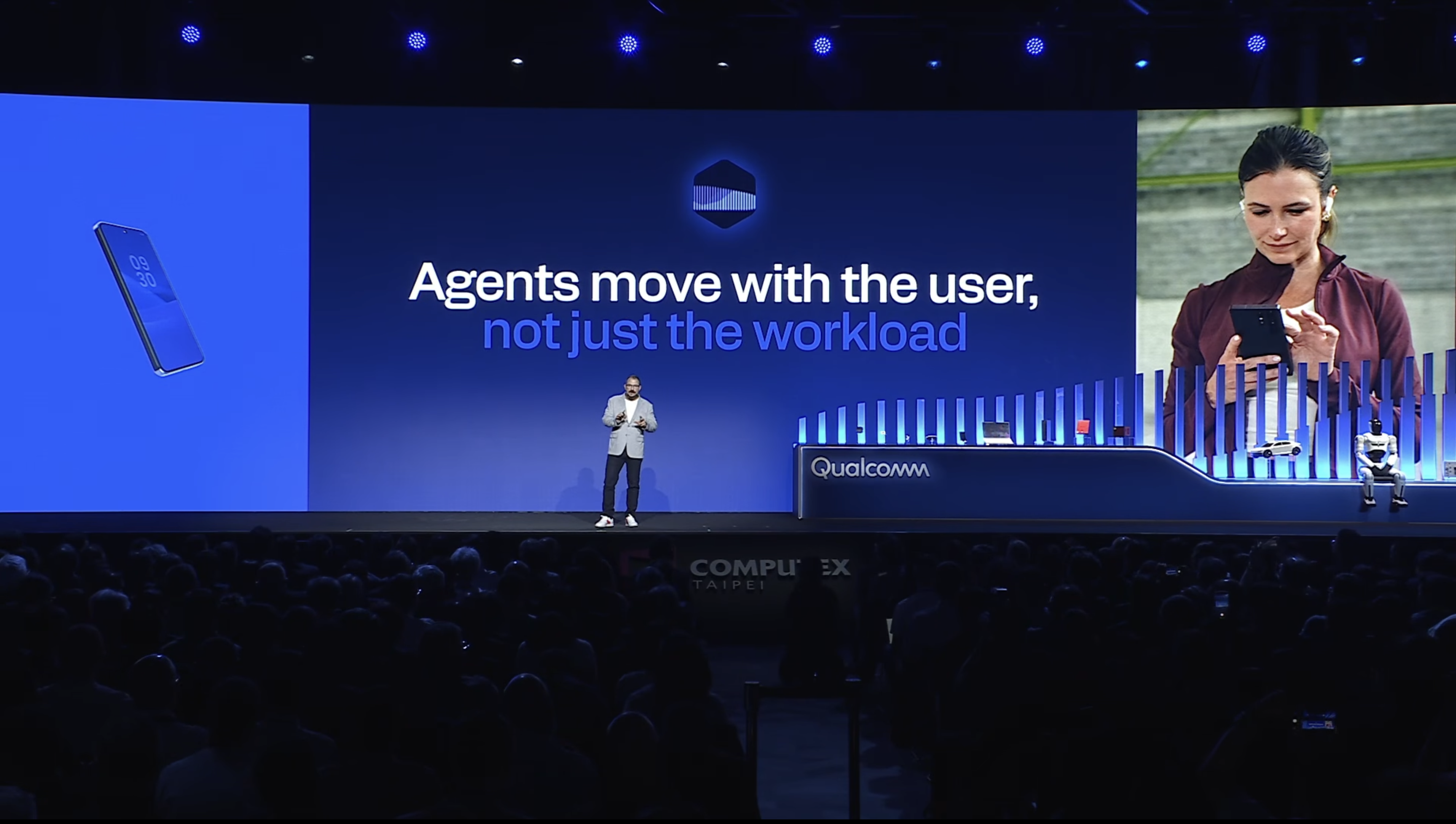
Image Source: Qualcomm
This also elucidates why Amon repeatedly stressed that today's devices are not designed for agents. Current smartphones, PCs, and applications are predominantly built around 'human-initiated operations': individuals open apps, input commands, click buttons, and await results. However, agents operate differently—they run continuously, carry context, coordinate tasks across multiple systems, and interact with software at machine speed.
This will directly transform hardware architectures.
CPUs will not merely run systems and applications but also manage task orchestration; GPUs and NPUs will be responsible for local models, inference, and generation; sensors will provide context; and connectivity will enable real-time switching between the cloud, edge, and surrounding devices. In essence, devices will no longer be mere containers for screens and applications but will evolve into sensors, actuators, and identity carriers for agents.
Amon used smartphones as a vivid illustration. Early agent users might purchase a computer, like a Mac mini, to run their agent and interact with it via messaging. However, the average person cannot lug around a battery-powered computer solely for a personal agent. The most logical carrier remains the smartphone, along with future personal AI devices like glasses, watches, and earbuds.
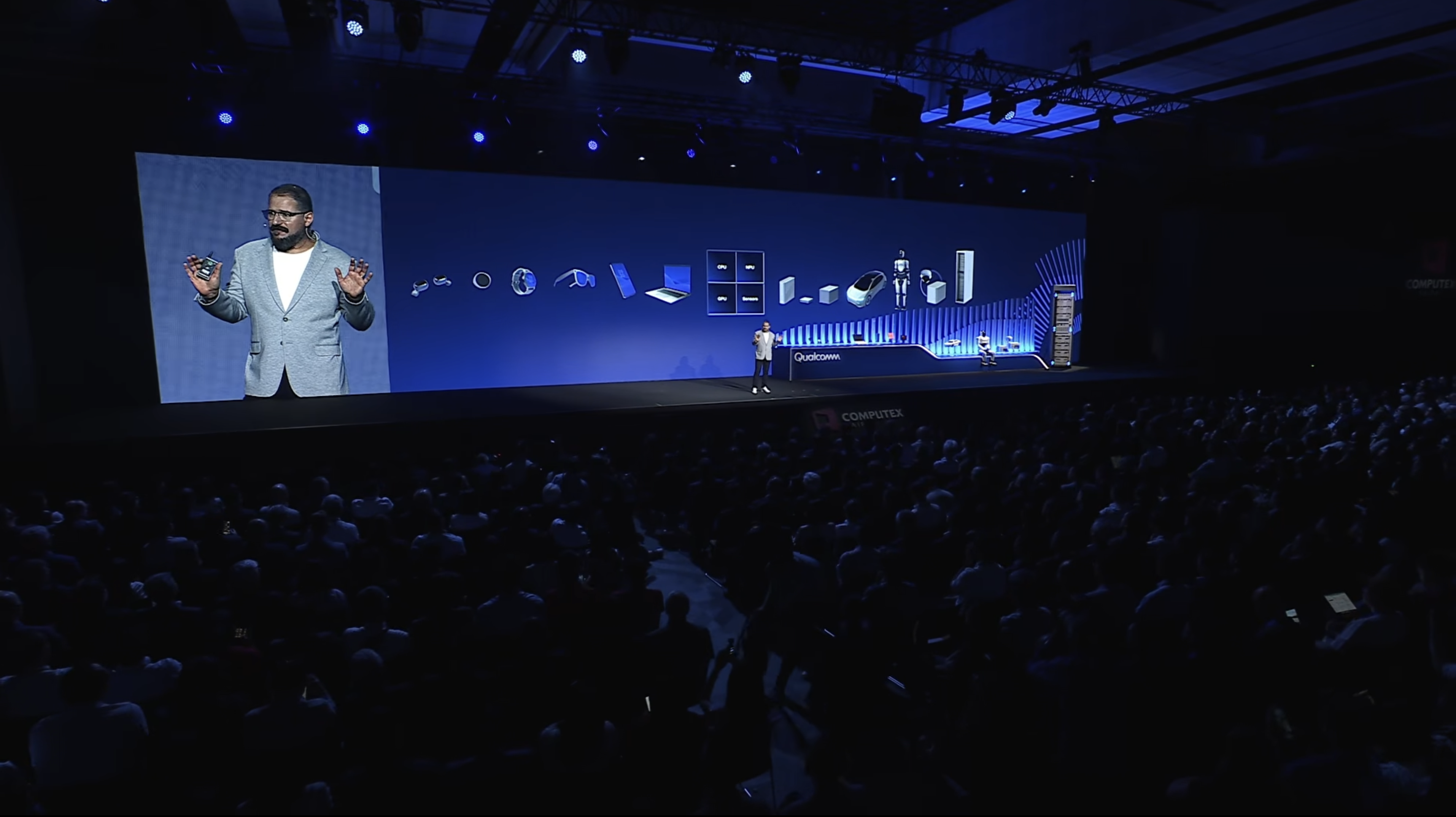
Image Source: Qualcomm
Thus, in Qualcomm's narrative, smartphones will not vanish, but they will no longer be the sole epicenter of digital life. They will possess two 'personalities': one as a device operated directly by humans and another as a device operated by agents. This transformation will subsequently influence PCs, cars, and other endpoints.
This is Qualcomm's vision for the age of agents. Future AI will not reside solely in a super app, a single computer, or a cloud model but will be distributed across all devices and networks surrounding the user. What Qualcomm envisions once again is the network between devices—once fragmented but now potentially reconnected by agents.
Qualcomm, Robots, PCs, AI, Hardware, Chips
Source: Leikeji
All images in this article are sourced from: 123RF Royalty-Free Image Library Source: Leikeji
-
![]()
From Elusive to Aggressively Priced: Lexus Sheds Its 'Standoffish' Image
-
![]()
China Initiates Satellite IoT Operations, with Geely Satellite Networks Poised for 6G
-
![]()
Is China's Auto Industry Heading into the 'Fiercest Final Showdown'? Li Bin Says It's Not a Simple Elimination, But the Grand Finale
-
![]()
Could MG Have Fared Better If Chen Cui Had Become General Manager Sooner?
-
![]()
Is Xiaohongshu Rushing into AI Development?
-
![]()
Liu Yan: Has the Automobile Become a 'Fast-Moving Consumer Good'? | Voice of CAAM
-
![]()
Ali (Summary): AI CAPEX Recouped in 3 Years
-
![]()
Europe Transforms into a Haven for Chinese Cars: BYD Seal U Surpasses 10,000 Monthly Sales