Token Demand Skyrockets, AI Computing Power Faces 'Inflationary' Pressure
 04/03 2026
 540
540

The skyrocketing demand for tokens is driving a significant transformation in AI computing power, shifting from a 'training-centric' approach to an 'inference-centric' one. Leveraging its cost-effective energy resources, China is pioneering a new digital and intelligent trade paradigm through token exports, using computing power as the conduit and electricity prices as the stabilizing factor.

According to the latest data from OpenRouter, a third-party AI model aggregation platform, the weekly token invocation volume on the platform soared to 20.4 trillion times from March 16 to March 22, 2026, marking a 20.7% week-over-week increase. In February 2026, the average weekly token usage on OpenRouter had already more than doubled compared to the weekly average in the fourth quarter of 2025.
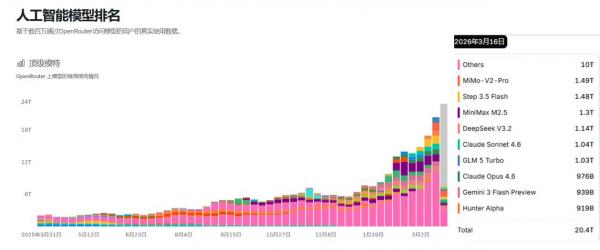
Chinese large-scale models have, for the first time, surpassed their U.S. counterparts with 4.12 trillion token invocations, securing four out of the top five global positions. This achievement underscores the growing trust and recognition of domestic large models among developers worldwide.
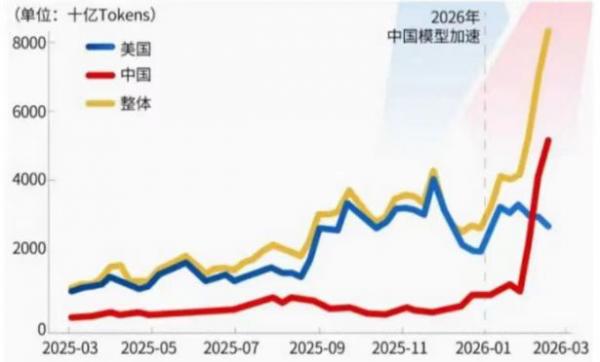
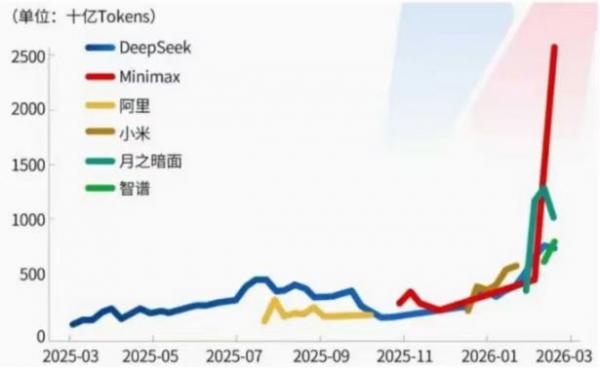
Source: Cailian Press, OpenRouter, Huatai Research

OpenClaw has emerged as the primary catalyst behind the current surge in token demand. From March 16 to March 22, 2026, OpenRouter's weekly data reveals that nearly a quarter of the platform's token consumption was attributed to OpenClaw.
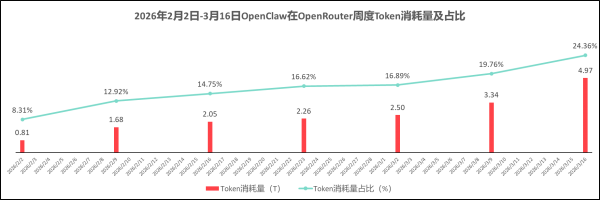
Data Source: OpenRouter, Research by Xiaguang Think Tank
The computing power required for an AI agent to complete a complex task is equivalent to that of nearly ten thousand interactions between an ordinary user and ChatGPT. Previously, it was noted that: 'Early large models primarily handled simple interactions such as Q&A and text generation, with limited token consumption per conversation. However, agents, akin to 'digital employees,' can autonomously break down tasks, call tools, and iterate through multiple rounds. For instance, OpenClaw completing an automated office task may involve over a dozen steps, including file reading, email sending, and data processing, each requiring substantial token support for logical operations.'
Typical Token Consumption in AI LLM Scheduling
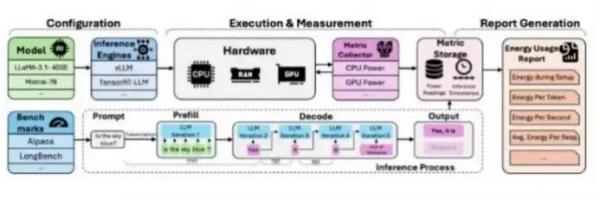
Data Source: Token Power Bench

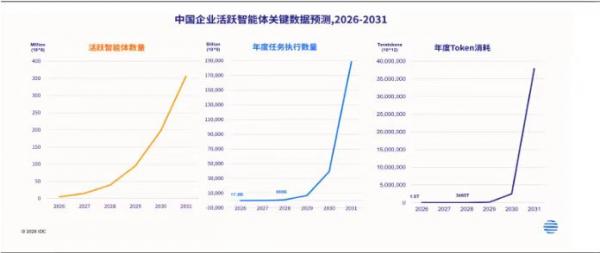
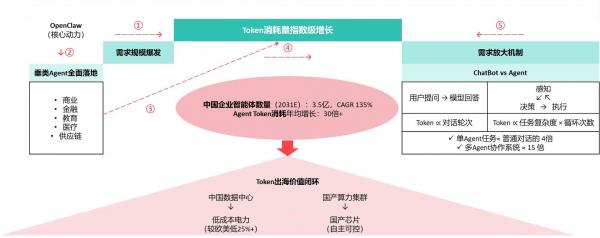
IDC data indicates that the number of active AI agents among Chinese enterprises is projected to exceed 350 million by 2031, with a compound annual growth rate surpassing 135%. Meanwhile, due to the increased density and complexity of agent tasks, token consumption by agents is expected to grow exponentially, surpassing 30-fold annually.
The reason agents have become 'token consumption amplifiers' lies in their fundamentally different business logic compared to traditional chatbots. Traditional chatbots follow a single-round interaction model of 'user question—model answer,' with token consumption linearly correlated to conversation turns. In contrast, vertical agents (e.g., financial risk control agents, supply chain scheduling agents) possess closed-loop capabilities of 'perception—decision—execution': they autonomously break down complex tasks, call external tools, and iterate through multiple rounds until completion. Anthropic's real-world testing shows that a single agent completing a typical task consumes approximately four times the tokens of a standard conversation mode, while multi-agent collaboration systems consume up to 15 times more.
As token consumption surges from hundreds of billions to trillions or even quadrillions, how can the computing power 'deficit' be addressed? The structure of computing power demand may undergo fundamental changes:
Shift 1: From 'Training-Led' to 'Inference-Led'
Over the past two years, the AI computing power market has been dominated by large model training, with vendors competing on 'how large a model they can train.' However, with the large-scale deployment of agents, inference is becoming the primary battleground for computing power consumption. Deloitte predicts that the global share of inference workloads in AI computing power will rise from about one-third in 2023 to about two-thirds by 2026, potentially exceeding 80% in the future. NVIDIA forecasts that the potential market size for AI inference chips could reach $1 trillion by 2027.
Shift 2: From 'Peak Computing Power' to 'Sustained Throughput'
Training tasks prioritize peak computing power—completing model parameter updates in the shortest time possible. In contrast, agent inference tasks prioritize sustained and stable throughput: agents in production environments need to respond to business requests 24/7, and any latency or jitter could disrupt business processes. This requires computing infrastructure to shift from a 'benchmarking race' to a 'stability race.'
Shift 3: From 'Single-Point Optimization' to 'Cluster Collaboration'
When agent tasks require cross-node parallelism, network performance directly determines computing power utilization. In large model inference, GPUs may complete a batch computation in milliseconds, but synchronizing contextual data across nodes can take tens of milliseconds. This means that even if a single GPU performs exceptionally well, overall efficiency will still be hindered if network interconnection lags. The focus of computing power competition is shifting from the 'chip level' to the 'data center cluster level.'

The essence of token exports can be defined as Chinese domestic AI models exporting 'Inference-as-a-Service' to overseas markets through global standardized API interfaces, billing based on actual token processing volume, thereby achieving the 'digital export' of computing power and electricity.
Inference requests from overseas users are transmitted to data centers deployed within China, where computations are completed using local power supply and domestic computing clusters, with results returned to overseas endpoints. Although no physical electricity is exported, this process achieves the indirect export of 'electricity value' through the value conversion of computing services, forming a unique non-physical energy trade pathway.
The core driver behind the rapid global market share gains of domestic large models lies in the establishment of a highly intensive cost control system. While the procurement cost per unit of computing power is converging between China and the United States, energy cost advantages have become the key pillar of competitiveness for Chinese large models. According to Global Petrol Price data from June 2025, the average electricity price for Chinese enterprises is about 25% lower than that in the United States, with an even greater gap compared to industrial nations like the UK and Germany. This energy cost differential is significantly amplified in large-scale inference scenarios, creating sustainable pricing advantages and profit buffers.

Whether it's the surge in token demand or the restructuring of computing power demand, both point to a more fundamental proposition: the AI industry is transitioning from a 'model capability race' to a 'computing efficiency revolution.'
Over the past two years, parameter scale, context length, and multimodal capabilities have been the benchmarks for measuring AI technology. However, as agents like OpenClaw push large models into real-world physical environments, the focus has shifted to 'whether they can support the continuous flow of massive tokens at lower costs and with more stable performance.' This represents not just a technical shift but a fundamental transformation in industrial logic.
Notably, this round of computing power transformation is not simply about 'stacking chips.' From system-level collaborative design to the widespread adoption of liquid cooling, from optical-copper hybrid interconnection architectures to the rigid demand for private deployments, every aspect of infrastructure is undergoing refined restructuring. This means that future AI infrastructure dividends will no longer belong to the players with the most GPUs but to those who can continuously climb higher on the new benchmark of 'tokens produced per watt of electricity.'
Tokens are emerging as the new unit of productive forces in the AI era. As agents penetrate various sectors such as commerce, finance, healthcare, education, and supply chains, evolving from 'auxiliary tools' to 'business executors,' tokens essentially measure the depth and breadth of an economy's digitization and intelligence. This, in turn, depends on how we build a computing infrastructure capable of supporting exponential token demand.
Token exports not only represent a critical leap for China's AI industry from technological catch-up to commercialization output but also embody a new paradigm of resource-based service trade—using computing power as the medium, electricity prices as the anchor point, and intelligence as the endpoint to construct an industrial moat with both strategic depth and cost resilience in the process of digital globalization.
-
Alibaba’s Earnings Soar with Triple Catalysts: Full-Stack AI Hits Maturity, Capital Efficiency Drives Sustainable Growth
-
![]()
Raking in Big Profits Overseas! Chery’s Overseas Revenue Makes Up 70% in H1, with Gross Margin Climbing to 16.1%
-
![]()
Alibaba’s New Fiscal Quarter: 45% Revenue Surge in Alibaba Cloud, Enhanced Profitability in AI Cloud, but Widening Losses in the Application Layer
-
![]()
The AI Version of 'PayPal Mafia' Has Arrived: 20 AI Startups Raise Over $4.6 Billion in Funding
-
![]()
Wang Jian's Vision: Paving a Pathway for Alibaba Through AI
-
![]()
Hyundai Motor Workers Strike Today, Fearing Job Losses to Robots
-
![]()
Embracing 'Light': O-film Unveils Its 'Illuminating the Future' Strategy
-
![]()
SenseTime’s SenseNova U1.5 Lite Goes Open Source: Ushering in a New Era of Predictable AI Image Generation