Pony.ai Explains Robotaxi 'Profit Replication Strategy': How to Scale from a Vehicle Earning RMB 338 Daily to 20 Cities?
 03/31 2026
 641
641
Covering the cost of a Robotaxi with an average daily revenue exceeding RMB 300, the next step is scaling from '1' to '3,000'.
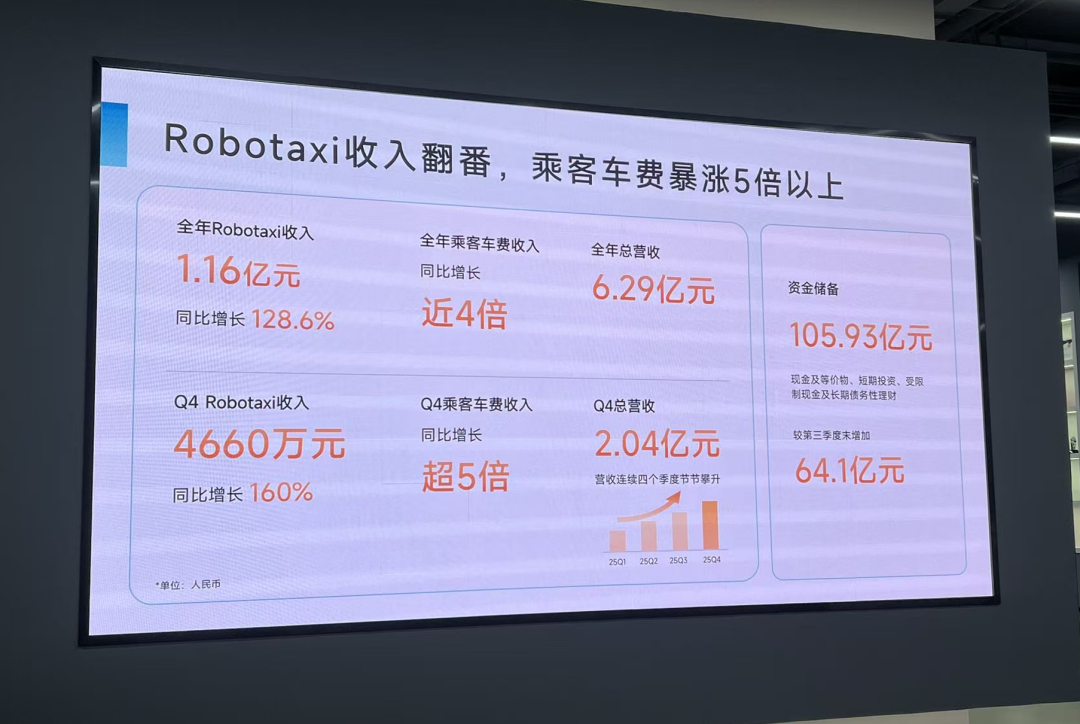
On March 26, Pony.ai released its financial results for the fourth quarter and full year of 2025: Total annual revenue reached RMB 629 million, up 20% year-on-year; the fourth quarter marked the first quarterly profit, with a net profit of RMB 520 million. Robotaxi revenue was RMB 166 million, up 128.6% year-on-year; fourth-quarter revenue from this segment was RMB 46.6 million, accounting for 40% of the annual total, up 160% year-on-year, with passenger fare revenue increasing over 500% year-on-year.
More significant than these figures: Pony.ai achieved positive unit economics (UE) for individual vehicles in Guangzhou and Shenzhen. CEO James Peng remarked during the earnings call, 'This is a major victory for the entire industry, not just us.' He noted that after achieving positive UE in Guangzhou, the company reached this milestone again in Shenzhen, validating the replicability of its model.
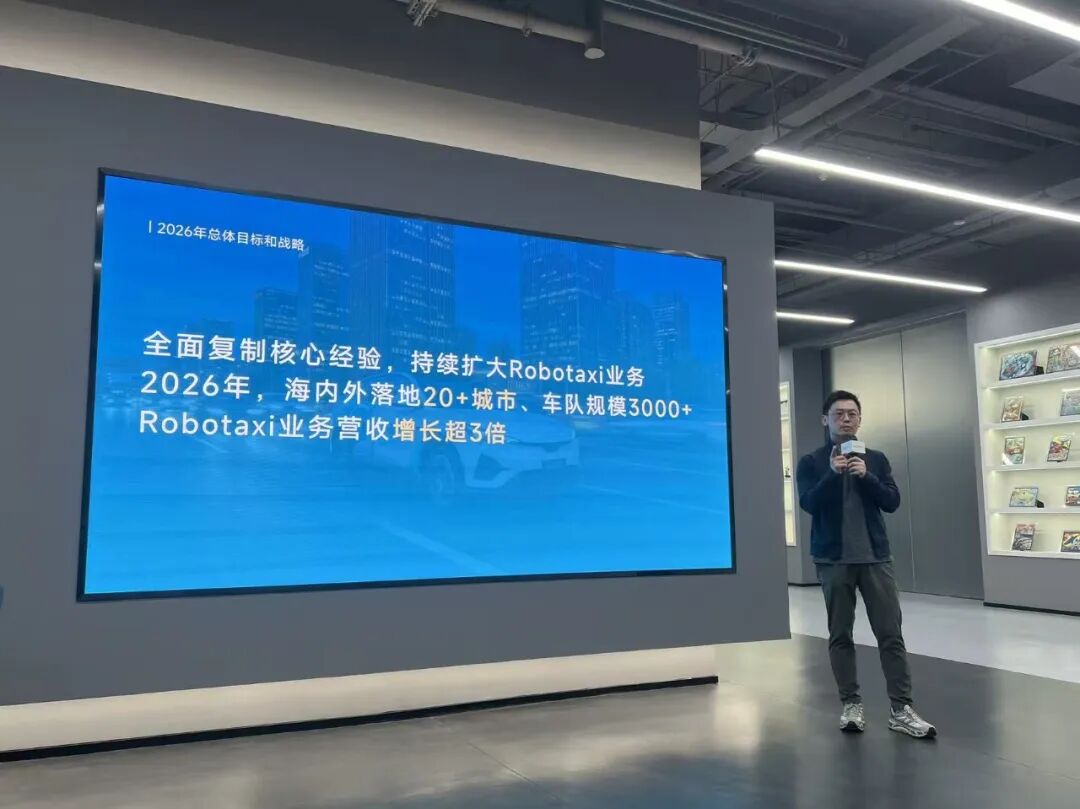
Next, Pony.ai aims to replicate more 'profitable vehicles.' Its 2026 expansion goals are clear: Deploy services in over 20 domestic and international cities, expand the fleet to over 3,000 vehicles, and more than triple Robotaxi business revenue.
But questions remain: How is profitability achieved? How can it be replicated? Where specifically? Who funds the vehicle purchases?
On March 30, Pony.ai held a media briefing where co-founder and CFO Jerry Wang provided detailed explanations.
01
Revenue 'Formula' Revealed: Why Do Users Pay?
Let's break down the financials of 'this vehicle.'
Wang explained in detail how positive UE is calculated.
Revenue is straightforward: Daily ride count × average distance per ride × fare per kilometer.
Taking Shenzhen as an example, February 2026 data showed an average daily revenue of RMB 338, with 23 daily rides. March peaks reached RMB 394 and 25 rides. Note that this is 'net revenue,' after all discounts.
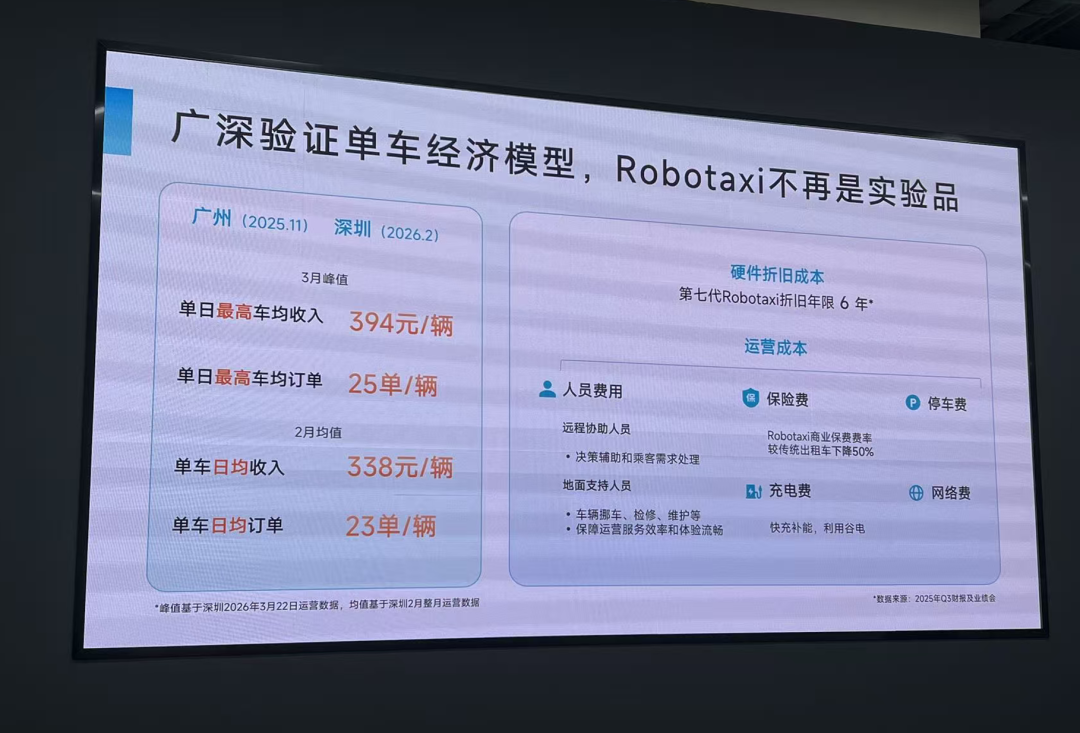
Costs fall into two main categories:
The first is vehicle depreciation. The seventh-generation Robotaxi is depreciated over six years, accounting for roughly half of the per-vehicle cost.
The second is daily operating costs, comprising five subcategories: Personnel expenses, including remote assistance staff (with a vehicle-to-staff ratio of 1:20 when Guangzhou achieved positive UE in late 2025, improved to 1:30 by year-end) and ground support staff (responsible for vehicle relocation, maintenance, and servicing); Insurance, with Robotaxi commercial premium rates now 50% lower than traditional taxis; Charging, balancing fast charging and off-peak electricity usage; Parking fees; and Network fees.
Wang emphasized, 'If either depreciation or operating costs are not optimized, achieving positive UE with around RMB 300 in daily vehicle revenue is impossible.'
Even the best model needs user buy-in. A practical question: Why do users consistently choose Robotaxi?
Wang's answer was direct: 'Relying on heavy promotions to acquire new users won't work if you can't secure stable, daily repeat orders. Without that, you can't ensure stable or growing UE.'
So what does work?
Pony.ai's answer: Consistency, high quality, high reliability, and safety.
'Whether it's rainy, daytime, nighttime, sunny, or snowy, users should be able to hail a ride,' Wang said. That, he explained, is why users keep coming back. 'Otherwise, adding vehicles doesn't guarantee revenue growth. You might add many vehicles, but if users aren't satisfied, they won't make it their daily choice.'
Data shows Pony.ai's app has surpassed 1 million registered users, nearly tripling from the same period last year. More critically, paid orders have surged—by mid-February 2026, Shenzhen's orders for the year already exceeded the total for all of 2025.
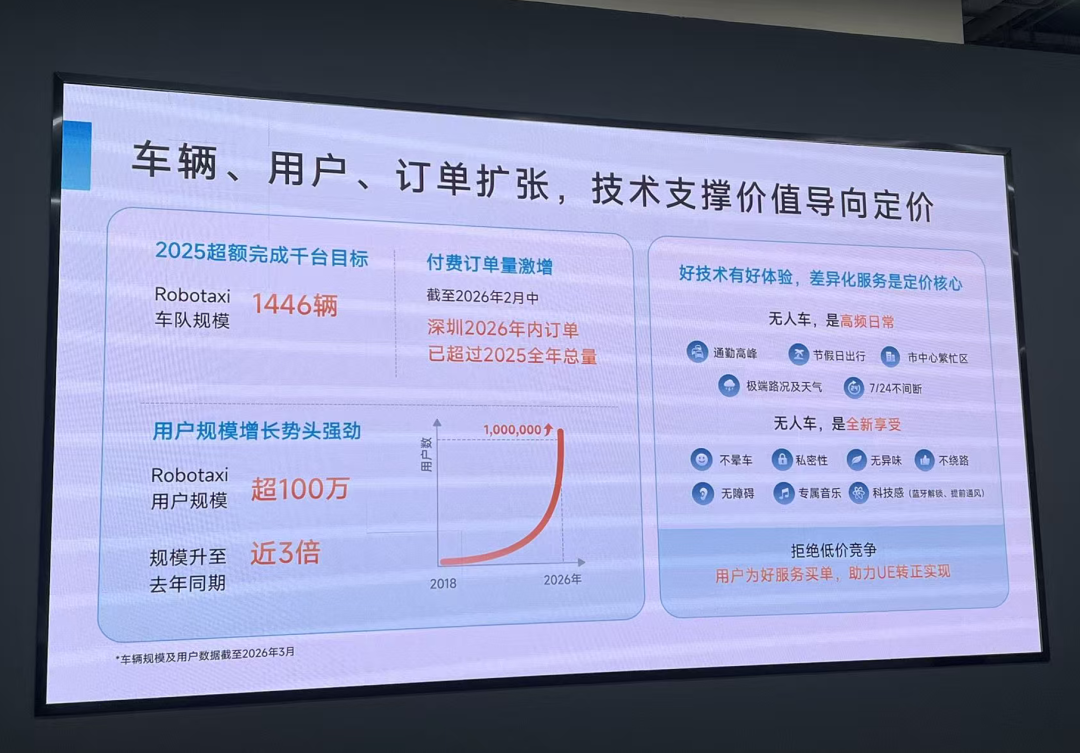
Why do users keep returning? Wang highlighted two details:
The first is privacy. 'A relatively high proportion of repeat users are women'—addressing a pain point in ride-hailing, especially for nighttime rides. Pony.ai's data shows women prefer Robotaxi for not sharing enclosed space with strange (unknown) drivers.
The second is inside the car (in-car) odor. 'Vehicles return to the operations center daily for maintenance and cleaning, so odor issues are far less common than in many ride-hailing cars.' While seemingly minor, complaints about smoke and odors are widespread among ride-hailing users—a systemic issue Robotaxi can resolve.
In summary: At similar or slightly higher prices, users get privacy, a better ride environment, and no interaction with drivers. This differentiated positioning lets Pony.ai avoid price wars with ride-hailing services.
Wang stressed, 'We don't engage in low-price wars with our pricing strategy.'
02
Implementing the 'Dual-Engine Strategy': Scale First, Optimize Later
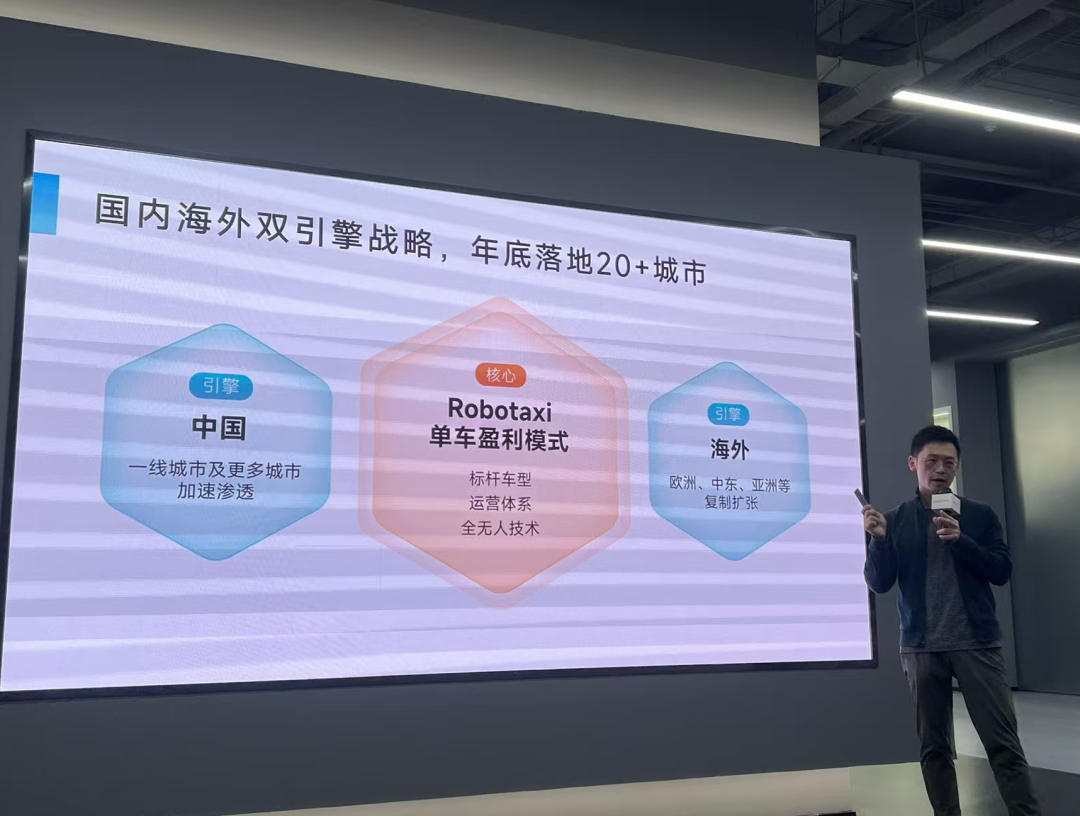
After achieving positive UE in two cities, Pony.ai's 2026 goal is clear: Implement the 'dual-engine strategy.'
But can the Guangzhou-Shenzhen model replicate elsewhere?
CTO Tiancheng Lou answered from a technical perspective: Yes.
'Driving fundamentally involves interacting and negotiating with surrounding dynamic traffic participants. This essence doesn't change whether in Guangzhou, Shenzhen, or Zagreb. The difference between cities and countries lies in the combination probability of similar scenarios, not the fundamental nature of the challenges.'
In other words, all potential 'odd situations'—like abrupt lane changes without checking mirrors or bicycles suddenly falling on the road—occur everywhere, just at different frequencies.
How does Pony.ai handle this?
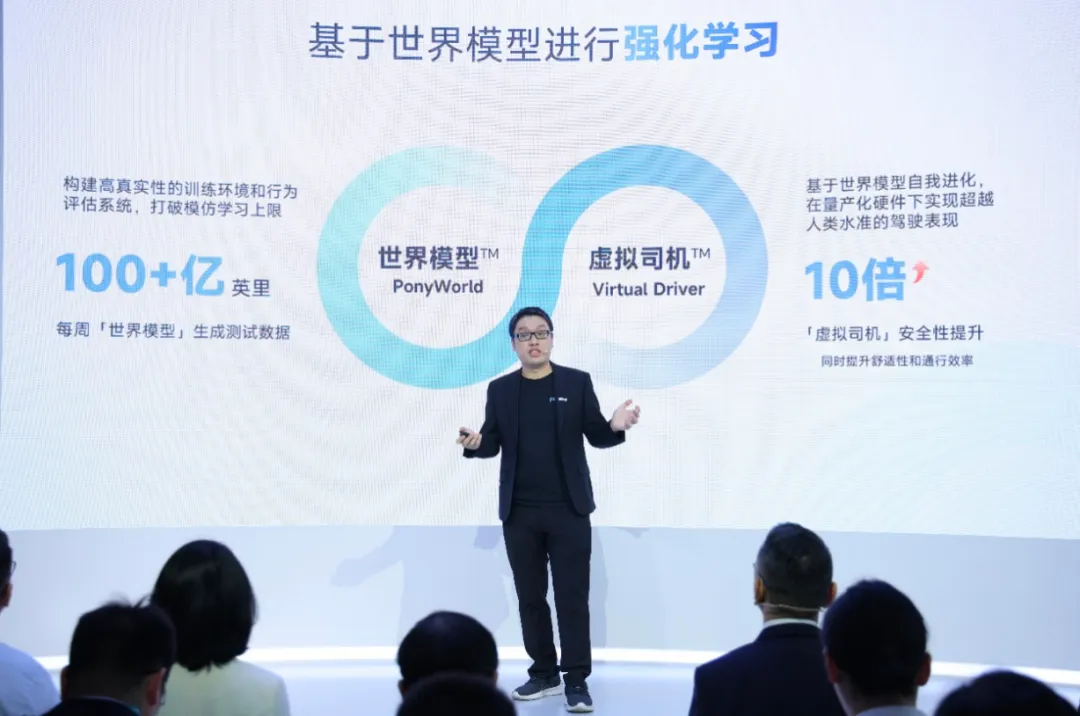 Lou introduces the 'World Model + Virtual Driver' technology
The core is their self-developed 'World Model.'
Lou explained: The World Model accurately simulates interactions between the vehicle and surrounding traffic participants, generating large-scale simulation scenarios that reflect specific traffic patterns in new markets. 'This eliminates the need to collect vast amounts of real-world data for every new city, enabling efficient validation and fine-tuning.'
Wang supplemented from an operational perspective.
He argued that the core challenge in replicating to new cities isn't technology but adapting 'network scale' and 'cost structure.'
'The vehicle costs are the same domestically, but operating costs vary, like labor wages. Meanwhile, you face another question: Can per-kilometer fares remain the same as in first-tier cities?'
His conclusion: The key is achieving sufficient network scale to guarantee daily ride volumes and reasonable fares. But Pony.ai won't pursue profitability in every city before expanding. 'At this stage, we prioritize top-line growth. Once scale is achieved, profitability will follow naturally.'
Overseas markets offer higher profit margins. 'In any overseas market, if labor and fare costs are high, margin potential is high.' Abroad, Pony.ai will also prioritize scale over immediate profitability.
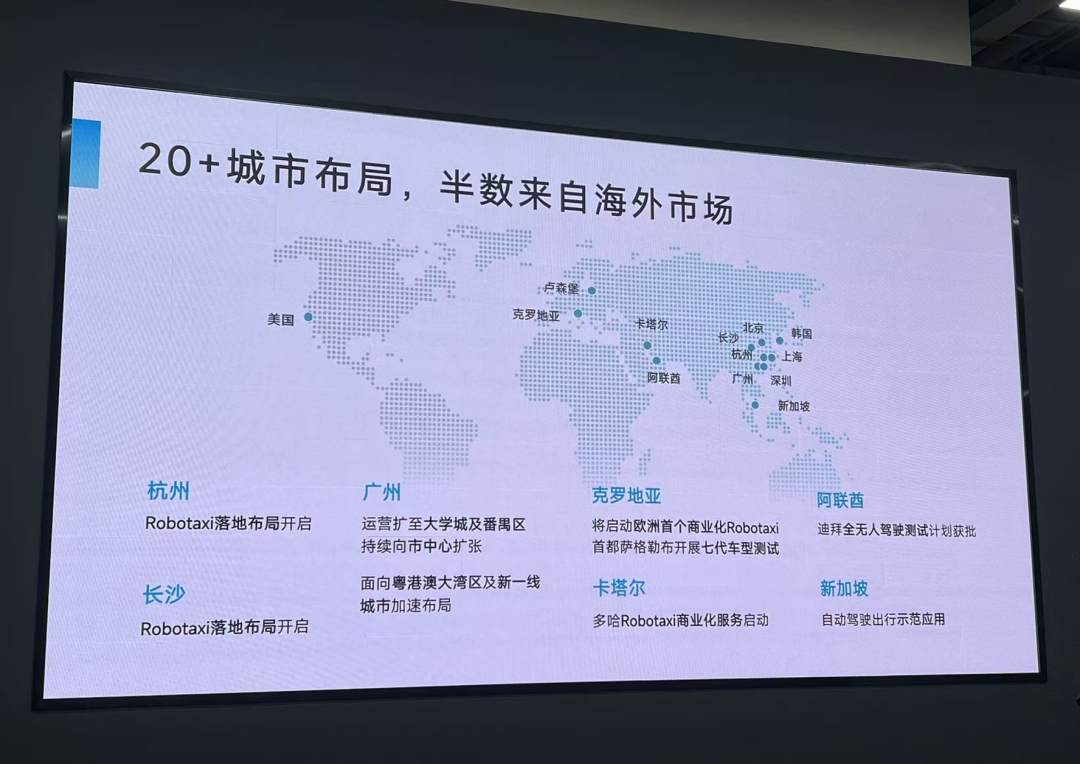
This is why they aim to enter over 20 cities in 2026, with nearly half overseas—in Asia, Europe, and the Middle East.
In other words, the replication strategy isn't 'achieve profitability first, then expand,' but 'scale first, optimize later.' Guangzhou and Shenzhen serve as blueprints—proving the model works, then using that to persuade partners and local governments to enter more cities quickly. Higher overseas margins offer greater imagination for future profitability.
03
'Co-Built Fleet' Model Works; Musk's 'C2C' Doesn't
Expansion requires vehicles. By 2026, Pony.ai aims to grow its fleet from over 1,000 to over 3,000 vehicles.
Buying each vehicle outright at RMB 300,000 would require hundreds of millions in investment.
Pony.ai's solution: The 'co-built fleet' model.
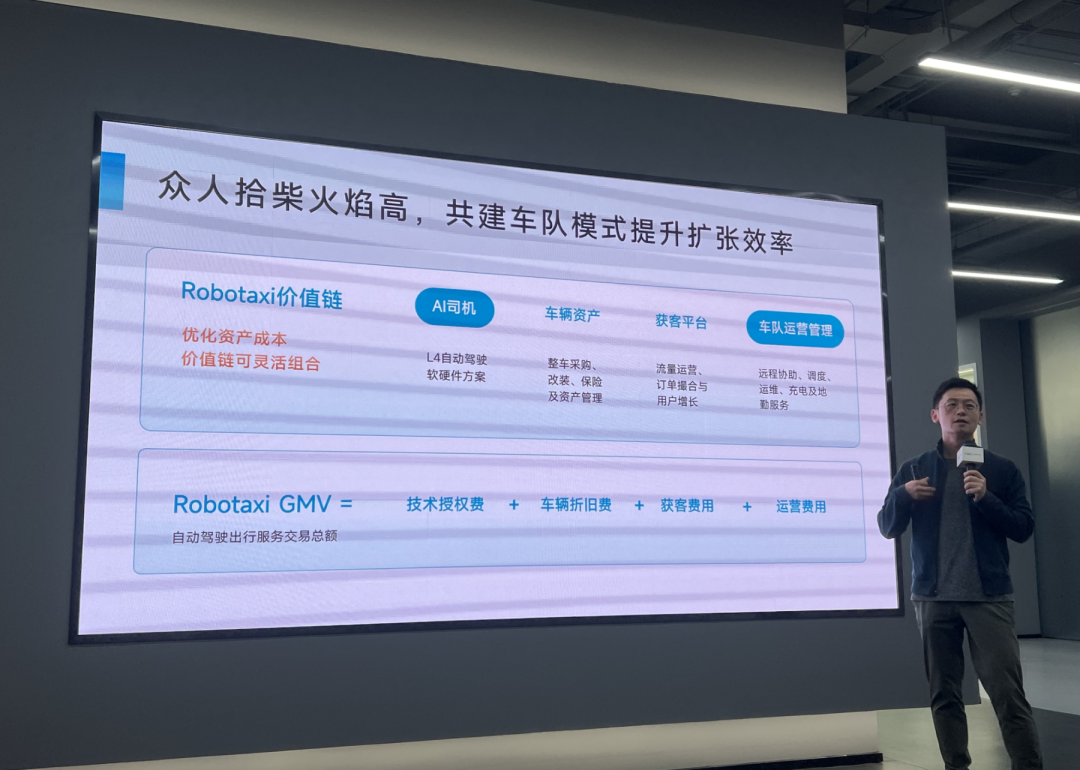
Wang broke down the Robotaxi value chain: AI driver (Pony's core), vehicle assets, customer acquisition platform, and fleet operations management.
Under the co-built model, Pony.ai focuses on one thing: the AI driver, earning technology licensing fees and potential revenue shares. Partners fund vehicle purchases and can participate in operations management.
'It's a win-win,' Wang said. 'Partners gain growing revenue from deploying vehicles, while we rapidly scale the fleet without heavy capital expenditure.'
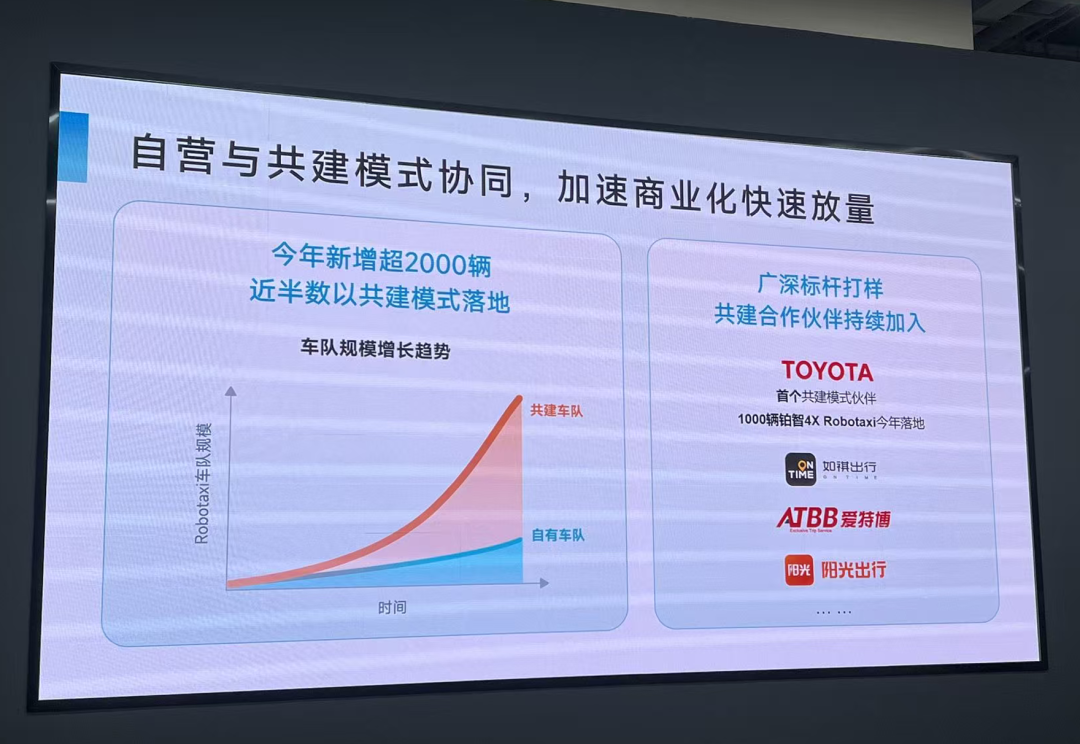
In 2026, over 2,000 new vehicles will be added, nearly half under co-built arrangements. Toyota is the first co-built partner—1,000 bZ4X Robotaxis will launch this year. Others like OnTime, Aitebo, and Yangguang Chuxing have also joined.
'Co-built and self-built are different from self-operated and partner-operated,' Wang clarified. 'In co-built models, some partners hold vehicles and lease them back to us.'""The co-built model's core is reducing capital expenditure pressure. In domestic first-tier cities, Pony.ai still relies mainly on self-operated fleets to set operational benchmarks. Overseas, it will adopt more 'partner-operated + co-built' approaches, profiting through technology licensing and revenue sharing.
Wang also shared an intriguing vision: Future possibilities for ordinary people to buy vehicles and earn money through the Robotaxi network.
'It could become a form of co-built model—you own a vehicle and deploy it into the Robotaxi network to generate income,' he said. However, he acknowledged that current regulations aren't there yet—issues like liability division and accident responsibility remain unresolved.
Regarding Musk's vision of a C2C model, where vehicles with autonomous capabilities 'go out and earn money' for consumers, Wang disagreed.
'Musk says private car owners can use their vehicles when needed and let them earn money otherwise. But if your private car crashes with passengers inside, who do they sue? You're at work—how do you resolve it?' Meanwhile, the times when private cars are unused coincide with the weakest demand for ride-hailing, making unit economics potentially poor.
As for whether L2+ can gradually evolve to L4, Pony.ai's answer: No.
'L2 and L4 are fundamentally different—they're not two stages on the same path,' Lou argued. Improving L2's MPI (miles per intervention) might actually increase risk, as partial automation creates a false sense of security. Users might assume the system is 'mostly fine' until it suddenly fails, leaving them unprepared to take over.
What's the core challenge of L4? 'The hardest part isn't the first 99%, but the last 1%—those rare but safety-critical long-tail scenarios.' In Lou's view, this is why the 'World Model' is crucial—it comprehensively covers the full combination space of different intentions in these long-tail scenarios.
04
More Players Welcome; Financial Priority Isn't Profitability
Despite L4's high barriers, more automakers and tech firms are entering the space.
Peng responded openly: 'New players entering shows confidence in the sector's long-term potential. We welcome them—let's grow the market together.'""But he drew a clear line: L4 Robotaxi is an extremely complex systems engineering challenge, requiring five interlocking pillars—technology, policy, mass production, operations, and ecosystem collaboration—'not something that can be accelerated by simply throwing resources at it.'""Wang cited Tesla as an example.
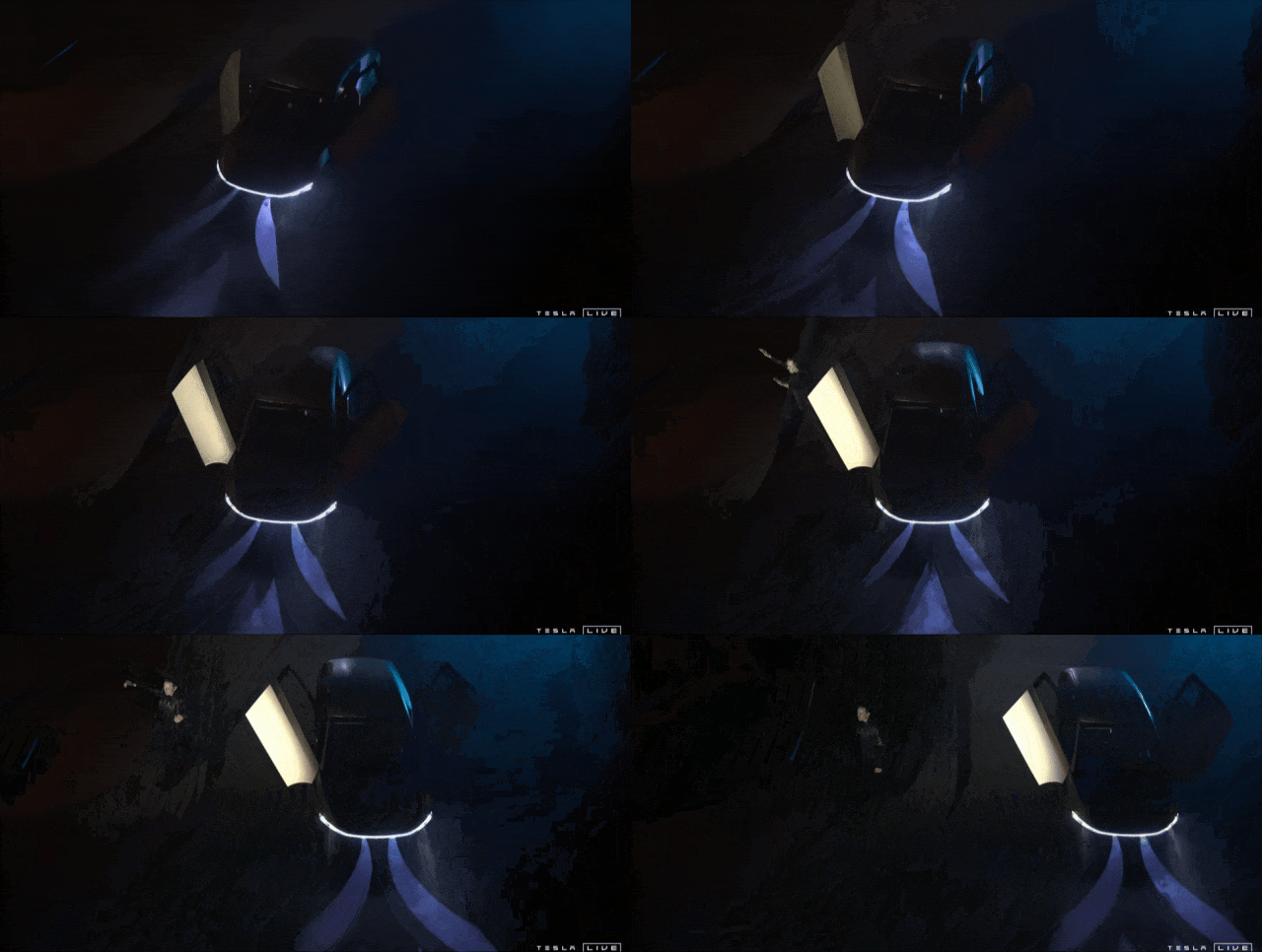 Tesla Cyberca
"Today, everyone acknowledges that there is an automotive company with strong technical capabilities and a significant number of GPUs, and that company is Tesla. However, from the announcement of the Cybertruck in 2024 to its actual achievements in 2025, among all the services Tesla has provided to the public so far, none of them are fully autonomous; all come with safety operators."
His conclusion is: The difficulty of L4 lies not only in the vehicle but also in the optimization of the operational system. Ultimately, the number of companies that can successfully implement L4 will be far fewer than those implementing L2+.
As for whether NVIDIA's L4 open-source model will lower the barrier? Lou Tiancheng's response was concise:
"There is a huge gap between a model and a fleet of Robotaxis that have undergone safety verification, received government approval, and can operate commercially on a large scale. Filling this gap is precisely our core strength."
After discussing technology, operations, and competition, there is still an unavoidable question: Since the unit economics (UE) per vehicle has turned positive, why are losses still increasing?
Wang Haojun's explanation was frank: "UE turning positive doesn't mean we will stop investing in R&D. The development of the seventh-generation vehicle and collaboration fees with OEMs are all upfront investments. What we are pursuing now is for top-line growth to outpace expense growth, which is a healthy trajectory."
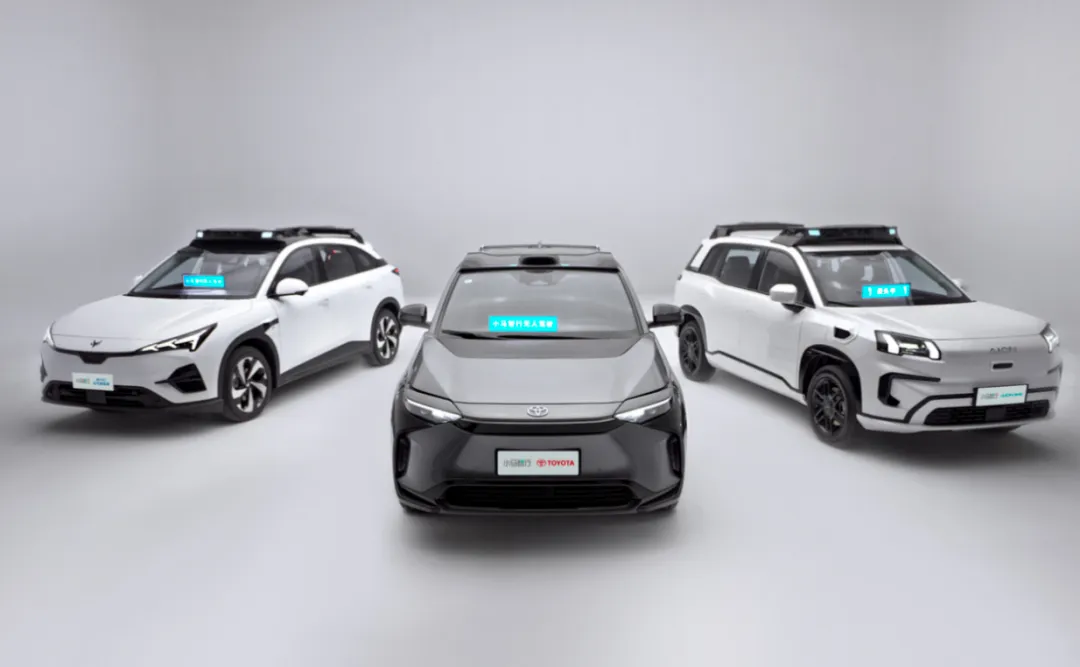 Members of Pony.ai's seventh-generation Robotaxi family
In other words, Pony.ai's core financial priority at this stage is not profitability but rapid revenue growth.
He framed the time expectation with an industry consensus: "The industry consensus is that there will be around 100,000 Robotaxis by around 2030. If that number is reached, many companies should be able to achieve overall profitability."
Currently, Pony.ai has over 1,400 vehicles. It took one year to grow from 270 to 1,000 vehicles and another year to grow from 1,000 to 3,000 vehicles. This curve is steepening.
Investors are also accepting this logic. Wang Haojun mentioned: "Waymo's recent funding round valued it at nearly 300 times its ARR, showing that the market is willing to pay a premium for high growth."
Clearly, Pony.ai's Robotaxi business has moved from the stage of "can it make money" to "how to replicate its money-making model."
UE turning positive is a milestone, but it is not the endpoint. The real test lies in: Can your world model quickly adapt when you expand from Guangzhou and Shenzhen to Hangzhou, Changsha, Doha, and Zagreb? Can your co-built fleet model attract more partners? Can your operational system work in more cities? Can your top-line growth continue to outpace expense growth?
The answers to these questions will become clear by the end of 2026.
-END-
-
![]()
The Allure of 'Acquisition Spree': Li Shufu's Left Turn, Xu Jiayin's Right
-
![]()
Strategic Transformation Yields Results: Phoenix Optics Reports 10.9% YoY Rise in Core Net Profit for H1 2026
-
![]()
Three Key Growth Trajectories Synergize! Crystal-Optech Reports 3.478 Billion Yuan in Revenue for H1 2026
-
![]()
Semi-Annual Report Sparks XPENG Motors Buzz
-
![]()
1.6 Billion Big Order Secured! SeeYA Technology's Revenue Soars by 287.87% in the First Half of the Year
-
![]()
Baidu's Profits Plunge by 68%: Unraveling the Mystery Behind the Numbers
-
![]()
Baidu’s Profits Tumble by 68%! Where Has All the Money Gone?
-
![]()
Hynix’s Taobao Store Shuts Down Abruptly: What Should Customers Do About Warranty Services for Memory Modules?