BYD at the Crossroads of Scale and Profitability
 03/31 2026
 678
678
Text by Yang Xuejian | Source: Jiedian Auto
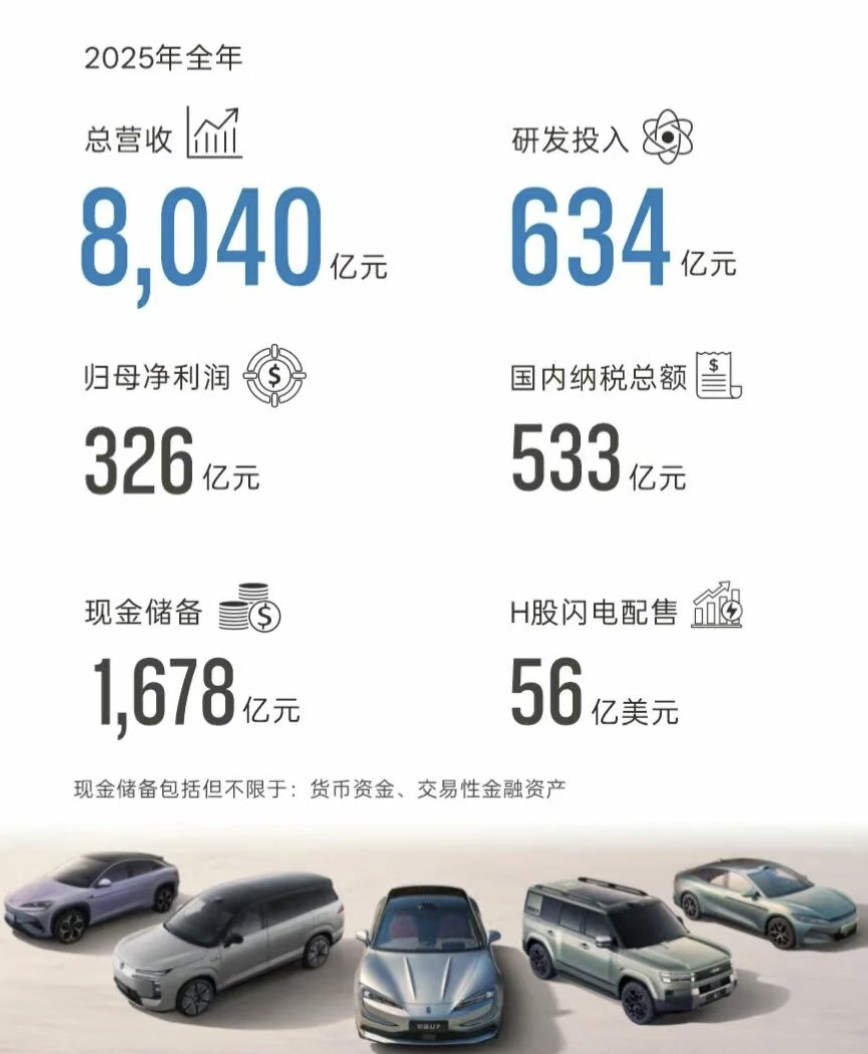
On the evening of March 27, BYD released its 2025 annual report. The global new energy vehicle (NEV) leader's annual performance naturally drew significant attention: full-year revenue reached RMB 803.965 billion, up 3.46% year-on-year, surpassing the RMB 800 billion mark for the first time; net profit attributable to shareholders fell 18.97% year-on-year to RMB 32.619 billion. Notably, BYD's 2025 R&D investment hit RMB 63.4 billion, up 17% year-on-year, with cumulative R&D spending exceeding RMB 240 billion; cash reserves remained high at RMB 167.8 billion.
Undeniably, BYD's operational metrics remain at the forefront of the industry. Globally, the BYD brand's influence continues to grow.
Debuting in Global Top 5, R&D Spending Leads A-Shares Again
In 2025, BYD sold over 4.6 million vehicles, securing its fourth consecutive year as the global NEV sales champion while debuting in the top five global automaker groups by sales. The 2025 global top five automaker groups by sales were Toyota (11.322 million), Volkswagen (8.984 million), Stellantis (7.8 million), Hyundai (7.244 million), and BYD (4.602 million).
BYD's overseas business was a major highlight in 2025. Annual overseas sales of passenger vehicles and pickups surpassed 1 million units for the first time, reaching 1.05 million, up 145% year-on-year, with overseas revenue exceeding RMB 310 billion, accounting for nearly 40% of total revenue. BYD's operations now span 119 countries and regions globally.
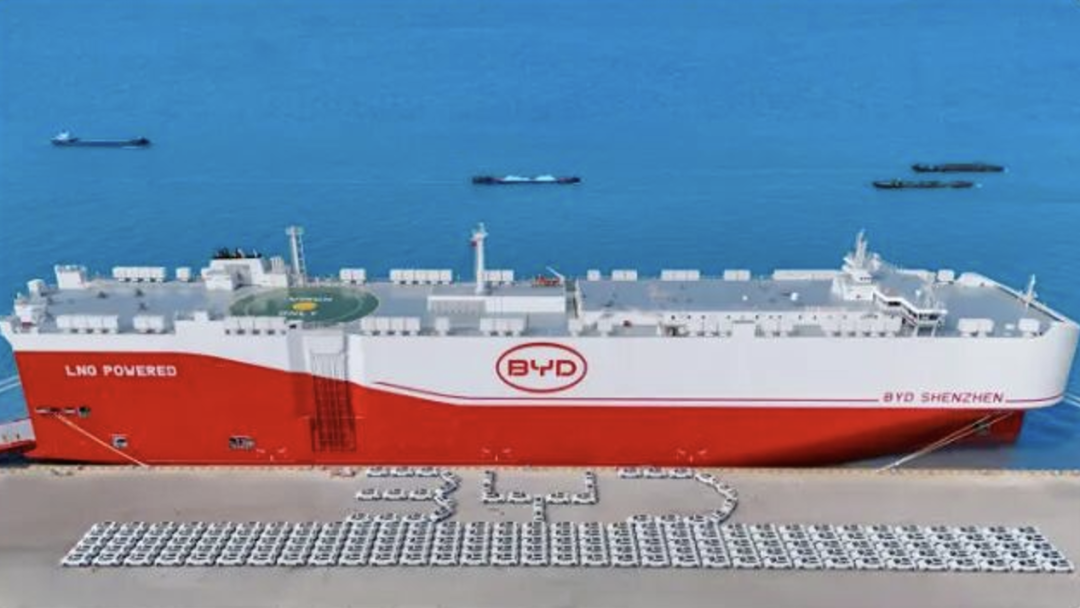
Unlike mere vehicle exports in the past, BYD's global expansion now drives its supply chain abroad. BYD has localized vehicle production in Brazil and Thailand, with its Hungarian European headquarters handling sales and local development. All eight car carriers are now operational, forming a "maritime transport + local production" supply chain model.
"Whether it's brand elevation or overseas expansion, globalization is an unavoidable path. Especially with the NEV trend irreversible, we will fully leverage both domestic and international markets and resources, collaborate with global supply chain partners, create locally branded products, offer more green technologies and eco-friendly experiences to global consumers, and share China's NEV industry dividends with more global peers, jointly advancing the global automotive industry toward intelligence, greenness, and integration," said Wang Chuanfu, Chairman of BYD Co., Ltd.
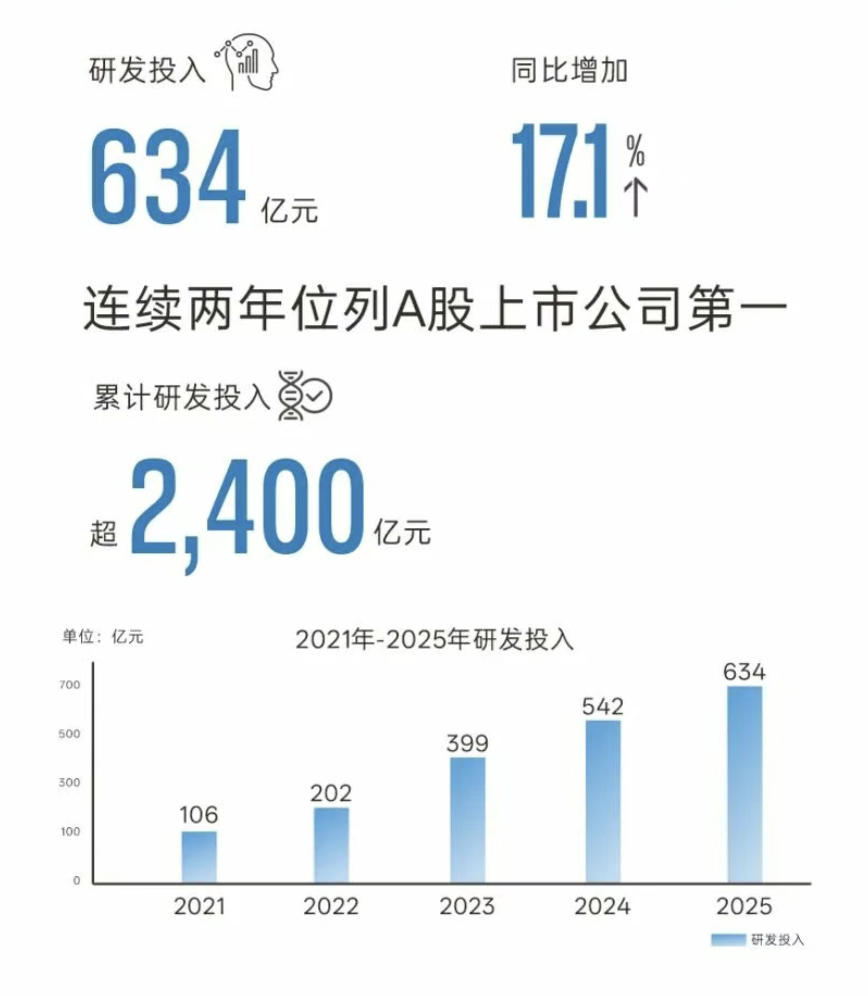
Another highlight of BYD's 2025 financials is its R&D spending, which once again topped A-shares. In 2025, R&D investment reached RMB 63.4 billion, up 17.1% year-on-year, ranking first among A-share listed companies for the second consecutive year, with cumulative R&D spending exceeding RMB 240 billion.
As of the end of 2025, BYD employed over 120,000 R&D engineers, with cumulative patent applications exceeding 71,000 and granted patents surpassing 42,000.
"From its inception, BYD has been clear about taking technology as its foundation," Wang Chuanfu emphasized.
Massive R&D investments are accelerating technological commercialization. BYD has completed a vertical technological layout in NEVs, including:
Second-generation Blade Battery: 5% higher energy density, over 1,000 km range; megawatt-level flash charging, 10-70% SOC in 5 minutes at normal temperatures, achieving "fuel-electric parity" in charging speed;
Evolution 5.0: End-to-end large-model intelligent driving system, with over 2.7 million units equipped with Evolution ADAS, generating over 170 million km of daily data, forming a positive "data-algorithm-experience" cycle;
Plans to build 20,000 flash charging stations by the end of 2026, combining second-generation Blade Battery technology for 5-minute charging from 10-70% SOC at normal temperatures and 12-minute charging from 20-97% SOC at -30°C.
Technological investments have also driven BYD's progress in the mid-to-high-end passenger vehicle market. Its three mid-to-high-end brands—Fangchengbao, Denza, and Yangwang—sold approximately 400,000 units in 2025, up 109% year-on-year, accounting for 8.7% of BYD Group's passenger vehicle sales, doubling from 4.5% in 2024.
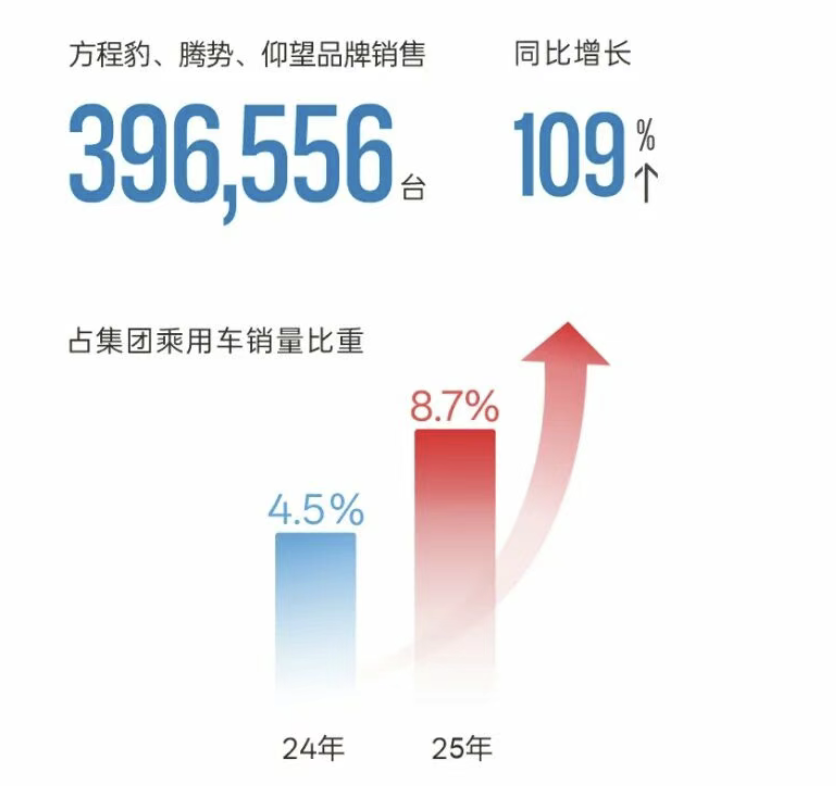
In terms of products, the Fangchengbao Leopard 5, Fangchengbao Titan 7, and Denza D9 maintain leading positions in their respective segments. For example, the Leopard 5 became the 2025 hardcore off-road sales champion, while the Denza D9 secured its third consecutive year as the new energy MPV sales champion.
High-end models often debut cutting-edge technologies, enabling higher technical premiums and profits.
However, the three brands—Fangchengbao, Denza, and Yangwang—accounted for only 8.7% of BYD's total passenger vehicle sales. Thus, while BYD accelerates mass production of high-end technologies like power batteries and intelligent cockpits, the market awaits whether it can further elevate its influence in the mid-to-high-end automotive market.
Can Vertical Integration Overcome Profitability Pressures?
The collective dilemma facing all Chinese automakers is that while Chinese brands have driven NEV penetration beyond 50%, making China the world's largest NEV market, the market has also entered a mature phase, with nearly every segment turning "red ocean."
Especially in the sub-RMB 250,000 market, product clustering and intense competition define the landscape—BYD's core battleground. Its Dynasty and Ocean series deploy numerous models here, but scaling up also brings severe profitability pressures.
Jiedian Auto's financial review reveals that despite record-high 2025 metrics, the report also exposes BYD's "revenue growth without profit growth" pressure: net profit attributable to shareholders fell 18.97% year-on-year, with the overall gross margin dropping to 18%, a three-year low.
The domestic market competition will intensify further in 2026.
Wang Chuanfu stated in the annual report that the industry is undergoing a brutal "knockout phase," with competition shifting from pure product battles to all-round contests of "technology + price + ecosystem."
While BYD's vertical integration gives it industry-leading resilience, rebuilding profit margins amid prolonged price wars and overseas expansion capital demands will be its core challenge in 2026.
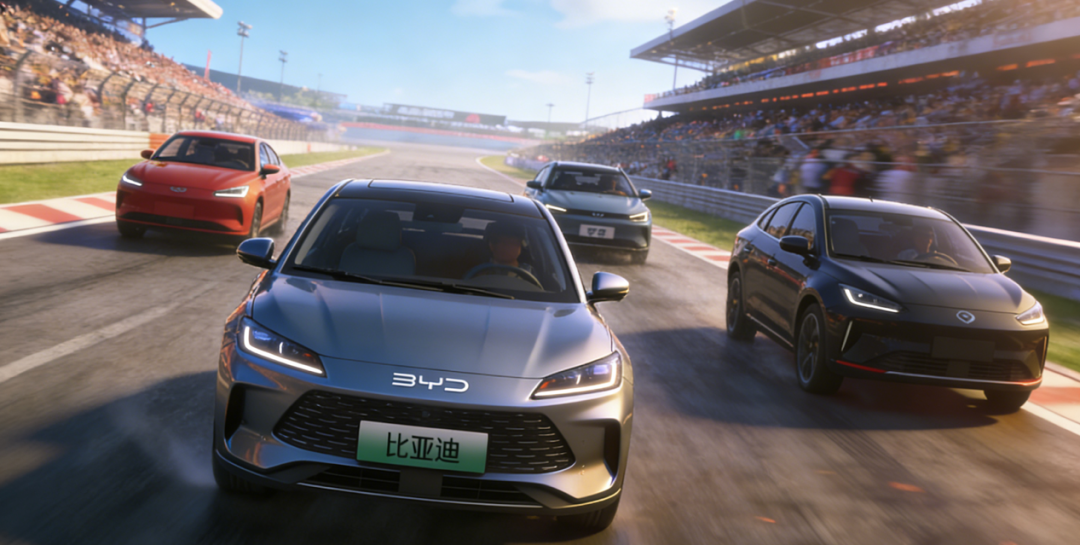
In the domestic market, more competitors are catching up rapidly. Geely, in particular, has become BYD's most formidable rival. In 2025, Geely achieved high-quality growth with 3.02 million units sold, RMB 345.2 billion in revenue, and RMB 14.4 billion in core net profit. Though still lagging BYD in overall scale, Geely surpassed BYD in sales for two consecutive months in early 2026, breaking the latter's long-standing lead.
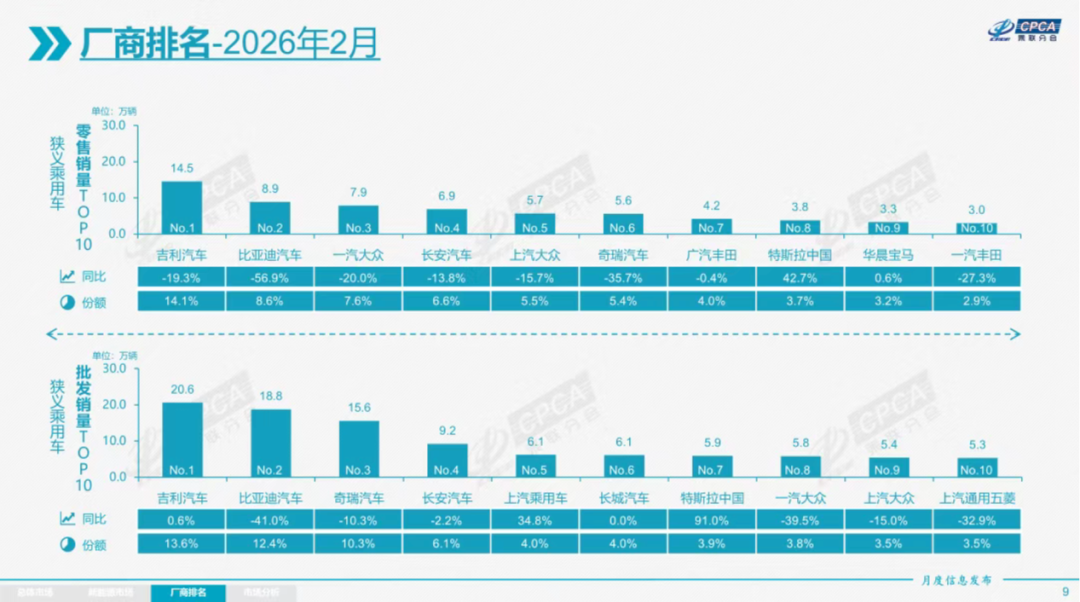 Source: China Passenger Car Association
Especially in BYD's core RMB 100,000–200,000 segment, Geely's Galaxy series now closely competes with BYD's Ocean/Dynasty series, vying for market share in both BEV and PHEV segments. Additionally, brands like Leapmotor and Changan are also engaging in fierce competition in this price band, placing unprecedented pressure on BYD in the domestic market.
However, with RMB 167.8 billion in cash reserves, BYD remains the most "resilient" player. Its vertical integration capabilities across power batteries, intelligent driving, energy replenishment systems, and even upstream supply chains will serve as its long-term profit moat.
In Conclusion
Overall, BYD's 2025 fiscal year performance remains impressive: approximately RMB 804 billion in revenue, RMB 32.619 billion in net profit, RMB 63.4 billion in R&D investment, RMB 167.8 billion in cash reserves, and a debut in the global top five automaker groups by sales. However, this comes with the reality of declining year-on-year profits and per-unit revenue.
BYD's financials lay bare the dilemmas, operational logic, and strategic choices faced by leading automakers in hyper-competitive markets. Ultimately, its future hinges on the depth of its technological reserves.
In 2026, can BYD further advance overseas, maintain its domestic lead, and resolve profitability pressures? BYD now stands at a new crossroads.
-
![]()
The Allure of 'Acquisition Spree': Li Shufu's Left Turn, Xu Jiayin's Right
-
![]()
Strategic Transformation Yields Results: Phoenix Optics Reports 10.9% YoY Rise in Core Net Profit for H1 2026
-
![]()
Three Key Growth Trajectories Synergize! Crystal-Optech Reports 3.478 Billion Yuan in Revenue for H1 2026
-
![]()
Semi-Annual Report Sparks XPENG Motors Buzz
-
![]()
1.6 Billion Big Order Secured! SeeYA Technology's Revenue Soars by 287.87% in the First Half of the Year
-
![]()
Baidu's Profits Plunge by 68%: Unraveling the Mystery Behind the Numbers
-
![]()
Baidu’s Profits Tumble by 68%! Where Has All the Money Gone?
-
![]()
Hynix’s Taobao Store Shuts Down Abruptly: What Should Customers Do About Warranty Services for Memory Modules?