Employees Facing Elimination and Those in High Demand in Automobile Companies
 04/01 2026
 447
447
"The financial reports indicate that Great Wall and Seres expanded their professional staff, while BYD, GAC Group, and FAW Jiefang downsized."
Author | Long Yuan Editor | Li Guozheng Produced by | Bangning Studio (gbngzs)
"We've never encountered anything like this before. In 2024 and early 2025, every core member of the assisted driving team basically received over 20 calls from headhunters," said Li Xiang, CEO of Li Auto, in mid-2025 regarding talent competition. This sentiment is now reflected in the 2025 annual financial reports of some mainstream automobile companies.
At the end of March 2026, five automobile companies, including GAC Group, FAW Jiefang, BYD, Seres, and Great Wall Motor, successively disclosed their 2025 financial reports, revealing an overview of their personnel structure adjustments.
The most common changes among these companies are concentrated in professional composition and educational attainment.
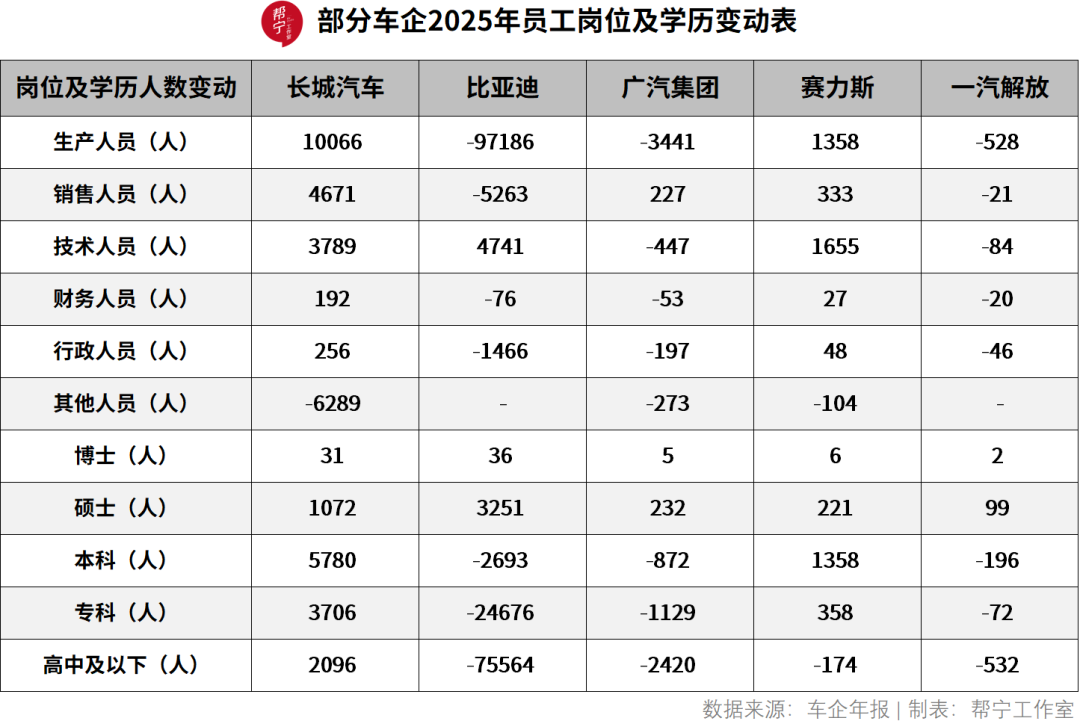
In this regard, the number of highly educated talents such as master's and doctoral degree holders increased across all five companies, with varying degrees of growth in the number of technical talents at BYD, Great Wall Motor, and Seres. Although the number of technical personnel at FAW Jiefang and GAC Group slightly declined, the size of their core R&D teams remained stable.
Overall, the personnel adjustments among automobile companies showed distinct differentiation: Great Wall Motor and Seres expanded their professional staff to boost production capacity, R&D, and market expansion; BYD, GAC Group, and FAW Jiefang proactively reduced their workforce, focusing on cost reduction, efficiency enhancement, core capability optimization, and industrial upgrading.
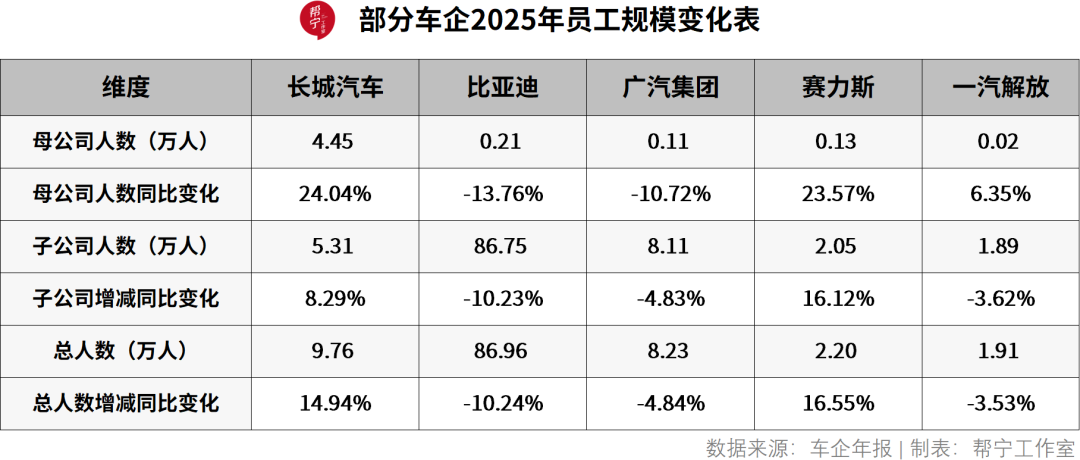
Specifically, FAW Jiefang's 2025 personnel adjustments centered on moderate production-side reductions; GAC Group downsized non-core positions, strengthened its sales force, and optimized functional roles; BYD focused on large-scale production-side reductions; Great Wall Motor significantly expanded its production, sales, and technical talent; Seres also substantially increased its technical positions.
Compared to 2024, BYD saw the most significant reduction last year, with nearly 100,000 employees cut, a 10.23% decrease; GAC Group and FAW Jiefang adopted moderate reduction strategies, with reduction ratios of 4.84% and 3.53%, respectively; Great Wall Motor and Seres both saw total workforce increases exceeding 14%.
What development trends in the Chinese automotive industry lie behind these differentiated personnel adjustments?
▍01 Varying Increases and Decreases
The personnel changes at the five automobile companies each have distinct characteristics.
From the perspective of workforce size and structural adjustments, they can be divided into two camps: Great Wall Motor and Seres are in the expansion phase to capture market share, while BYD, GAC Group, and FAW Jiefang are contracting to improve efficiency.
Both Seres and Great Wall Motor saw sales growth in 2025. The former sold 472,300 new energy vehicles, a year-on-year increase of approximately 10.6%, setting a new annual sales record. The latter sold 1.324 million vehicles, a 7% year-on-year increase, including 406,000 new energy vehicles, a 26% year-on-year increase.
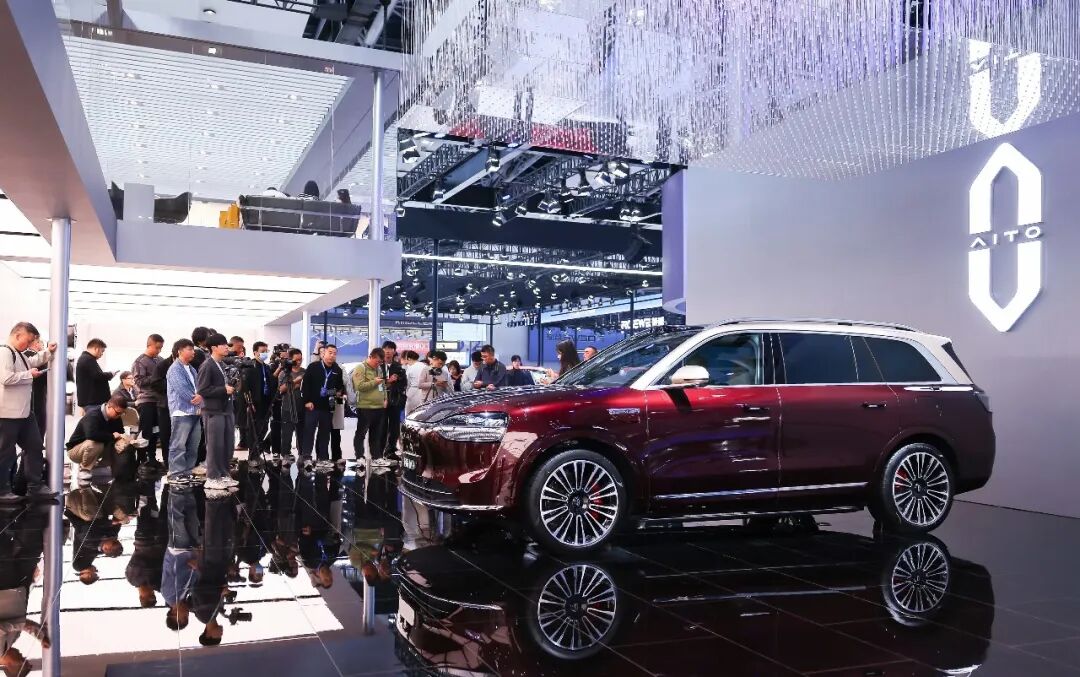
Moreover, among the five companies, Great Wall Motor had the largest workforce increase, with a net gain of 12,700 employees throughout the year, bringing its total workforce to 97,600 by the end of 2025. Production personnel were the primary contributors to this growth, with a net increase of 10,000; sales personnel saw a net increase of nearly 5,000, a 75.47% increase.
The financial report showed that Great Wall Motor's sales expenses reached 11.273 billion yuan in 2025, a 43.93% year-on-year increase. The main reason for this expense change was the company's acceleration in building new direct-to-consumer channels and increasing marketing efforts for new models and technologies, as well as brand enhancement.
The main entity expanding its direct sales channel network was WEY. Public information shows that WEY began building its own digital direct sales channels at the end of 2024, with over 500 direct sales stores by 2025. The brand's sales that year reached 102,000 vehicles, an 86% year-on-year increase.
Seres also saw workforce growth, with a net increase of 3,117 employees throughout the year, a 16.55% increase, with growth across technical, production, sales, and financial departments. However, the company reduced non-core positions by 33.02%.
In contrast, industry leader BYD and traditional player GAC Group adopted proactive downsizing strategies, focusing on cost reduction, efficiency enhancement, and structural optimization, transitioning from quantity to quality.
Among them, GAC Group's total workforce decreased from 85,000 in 2024 to 82,100 by the end of 2025, a roughly 5.07% decrease, primarily due to a reduction of over 3,000 employees in other positions, a 37.57% decrease. This indicates that GAC Group significantly streamlined non-core and support positions.
In the chairman's statement in the annual report, Feng Xingya, chairman of GAC Group, specifically mentioned that in 2025, the company would advance management reforms, reshape organizational efficiency, deepen cadre personnel and three institutional reforms, establish a rigid assessment and exit mechanism centered on business performance, implement market-oriented selection and competitive employment, and complete the global recruitment of a new generation of professional managers.
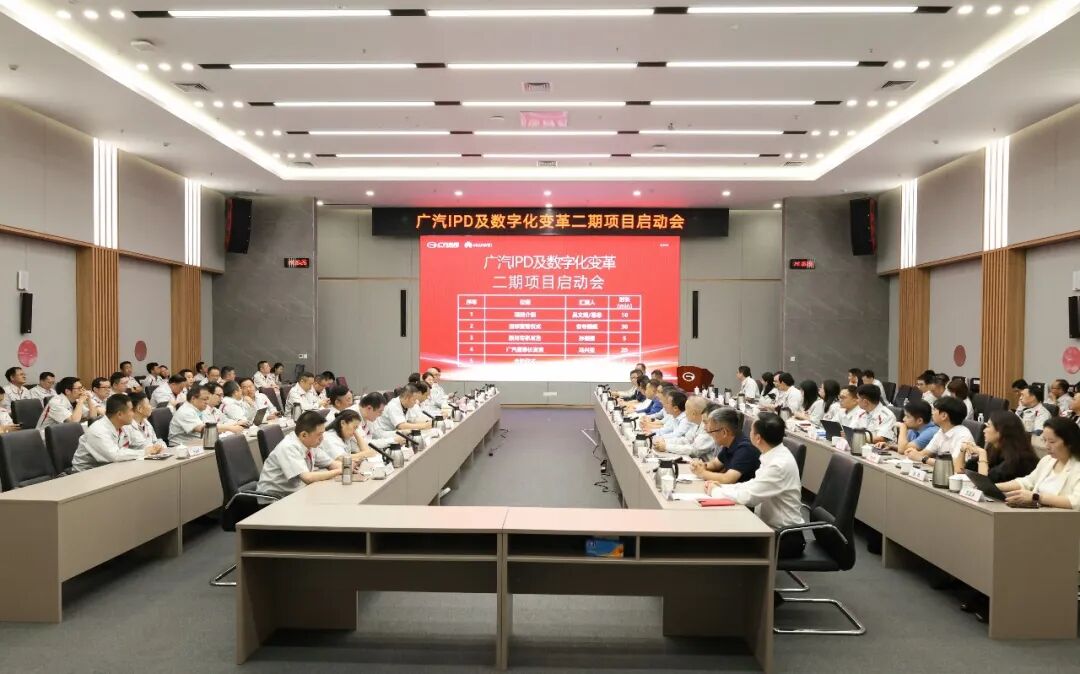
Its personnel changes were mainly reflected in the Panyu Initiative and BU system reforms, such as the organizational restructuring of the Panyu Initiative, IPD/DSTE process reengineering, and the operational control and decentralization of authority in the BU system reforms.
Among the five companies, BYD had the largest total workforce and the highest reduction, decreasing from 968,900 in 2024 to 869,600 in 2025. Production personnel were the primary contributors to the reduction, with a decrease of 97,200, accounting for 97.92% of the total reduction. This reflects BYD's large-scale efficiency optimization and capacity upgrading on the production side in 2025.
FAW Jiefang had the smallest personnel changes, with its total workforce decreasing from 19,800 in 2024 to 19,100 in 2025, a net reduction of 699 employees, a roughly 3.53% decrease, showing a trend of moderate downsizing, cost control, and efficiency enhancement. From a professional composition perspective, all positions underwent fine-tuning optimizations without large-scale adjustments. Its production side was also the primary contributor to the reduction, accounting for 75.54% of the total reduction.
Against the backdrop of the moderate recovery of the commercial vehicle market in 2025, FAW Jiefang's personnel changes reflect its strategic orientation of comprehensive cost control and stable operation.
▍02 Overall Growth in High-End Talent
Although the personnel changes at the five automobile companies each have distinct characteristics, they share a commonality: an overall increase in high-end talent. At the same time, most employees with lower educational attainment were continuously optimized, and the proportion of technical personnel steadily increased.
High-end technical talent is a rigid demand in the automotive industry. The number of master's and doctoral degree holders at the five companies increased, and the proportion of technical personnel generally rose.
In terms of the proportion of technical personnel, Seres surpassed 44%, a significant increase from 37.8% the previous year, ranking first among the five companies. FAW Jiefang's proportion of technical personnel was approximately 31.2%. Great Wall Motor's was around 27.8%. GAC Group's was about 18.6%. BYD's was 14.7%.
Although BYD's proportion of technical personnel was relatively low, its absolute size was the largest among the five companies, at 127,800.
Public information indicates that the competition for high-end talent in the automotive industry has intensified. Since 2025, several automobile companies have offered positions with annual salaries exceeding one million yuan to recruit intelligent talent, focusing on expanding recruitment of master's and higher-educated talent, with campus and social recruitment both tilt [qīngxié] (leaning) towards core technical fields.
At the 2025 Chongqing University autumn job fair, a representative from Seres stated that the group's recruitment plan would significantly increase in 2025, with over 1,000 positions expected to be filled in mechanical and electrical engineering, intelligent manufacturing, computer science, and other directions.
A representative from XPENG Motors stated at a 2025 job fair that the company planned to add 6,000 new positions that year, covering directions such as autonomous driving, intelligent cockpits, and hardware R&D.
Conversely, employees with lower educational attainment and ordinary production-side personnel became the focus of optimization for automobile companies. BYD, GAC Group, and FAW Jiefang structurally streamlined employees with junior college education or below, with reductions concentrated in traditional production and manufacturing positions. For example, in 2025, BYD reduced its workforce of individuals with high school education or below by 75,600, and GAC Group reduced its workforce by over 2,000.
This change is an inevitable result of the deepening intelligence of the manufacturing industry.
Wang Chuanfu, chairman of BYD, publicly stated at the end of 2025 that BYD is accelerating its comprehensive transformation into a "lights-out factory" and has already achieved substantive results.
BYD's overseas factory in Hungary adopts a pure "lights-out factory" model, with an automation rate as high as 95% and an initial annual production capacity of 150,000 vehicles, serving as a core implementation scenario for its intelligent manufacturing strategy. Domestic core bases, such as the Xi'an factory, have also completed in-depth intelligent transformations.
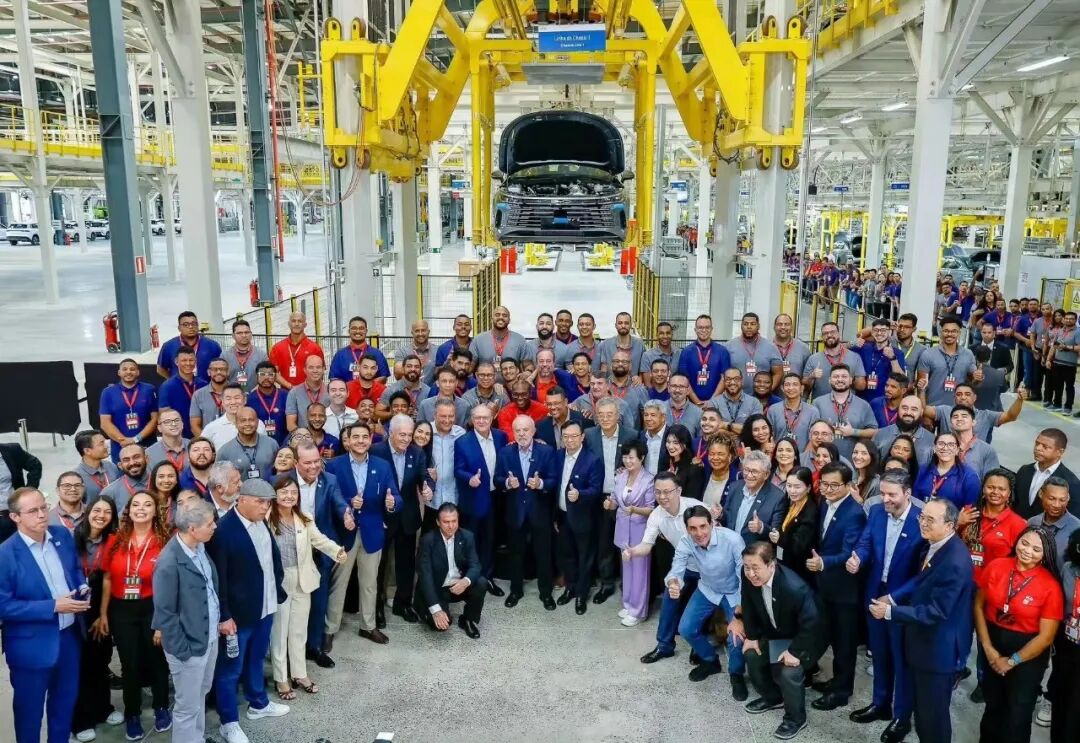
From a structural perspective, the personnel changes at the five companies have two clear characteristics: First, the focus of talent has shifted from production personnel to technical backbone, with R&D and intelligent talent becoming core assets for automobile companies. Second, the competition for high-end talent has become normalization [chánghuà zhī] (normalized).
In mid-March 2026, BYD launched a large-scale spring recruitment drive, planning to hire over 2,200 industrial workers, including more than 2,000 technical personnel, with positions such as robot technicians. This is linked to the company's factory intelligence technology upgrades.
The personnel changes at automobile companies are rational choices made by each enterprise to adapt to industry development and align with their own strategies. They are a true reflection of China's automotive industry entering the deep waters of stock competition [cúnliàng jìngzhēng] (stock competition) and cannot be simply summarized as "expansion" or "contraction."
Only by precisely aligning talent strategies with business strategies, maintaining a baseline of high-end talent, optimizing personnel structure, and enhancing talent efficiency can automobile companies stand firm in the fierce industry competition.
These structural changes in personnel numbers are driving China's automotive industry towards sustained high-quality development.
(Featured image created using AI)

-
![]()
The Allure of 'Acquisition Spree': Li Shufu's Left Turn, Xu Jiayin's Right
-
![]()
Strategic Transformation Yields Results: Phoenix Optics Reports 10.9% YoY Rise in Core Net Profit for H1 2026
-
![]()
Three Key Growth Trajectories Synergize! Crystal-Optech Reports 3.478 Billion Yuan in Revenue for H1 2026
-
![]()
Semi-Annual Report Sparks XPENG Motors Buzz
-
![]()
1.6 Billion Big Order Secured! SeeYA Technology's Revenue Soars by 287.87% in the First Half of the Year
-
![]()
Baidu's Profits Plunge by 68%: Unraveling the Mystery Behind the Numbers
-
![]()
Baidu’s Profits Tumble by 68%! Where Has All the Money Gone?
-
![]()
Hynix’s Taobao Store Shuts Down Abruptly: What Should Customers Do About Warranty Services for Memory Modules?