9X Takes the Lead, SAIC Volkswagen Remakes Products and Organization
 04/03 2026
 518
518
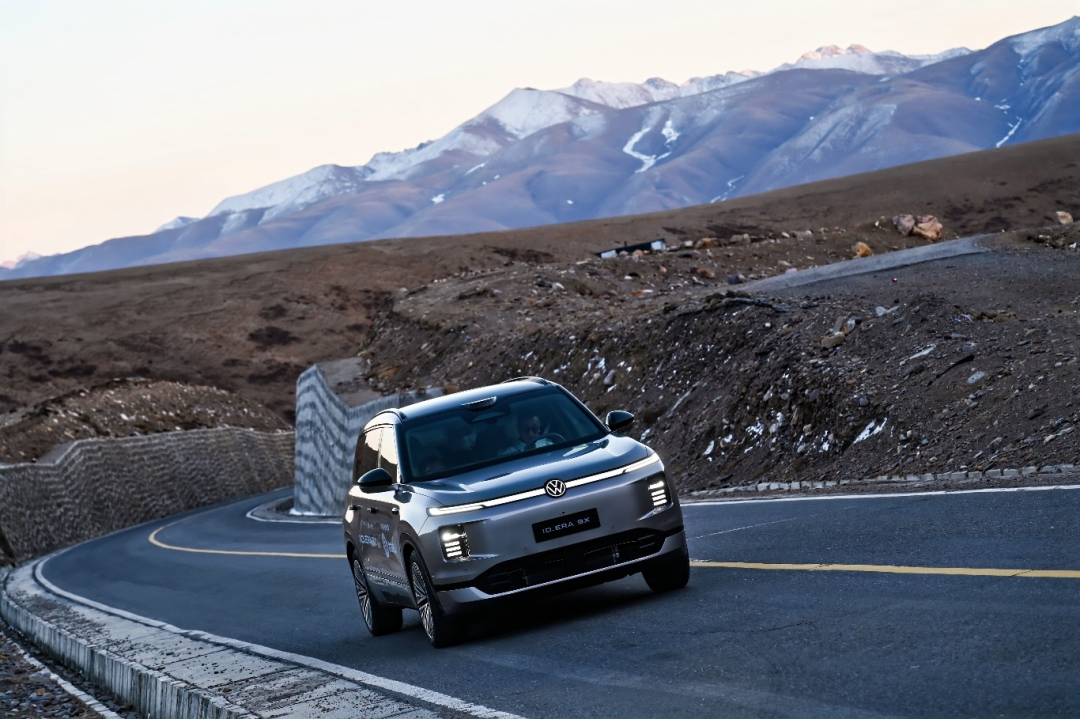
Refining rigorous engineering discipline into competitiveness for new energy vehicles.
Original content from Autopix (ID: autopix)
After the pre-sale launch event for the SAIC Volkswagen 9X, General Manager Tao Hailong pulled out a universal performance curve chart.
This technical chart, which typically only appears in internal engineer meetings, was used to explain the power coverage advantages of the EA211 engine when used as a range extender. At 100kW power, the engine only needs to run at 3,500 to 4,000 RPM, while competitors require 4,500 or even 5,500 RPM.
"The higher the RPM, the louder the noise," Tao Hailong told us, explaining why many competitors struggle with NVH performance. "To achieve power, the engine (range extender) must run at high RPMs, working at full throttle."
It’s hard to imagine three years ago that the general manager of a joint-venture automaker would spend significant time discussing the universal performance curves of engines, the calibration differences between ABS and ESP, or the engineering logic behind brake response times.
Back then, new energy vehicle launches by joint-venture automakers felt more like brand ceremonies—brief, dignified, and devoid of technical details. This was because core technical decisions were made at overseas headquarters, leaving Chinese teams with little to discuss.
But the Volkswagen 9X is different. The product definition for this model was entirely completed in China. It features a battery from CATL, an intelligent driving solution from Momenta, and will debut the R7 world model in the future.
This six-seat range-extending SUV, with a pre-sale price ranging from RMB 329,800 to RMB 379,800, is defined by SAIC Volkswagen as the "first product of Joint Venture 2.0." The new car represents only the most superficial change. To make this model competitive and sellable, SAIC Volkswagen is simultaneously overhauling its product logic, engineering processes, and sales system.
The difficulty of these three tasks increases sequentially, with the last one still incomplete.
01
Using a Flagship Model to Explore the Path
SAIC Volkswagen’s decision to lead with a flagship model is counterintuitive.
For a brand lacking recognition in the new energy market, a safer approach would be to launch an affordable, high-volume model first, lowering the barrier for consumer trials and building trust through sales volume.
Last year’s popular models, such as the Dongfeng Nissan N7 and GAC Toyota bZ3X, followed this path. The bZ3X, priced starting at RMB 100,000, sold 80,000 units in nine months after its launch, becoming the best-selling new energy model among joint-venture brands last year.
However, SAIC Volkswagen took the opposite approach, pricing its first Joint Venture 2.0 product above RMB 300,000 to compete with the Li Auto L8 and Seres M8.
Tao Hailong explained this choice, stating that launching the 9X first was based on brand strategy considerations—"using a flagship product to lead the way." He placed the 9X in a very high reference frame, describing it as Volkswagen’s most premium model since the Phaeton and Touareg in the fuel-powered vehicle (internal combustion engine vehicle) era.
The mission of the 9X is not just to sell cars. Fu Qiang, executive deputy general manager of sales and marketing at Volkswagen, told us that he hopes the new model will "drive the renewal of the Volkswagen brand in the new energy market and pull it upward." However, he also set an aggressive sales target: to rank among the top three in the same-class range-extending market segment (market segment).
If the flagship product can establish itself, subsequent mid- to low-priced models will benefit from brand momentum; if the flagship fails, the battle becomes even tougher. This year, Volkswagen plans to launch six new energy products, with the 9X being just the first in the series.
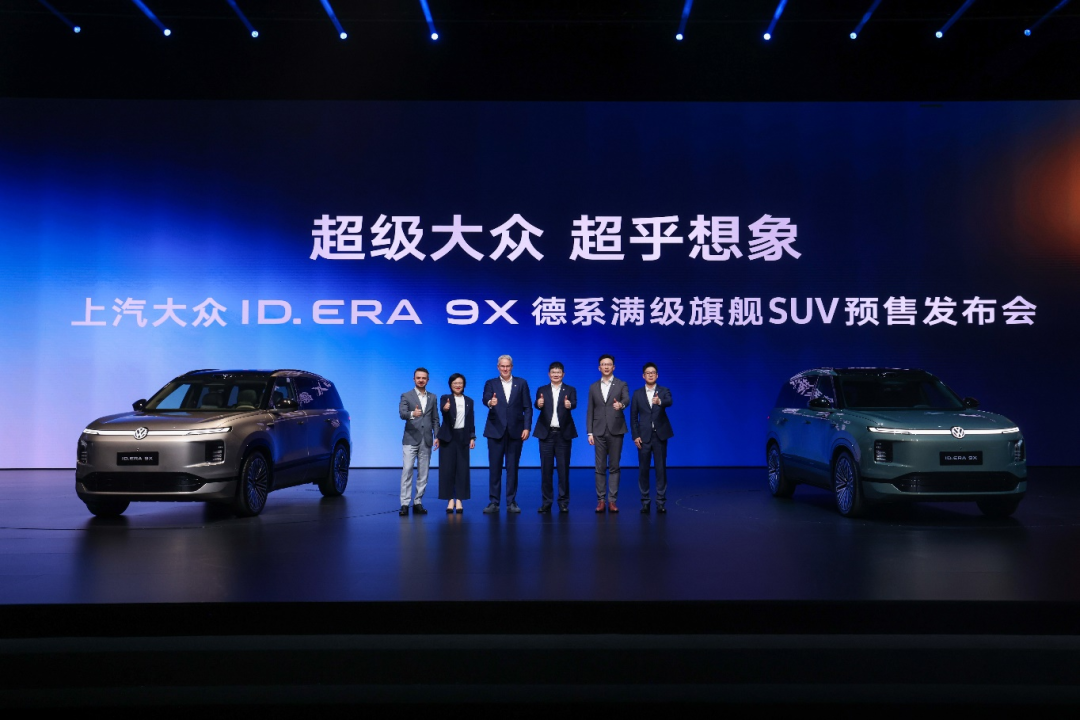
For SAIC Volkswagen, the past few years have not lacked new energy products, as evidenced by the ID. series launched as early as 2021. However, what SAIC Volkswagen lacked was a product logic that could re-convince the market. Volkswagen’s dominance in the internal combustion engine vehicle era is undeniable, but the new energy era changes first not the powertrain form but the product definition rights.
The value of German internal combustion engine vehicles was understood in terms of traditional mechanical capabilities—engine, transmission, chassis—and the resulting brand premium. In the new energy era, intelligence has become the most prominent consideration for users when making choices, which was once a technical barrier for SAIC Volkswagen in building new energy vehicles.
Even more problematic is that beyond technical barriers, new competitors also possess a product definition capability that starts from user needs. Li Auto and Seres have turned this into a clear advantage, something Volkswagen was not traditionally skilled at. In terms of efficiency, cost, and iteration speed, SAIC Volkswagen has been far surpassed by these new competitors.
Fu Qiang told us that consumers have always known SAIC Volkswagen is working on new energy vehicles but have not believed the company could excel at it.
Therefore, SAIC Volkswagen needs a product with a strong presence to clearly articulate this internal shift and explain the competitive strategy for its new generation of new energy vehicles.
The 9X carries several layers of tasks, with the most important being to recapture user mindshare. Fu Qiang told us that he hopes the new model will bring back customers that Volkswagen has lost to new competitors.
02
Changing the Product Competition Logic
In the internal combustion engine vehicle era, SAIC Volkswagen’s development model involved localizing global models from Volkswagen’s German headquarters.
Adding chrome trim, softening the suspension, lengthening the body—core product forms, technical routes, and market positioning decisions remained in Germany. Even minor modifications to models required approval from headquarters.
Today, the most sensitive and user-perceptible capabilities in new energy vehicle competition increasingly come from China. Intelligent cockpits, advanced driver-assistance systems, supply chain integration, and localized product definition—these capabilities are concentrated in China’s industrial ecosystem.
Therefore, SAIC Volkswagen’s first step was to break from past models and return product definition rights from Germany to China. This involved not just deciding what cars to build but also refactor (restructuring) the entire product development process. The Chinese team defines the product, the Chinese supply chain supports intelligence, and the Chinese market determines its rhythm and messaging.
Achieving these goals allows SAIC Volkswagen to stay in the game but not necessarily win. Tesla, NIO, XPeng, Li Auto, and Seres have already accomplished this. Nearly all remaining new energy players in the market—Geely, BYD, Changan, Voyah—can do the same.
SAIC Volkswagen needs new selling points and new product definition methods. The 9X was reorganized precisely along these lines. While integrating China’s cutting-edge intelligent capabilities, it recompresses Volkswagen’s inherent strengths into another set of capabilities.
More mature vehicle integration, higher-quality chassis tuning, conservative but consistent engineering validation—ultimately achieving a lower long-term error probability. What SAIC Volkswagen truly wants to sell is not another new intelligent concept but the judgment that, when placed within Volkswagen’s vehicle system, the Chinese solution should be more competitive.
The question, however, is whether this value is scarce enough today to compel users to repurchase.
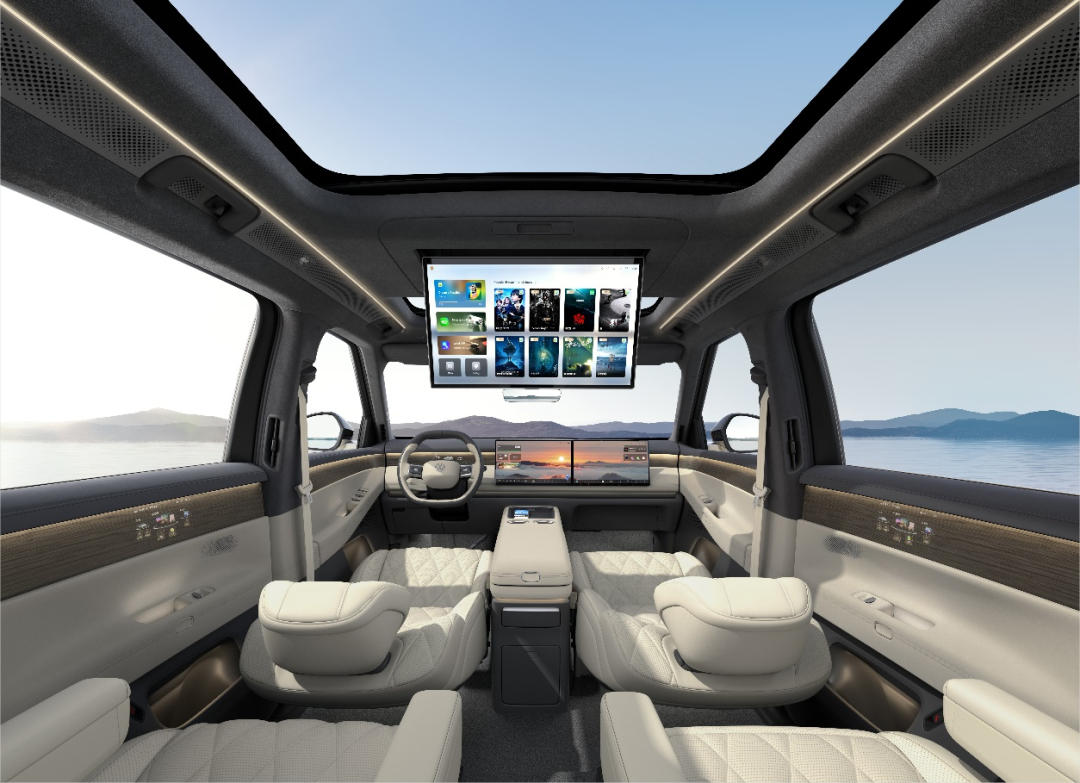 ▍9X Cockpit
Tao Hailong elaborated extensively on this point. When discussing intelligent driver-assistance systems, he did not focus on the upper limits of the solution’s capabilities but rather on its "lower limits." He told us that the same Momenta intelligent driving solution could perform entirely differently when installed in different vehicles. Recalibration and retesting are necessary.
The differences do not lie in algorithms but in vehicle integration. For example, when the driver-assistance system engages braking, can the brake system adapt? Can the steering system provide consistent responses? Are ABS and ESP properly calibrated? These factors require extensive testing data and experience, determining whether an intelligent driver-assistance system performs smoothly or rigidly once installed in a vehicle.
This conservative development process might be seen as inflexible and inefficient in the lexicon of new competitors. However, in the context of traditional automotive engineering, it represents basic quality control discipline.
SAIC Volkswagen attempts to turn this discipline itself into a differentiated strategy for its new energy products.
Here lies a contradiction: the differentiation SAIC Volkswagen seeks to achieve is precisely the hardest to quickly perceive and quantify—they are slow variables.
New energy products, constrained by battery life, rarely see automakers offer lifetime warranties—but the 9X does. Li Jun, executive director of marketing for the Volkswagen brand, told us that the goal is to transform hidden quality advantages into explicit, user-perceptible product competitiveness.
Restructuring product logic was relatively easy and accomplished in two years. However, getting consumers to accept this logic requires transforming far more than just a single vehicle.
03
The Hardest Layer to Change
What Tao Hailong refers to as "Joint Venture 2.0" represents a new division of labor currently adopted by joint-venture brands. Toyota, Nissan, and Volkswagen have all moved in similar directions regarding R&D decentralization in recent years, differing only in speed, thoroughness, and adherence to standards.
However, at the user level, reputation cannot rely solely on long-term accumulation. Brand perception is not changed by a single launch event but by every touchpoint from store visits to test drives, from purchasing to after-sales service. Most of these touchpoints are controlled by dealers.
SAIC Volkswagen has over 1,000 dealer stores nationwide—its greatest channel asset and its largest transformation burden.
Tao Hailong told us that he publicly asked management at a leadership conference: "Are you brave enough to undertake corresponding system reforms?" The fact that a general manager needs to ask this question publicly indicates significant resistance.
Fu Qiang broke down the reforms into three levels.
The first level involves changing the physical touchpoints of the channel. In the past, customers could only view vehicles at 4S stores. Now, SAIC Volkswagen aims to increase touchpoints by establishing satellite stores and approximately 160 pop-up stores in shopping malls.
As the first joint venture to enter China, SAIC Volkswagen has a robust channel network, but robustness also means heaviness. The operational costs, staffing, and inertia of over 1,000 4S stores cannot be offset by opening a few pop-up stores.
SAIC Volkswagen’s marketing system has begun learning the IPMS process, a methodology popular within Huawei’s ecosystem. This process binds production and sales at key nodes while increasing marketing’s density of user engagement.
The pre-sale of the 9X served as a practical test of this restructured marketing process. Trial driving vehicles were delivered to dealer stores the day after pre-sales began in late March. By the end of April, when the model officially launched, the goal was to achieve immediate delivery upon launch.
This meant that production, logistics, and dealer stocking had to be fully prepared by the pre-sale and official launch nodes. Such a rhythm would have been impossible at SAIC Volkswagen in the past.
The second level is more challenging: changing the relationship between manufacturers and dealers. Fu Qiang told us that in the past, automakers handed vehicles over to dealers, who sold them to customers. When customers had issues, they communicated with dealers, who only escalated problems to manufacturers if they could not resolve them.
Now, the mindset has shifted entirely. Communication channels between customers and automakers must be open, and all manufacturer-announced benefits are directed at consumers. The authorization model for automakers toward dealers has changed—it is no longer just authorization to sell cars but procurement of services from dealers.
The core of this transformation is to reclaim a portion of customer relationships from dealers to the brand. New competitors have operated this way since their inception—under direct sales models, user data, service standards, and pricing power all reside with the brand.
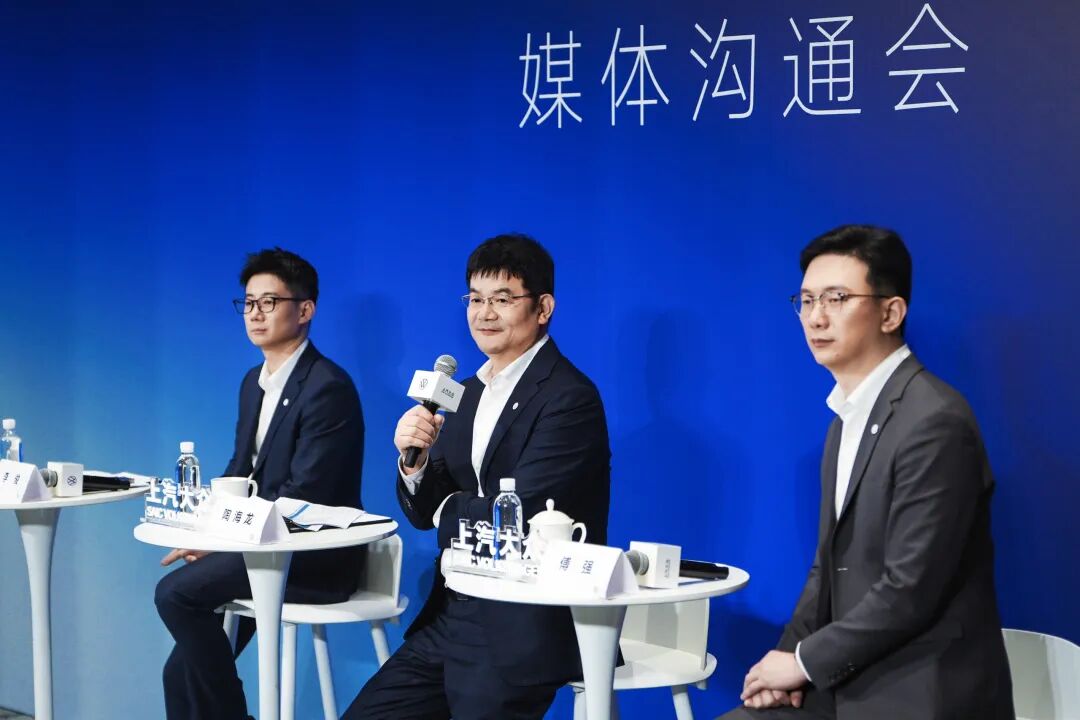 ▍From left: Li Jun, Tao Hailong, Fu Qiang
However, for a joint-venture automaker with four decades of dealer collaboration history, this transformation alters the interest structure.
Fu Qiang introduced buffer mechanisms. SAIC Volkswagen stopped pressuring dealers with inventory over a year ago, returning dealer inventory coefficients to a healthy level around 1.5—"many dealers are below 1.5."
In return, the focus of dealer evaluations has shifted. Instead of sales volume, consumer satisfaction is now prioritized. "If dealers provide good service but still struggle with sales, we look inward for reasons—whether our promotion was inadequate or if there are issues with product design," Fu Qiang told us. These measures aim to redirect dealer attention from inventory pressure to service quality.
Whether this shift can truly occur depends on determination and methodology, but sustaining it tests standards.
This year, SAIC Volkswagen deployed over 200 supervisors to 4S stores to clarify all customer touchpoints and establish process standards—from product introductions to test drive services and finally the ceremonial aspect of vehicle handovers. The entire customer lifecycle across all touchpoints must be standardized.
The fact that 200 supervisors were deployed to over 1,000 stores illustrates the scale of the problem. Many SAIC Volkswagen dealers are older and struggle to memorize product details, leading to significant online complaints.
Despite resistance, this must be done. When customers of new competitors visit SAIC Volkswagen stores, they should no longer encounter the old Volkswagen that only talks about German quality but a new Volkswagen capable of clearly explaining new technologies and delivering new experiences.
This represents the hardest layer to implement for Joint Venture 2.0. Products can iterate in two years, but organizations cannot. Users will not immediately believe that Volkswagen has learned to build Chinese-style new energy vehicles because of a single universal performance curve chart shown at a launch event.
For SAIC Volkswagen, what the 9X truly needs to supplement (supplement) is an entire chain of capabilities from product definition to sales systems. As long as any link remains stuck in the old era, Joint Venture 2.0 will remain merely a vehicle change rather than a company-wide transformation.
What will determine the success or failure of the 9X is not how professional the launch event was but whether, months or years later, consumers will truly view SAIC Volkswagen differently because of these changes.
This article is original content from Autopix (autopix) and is not authorized for reproduction.
-
![]()
The Allure of 'Acquisition Spree': Li Shufu's Left Turn, Xu Jiayin's Right
-
![]()
Strategic Transformation Yields Results: Phoenix Optics Reports 10.9% YoY Rise in Core Net Profit for H1 2026
-
![]()
Three Key Growth Trajectories Synergize! Crystal-Optech Reports 3.478 Billion Yuan in Revenue for H1 2026
-
![]()
Semi-Annual Report Sparks XPENG Motors Buzz
-
![]()
1.6 Billion Big Order Secured! SeeYA Technology's Revenue Soars by 287.87% in the First Half of the Year
-
![]()
Baidu's Profits Plunge by 68%: Unraveling the Mystery Behind the Numbers
-
![]()
Baidu’s Profits Tumble by 68%! Where Has All the Money Gone?
-
![]()
Hynix’s Taobao Store Shuts Down Abruptly: What Should Customers Do About Warranty Services for Memory Modules?