Global and Chinese Market Research Report on Autonomous Logistics Delivery Vehicles
 08/26 2026
 553
553
The global market for autonomous logistics delivery vehicles is at a critical juncture, transitioning from technological validation to large-scale commercial operations. Driven by sustained growth in express delivery volumes, rising labor costs for last-mile delivery, and the increasing maturity of autonomous driving technologies, these vehicles are moving from pilot programs in enclosed campuses to regular operations on public roads.
The year 2025 is widely recognized as the 'first year of large-scale development for autonomous logistics delivery vehicles.' In 2024, the global market size for autonomous delivery vehicles was approximately USD 965 million, expected to surpass USD 1.2 billion in 2025. The Chinese market serves as the core engine for global growth—by 2025, sales of autonomous urban delivery vehicles in China are projected to reach around 22,000 units, with a national fleet size exceeding 30,000 units. It is estimated that by 2026, annual sales of autonomous urban delivery vehicles in China will reach 89,000 units, potentially approaching 1.5 million units by 2030, with a total fleet size exceeding 3.5 million units.
In terms of market competition, a significant concentration is observed at the top. Companies such as Neolix and 9D Robotics have formed a 'duopoly,' collectively capturing approximately 84% of the market share by 2025. Business models are evolving from traditional hardware sales to the RaaS (Robovan-as-a-Service) model, where customers pay per delivery or per mile without bearing the upfront vehicle investment.
The policy environment has achieved a critical breakthrough. On July 1, 2026, the Ministry of Public Security's 'Safety Traffic Regulations for Road Testing and Demonstration Applications of Intelligent Connected Vehicles' (GA/T 2388-2026) came into effect. This marks the first national industry standard covering all categories of autonomous delivery vehicles in China. Over 100 cities nationwide have now granted road access rights for autonomous delivery vehicles.
Autonomous logistics delivery vehicles are transforming from 'technological validation' into a 'hundred-billion-yuan blue ocean market,' becoming a key infrastructure in the intelligent logistics system.
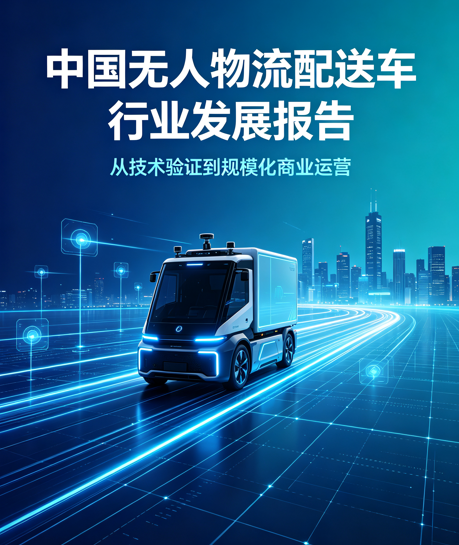
Chapter 1: Global Market Development Trends for Autonomous Logistics Delivery Vehicles
1.1 Global Logistics Delivery Market Development
The global logistics delivery market is undergoing profound transformations. The continuous expansion of e-commerce, the rise of instant retail, and increasing consumer demands for faster delivery times are driving the ongoing restructuring of last-mile delivery networks.
E-commerce and instant retail are driving explosive demand growth. Global e-commerce penetration continues to rise, with parcel volumes reaching new highs. Simultaneously, new consumption models such as instant retail and community group buying are expanding, compressing fulfillment radii and accelerating restocking cycles. Last-mile delivery is shifting from low-frequency, scheduled tasks to high-frequency, 24/7 operations. Consumer-facing logistics networks now feature denser nodes, fragmented orders, and stricter timeliness requirements, placing increasing pressure on traditional labor-intensive delivery models in terms of cost, stability, and scalability.
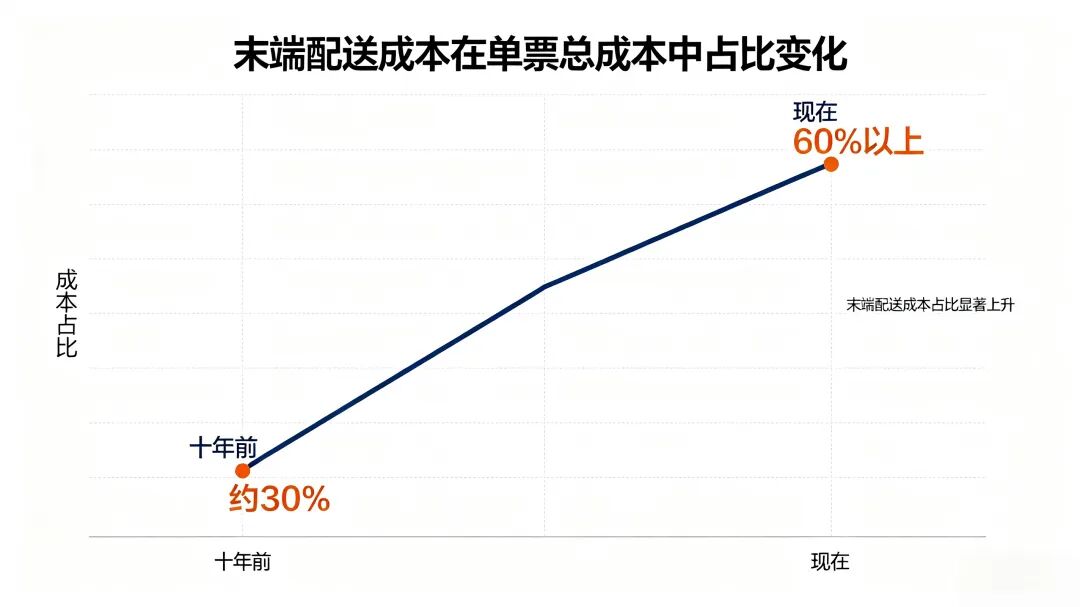
Last-mile delivery costs are surging. Against the backdrop of 'increasing volume but decreasing price' in China's express delivery industry, last-mile delivery costs now account for over 60% of total per-parcel costs, up from approximately 30% a decade ago, becoming a critical bottleneck for industry profitability. Rising labor costs and severe shortages of delivery personnel are compelling logistics companies to seek automated alternatives.
The global logistics delivery market continues to expand. Global express delivery volumes maintain steady growth, with last-mile delivery networks becoming denser and more extensive, providing broad application opportunities for autonomous logistics delivery vehicles.
1.2 Global Market Development of Autonomous Logistics Delivery Vehicles
Factors such as maturing technology, significant cost reductions, and gradually liberalized policies are collectively driving the global market for autonomous logistics delivery vehicles into a high-growth phase.
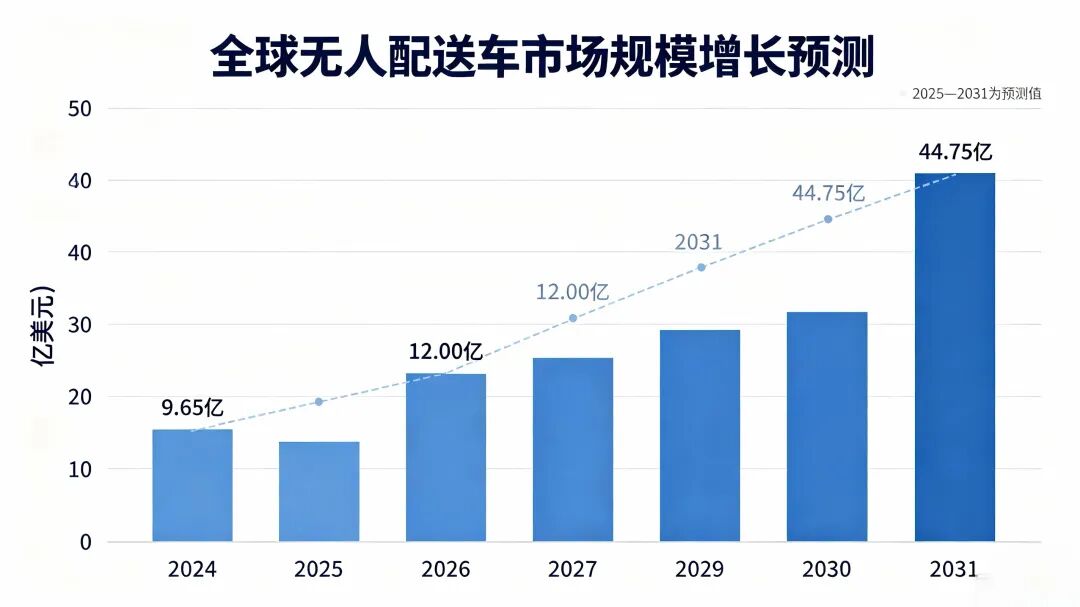
Rapid growth in global market size. In 2024, the global market size for autonomous delivery vehicles was approximately USD 965 million, expected to surpass USD 1.2 billion in 2025. Projections indicate the global market will reach USD 4.475 billion by 2031. Another research institution estimates the 2025 global market for autonomous ground delivery vehicles at approximately USD 1.118 billion, potentially reaching USD 6.021 billion by 2032 with a compound annual growth rate of 27.2%.
The Chinese market leads global growth. As the world's largest express delivery market, China has become the largest application market for autonomous logistics delivery vehicles. By 2025, sales of autonomous urban delivery vehicles in China are projected to reach around 22,000 units, with a national fleet size exceeding 30,000 units. Chinese companies are playing a leading role in the technological revolution of autonomous delivery vehicles, holding a dominant market share.
Exponential growth in production capacity and deliveries. In 2025, domestic deliveries of autonomous logistics vehicles reached approximately 30,000 units, a year-on-year surge of over 350%, marking the industry's official entry into large-scale operations. By the end of November 2025, cumulative shipments of autonomous delivery vehicles for outdoor applications in China exceeded 39,000 units. Deliveries for the first two months of 2026 are expected to reach 7,000–9,000 units, with annual deliveries potentially surpassing 100,000 units.
Region 2024 Market Size 2025 Market Size 2026 Forecast 2030 Forecast Global USD 965 million USD 1.2 billion + Sustained Growth USD 4.475 billion China RMB 4 billion (entire autonomous delivery market) RMB 17 billion Sustained Growth Hundred-billion-yuan level
Data Sources: iResearch, Zhongshang Industrial Research Institute, Low-Speed Autonomous Driving Industry Alliance
Technological maturity and cost reductions are the two primary drivers.
Technology is becoming increasingly mature. L4 autonomous driving technology has matured in semi-enclosed/structured environments such as industrial parks and fixed routes. By 2025, L4 'mapless' autonomous driving solutions have entered commercial deployment, further reducing implementation complexity. Autonomous logistics delivery vehicles have adopted a differentiated technological development path from Robotaxi, focusing on 'dispatch and control' as the core to achieve efficient and stable batch transportation in deterministic scenarios.
Significant supply chain cost reductions. Prices for core components such as domain controllers, LiDAR, batteries, and electric drives continue to decline. The total cost of autonomous delivery vehicles has dropped sharply from RMB 200,000–300,000 three years ago. For example, Neolix has completed six iterations of its autonomous vehicle, each reducing costs by approximately 30% while improving performance. Today, the cost per unit has fallen below RMB 100,000, representing an 80% reduction over four years.
Business models are undergoing initial validation. The industry is shifting from 'selling hardware' to 'selling services.' The RaaS (Robovan-as-a-Service) model is emerging as a significant trend, with service providers offering delivery services based on autonomous vehicle networks, and customers paying per delivery or per mile. A collaboration between an autonomous urban delivery vehicle operator and a freight platform in Qingdao has validated the commercial feasibility of this model.
Chapter 2: Market Development Trends in China's Autonomous Logistics Delivery Vehicle Sector
2.1 Market Size of Autonomous Logistics Delivery Vehicles in China
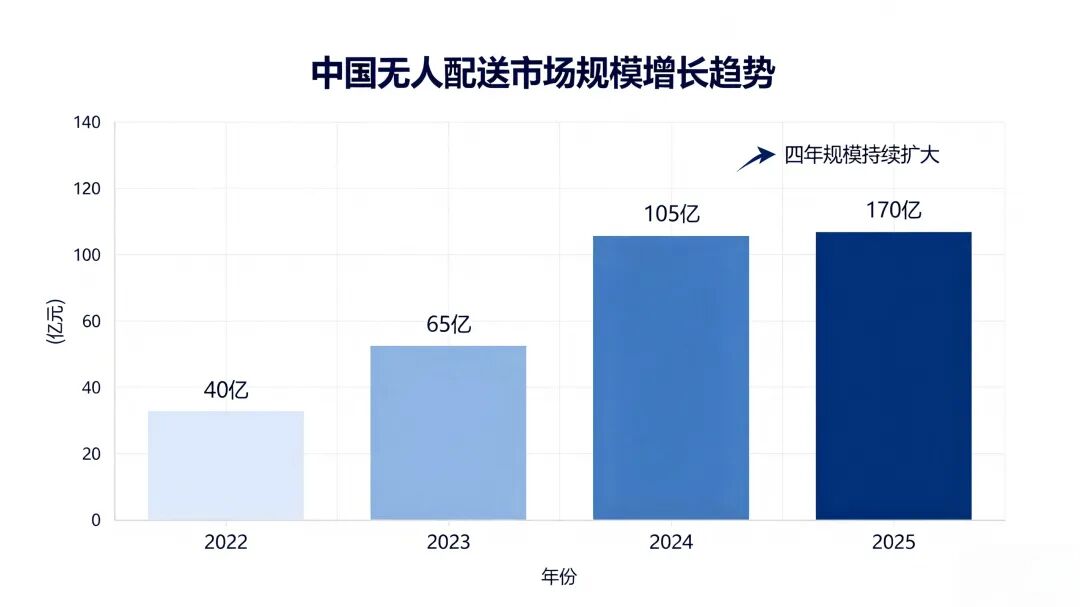
China has emerged as the most dynamic and promising market for autonomous logistics delivery vehicles globally. In 2022, China's autonomous delivery market was valued at RMB 4 billion, growing to RMB 6.5 billion in 2023, RMB 10.5 billion in 2024, and expanding further to RMB 17 billion in 2025.
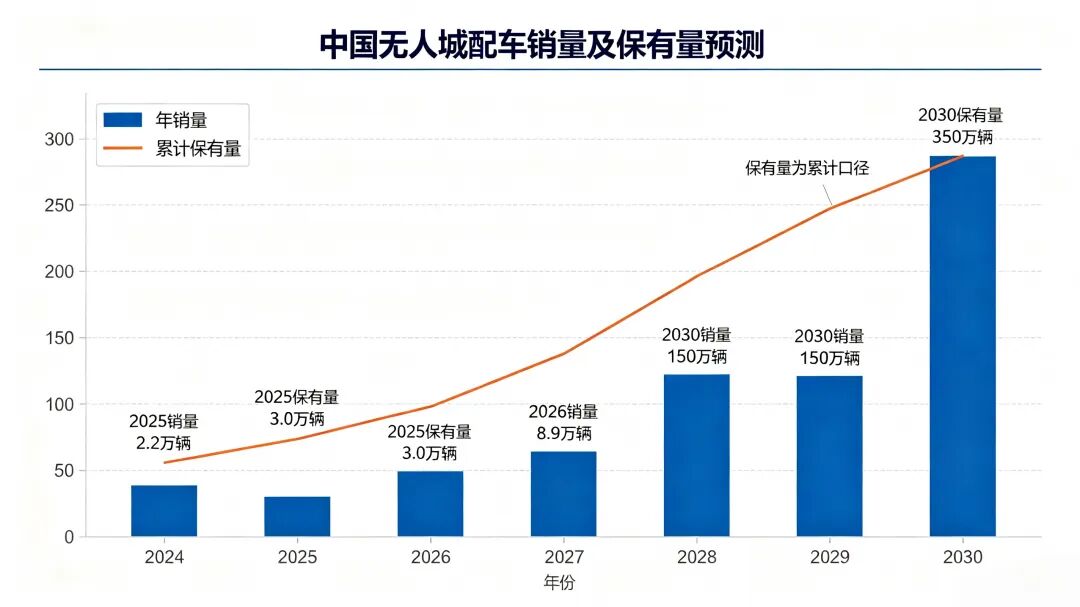
In terms of vehicle sales, by 2025, sales of autonomous urban delivery vehicles in China are projected to reach around 22,000 units, with a national fleet size exceeding 30,000 units. Looking ahead, annual sales of autonomous urban delivery vehicles in China are expected to reach 89,000 units by 2026, potentially approaching 1.5 million units by 2030, with a total fleet size exceeding 3.5 million units.
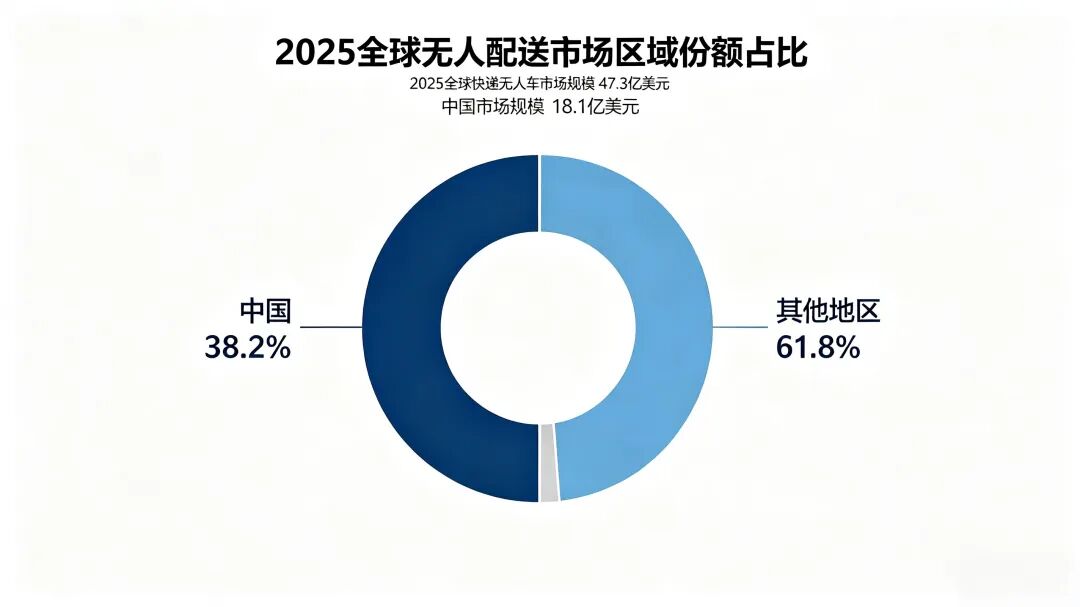
From a global perspective, the 2025 global market size for express delivery autonomous vehicles reached USD 4.73 billion, an 82.6% increase from 2024. As the core growth driver, China contributed 38.2% of the global total, with a market size of USD 1.81 billion.
2.2 Core Drivers and Development Trends in China's Autonomous Logistics Delivery Vehicle Market
2.2.1 Policy Support: From Local Pilots to National Standards
The rapid development of autonomous logistics delivery vehicles in China has been supported by continuous policy breakthroughs, transitioning from 'local pilots' to 'national standards.'
Implementation of national industry standards. On July 1, 2026, the Ministry of Public Security's industry standard 'Safety Traffic Regulations for Road Testing and Demonstration Applications of Intelligent Connected Vehicles' (GA/T 2388-2026) came into effect. This marks the first national industry standard covering all categories of autonomous delivery vehicles in China, establishing unified national traffic regulations for road testing and demonstration applications of L3+ intelligent connected vehicles. The standard provides unified criteria for road rights allocation and accident liability, ending the previous grey area where 'technology could go on the road, but the law was unclear.'
Accelerated road rights liberalization. The first legal road rights for autonomous delivery vehicles in China were granted in 2021, with Beijing taking the lead in issuing management rules and vehicle identification codes to companies such as JD.com and Neolix in its advanced autonomous driving demonstration zone, granting them legal access to public roads. To date, over 100 cities nationwide have opened road access for autonomous delivery vehicles.
Active exploration of local legislation. Beijing has released four local standards for autonomous driving, including 'Technical Specifications for Closed Test Site Testing of Intelligent Connected Vehicles Part 2: Autonomous Delivery Vehicles,' focusing on safety traffic and scenario adaptation. Cities such as Ningde, Tai'an, and Yibin have also introduced implementation rules for managing low-speed autonomous delivery vehicles.
Policy Direction/Type Core Content/Characteristics Key Progress National Industry Standards Unified road traffic regulations for L3/L4 autonomous vehicles GA/T 2388-2026 implemented on July 1, 2026 Road Rights Liberalization Legal public road access for autonomous delivery vehicles Over 100 cities nationwide have opened road rights Local Legislative Exploration Local management rules to regulate testing and demonstration applications Legislation introduced in Beijing, Ningde, Tai'an, Yibin, etc.
2.2.2 Technological Maturity: Focusing on Scenarios, Balancing Cost and Efficiency
Autonomous logistics delivery vehicles have adopted a technological development path differentiated from passenger vehicle autonomous driving, focusing on 'dispatch and control' as the core to achieve efficient and stable batch transportation in semi-enclosed/structured environments such as industrial parks and fixed routes.
Commercial deployment of 'mapless' autonomous driving solutions. By 2025, L4 'mapless' autonomous driving solutions have entered commercial deployment. Neolix became the first company in the autonomous delivery industry to deploy mapless technology, reducing reliance on high-definition maps and cutting related expenses by over 90%. Mapless technology reduces total costs by over 50% and can flexibly adapt to diverse application scenarios such as fresh food cold chain and supermarket express delivery.
End-to-end large models empower perception and decision-making. Leading industry players have begun applying end-to-end large model technologies. For example, vehicles equipped with 'Hongtu Intelligent Mapless Algorithm' and a one-stage end-to-end large model can predict pedestrian or vehicle intentions within 100 meters in 0.01 seconds and make evasive or emergency braking decisions within 100 milliseconds.
Continuous optimization of sensor solutions. While ensuring functional safety, autonomous logistics delivery vehicles adopt more cost-effective sensor solutions (e.g., vision-primary), effectively controlling total vehicle costs. This focus on deterministic scenarios lays a solid foundation for large-scale deployment.
2.2.3 Market Demand: Addressing the Last-Mile Delivery Cost Crisis
The fundamental driver of rapid growth in the autonomous logistics delivery vehicle industry is the urgent need to reduce costs in the logistics sector, particularly in express delivery.
Last-mile costs exceed 60% of total per-parcel costs. Against the backdrop of 'increasing volume but decreasing price' in China's express delivery industry, last-mile delivery costs now account for over 60% of total per-parcel costs, up from approximately 30% a decade ago. Autonomous urban delivery vehicles provide a quantifiable cost-reduction solution by converting variable labor costs into controllable asset depreciation for last-mile logistics.
Significant reduction in per-parcel costs. Under large-scale operational conditions, the per-parcel cost of autonomous delivery can be reduced to approximately one-third of traditional manned models. For example, in typical scenarios, traditional manned delivery costs approximately RMB 0.2 per parcel, while autonomous vehicles can reduce this to below RMB 0.1, still achieving over 50% cost savings on average.
Severe labor shortages. Same-day freight is undergoing a profound transformation from 'reliance on familiar vehicles' to 'intelligent capacity.' Delivery from wholesale markets to roadside stores heavily relies on shippers' own vehicles or familiar drivers, making it difficult to avoid negotiation costs related to leave or price increases, and unable to cope with the increasingly severe labor shortage. Autonomous urban delivery vehicles are restructuring this supply chain.
2.3 Application Scenarios for Autonomous Logistics Delivery Vehicles in China
The application scenarios for autonomous logistics delivery vehicles are rapidly expanding from single-scenario express delivery to diversified fields such as instant retail, supermarket restocking, wholesale freight, and industrial logistics.
Express delivery is currently the largest application scenario. As the most compatible scenario for autonomous vehicles, express delivery has become a fiercely contested market for autonomous vehicle brands. Penetration of autonomous delivery vehicles in the express delivery sector has reached nearly 50%. Taking Shenzhen as an example, in November 2025 during the 'Double 11' logistics peak, monthly delivery orders reached 1.29 million, including 1.08 million express deliveries and 210,000 fresh food deliveries, with direct commercial value rising to RMB 11.1 million.
Rapid rise of supermarket retail and instant delivery. Autonomous delivery vehicles are upgrading from 'once-daily' to 'multiple-daily' deliveries. This warehouse-to-distribution solution serves diverse supply chain scenarios such as chain retail, large supermarkets, express transportation, and community group buying. Cainiao's autonomous vehicles have entered supermarket restocking scenarios. Fresh food delivery now accounts for a stable 20%, targeting the high-timeliness demand for '30-minute delivery.'
Wholesale freight and industrial logistics are accelerating their penetration. Unmanned urban delivery vehicles transform uncertain, familiar driver capacities into standardized services, enabling merchants to lock in single-ticket costs without owning vehicles. In industrial logistics and supermarket replenishment scenarios, unmanned logistics vehicles are equally active.
New Model of Three-Dimensional Collaborative Delivery. SF Express leverages its vast express network to supplement last-mile capacity with unmanned vehicles, exploring three-dimensional collaboration of 'bus + subway + unmanned vehicles + drones' in Shenzhen-Dongguan and other regions. Meituan deeply integrates unmanned micro-trucks with its instant retail business.
Typical Representatives of Core Value in Application Scenarios
• Express Last-Mile Delivery: Cost reduction and efficiency improvement, with single-ticket costs down by over 50%—SF Express, J&T Express, Cainiao
• Supermarket Retail Replenishment: Multiple daily deliveries to enhance turnover efficiency—Cainiao
• Instant Retail/Fresh Delivery: 30-minute delivery with priority on timeliness—Meituan
• Wholesale Freight: Standardized capacity replacing familiar drivers—Risense Intelligence, etc.
Chapter III: Preliminary Validation of Business Models for Unmanned Logistics Delivery Vehicles
As technology matures and operational models become clearer, the business model for unmanned logistics delivery vehicles has evolved from single hardware sales to diversified service models, with economic models preliminarily validated across different scenarios.
3.1 Business Model Evolution: From Hardware Sales to Capacity Services
Traditional Model: Vehicle Sales and Leasing. Early business models focused on whole-vehicle sales or leasing. Customers purchased vehicle assets upfront, bearing operational and maintenance costs independently. This model required significant capital from customers, limiting rapid market expansion.
Innovative Model: RaaS (Robovan-as-a-Service). Neolix's pioneering RaaS model is becoming an industry trend. Under this model, service providers offer delivery services based on unmanned vehicle networks, with customers paying per order or per mile without vehicle asset investment. This model lowers entry barriers and initial costs for customers, better matching massive, decentralized urban delivery demands. A collaboration between unmanned urban delivery vehicle operators and freight platforms in Qingdao has validated the commercial feasibility of this model.
Customized Development Model. Customized development for large-scale customers is another key direction. Tailored unmanned delivery solutions are provided to meet specific needs of large logistics enterprises and retail chains.
3.2 Economic Analysis: Significant Cost Reductions, Inflection Point Reached
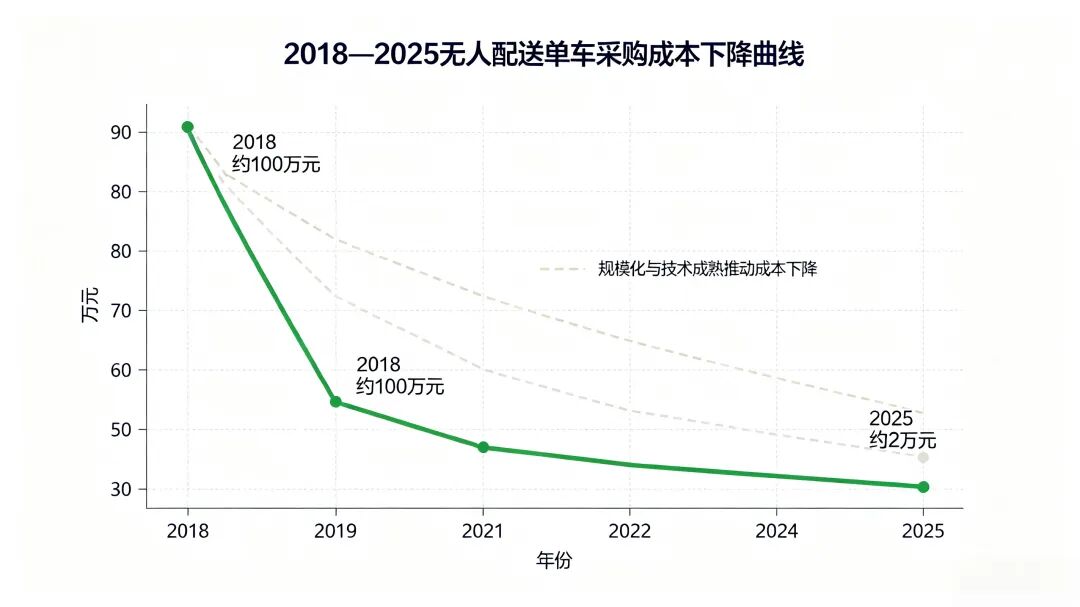
Sharp Decline in Vehicle Costs. From 2018 to 2025, the price of unmanned delivery vehicles plummeted from around 1 million yuan to the 20,000 yuan range. Between 2023 and 2025, core component costs dropped by over 80%. After 2025, continued cost reductions in the new energy vehicle supply chain will further lower prices of key components like domain controllers, LiDAR, batteries, and electric drives. Neolix's per-vehicle cost has fallen by over 50% compared to two years ago, dropping below $10,000.
Substantial Optimization of Operational Costs. In the second half of 2025, Risense Intelligence's overall operational costs decreased by about 60%, with remote manual intervention fees dropping below 3% of monthly operational costs. As vehicle scale expands and algorithms continue to optimize, per-vehicle operation and management costs are being further reduced. Some logistics companies using unmanned vehicles have seen monthly logistics costs fall from 5,000 yuan to over 2,000 yuan, a reduction of over 60%.
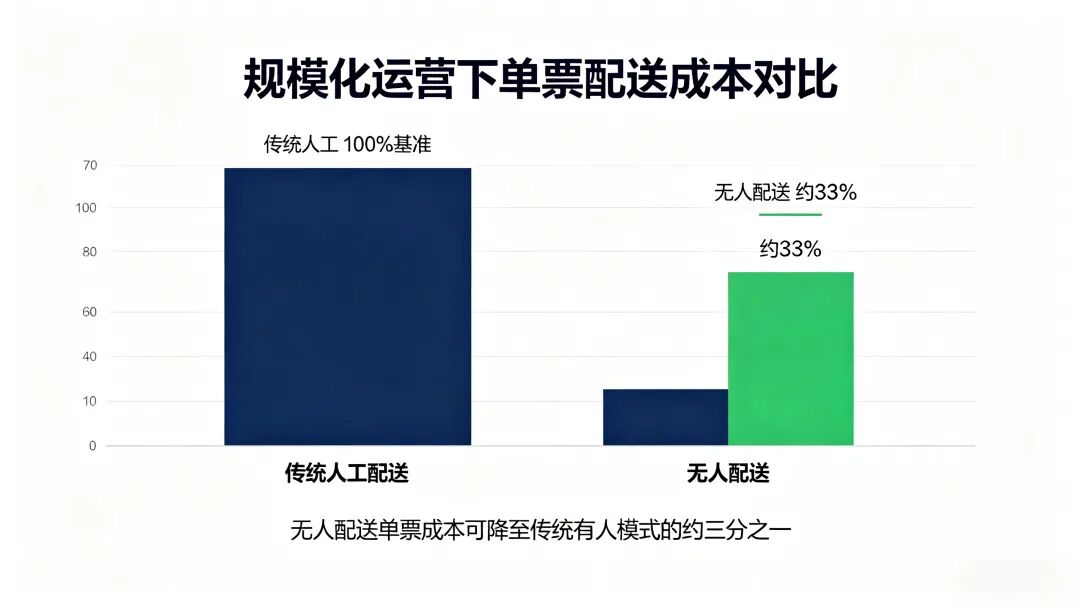
Significant Single-Ticket Cost Advantage. Under scaled operations, the single-ticket cost of unmanned delivery can be reduced to about one-third of traditional manned models. Single-ticket express costs decrease by 20%, with delivery timeliness improved by 2 hours.
3.3 Diversification of Customer Structure
Previously, orders for unmanned delivery vehicles came mostly from a few top logistics customers and scattered purchasers. By 2026, large customers began increasing investments, while small and medium-sized merchants, individual operators, and micro-delivery entities started entering the paid service system.
A Neolix representative stated that its customer base for unmanned delivery vehicles has shifted from early reliance on a single top logistics customer to a multi-tiered structure featuring deep binding with large customers, bulk purchases by small and medium-sized merchants, and independent payments from individuals and micro-operators.
Customers transitioning from single-vehicle purchases to fleet operations have further expanded demand. Risense Intelligence's current fleet orders account for about 20% of total company orders, expected to reach 50% by the end of 2026.
Chapter IV: Competitive Landscape of the Unmanned Logistics Delivery Vehicle Market
4.1 Key Players in the Unmanned Logistics Delivery Vehicle Market
As unmanned logistics delivery vehicles enter scaled commercial operations, the competitive landscape has largely formed, with multiple forces entering the fray.
The current market consists of four core player types:
Autonomous Driving Tech Companies (Neolix, Risense Intelligence, Bai Rhino, etc.): Leveraging flexible innovation mechanisms, these companies have been the first to complete scenario validations. With full-stack technical capabilities and deep scenario expertise, they are current market leaders. Neolix became the world's first L4 autonomous delivery vehicle company to surpass 10,000 cumulative deliveries in 2025. Risense Intelligence leads the industry with over 25,000 units in operation.
Internet Platform Companies (JD Logistics, Meituan, Cainiao, etc.): Relying on their proprietary logistics scenarios and massive data accumulation, these companies use unmanned delivery vehicles as effective supplements to last-mile capacity. JD Logistics' sixth-generation intelligent delivery vehicles, equipped with perception mega-models, cover 30 cities' communities and business districts.
Traditional OEMs (Chery, Changan, Dongfeng, Foton, JAC, Yutong, etc.): Nearly 15 mainstream OEMs are actively entering the unmanned delivery sector. Leveraging deep manufacturing expertise and supply chain integration capabilities, traditional automakers are making significant inroads. Their core competitiveness lies not in algorithm iteration speed but in profound understanding of vehicle engineering fundamentals—from safety compliance standard-setting and full-lifecycle quality control to scaled supply chain coordination.
ADAS Tier 1 Suppliers (MINIEYE, etc.): These companies enter the track [saìdào, track/sector] by providing autonomous driving solutions. MINIEYE's Xiaozhu unmanned vehicle is completing independent financing with a valuation reaching hundreds of millions of US dollars.
4.2 Competitive Landscape of Unmanned Logistics Delivery Vehicles
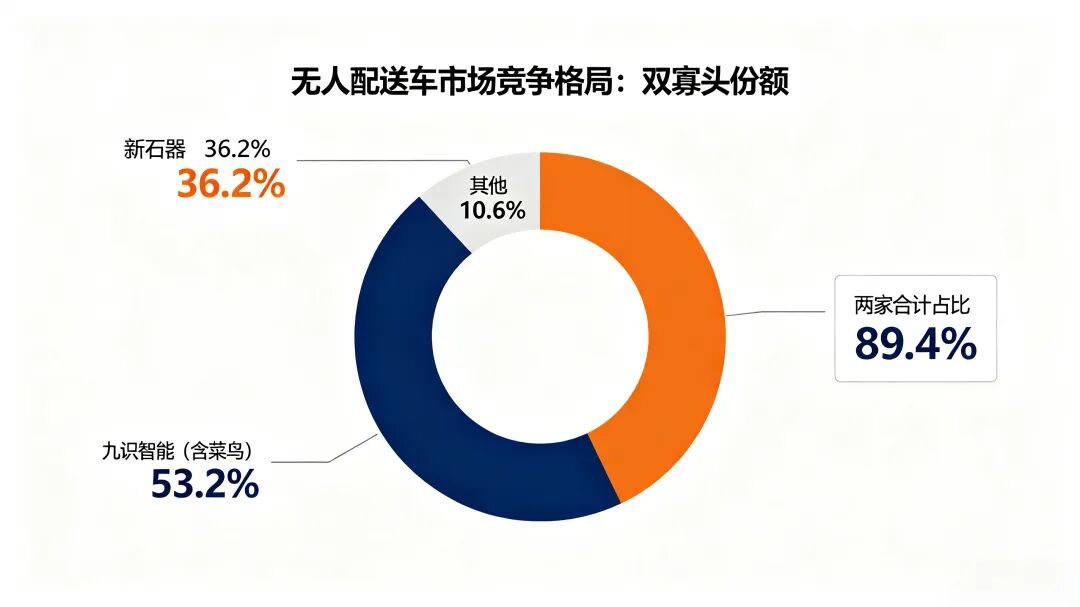
The market exhibits a 'dual oligopoly' structure. According to a report by the Logistics Investment and Financing Branch of the China Communications and Transportation Association, total industry inventory surged from over 10,000 units in 2024 to 47,000 units in Q1 2026. The market shows a dual oligopoly—Risense Intelligence (including Cainiao) holds 53.2% with 25,000 units, while Neolix accounts for 36.2% with 17,000 units. Together, they control nearly 90% of the market.
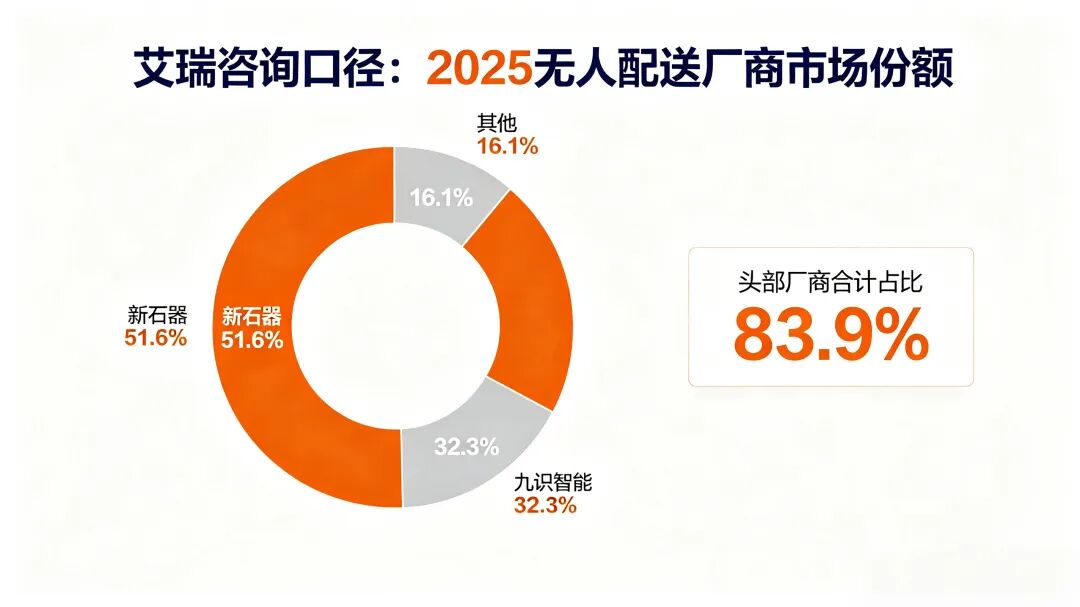
iResearch data shows that in 2025, Neolix (51.6% market share) and Risense Intelligence (32.3%) together dominated about 84% of the market. While share percentages vary slightly across different statistical approaches, the 'dual oligopoly' judgment remains highly consistent.
Enterprise | 2025 Market Share (iResearch) | 2026 Q1 Inventory (CCTA) | Market Position
Neolix | 51.6% | 17,000 units (36.2%) | Industry Leader
Risense Intelligence | 32.3% | 25,000 units (53.2%) | Industry Leader
Others (Bai Rhino, Cainiao, etc.) | 16.1% | ~10.6% | Challengers
Source: iResearch '2025 China Unmanned Urban Delivery Vehicle Industry White Paper', CCTA '2025-2026 China Unmanned Delivery Logistics Vehicle Market Development Report'
Competition Focus Shifts from 'Technical Validation' to 'Scaled Replication and Sustained Profitability'. Currently, the industry is in a period of rapid market expansion and capacity building, with obtaining road rights, acquiring customers, and validating scaled operation models as key competitive focuses. In the coming years, as large-scale deliveries and operational replication progress, companies lacking mass production capabilities, core road right resources, and sustainable business models will face pressure, potentially leading to further market concentration.
OEM Entry Drives Landscape Reshaping. The collective entry of nearly 15 mainstream OEMs has injected new variables into industry development. OEMs bring the automotive industry's century-long expertise in strict quality control, supply chain management, scaled production, and after-sales systems to the track [saìdào, track/sector], significantly enhancing vehicle reliability, consistency, and safety. Leveraging mature vehicle platforms and supply chains, OEMs can more rapidly standardize vehicle-by-wire chassis and substantially reduce hardware costs through scaled procurement and production. This trend will shift the industry more toward 'ecological niche competition' from 'technical cooperation'.
4.3 Core Competitive Elements in the Unmanned Logistics Delivery Vehicle Market
Amid intensifying market competition, the following five core capabilities construct formidable competitive barriers:
Full-Stack Technical Capability: Encompassing closed-loop R&D systems from bottom-layer sensor fusion and high-precision positioning to end-to-end algorithms. Commercial delivery capability of mapless autonomous driving technology represents the current key technical competitive high ground.
Scenario Implementation and Operational Capability: Ability to achieve scaled, normalized commercial operations across diverse scenarios such as express last-mile delivery, supermarket retail, and wholesale freight. By late August 2025, Neolix had deployed over 8,000 unmanned vehicles.
Mass Production and Supply Chain Capability: Ability to achieve 10,000-unit-scale production, continuously reducing costs through scaled procurement and manufacturing. Self-built factories, modular design, and supply chain collaboration are core means of cost reduction.
Road Rights and Policy Resources: Ability to secure key road right resources in over 100 cities that have opened road rights. Road rights are prerequisites for scaled unmanned delivery vehicle operations.
Sustainable Profitability: Ability to achieve long-term profitability independent of policy subsidies through innovative business models like RaaS. Whether single-ticket costs can be reduced to customer-acceptable levels and whether operational models are sustainable are core evaluation criteria.
4.4 Representative Companies in the Unmanned Logistics Delivery Vehicle Market
4.4.1 Neolix
Neolix is a technology company specializing in L4 autonomous driving unmanned logistics vehicles, becoming the world's first L4 autonomous delivery vehicle company to surpass 10,000 cumulative deliveries in 2025.
Technical Advantages: Neolix's self-developed L4 mapless autonomous driving technology solution has commenced commercial delivery, making it the first company in the unmanned delivery industry to deliver mapless technology solutions. By reducing reliance on high-definition maps, mapless technology saves over 90% of related expenditures while significantly lowering hardware costs. The company's self-developed modules account for 90% of its vehicles. Its unmanned vehicles have undergone six iterations, with each iteration improving performance while reducing costs by about 30%.
Deployment Scale: By late August 2025, Neolix had deployed over 8,000 unmanned vehicles, with an expected 15,000 units delivered annually. About 11,000 new units were delivered in 2025. Its self-built 10,000-unit-scale factory reduces vehicle costs by 50-70% through modular design.
Financing and Commercialization: In 2025, Neolix completed two financing rounds totaling over 5 billion yuan, including a $600 million Series D round in October jointly invested by UAE Leishi Capital, Gaocheng Capital, and China Mobile. In December, it received strategic investment from Didi Smart Transportation. Its unmanned delivery vehicle per-unit cost has dropped below 100,000 yuan.
4.4.2 Risense Intelligence
Risense Intelligence is one of the market leaders in unmanned logistics delivery vehicles, adding 16,000 vehicles in 2025 to maintain industry leadership with over 25,000 units in operation.
Market Position: According to the CCTA report, Risense Intelligence (including Cainiao) has over 25,000 units in operation, holding a 53.2% market share and maintaining a 17-percentage-point lead over the second-place competitor. The company has transitioned from pure technical validation to scaled commercial replication.
Operational Capability: In the second half of 2025, overall operational costs decreased by about 60%, with remote manual intervention fees dropping below 3% of monthly operational costs. As vehicle scale expands and algorithms continue to optimize, per-vehicle operation and management costs are being further reduced. The company's fleet orders account for about 20% of total orders, expected to reach 50% by the end of 2026.
Financing Progress: In February 2026, Risense Intelligence completed a new round of financing exceeding $300 million, with its valuation surpassing 10 billion yuan.
4.4.3 Other Key Players
JD Logistics: Its sixth-generation intelligent delivery vehicles, equipped with perception mega-models, cover 30 cities' communities and business districts. Lightweight mapping technology reduces reliance on high-definition maps, improving route planning efficiency by 40%.
Bai Rhino: Achieving normalized operations in an increasing number of campuses, communities, and parks, it precisely delivers parcels, fresh produce, and medications to stations. It held about a 5.63% market share in 2025. In May 2026, it completed its C1 round of financing.
Cainiao: Its unmanned delivery vehicles have entered store replenishment scenarios, with 'multiple daily deliveries' becoming the norm and delivery costs reduced by 15%.
OEM Camp: Nearly 15 mainstream OEMs including Chery, Changan, Dongfeng, Foton, JAC, and Yutong have all entered the unmanned delivery business. Xiamen Golden Dragon formed a strategic cooperation with Baidu in 2017 and launched the DIDO autonomous driving logistics vehicle with JD Logistics in 2020, achieving normalized operations in nearly 20 cities nationwide.
Chapter V: Conclusion",
3. Low-Speed Autonomous Driving Industry Alliance, New Strategy Low-Speed Autonomous Driving Industry Research Institute, "Blue Book on Insights into the Application and Development Trends of Unmanned Delivery Vehicle Technologies for 2025-2026, released in December 2025
4. Smart Logistics Branch of China Federation of Logistics & Purchasing, "Research Report on the Commercialization of the Unmanned Delivery Vehicle Industry for 2025-2026
5. Ministry of Public Security, "Safety Traffic Regulations for Road Testing and Demonstration Applications of Intelligent Connected Vehicles (GA/T 2388-2026), officially implemented on July 1, 2026
6. Beijing Local Standard, "Technical Specifications for Testing in Closed Test Sites for Intelligent Connected Vehicles—Part 2: Unmanned Delivery Vehicles (DB11/T 2471.2-2025), implemented on January 1, 2026
7. Official disclosures from unmanned logistics delivery vehicle companies
8. Media reports, etc.
-
![]()
The Dazzling Yet Impractical Internet-Famous Smart Driving Features
-
![]()
The Prequel of AI's Entry into Factories: Why Did the Previous Generation of Industrial Internet Platforms Falter?
-
![]()
Field Test of 'Doubao Work': Hiring a Diligent AI Worker for Just 68 Yuan
-
![]()
Why Did the Doubao Mobile Phone Face a Ban Shortly After Its Release?
-
[In-Depth] Breaking Overseas Technological Monopoly: Horizontally Opposed Engine Ushers in Era of Independent Chinese Mass Production
-
![]()
Mercedes-Benz GLE Now Boasts a 'Full-Power' Six-Cylinder Engine! Netizens Wonder: What Took Them So Long?
-
![]()
Global and Chinese Market Research Report on Autonomous Logistics Delivery Vehicles
-
![]()
Qianwen App Faces Financial Struggles Amidst Competition with Qianwen Office—Wu Jia Under Increasing Pressure