Domestic Memory Behemoth Unveils Plan to Invest 34.9 Billion Yuan in Production Scale-Up
 09/29 2026
 493
493
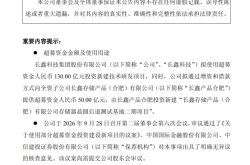
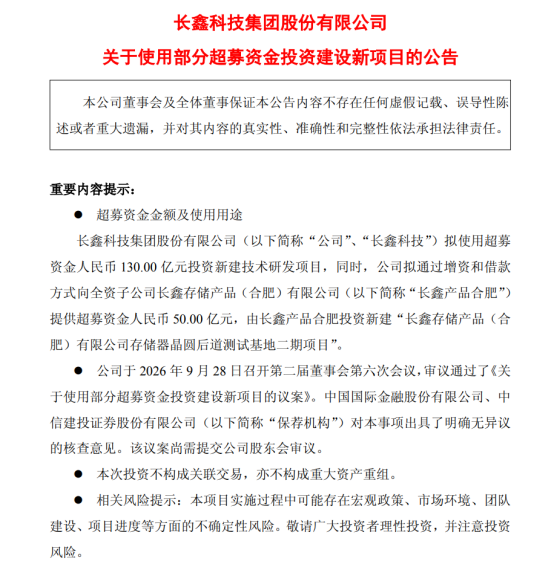
On the evening of September 28, Changxin Technology made a significant announcement, revealing that its board meeting on the same day had greenlit a proposal to allocate 1.8 billion yuan from its over-raised funds to two fresh projects.
The company intends to channel 13 billion yuan of these over-raised funds into technology R&D initiatives. Concurrently, it will inject 5 billion yuan into its wholly-owned subsidiary, Changxin Memory Products (Hefei) Co., Ltd., through a combination of capital increase and loan, to propel the Phase II project of the memory wafer back-end testing base. The combined investment for both projects stands at 34.9 billion yuan, with 18 billion yuan of over-raised funds being tapped into this time around.
Changxin Technology made its debut on the STAR Market on July 27 this year, marking the largest initial public offering (IPO) on the A-share market to date in 2026. It successfully raised 66.607 billion yuan, with a net amount of 66.310 billion yuan after deducting various fees. The over-raised portion amounted to 36.810 billion yuan, which only became available on July 22.
The 18 billion yuan allocated this time represents nearly half of the over-raised funds, leaving roughly 18.8 billion yuan still in the company's coffers post-utilization.
Specifically, the 18 billion yuan is earmarked for two distinct purposes. One portion, totaling 13 billion yuan, is earmarked for a technology R&D project undertaken by Changxin Technology itself. This project is situated at the 12-inch memory wafer manufacturing base in Hefei Xinqiao Science and Technology Innovation Demonstration Zone, with a construction timeline of 30 months.
The total investment for this project is pegged at 24.1 billion yuan, with equipment procurement costs accounting for a staggering 22.398 billion yuan, or 92.94%. Nearly the entirety of the 13 billion yuan of over-raised funds will be funneled into equipment purchases. The announcement underscores that this R&D project will not generate separate investment returns; instead, its benefits will materialize through technological advancements that propel the performance of the company's main products.
The remaining 5 billion yuan is allocated to the wholly-owned subsidiary, Changxin Memory Products (Hefei), in the form of a capital increase and loan, to finance the construction of the Phase II project of the memory wafer back-end testing base. This project, with a total investment of 10.8 billion yuan and a construction period of 37 months, is located in Feixi County, Hefei. It aims to establish a dedicated testing facility for DRAM chip testing and module assembly.
The equipment purchase and installation costs for this project are estimated at 8.180 billion yuan, accounting for 75.74% of the total investment. Calculations indicate that both the internal rate of return and the total investment return rate fall within acceptable ranges.
In sum, the total investment for the two projects amounts to 34.9 billion yuan, with precisely 18 billion yuan of over-raised funds being utilized this time.
Both projects sidestep the conventional route of building new wafer manufacturing capacity and instead focus on R&D and back-end testing. For a DRAM manufacturer like Changxin, front-end manufacturing has traditionally been its forte. However, once chips are produced, they must undergo testing, packaging, and module assembly before they can be brought to market.
The testing process necessitates specialized equipment and offers limited flexibility in capacity. As Changxin's production capacity and product portfolio continue to grow, the capacity of external packaging and testing factories may struggle to keep pace.
Therefore, bringing back-end testing in-house enables more flexible capacity scheduling, reduces testing costs, and eliminates a potential bottleneck in the supply chain. This strategic move extends the Integrated Device Manufacturer (IDM) model from being strong in the front-end to having full control over both the front-end and back-end processes.
Established in 2016, Changxin is engaged in the integrated business of DRAM design, manufacturing, and sales. Its fifth-generation process platform is now in mass production, with products spanning DDR5, LPDDR5/5X, and LPDDR6. As of the end of June this year, it boasts 4,484 domestic patents and 3,400 overseas patents, with 7,491 R&D personnel, constituting more than one-third of its total workforce.
According to its financial report, the company's revenue in the first half of the year was approximately 15.031 billion yuan, up 873.64% year-on-year. Its net profit attributable to the parent company was 7.7605 billion yuan, reversing last year's losses. Despite its robust financial standing, the company still invested 13 billion yuan in R&D, explicitly stating that it will not calculate returns separately, underscoring its commitment to continuous process and product iteration.
The announcement clearly outlines the risks involved. R&D projects do not guarantee returns; if the back-end testing base fails to reach full capacity as anticipated, fixed costs such as equipment depreciation, labor, and factory maintenance will temporarily weigh on profits.
Less than two months after its listing, Changxin has already utilized nearly half of its over-raised funds. How will it allocate the remaining 18.8 billion yuan?
-
![]()
Office Agent Showdown: Kingsoft, SenseTime, iFLYTEK, Youdao - Who Makes the Cut, Who's Just Along for the Ride?
-
![]()
Starting at 118,800 yuan with standard LiDAR, the new Lynk & Co 20 is all business this time around.
-
COSTAR Auto Optoelectronic Display Branch Passes Supplier Admittance Review by a Leading Headlamp Enterprise!
-
![]()
Domestic Memory Behemoth Unveils Plan to Invest 34.9 Billion Yuan in Production Scale-Up
-
![]()
Why Is Luxshare Precision Covering the Costs for Chenling Optics, Despite Harson’s Aborted Acquisition?
-
![]()
Dialogue with Phoenix Optics: Riding the 'Optics + AI' Wave with Six Decades of Expertise
-
![]()
Competing on Assets, Not Just Price: 10 Key Insights from NIO and Geely's Battery Swap Integration
-
![]()
Fliggy is Becoming More and More Like a Plugin