Why Is Luxshare Precision Covering the Costs for Chenling Optics, Despite Harson’s Aborted Acquisition?
 09/29 2026
 383
383
Recently, a company that began with optical inspection has garnered considerable attention. Suzhou Chenling Optics Co., Ltd. (hereinafter referred to as "Chenling Optics") was initially slated for acquisition by a listed company, only to be rejected due to its "overly high valuation." Nevertheless, it has simultaneously secured top-tier clients such as Luxshare Precision and Dongshan Precision, expanding its business into the robotics sector.
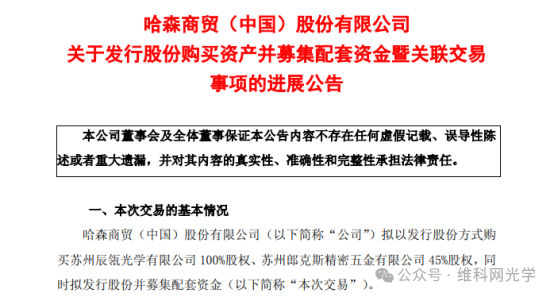
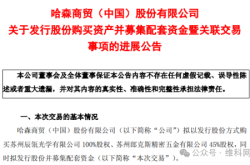
In December 2025, Harson announced the termination of its acquisition of 100% equity in Chenling Optics. The reason cited was that "the counterparty proposed new valuation requirements for Chenling Optics, which could not be agreed upon with the company, and the proposed transaction price exceeded the company's expectations."
What justifies Chenling Optics' high valuation? Firstly, the strength of its client base underpins its valuation confidence. Chenling Optics' end clients include leading manufacturing enterprises in the consumer electronics and new energy sectors, such as Luxshare Precision and Dongshan Precision. Its products are primarily applied in FPC production lines, FATP production lines, and PACK module production lines. The ongoing capacity expansions by these top clients suggest a high degree of certainty in demand for visual inspection equipment, providing Chenling Optics with a predictable foundation for revenue growth as their supplier.
More impressively, Chenling Optics has rapidly expanded its business boundaries. In May 2026, Chenling Optics visited Fuyang, Anhui, and revealed during discussions that its "business spans the entire process of AI training and optical design." In September 2026, its "Humanoid Intelligent Robot R&D and Production Base Project" was filed for record.
Chenling Optics' strategic move from visual inspection to the robotics sector took less than two years. In September 2025, Chenling Optics invested 51 million yuan to acquire a 51% stake, jointly establishing a robot supply chain equity company with a registered capital of 100 million yuan, alongside Harson and Zhongke Zhongcheng. Harson holds a 10% stake in this venture.
Business registration information indicates that the company's scope includes the procurement and sales of robot components and related technical services, marking Chenling Optics' substantive entry into the robotics sector.
Chenling Optics' asset-light business model also merits attention. Public information reveals that over 60% of the company's employees are engaged in R&D, with machining and assembly tasks outsourced to external partners. This allows the company to concentrate on core technology development in algorithms, optics, and vision. This "core self-research + peripheral collaboration" structure enables it to maintain technological density while enjoying greater cost flexibility and iteration speed.
Chenling Optics' case raises a question worthy of deep industry reflection: What should be the valuation benchmark for enterprises in the machine vision sector?
If measured by the traditional metrics of revenue and profit, Chenling Optics' projected revenue for 2024 was 153 million yuan, with a net profit of 19.1456 million yuan (unaudited), representing a net profit margin of approximately 12.5%. Founded in January 2022, Chenling Optics achieved nearly 20 million yuan in net profit during its startup phase, a relatively outstanding profit performance among its peers.
At this profit level, valuation discrepancies are more likely attributable to differing expectations on growth rates and sector premiums between the parties. The valuation frameworks of the buyer and seller differ; Chenling Optics assigns a higher premium to its expansion into robotics and AI, while Harson, as a listed company primarily engaged in footwear and precision structural components, finds it difficult to match this premium due to its risk appetite and valuation framework.
In the hard technology sector, the pricing of technological assets is indeed undergoing adjustment, and the completion of this adjustment hinges on both the enterprise's ability to deliver on its technology and the risk appetite and patience of the capital markets.
For Chenling Optics, the real test lies in whether its business narrative of expanding from visual inspection to chips, robotics, and other directions can gradually materialize in verifiable customer deliveries and revenue structures.
-
![]()
Office Agent Showdown: Kingsoft, SenseTime, iFLYTEK, Youdao - Who Makes the Cut, Who's Just Along for the Ride?
-
![]()
Starting at 118,800 yuan with standard LiDAR, the new Lynk & Co 20 is all business this time around.
-
COSTAR Auto Optoelectronic Display Branch Passes Supplier Admittance Review by a Leading Headlamp Enterprise!
-
![]()
Domestic Memory Behemoth Unveils Plan to Invest 34.9 Billion Yuan in Production Scale-Up
-
![]()
Why Is Luxshare Precision Covering the Costs for Chenling Optics, Despite Harson’s Aborted Acquisition?
-
![]()
Dialogue with Phoenix Optics: Riding the 'Optics + AI' Wave with Six Decades of Expertise
-
![]()
Competing on Assets, Not Just Price: 10 Key Insights from NIO and Geely's Battery Swap Integration
-
![]()
Fliggy is Becoming More and More Like a Plugin