Micron: Without the Frenzied Surge, Can Long-Term Agreements Really Sustain the Storage Resurgence?
 10/08 2026
 331
331
Micron (MU.O) released its financial results for the fourth quarter of fiscal year 2026 (ending August 2026) after the market closed on October 1, 2026, Beijing time. Key points are as follows:
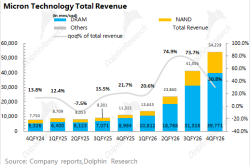
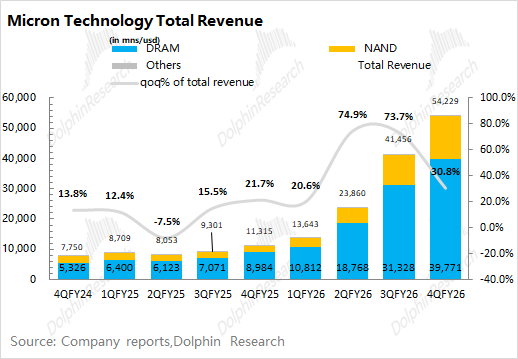
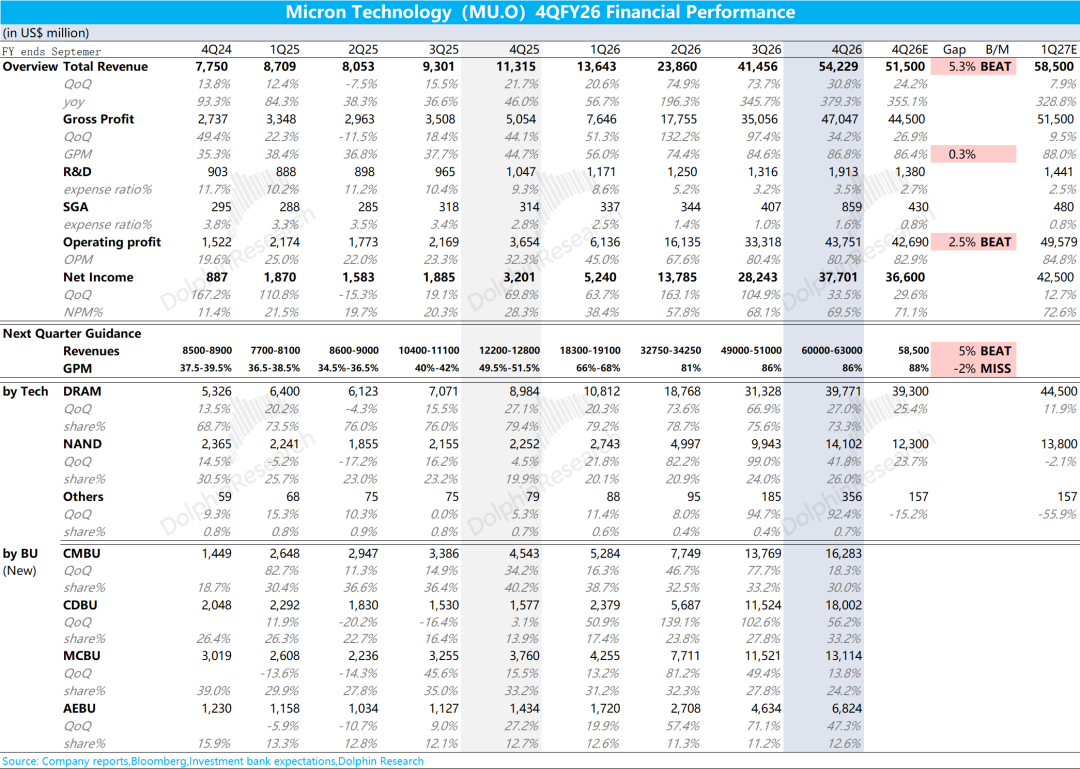
1. Overall Performance: Micron's revenue for this quarter was $54.2 billion, up 31% sequentially. Compared to the 70%+ sequential growth in the previous two quarters, the growth rate has slowed significantly this quarter. The company's revenue exceeded guidance by $8 billion last quarter, while it only exceeded by $4 billion this quarter.
When providing guidance, shipment volumes are largely determined, with flexibility almost entirely dependent on price factors. The company's gross margin has now reached 85%+. With Micron signing more SCA (long-term contracts), it is difficult for storage prices to experience another 'frenzied surge.' Market and company attention has shifted from 'how high can prices go' to 'how long can the good times last.'
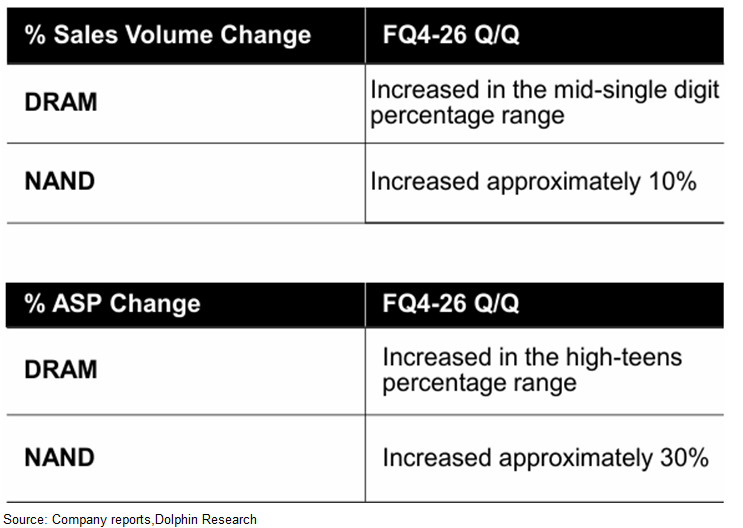
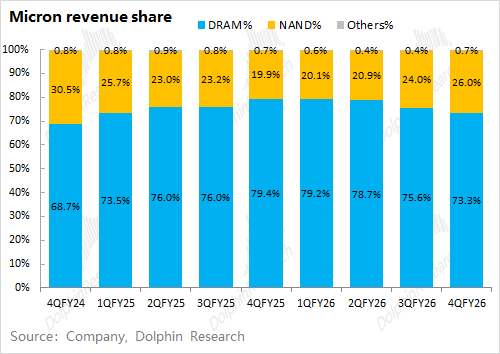
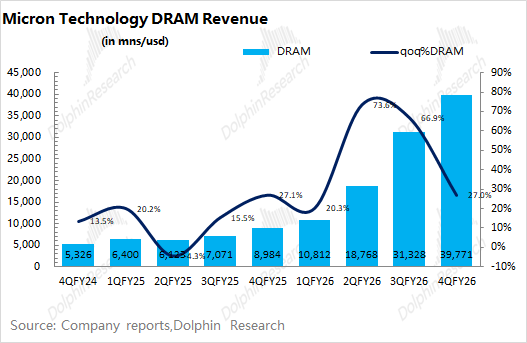
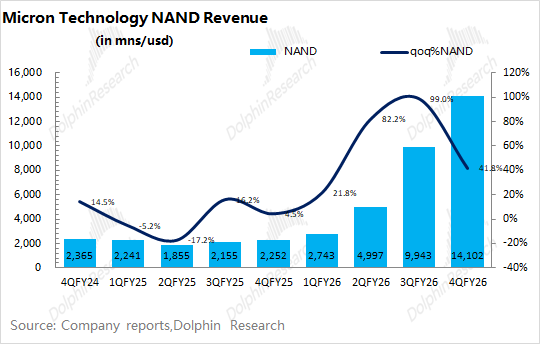
Volume-Price Relationship: Shipment volumes - DRAM saw a mid-single-digit sequential increase, while NAND increased by around 10%; Prices - DRAM unit price rose by 20% sequentially, and NAND by around 30%. Compared to the approximately 80% sequential price increases in the previous two quarters, the growth rate has slowed significantly this quarter.
From a volume-price comparison, the main driver of this supercycle in storage is capacity. Especially, DRAM shipment volumes have increased too slowly. Under such price dividends, shipment volumes have only seen single-digit sequential increases for four consecutive quarters. It's not that manufacturers are unwilling to expand, but rather that the cleanrooms required for expansion generally take two years or more, leading to the current situation where capacity cannot keep up.
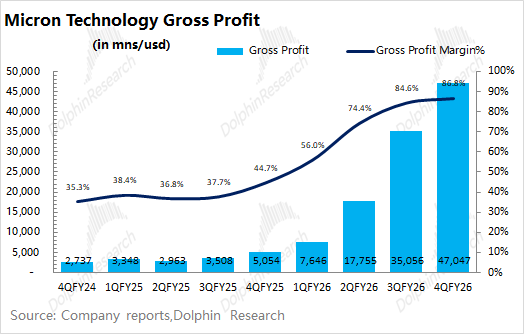
2. Gross Margin: Micron's gross margin for this quarter reached 86.8%, up 2.2 percentage points sequentially, meeting market expectations (86.4%), primarily driven by price increases.
The company provided a gross margin guidance of 86% for the next quarter, mainly affected by high-cost inventory, startup costs, and other expenses resulting from incentive compensation accrued in the fourth quarter, with an approximate impact of $1 billion. Excluding these impacts, the company's gross margin for the next quarter is expected to rebound to around 87.6%.
3. Guidance: Short-term guidance is less important than long-term guidance
① Short-term guidance: Micron expects revenue of $61.5 billion (±$1.5 billion) next quarter, up $7.3 billion sequentially. Although the sequential growth has slowed, it is still better than buyer expectations ($58.5 billion); the gross margin is expected to be around 86%, with an adjusted gross margin of approximately 87.6% (excluding inventory, expenses, etc.), slightly lower than buyer expectations (88%).
Such guidance implies that the sequential increase in storage ASP next quarter will only be around 10-15%, with growth slowing again. If the sequential increase in unit prices continues to slow, it will fundamentally fail to drive up the company's valuation.
② Long-term guidance: More important. Regarding the supply and demand situation in storage, the company believes that 'memory supply and demand will be much tighter in the calendar years 2027 and 2028 than in 2026.' Compared to last quarter's statement, 'even if supply and demand start to ease from 2028, it is difficult to determine when supply can truly catch up with demand,' it is clear that management is more confident in the sustainability of the storage cycle.
The main factor strengthening confidence among the market and management is the signing of strategic long-term agreements (SCAs). The term of SCA agreements is usually five years (from the natural year 2026 to the end of 2030), with automotive agreements generally lasting three years.
As of now, the company has signed 26 strategic agreements (16 last quarter), with remaining performance obligations (RPOs) of approximately $150 billion. All SCAs include take-or-pay contract volumes, with RPOs only counting the portions with determined pricing frameworks (fixed prices or price bands with upper and lower limits).
Among these SCA agreements, Micron has also obtained $32 billion in performance guarantees (an increase of $10 billion quarterly). This not only reflects the company's bargaining power but also enhances its risk resistance within the agreements.
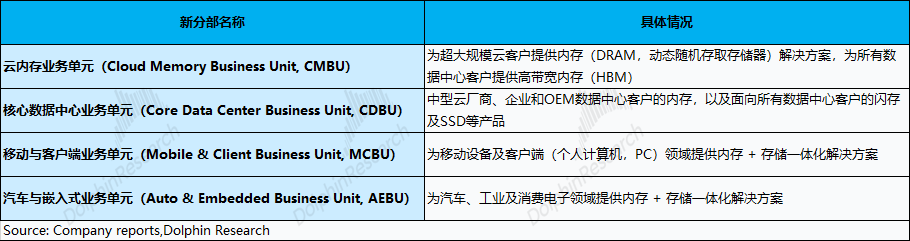
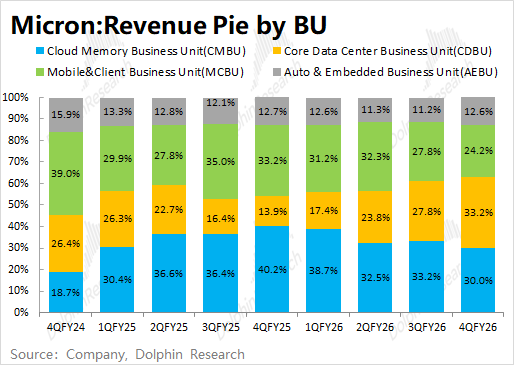
4. Performance by Segment: Micron's revenue from data centers has now increased to 63%. The Cloud Memory Business Unit (CMBU) saw a significant slowdown in sequential growth, mainly corresponding to the memory (including HBM) demand from hyperscale cloud customers.
The Core Data Center Business Unit (CDBU) saw the strongest sequential growth in the past two quarters, mainly including memory for small and medium-sized customers and flash memory and SSDs in the data center sector.
Combined with the company's signed long-term contracts, the price elasticity ceiling for Oversized customers (extra-large customers) has been locked in as contracts are signed. Prices for small and medium-sized customers are more susceptible to market prices, showing greater price elasticity, which has also led to stronger performance in the CDBU.
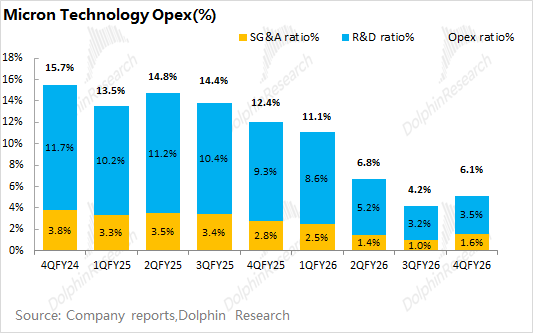
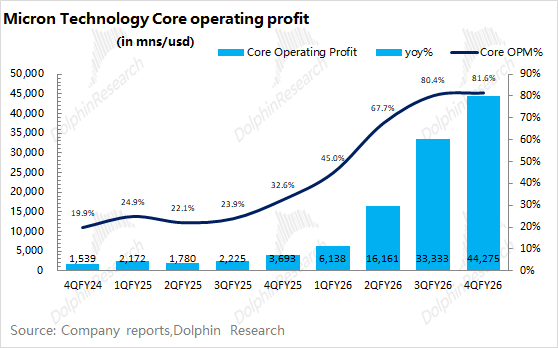
5. Operating Leverage: Affected by significant revenue expansion, the company's R&D expense ratio and sales and administrative expense ratio have dropped to mid-single digits, showing significant operating leverage. The increase in these two expenses this quarter is mainly due to increased R&D investment and salary incentives. The company's core operating profit for this quarter was $44.3 billion, with the core operating profit margin increasing to 81.6%.
6. Capital Expenditures: Due to the cyclical nature of storage, the market often worries that a significant increase in capital expenditures will lead to a re-imbalance in supply and demand. However, this time is different. Currently, major storage manufacturers are 'making crazy profits,' and even if they want to expand, they cannot spend the money due to hard constraints.
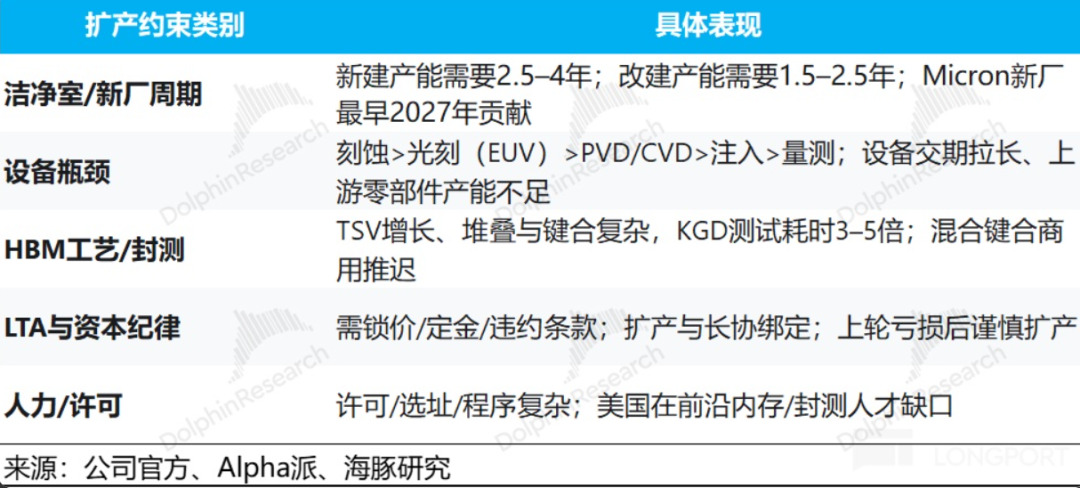
The company's capital expenditures this quarter, excluding government subsidies ($300 million), were $10.8 billion (exceeding last quarter's plan of $10 billion). Capital expenditures for fiscal year 2027 have been revised upward from previous plans (previously expected to be over $10 billion per quarter), with approximately $11.5 billion in the first quarter, around $25 billion in the first half of the year, and even higher in the second half.
The company specifically pointed out that more than half of the new capital expenditures will be for 'factory construction expenses,' meaning early construction of cleanrooms rather than simply purchasing equipment, which will mainly be used to accelerate the supply of cleanroom space in the second half of the calendar year 2028 and beyond.
Dolphin Research's Overall View: Narrowing of Positive Surprises, Storage 'Feast' Enters the Second Half
Micron's performance this quarter can be described as 'good, but not as impressive.' Revenue and gross margin met expectations, but the magnitude of positive surprises was halved compared to last quarter. Growth rates in volume and price also slowed, with DRAM and NAND prices rising by 20%-30% sequentially, down from around 80% previously. Market attention has shifted from 'how high can prices go' to 'how long can the good times last.'""Regarding the latter question, Micron's answer is quite confident. Management believes that supply and demand will be tighter in 2027 and 2028 than this year, supported by the continuous signing of strategic long-term agreements: 26 have been signed so far, locking in approximately $150 billion in remaining performance obligations. The price ceiling for extra-large customers has been locked, with more elasticity coming from small and medium-sized customers.
Ultimately, this cycle comes down to capacity issues. Cleanroom expansion takes more than two years, and manufacturers cannot spend even if they have the money. Although Micron has increased capital expenditures, more than half is for factory construction, with actual supply release not expected until the second half of 2028 or later. In the short term, the supply-demand imbalance is unlikely to be broken.
As market attention to the storage industry shifts from 'how high can prices go' to 'how long can the good times last,' Micron's main focus points are as follows:
1) Cycle Sustainability: Driven by AI demand, the current storage market is still in an upward cycle. TrendForce expects DRAM and NAND prices to maintain double-digit sequential growth in the fourth quarter. Notably, with the setting of ceiling prices in long-term contracts, the growth rate of storage product prices will slow down.
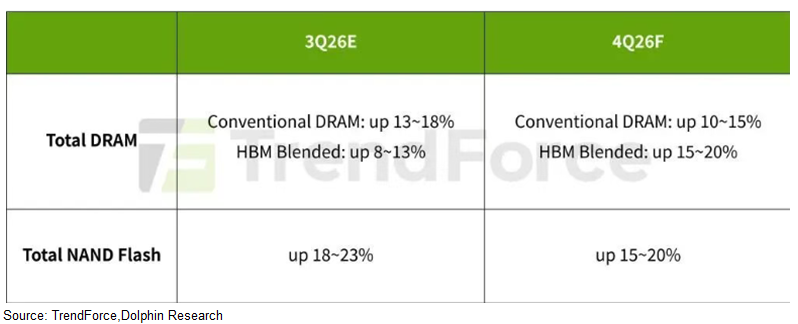
Compared to recent price increases, the market is more concerned about the length of this storage cycle. Currently, mainstream institutions generally agree that 'storage prices will continue to rise until the second half of 2027,' but there are significant differences in price expectations for 2028 and beyond.
Driven by incremental demand from Agent AI and other areas, even relatively pessimistic market expectations do not foresee a 'collapse-like decline' in prices for 2028, especially since major storage manufacturers like Micron have signed multiple five-year long-term agreements, with floor prices providing assurance.
Micron management mentioned in exchanges that 'memory supply and demand will be much tighter in the calendar years 2027 and 2028 than in 2026,' providing 'reassurance' for market concerns about 2028.
2) SCA Long-Term Agreements: Micron disclosed that it has signed 26 SCA long-term agreements (16 last quarter), including hyperscale customers like Google, Meta, Microsoft, and Amazon, with five-year terms and 'Take or Pay' binding clauses, requiring customers to pay a 20-30% deposit and pay even if they do not take delivery.
Notably, long-term contracts set both ceiling and floor prices - meaning that while they lock in volume certainty, they also seal off some of the spot price increase elasticity.
Under the influence of long-term agreements, the predictability of the company's storage product ASP increases, price increases will slow down, and it is difficult for performance to significantly exceed expectations. Company management will pay more attention to 'price sustainability.'
3) HBM Progress: Recently, the market has speculated that 'the number of layers in HBM may decrease rather than increase,' originating from NVIDIA's next-generation Rubin Ultra, initially specified with 16 layers, later rumored to be reduced to 8 layers, and most recently to 4 layers. Correspondingly, HBM capacity would also be significantly reduced from 768GB to 192GB.
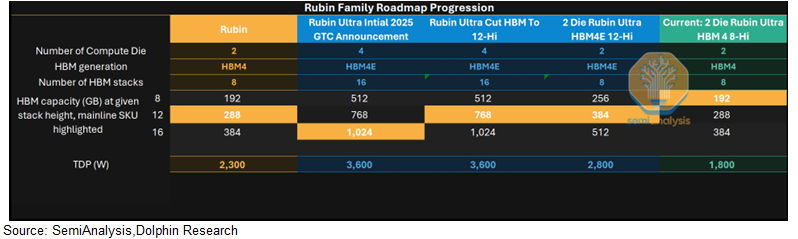
Dolphin Research leans towards this being a 'passive choice,' mainly due to supply considerations. HBM wafer supply is tight, and the current wafer quantity is insufficient to support NVIDIA's GPU requirements for 16-hi/12-hi next year. Switching to 8-hi or 4-hi can yield more output with limited wafers, helping to bridge the supply-demand gap.
On the other hand, the inference stage increasingly focuses on 'bandwidth constraints' rather than 'capacity constraints' (which can be compensate (offset) by scaling up interconnection). 4-hi stacking provides the same bandwidth as 8-hi/12-hi (stacking layers do not determine bandwidth; the number of channels does), so changing from 12-hi to 4-hi on the same wafer can triple the bandwidth per HBM wafer; for 8-hi, it doubles, and packaging yield is also higher.
Micron is currently the only 4-hi collaborator. As of now, only Micron is conducting compliance testing and verification for at least two customers. Samsung and SK Hynix are reserved about 4-hi, but the market expects them to follow suit later.
4) Focus on Buyback Information: Micron has received funding support from the CHIPS and Science Act, receiving its first disbursement in December 2024. In return, the act imposes capital allocation restrictions on funded enterprises - within two years of receiving funds, Micron is restricted from conducting large-scale stock buybacks.
Micron announced in July 2026 that it would increase capital returns starting from December 9, 2026 (the second anniversary of the CHIPS agreement), with a long-term goal of returning 100% of excess cash to shareholders. As the date approaches, attention is focused on management's statements regarding buybacks after this earnings report.
Combined with Micron's current market capitalization ($1.2 trillion), it may not seem expensive, but the company's valuation is unlikely to see a significant increase.
From this quarter's storage price increases, the sequential growth in average prices for DRAM and NAND has clearly slowed, with prices stabilizing. In this context, it means that the phase of significant valuation increases for the company has passed unless ASP growth accelerates again.
At the same time, the company's stock price is unlikely to experience a significant decline, which would require downward price movements, but this is unlikely in the short term. Currently, the company's stock price is more likely to oscillate within a 'range-bound' zone.
With storage prices stabilizing, if the company's stock price and PE fall to the lower limit of the range (relative lows), the company may increase dividend buybacks, again attracting market attention. After all, the company's quarterly profit has reached around $40 billion, and the CHIPS agreement's commitment is set to expire on December 9.
For reference to the lower bound of the range, from the perspective of cash flow, the corporate free cash flow is selected (assuming a discount rate of 10%). Given that storage prices will remain high from FY2027 to FY2028, the profitability from FY2026 to FY2028 is quite substantial.
As for the free cash flow situation after FY2028, the average value from FY2023 to FY2028 (cycle low point - cycle high point), which is approximately USD 60 billion, is directly referenced as the perpetuity free cash flow.
The estimation of cash flow = Free cash flow from FY2026 to FY2028 + Perpetuity free cash flow = USD 322 billion + USD 600 billion = USD 922 billion, roughly corresponding to a PE of around 4.3 times the after-tax operating profit for FY2027.
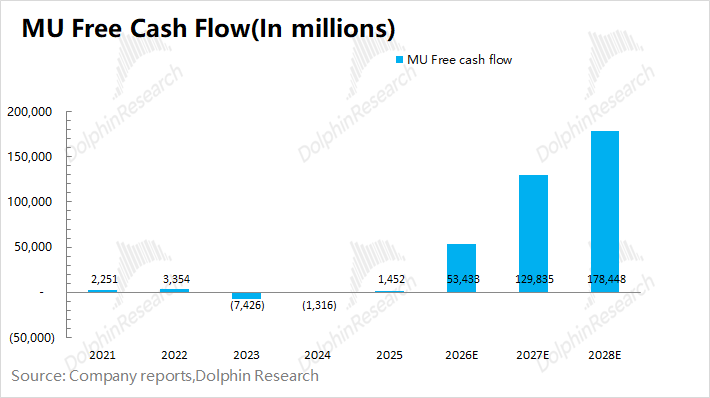
The following are Micron's financial report data and detailed charts:
- END -
// Reprint Authorization
This article is an original work by Dolphin Research. If you need to reprint it, please obtain authorization.
// Disclaimer and General Disclosure Notice
This report is for general comprehensive data purposes only, intended for general viewing and data reference by users of Dolphin Research and its affiliated institutions. It does not take into account the specific investment objectives, investment product preferences, risk tolerance, financial situation, or special needs of any person receiving this report. Investors must consult with an independent professional advisor before making any investment decisions based on this report. Any person making investment decisions using or referring to the content or information mentioned in this report shall bear their own risks. Dolphin Research shall not be liable for any responsibility or loss that may directly or indirectly arise from the use of the data contained in this report. The information and data contained in this report are based on publicly available materials and are for reference purposes only. Dolphin Research strives to ensure but does not guarantee the reliability, accuracy, and completeness of the relevant information and data.
The information mentioned or the views expressed in this report shall not, in any jurisdiction, be regarded or construed as an offer to sell securities or an invitation to buy or sell securities, nor shall it constitute advice, solicitation, or recommendation regarding relevant securities or related financial instruments. The information, tools, and materials contained in this report are not intended for distribution to, or use by, any person or resident in any jurisdiction where such distribution, publication, provision, or use would be contrary to applicable laws or regulations or would subject Dolphin Research and/or its subsidiaries or affiliated companies to any registration or licensing requirements in that jurisdiction.
This report only reflects the personal views, opinions, and analytical methods of the relevant creators and does not represent the stance of Dolphin Research and/or its affiliated institutions.
This report is produced by Dolphin Research, and the copyright is solely owned by Dolphin Research. Without the prior written consent of Dolphin Research, no institution or individual shall (i) make, copy, reproduce, duplicate, forward, or any other form of copies or reproductions in any way, and/or (ii) directly or indirectly redistribute or transfer to other unauthorized persons. Dolphin Research reserves all related rights.
-
![]()
Micron: Without the Frenzied Surge, Can Long-Term Agreements Really Sustain the Storage Resurgence?
-
![]()
Leapmotor Cuts Ties with Kevin Tsai Amid Controversy: Upholding Unwavering Principles
-
![]()
From Green Leaves to Flowers: How AI Inference Transforms NAND's Destiny?
-
![]()
Paris Auto Show Transforms into a Chinese Auto Extravaganza: AITO Showcases Full Lineup, Geely Occupies 5 Halls
-
![]()
Will Chinese Cars Secure 20% of the European Market This Year?
-
![]()
Is the auto industry too depressing? Feedback from the front lines is a bit heart-wrenching
-
![]()
Qualcomm Pays Huawei, Yet Chip Sales Remain Restricted
-
![]()
The Android Moment of Embodied AI Lies in the Cost of Switching Bodies